
AI Voice Assistant
Onkar Yede1, Srushti Raut2
1Student at MAEER’S MIT College of Railway Engineering and Research, Barshi, Maharashtra, India. 2 Assistant Professor, Dept. of Computer Science and Engineering, MAEER’S MIT College of Railway Engineering and Research, Barshi, Maharashtra, India.
Abstract – In the imminent future, all electronic devices are anticipated to function with the aid of a remote assistant, which is easily accessible yet requires a certain level of vulnerability. This configuration permits users to interact with the system via voice commands. Users can instruct the assistant to perform various tasks within the framework's capabilities, such as playing music, opening applications, accessing tabs, visiting websites, and more. Expert programmers, known as voice associates, possess the ability to comprehend human speech and respond with carefully crafted responses. The primary objective of our voice assistant is to educate individuals and provide prompt, precise solutions. Voice assistance receives input from microphones (both wired and Bluetooth) and translates it into comprehensible English for the computer system, subsequently delivering the necessary responses and solutions to the user. The assistant establishes a connection to the Internet to fulfill user queries, facilitated by a natural language processing algorithm that enables communication usingvarious forms ofhumanlanguage.
KeyWords: TTS (Text-to-Speech), AI (Artificial Intelligence), Voice Assistant, NLTK(Natural Language Toolkit),Python.
1. INTRODUCTION
SomeofthemostrecognizablevoiceassistantsincludeSiri byAppleInc.,AlexabyAmazon,CortanabyMicrosoft,and others. These assistants are software agents designed to understand and respond to spoken language wit synthesized voices.The transition from the futuristic conceptoftalkingtocomputerstoitsrealizationisevident in today's technological landscape. Advancements continue to occur rapidly, driven by the persistent efforts of computer scientists. Since the inception of computers, there has been a desire to communicate with them, a desirethathasnowbeenfulfilledthroughthetechnologies developed by dedicated researchers.In recent years, numerous products have been introduced, making voice assistants more accessible and integrated into our daily lives. These advancements have made voice assistants more affordable and user-friendly. As time progresses, additional features and platforms are continuously being addedandupdated,enhancingtheutilityandversatilityof voiceassistants.Intoday'srapidlyevolvingsociety,there's a widespread preference for efficiency and speed in
completing tasks. To meet this demand, we're embarking on the development of an AI Voice Assistant aimed at streamlining various activities. Whether it's opening files or conducting Google searches, this assistant will cater to every need, promising convenience and promptness in taskexecution.
Furthermore, this personalized assistant will imbue users with a sense of authority and control, akin to having a dedicated aide at their disposal. By utilizing voice commands, users can effortlessly convey instructions, which the assistant will interpret and act upon accordingly. This seamless interaction enables users to engage with the machine in a natural, conversational manner,enhancinguserexperience.Theprimaryobjective of this endeavor is to harness the power of Natural LanguageProcessing(NLP)tocreateanAIVoiceAssistant that serves as a valuable tool, particularly for individuals with visual impairments or physical disabilities. By providing a hands-free solution, this assistant aims to simplify daily tasks and enhance accessibility, thereby empowering users to navigate their routines more effectivelyandindependently.
1.1 Project Scope
The pace of change in technology has been remarkable. Reflecting on the past two decades, it's clear how rapidly VoiceRecognitionhasevolved.Initsnascentstages,itwas merelyaconcept,adistantdreamofachievingfull-fledged interaction with computer systems. Today, however, that dreamhasmaterializedintoreality.Wecannowconverse, inquire,andevendelegatetaskstoourdevices.
This technological advancement has propelled the world forward, revolutionizing the way we interact with machines. While current virtual assistants are already accessible and beneficial, there remains ample room for improvement. Their comprehension and reliability, especially in critical situations, still require significant enhancement.
Looking ahead, the virtual assistants of the future will be equipped with cutting-edge artificial intelligence technologies,includingmachinelearning,neuralnetworks, and the Internet of Things. These advancements promise to elevate our capabilities to unprecedented levels. The
potential of virtual assistants extends far beyond our currentachievements,offeringopportunitiestoreachnew heightsandaccomplishtaskspreviouslyunimaginable.
1.2 Project Goals and Objectives
1.2.1.
Project Goals:
The main objective of developing an AI Voice Assistant Project for desktops is to offer users a hands-free and convenient tool to accomplish various tasks on their computers without manual input. Leveraging Natural Language Processing (NLP) algorithms, this assistant can comprehend user voice commands, interpret them, and carry out actions accordingly. Integration with diverse softwareandapplicationsinstalledontheuser'scomputer enables tasks like opening applications, web searches, accessing YouTube, and utilizing text-to-speech features, allviavoicecommands.
This functionality proves especially advantageous for individuals with mobility impairments, for whom traditional keyboard and mouse interactions may pose challenges. Ultimately, the aim of creating an AI Voice Assistant Project for desktops is to simplify users' daily routines, boost productivity, and elevate their overall computingexperience.
1.2.2.
Objectives:
i. The objective is to design a system optimized for desktopusage,prioritizingefficiencyinoperation.
ii. The aim is to develop a user-friendly software tool that isbothaccessibleandeasytouse.
iii. The goal is to create an interactive software solution thatiscost-effective.
iv. Ensuring that the AI Voice Assistant accurately recognizes and responds to a broad spectrum of voice commands, accommodating diverse accents and speech patterns, is essential for enhancing user experience and accessibility.
v. Integration of the AI Voice Assistant with commonly utilized desktop applications like email clients, web browsers, and productivity software is crucial for providingaseamlessuserexperience.
vi. Conducting user testing and soliciting feedback from visually impaired and handicapped users is imperative to guarantee that the AI Voice Assistant is accessible, userfriendly, and tailored to their specific requirements. This process will validatethe effectivenessand utility of the AI VoiceAssistantforthistargetdemographic.
2. LITERATURE REVIEW
Artificial intelligence (AI) systems capable of facilitating naturalhuman-machineinteraction,encompassingspeech, gestures, and facial expressions, are experiencing a surge in popularity. The evolution of interaction dynamics, wheremachinesinterpretrealhumanlanguage,hasbeena focal point of extensive research and widespread interest. Today, machines are not just learning to understand human language; they are observing human activities, routines,andbehaviorstobecomepersonalizedassistants, shifting the dynamic from machine-serving-human to the machinebecomingtheuser'sassistant.
Personalassistantshavebecomeintegraltoourdailylives, oftenwithoutusfullyrecognizingtheirsignificance.Thisis primarily due to their multifaceted features and userfriendlyinterfaces,whichsignificantlyenhanceeaseofuse and functionality. A user can streamline their focus on priorities by leveraging a personal assistant to automate routine tasks. These assistants offer a range of features suchasmakingcalls,sendingmessages,capturing photos, managing to-doson the fly, and browsing the internet. By utilizing these features, individuals can save considerable time and effort, allowing them to allocate more attention to what truly matters, whether in their personal or professional lives. Personal assistants excel at automating mundanetasksthatoftenconsumesignificanttime.
In unfamiliar work environments, individuals frequently struggletolocatenecessaryapplications,suchasbrowsers or IDEs, leading to wasted time in searching. A voiceactivatedpersonalassistantcanalleviatethischallengeby automating the process. With a simple voice command, users can prompt the assistant to locate and launch the desired application, eliminating unnecessary time wastage.
This paper explores the benefits of utilizing a voiceactivatedpersonalassistanttoexpeditetasksandenhance user convenience. By responding to voice instructions, these devices facilitate quicker and easier task execution, ultimately improving overall productivity and efficiency. The final product of an intelligent assistant is shaped by thedistinctivemethodsandapproachesemployedbyeach organization utilizing it. While one assistant may excel in executing tasks accurately and in line with user preferences, another may prioritize precision and efficiency, requiring minimal explanations or corrections. It'simportant to acknowledge that no single assistantcan performflawlesslyineveryaspect.
The traits and capabilities of an assistant are primarily determined by the focus areas emphasized by its developers. The data sources utilized, whether search engines, diverse information repositories, or social networks, exert a significant influence on the assistant's capabilities. The breadth and quality of data from various
sources contribute to the effectiveness of the assistant's outcomes.
While there exist diverse learning strategies, algorithms, andmethodologies,thefundamentalprinciplesunderlying the development of such systems remain largely consistentacrosstheboard.Ultimately,the successof an intelligent assistant hinges on the integration of relevant data sources, robust algorithms, and effective learningmechanisms todeliveroptimal performance. The initial approach we examined involves acoustic analysis, which entails capturing and analyzing partially pronouncedfeaturesusinglearneddatatocompletethem. The user's command is segmented into individual words, cross-referenced with a command list, and then a corresponding response is generated based on the identifiedcommand.[1]
The second assessment pertains to a smartphone application featuring several functionalities, which integrates natural language processing for audio-to-text conversion and employs a decision tree algorithm to classifyphotographsandidentifyobjectswithinthem.The application operates by extracting keywords provided by the user, which are then matched against training data to generatearesponse.[2]
The modelsunder examination encompassed various task or service categories, each associated with a class of service modules. Thesemodulesoffered identical services and presented consistent interfaces, yet exhibited differences in performance, computational complexity, memory usage, portability (with some relying on proprietary services), and potential dependencies on externalcloudservices.[3]
The assistant being evaluated is resource-efficient, interactive, and adaptable. The developed prototype operates effectively on an affordable Raspberry Pi 3 device. For testing, the system was integrated into an open-source home automation environment and continuously operated for several days, encouraging user engagement. The results demonstrated its accuracy, reliability, and user appeal. [4] Dialogue systems that integrate multiple user input methods, such as speech, image, video, touch, and manual gestures, are referred to as multi-modal dialogue systems. The foundational framework of generic dialogue systems encompasses various elements including the ASR Model (Automatic Speech Recognition), Gesture Model, Graph Model, InteractionModel,UserModel,InputModel,OutputModel, Inference Engine, Cloud Servers, and Knowledge Base for responsegeneration.[5]
TheexaminedDIVAassistantdesignoperatesasastrategy incorporating accent recognition, speech registration, and affording users increased manual control within the framework of a mobile application. To fulfill user objectives effectively, the virtual assistant employs
techniques such as natural language processing, speech patternrecognition,andmachinelearning.[6]
The subsequent system utilizes a meticulously curated dataset, which has undergone thorough cleaning processes. This cleaning involves the removal of punctuation, extraneous symbols, and other unnecessary elements. Furthermore, redundant logos were identified and eliminated from the dataset using the Bag of Words technique, following comprehensive data preparation. Despite diligent efforts to refine incoming data and transform it into coherent phrases and clear terminology, duplicationhasbeendiligentlyremoved fromour dataset. [7]
The chatbots examined in our study utilize natural languageprocessing(NLP)techniques tounderstanduser commands and provide responses. Their primary architecturecomprisesdeepneuralnetworksandAPIsfor text-to-speech and speech-to-text conversion. Commands in the form of voice signals, converted to text, are transmitted overa Bluetoothnetwork to the robot, which employs OpenCV for processing. Additionally, the chatbot utilizes stemming, lemmatization, and word filtering in tandem with the NLTK module to conduct natural language processing and generate appropriate responses touserqueries.[8]
The NLP-based chatbot under examination is designed to accommodate audio notes from users, in contrast to traditional text-based input methods used by other chatbots. This architecture initially converts the audio notes into text format. The main structure of the chatbot comprisesdeepneuralnetworksandAPIsforbothtext-tospeechandspeech-to-textconversionfunctionalities.[9]
The most recent system being studied is a mobile applicationthat depends on voice commands provided by the user. These commands are processed by the mobile device using natural language processing (NLP) techniques. Serving as a central hub, the mobile device decides which appliance should carry out specific actions to meet the user's request. Data transmission is handled through cloud infrastructure, which processes the information. By leveraging an Arduino Board, the mobile device establishes connections with appliances, enabling theInternetofThings(IoT)framework.[10]
3. PROBLEM STATEMENT
We're embarking on an AI-based Voice Assistant implementation utilizing NLP techniques. Our primary objective is to assist visually impaired or handicapped individualsbyofferingahands-freetool,enablingthemto access technology without requiring manual input. While existing solutions like Google Voice Assistant, Siri, and Cortana are widely known, they are limited to specific devices. Our aim is to develop a voice assistant that can seamlesslyoperateacrossallplatforms,ensuringuniversal
accessibility for users regardless of their device preferences.
4. PROPOSED SYSTEM
Our goal is to develop software that is both simple and highly effective. The proposed software is primarily designed to facilitate hands-free operation andstreamline theuser'sdailytasks.Itaimstosaveuserstimeandmoney byprovidingefficientassistance.Thisdesktop-basedvoice assistant operates by interpreting voice commands from theuserandgeneratingthedesiredoutputaccordingly.
Theassistantcomprisesthreekeymodules.First,itaccepts voice input from the user or client. Next, it analyzes and mapstheuser'sinputtodetermineitsintentandfunction. Finally, the assistant verbally communicates the outcome totheuser.Theassistantwillcommencebyreceivinguser input in the form of voice commands. Upon receipt, it will translate the analog voice input into digital text. If the translation is unsuccessful, the assistant will prompt the userforinputoncemore.Oncesuccessfullyconverted,the inputwillbeanalyzedandmappedtoaspecificfunction.
Utilizing NLP algorithms, the assistant will convert the user input into machine-understandable language and associateit withappropriate responses. Subsequently, the output will be delivered to the user via voice commands. To facilitate this process, the assistant employs Text-toSpeech (TTS) modules to convert voice commands into textandtextresponsesbackintovoicecommands.
Additionally, users have the flexibility to customize the assistant's name according to their preference. This proposedassistantservesasavaluabletoolforsimplifying the user's day-to-day desktop tasks. The assistant swiftly searchesandopensanydesignatedfolderuponreceivinga voiceinstruction,aidingusersinlocatingmisplacedfolders efficiently. It seamlessly accesses Google, Wikipedia, YouTube, plays music, and plays videos within the system in response to voice commands. Users can inquire about and adjust the temperature, date, and time simply by askingtheassistant.
Moreover, the software can read aloud the text of a documentuponrequest.Whenusersaskfornewsupdates, the assistant not only reads the news aloud but also displays it line by line, allowing users to control the readingspeed.Additionally,theassistantoffersSpeech-toText conversion, enabling users to document text without theneedformanualtyping.Thisfeatureproves invaluable for tasks like composing emails and texts, as users can dictatetheirmessageswithoutusingthekeyboard.
Furthermore,usershavetheoptiontocustomizethevoice of the assistant, selecting either a male or female voice based on their preference and comfort. Additionally, whenever the user summons the assistant, it greets the userbytheirusernameandadjuststhegreetingaccording tothecurrenttimeofday.


Fig.1 Use-CaseDiagram


Fig.2DataFlowDiagram

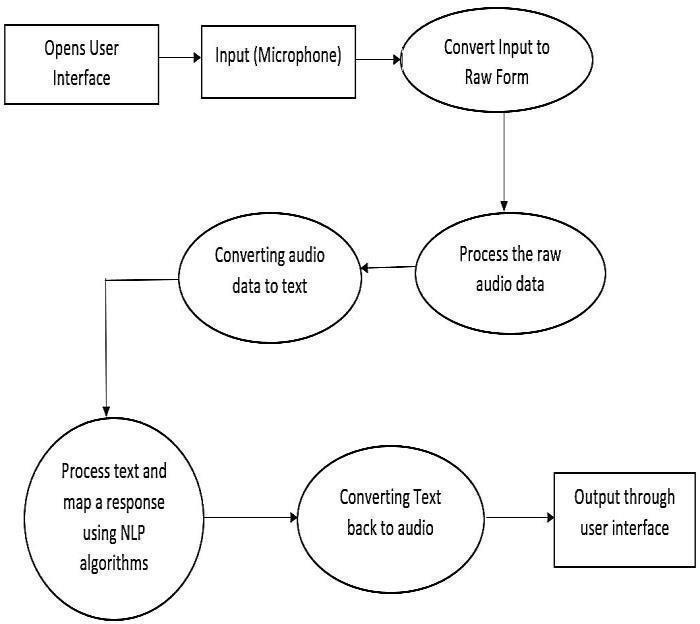


Fig.3 SequenceDiagram


Volume: 11 Issue: 05 | May 2024
5. FUTURE WORK
As AI continues to evolve and gain popularity for daily tasks, its future scope is vast. An upcoming enhancement will be the addition of multilingual support. This feature will enable users to issue commands in Hindi, and the assistant will respond in both Hindi and English. Furthermore, additional features will be introduced to enhance user experience and streamline tasks. The convergence of ancient wisdom with modern technology has the potential to profoundly reshape healthcare practices.
6. CONCLUSION
Thepapertitled"NLP-basedAIVoiceAssistant"providesa detailedexaminationofthedesignandcreationprocessof a voice-enabled personal assistant tailored for desktop use. The project's modular structure enhances flexibility, allowing for the seamless incorporation of additional features without disrupting existing system functionalities.
In today's fast-paced lifestyle, this voice-enabled desktop assistantprovestobeexceptionallytime-savingcompared to earlier methods. Designed with user-friendliness as its primaryfocus,theassistantefficientlycarriesoutassigned tasks. It not only executes commands issued by the user but also responds to inquiries and statements, such as initiating operations and tasks. The assistant introduces itself to users in a manner that fosters a sense of comfort and encourages open interaction. The program aims to eliminate any unnecessary manual effort required to completetasks,operating entirelyonverbal input instead oftraditionalphysicalinputs.Additionally,theassistantis capable of performing a diverse range of tasks, including restarting or shutting down the PC with a simple voice command.
REFERENCES
[1] S. Subhash, P. N. Srivatsa, S. Siddesh, A. Ullas and B. Santhosh, "Artificial Intelligence-based Voice Assistant," 2020 Fourth World Conference on Smart Trends in Systems, Security and Sustainability (WorldS4), 2020, pp. 593-596, doi: 10.1109/WorldS450073.2020.9210344.
[2] Felix, S. M., Kumar, S., & Veeramuthu, A. (2018). A Smart Personal AI Assistant for Visually Impaired People. 2018 2nd International Conference on Trends in Electronics and Informatics (ICOEI). doi:10.1109/icoei.2018.8553750
[3]
Ee. P. M., Santra, S., Bhowmick, S., Paul, A., Chatterjee, P., & Deyasi, A. (2018). Development of GUI for Text-to-Speech Recognition using Natural Language Processing. 2018 2nd International Conference on Electronics, Materials Engineering &
2395-0072
Nano-Technology (IEMENTech). doi: 10.1109/ iementech.2018.8465238
[4] Iannizzotto, G., Bello, L. L, Nucita, A, & Grasso, G. M. (2018). A Vision and Speech Enabled, Customizable, Virtual Assistant for Smart Environments.201811thInternationalConferenceon Human System Interaction (HSI).doi:10.1109/hsi.2018.8431232
[5] Kepuska, V, & Bohouta, G. (2018). Next-generation of virtual personal assistants (Microsoft Cortana, Apple Siri, Amazon Alexa and Google Home). 2018 IEEE 8th AnnualComputingandCommunicationWorkshopand Conference(CCWC).doi:10.1109/ccwc.2018.8301638
[6] J.Sayed,M.W.Ashour,2022InternationalConference on Edge Computing and Applications (ICECAA), DOI: 10.1049/icp.2022.0334
[7] Vindhya Vasini K; Tejasvi K; Pravallika K , 2022 International Conference on Sustainable Computing andDataCommunicationSystems(ICSCDS),DOI: 10.1109/ICSCDS53736.2022.9760998
[8] Satyendra Praneel Reddy Karri; B. Santhosh Kumar, Deep Learning Techniques for Implementation of Chatbots,2020InternationalConferenceonComputer Communication and Informatics (ICCCI),DOI: 10.1109/ICCCI48352.2020.9104143
[9] Aashdeep Singh, P. Murugeswari, S D Prabu Ragavendiran, Amanpreet Kaur, AI-based Chatbot for Physically Challenged People, 2022 International Conference on Edge Computing and Applications (ICECAA),DOI:10.1109/ICECAA55415.2022.9936585
[10] RaniP.J,Bakthakumar,J,Kumaar,B.P,Kumaar,U. P, & Kumar, S. (2017). Voice controlled home automationsystemusingNaturalLanguageProcessing (NLP) and Internet of Things (IoT). 2017 Third International Conference on Science Technology Engineering & Management (ICONSTEM).doi:10.1109/iconstem.2017.8261311