
International Research Journal of Engineering and Technology (IRJET) e-ISSN: 2395-0056
International Research Journal of Engineering and Technology (IRJET) e-ISSN: 2395-0056
Mrs.
Reshma Shivraj Bhalke1 , Dr. A. A. Dandvate2 ,
1Student , Department of Computer engineering, Dhole Patil College of engineering, Pune, Maharashtra, India
2Head of Department , Department of Computer engineering, Dhole Patil College of engineering, Pune Maharashtra, India
Abstract - Due to the variable plant spacing in vegetable plantations, weed identification is more difficult in vegetable than weed identification in crops. There has been minimal researchonweedidentificationinvegetableplantationssofar. In the numerous focuses on traditional crop weed identification approaches have mostly focused on detecting weeds directly. Nevertheless, weed species vary greatly. In contrast, this research provides a new method that blends Machine learning and video/ image processing technologies. The first step was to use a trained center Net model to detect veggies and create bounding boxes around them. The remaining green objects that fell out of the boundary boxes were then labeled as weeds. As a result, the structure concentrates solely on detecting vegetables, avoiding the handling of numerous weed species.
Key Words: Deep Learning, Image Processing, Weed Detection, Machine Learning, YOLO 3
1.INTRODUCTION
Modern agriculture is becoming more reliant on computer-basedsystems.Varioustechnicaladvanceshave openednewpossibilitiestogatherinformationanduseitin agricultureaswellasinothersubjects.Agriculturemaynot have traditionally been the first to implement the latest discoveries in technology, however, precision agriculture with localization such as Global Positioning System (GPS) andotherinformationtechnologiesarebecomingeveryday toolsforfarmers.Automatedmachinesarestartingtotake overtedioustasksformerlyperformedonlybyhumans.
IntheneweraEconomicandecologicalbenefitsare the driving forces to implement new methods into agriculture to increase production. Balancing efficient farming and preservation of nature has traditionally been difficult.
2.
Thetechniqueusedforincreasingresulttoidentifyand reuse weed affected area for more seeding to increase production.Intheagriculturalfieldweedhaddetectedbyits properties such as its Size, Shape, Spectral Reflectance, Texture features and gives the result crop/weed. In this documenttheyhavedemonstratedweeddetectionbyitsSize featuresaswellasvideoprocessing
XIAOJUNJIN1,JUNCHE2,ANDYONGCHEN1[1]“Weed IdentificationUsingDeepLearningandImageProcessingin
VegetablePlantation”,Duetothevariableplantspacing invegetableplantationsaswellascrop,weedidentification ismoredifficultthanweedidentificationincrops.Therehas beenminimalresearchonweedidentificationinvegetable plantations thus far. Traditional crop weed identification approacheshavemostlyfocusedondetectingweedsdirectly through traditional methods; nevertheless, weed species vary greatly. In contrast, this research provides a new methodthatblendsmachinelearningandimageprocessing technologies.ThefirststepwastouseatrainedCenterNet modeltodetectveggiesandcreateboundingboxesaround them. The remaining green objects that fell out of the boundaryboxeswerethenlabeledasweeds.Asaresult,the structure concentrates solely on detecting vegetables and weed.Furthermore,byreducingtheamountofthetraining image data set and the complexity of weed detection, this techniquecanimprovetheweedidentificationperformance andaccuracy.Acolourindex-basedsegmentationwasused in image processing to extract weeds from the backdrop. GeneticAlgorithms(GAs)wereusedtodetermineandassess the colour index used, which was based on Bayesian classification error. The trained Center Net model had a precisionof95.6percent,arecallof95.0percent,andanF1 scoreof0.953duringthefieldtest.
Pignatti S,Casa R.2,HarfoucheA.2,Huang W.3, PalomboA.“MaizeCropAndWeeds SpeciesDetectionBy Using Uav perpectral Data”,[2] In order to use precision agriculturetechniqueslikepatchspraying,it’snecessaryto monitor and map weeds within agricultural crops. Both environmentallyandeconomically,precisionandtargeted weederadicationwouldbebeneficial.Whenhighspatialand spectral resolution data (i.e., from UAV platforms) is available,VNIRhyperspectraldatacanbeastrongtoolfor performing effective weed monitoring and identification. This study investigates the spectral differences between crops and weeds in order to assess the potential of UAV hyperspectraldatatodistinguishmaizecropsfromweeds and different types of weeds. During the 2016 growing season in Italy, UAV and field hyper spectral data were collectedinafewcornfields.Theresultsdemonstratedthat leaf chlorophyll and carotenoid content, extracted using spectral indices or inverting PROSAIL, may be used to
Volume: 11 Issue: 05 | May 2024 www.irjet.net p-ISSN: 2395-0072 © 2024, IRJET |
International Research Journal of Engineering and Technology (IRJET) e-ISSN: 2395-0056
Volume: 11 Issue: 05 | May 2024 www.irjet.net p-ISSN: 2395-0072
distinguish between maize crops and weeds, as well as between weed species. The approach allowed for the measurement of crop/weed relative ground cover, which demonstratedastrongcorrelationwiththeobtainedrelative LAIvalues.
A. J. Ir´ıas Tejeda1 F,” Algorithm of Weed Detection in Crops by Computational Vision”, [3] The use of precision agriculture tools for weed management in crops was the subject of this study. Its focus has been on developing an image-processingsystemtodetectthepresenceofweedsin a specific agricultural site. The main goal was to find a formula that could be used to create a weed detection systemusingbinaryclassifications.Thefirststepinimage processingistodetectgreenplantsinordertoremoveallof thesoilfromtheimageandreduceunnecessarydata.Then, using different medium and morphological filters, and it focused on the vegetation, segmenting and removing unwanted data. Finally, the image has been labeled with items such that weed detection may be done using a thresholddependingonthedetectionarea.Thisalgorithm establishes accurate weed monitoring and can be used in automated systems for weed eradication in crops, either through the use of specific-site automated sprayers or a weed cutting mechanism. Furthermore, it improves the efficiency of crop management operational operations by reducingthetimespentsearchingforweedsacrossaplotof land and concentrating weed removal tasks on specific placesforeffectivecontrol.
Om Tiwari ,“ An experimental set up for utilizing convolutionalneuralnetworkinautomatedweeddetection ”, [4] : One of the variables that contribute to a decline in agricultural yield is the presence of weeds in the crops. Weedstakeupnutrientsandwater,causingtheplanttolose weightandreducethenumberofgrainsperearandgrain output.So,usingnewdronetechnologyanddeeplearningin the field of convolutional neural networks, a way mustbe devised to detect these weeds in the field and then spray herbicideonthemtocompletelyeliminatethem.Theauthors used a data set from the Indian Agriculture Research Institute(IARI)fieldstoapplyatransferlearningtechnique toidentifythreeweeds
UmamaheswariS,”WeedDetectioninFarmCropsusing ParallelImageProcessing”,[5]Pesticidesandfertilizersused inagricultureareutilizedtoeducatethehumancommunity about environmental issues. Agriculture producers must meet an ever-increasing demand for food. Precision agriculture based on IoT has evolved to address environmental challenges and food security. Precision agricultureenhancesproductionandqualitywhilelowering costsandwaste.Basedonthecollectedphotographsofthe farm, we present a system to recognize and locate weed plantsamongthefarmedagriculturalcrops.Wealsopropose employing parallel processing on the GPU to improve the performanceoftheabovesystemsothatitmaybeusedin
real-time.Thesuggestedmethodusesareal-timeimageofa farmasaninputtodeterminethekindandpositionofweeds intheimage.Theproposedworkusesphotosofcropsand weedstotrainthesystemusingadeeplearningarchitecture thatincorporatesfeatureextractionandclassification.The findingscanbeemployedbyanautomatedweeddetection systemforprecisionagricultureoperations.
YUHENG WANG, “image matching algorithm for weed controlapplicationinorganicfarming”,[6]Aweedcontrol robotsystemingeneralconsistsofaweedclassificationand a weed destruction unit, both of which are physically separatedfromoneanotherinsidetherobot,resultinginthe weed distraction result. As a result, tracking of classified weed positions with a low-resolution VGA camera and a developedmatchingalgorithmisanimportantstepforweed destructioninorganicfarmingwitharobotsystem.Inthis paper,trackingisdone with a low-resolutionVGA camera and a developed matching algorithm. Because the robot’s positioncanshiftowingtoastoneorotherobstructioninits path,trackingisrequired.Also,modificationsintherobot’s pace resulted in weed destruction. Simulation and experimental results are used to summarize the performanceofthepicturematchingtechnique.
Wei-Che Liang, “Low-Cost Weed Identification System UsingDrones”,[7]Weedscompetewithcropsforresources like sunshine, nutrients, water, and space. Weeds can developdozenstohundredsofthousandsofseedsthatcan survive for a long period, posing a serious threat to crops oncetheyreachmaturity.Theeasieststrategytoeliminate weedrisksistoremoveweedsbeforetheyblossom,which reducesthelikelihoodofweedseedsdroppingintothesoil. The majority of existing drone-based weed identification technologies rely on extra equipment to improve their accuracy. Drones power consumption and efficiency and loadburdenriseasaresultofsuchsolutions,inadditionto raising their cost. In this paper, researcher propose a low costWeedIdentificationSystem(WIS)thatusesRGBphotos captured by drones as training data and builds the identificationmodelusingConvolutionalNeuralNetworks (CNN)modelwhichgivesresultsintermsofweed/crop.The WIS results can be used as a reference for agriculture researchers,aswellastoalertfarmersabouttheactivities thatneedtobeundertaken.TheWIScanaccuratelyidentify weedsupto98.8
AdnanFarooq,JiankunHu,XiupingJia,“WeedClassification In Hyper spectral Remote Sensing Images Via Deep ConvolutionalNeuralNetwork”,[8]:Inordertoreducethe expenseoffarmingandtheimpactofherbicidesonhuman health,automaticweeddetectionandmappingareessential for site-specific weed control. In this paper, we use hyper spectralimagestoexaminepatch-basedweedidentification. For this aim, the Convolutional Neural Network (CNN) is evaluated and compared to the Histogram of Oriented Gradients (HoG). Patch sizes that are appropriate are studied.
International Research Journal of Engineering and Technology (IRJET) e-ISSN: 2395-0056
Volume: 11 Issue: 05 | May 2024 www.irjet.net p-ISSN: 2395-0072
Syed I. Moazzam, “A Review of Application of Deep LearningforWeedsandCropsClassificationinAgriculture” ,[9]Weedsareamajorreasonwhyfarmershaveapoorcrop harvest.Toidentifyweedsincrops,manyalgorithmshave been developed. Inthe past,color based,threshold-based, and learning-based techniques were used. Deep-learning based techniques stand out among all the techniques because they produce the best results. The application of deep learning-based approaches for weed detection in agriculturalcropsisdiscussedinthisresearch.Thepresence of weeds in sunflower, carrot, soybean, sugar beet, and maize is investigated. Deep learning structures and parametersarediscussed,aswellasresearchgapsthatneed tobefilled.
Weeddetectionistheproblemofaccuratelyidentifyingthe area of weeds so that specific areas can be targeted for spraying with minimum spraying on the other plants of interest.
The YOLO v3 detector inthis situationisbased totallyon Squeezenet, andmakes useofthecharacteristicextraction communityin Squeezeinternetwith the addition ofdetectionheadsattheend.Theseconddetectionheadis twicethesizeofthefirstdetectionhead,soitisbetterableto detectsmall objects.Inthistechnique youcanspecifyany number of detection heads of different sizes based on the structureandsizeoftheobjectsthatyouwanttodetect.The YOLO v3 detectormakes use ofanchorboxeson video andphotographsanticipatedusingtraining data to havebetterpreliminarypriorssimilartotheformofdataset and toassistthe detectordiscover ways topredicttheboxesasitshouldbe. Forinformationabout anchorboxes,seeAnchorBoxesforObjectDetection.
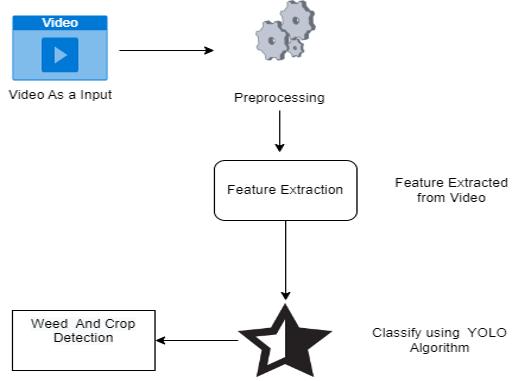
Systemarchitectureistheconceptualmodelthatdefinesthe structure,behavior,anarchitecturedescriptionisaformal descriptionandrepresentationofasystem,organizedina waythatsupportsandreasoningaboutthestructuresand behaviors of the system as shown Agadgetstructurecanconsistofmachinecomponentsand the sub-systemsadvanced,on the way toworktogethertoput into effectthe overallsystem. Therehad beenefforts to formalize languagesto explainmachinestructure;collectivelythose arecalledarchitecturedescriptionlanguages.

International Research Journal of Engineering and Technology (IRJET) e-ISSN: 2395-0056
Volume: 11 Issue: 05 | May 2024 www.irjet.net p-ISSN: 2395-0072
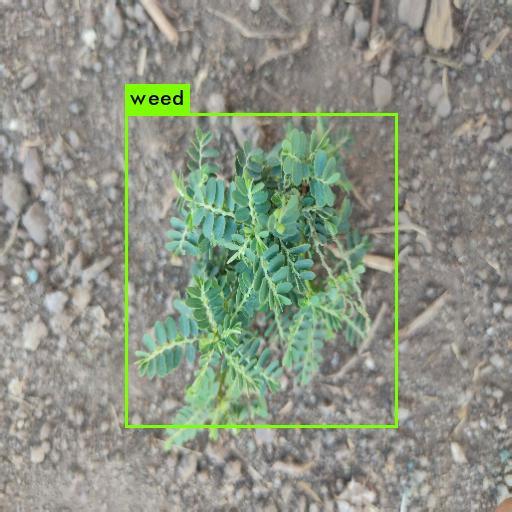
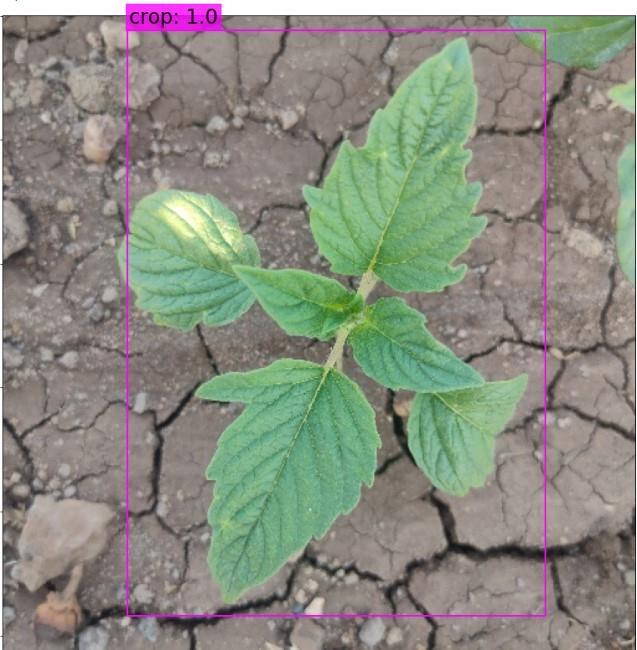
We proposed an approach to identify weeds in vegetable plantation using deep learning and image processing. The algorithmwasdepictedintwosteps.AYOLOv3algorithm wastrainedtodetectvegetables.Thentheremaininggreen objects in the color image were considered as weeds. To extractweedsfromthebackgroundInthisway,themodel focuses on identifying only the vegetables and thus avoid handlingvariousweedspecies.
[1] T.W.Berge,A.H.Aastveit,andH.Fykse,“Evaluationofan algorithm for automatic detection of broad-leaved weedsinspringcereals,”Precis.Agricult.,vol.9,no.6, pp.391–405,Dec.2008
[2] E.Hamuda,M.Glavin,andE.Jones,“Asurveyofimage processing techniques for plant extraction and segmentationinthefield,”Comput.Electron.Agricult., vol.125,pp.184–199,Jul.2016.R.Nicole,“Titleofpaper withonlyfirstwordcapitalized,”J.NameStand.Abbrev., inpress.
[3] H.Mennan,K.Jabran,B.H.Zandstra,andF.Pala,“Nonchemical weed management in vegetables by using covercrops:Areview,”Agronomy,vol.10,no.2,p.257, Feb.2020.
[4] X. Dai, Y. Xu, J. Zheng, and H. Song, “Analysis of the variability of pesticide concentration downstream of inline mixers for direct nozzle injection systems,” Biosyst.Eng.,vol.180,pp.59–69,Apr.2019.
[5] D.C.Slaughter,D.K.Giles,andD.Downey,“Autonomous robotic weed control systems: A review,” Comput. Electron.Agricult.,vol.61,no.1,pp.63–78,Apr.2008.
International Research Journal of Engineering and Technology (IRJET) e-ISSN: 2395-0056
Volume: 11 Issue: 05 | May 2024 www.irjet.net p-ISSN: 2395-0072
[6] K. Liakos, P. Busato, D. Moshou, S. Pearson, and D. Bochtis, “Machine learning in agriculture: A review,” Sensors,vol.18,no.8,p.2674,Aug.2018.
2024, IRJET | Impact Factor value: 8.226 | ISO 9001:2008