
International Research Journal of Engineering and Technology (IRJET) e-ISSN: 2395-0056
Volume: 11 Issue: 05 | May 2024 www.irjet.net p-ISSN: 2395-0072
International Research Journal of Engineering and Technology (IRJET) e-ISSN: 2395-0056
Volume: 11 Issue: 05 | May 2024 www.irjet.net p-ISSN: 2395-0072
Ayisha
Nidha P P1,
Hridya
Nanda K2, Ayisha Marva A3 ,Najna Nazir M K4
123Student, Dept. of Information Technology, KMCT College of Engineering, Kerala, India
4Assisstant Professor, Dept. of Information Technology, KMCT College of Engineering, Kerala, India
Abstract - Technology which is getting updated day-by-day has made the work load of human more easier and effort less. Also, social media networks which were created for the purpose of recreation and socialization over internet has become an inevitable part of our life. Now a days, rather than entertainment, more often social media is used for checking out news feeds. But the trustworthiness of source and content of news that is being viewed and shared over the internet is a greater matter of concern. Because, pseudo news and hoaxes are spreading in a menacing manner like a pandemic which is yet to be sorted out. Without checking the reliability of source and without knowing whether the news is reel or real people used to share news which seems to be satisfactory, without realizing the fact that these incognizant acts may abate the power of fake news and may end up in a severe issue especially during the time of disaster. We have a set of trusted sites such as Google. In these sites, if we search for a real content relevant information will be provided. If we search for a fake content, mismatching and irrelevant information will be retrieved as output. In this application, the news to be checked is searched online and results are gathered through web scrolling i.e., from different sites or from different links of Google. Then, the content obtained through search and the content of the concerned news is compared. comparing and finding out similarities by understanding contents is not an easy task. For that, we use techniques like natural language processing and associated set of algorithms. If similarities are found then that would be a real news and if not, it would be a fake news. Thus, one can easily figure out fake news and break the chain of fake news from being shared over the internet globally.
Key Words: FakeNews,falseinformation,analysis,Machine Learning,WebScrapping.
Theterm"fakenews"describesnewsthatismanufactured, misleading, or false and in which the veracity of the comments,sources,orfactscitedarenotknown.Throughout humanhistory,misinformation,rumors,andgossiphaveall been forms of fake news. This fake news is disseminated oversocialmediainanefforttomaximizeitsefficacy.Social media is used by billions of people, but it also contains robots,orsimplybots.Thesebotsaidinthequickerspread of false information and increase its visibility on social media. The quick dissemination of false information has grown to be a global problem. The dissemination of
inaccurateanddeceptiveinformationhashadasubstantial negative social and economic impact on a variety of industries,includinghealthcareandbanking.
The need to recognize fake news has never been more urgent.Thecredibilityofthesourceandqualityofnewsthat is being viewed and shared online, however, is a greater reason for concern. Because misleading information and hoaxes are alarmingly proliferating like an uncontrollably expanding illness. In the past, people would spread news thatseemedcrediblewithoutcheckingtoseeifthesource wasreliableorifitwasphony.Theydidn'trealize,though, that these thoughtless acts could accelerate the spread of false information and result in major issues, especially duringemergencies.
AstheUnitedStatesgotreadyforHurricaneIrmain2017,a lotofmisleadinginformationcirculatedonline.Thisincluded a Facebook post that, according to the alert, incorrectly predictedthestormwouldapproachHoustonandprovided amapwitha14-dayforecastthatwasninedayslongerthan official forecasts. "The post had been shared over 36,000 times on Facebook when the national weather service publicly refuted the forecast on Twitter with in the same day."
These instances actually give a clear-cut idea about the dangerhiddenwithinfakenewsandtheimpactcreatedby thesame.So,itishightimeto“thinkbeforeclick”i.e.,tofact check the news and its reliability before sharing. For the above-mentioned purpose, design an application to check whether a news is fake or real so that users can share reliableinformationwhichensuresprotectionfromcritical falsenewsdisasters.Oursystemidentifiesanewspostedon theapplicationasrealornot.Asetoftrustedsitessuchas Google.Inthesesites,ifwesearchforarealcontentrelevant information will be provided. If search for a fake content, mismatchingandirrelevantinformationwillberetrievedas output. In this application, the news to be checked is searched online and results are gathered through web scrollingi.e.,fromdifferent sitesor fromdifferent linksof Google.Then,thecontentobtainedthroughsearchandthe contentoftheconcernednewsiscompared.Comparingand findingoutsimilaritiesbyunderstandingcontentsisnotan easytask.Forthat,weusetechniqueslikenaturallanguage processingandassociated setofalgorithms.If similarities arefoundthenthatwouldbearealnewsandifnot,itwould beafakenews.
Volume: 11 Issue: 05 | May 2024 www.irjet.net p-ISSN: 2395-0072
Fakenewsdetectionisusedtoavoidrumorsfromspreading across various platforms, such as social media and messagingplatforms.Theimpetusforthisworkistoavoid the spread of Fake-news which can even lead to worse activities.Therehasbeenariseinthenewslatelyaboutriots that result in mass deaths; fake news detection aims to detecttheseandstopsimilaractivities,therebyprotecting society from these unwelcome violent acts. The proposed systemhelpstofindtheauthenticityofthenews.Thenews givenbytheuserisclassifiedastrueorfalsebasedonthe data collected using Web Scraping. This task uses five various classification models, including Random Forest, Logistic Regression, Decision Tree, KNN, and Gradient Booster.Toimprovepredictionaccuracy,amixtureofthese modelsistested.Further,thepaperisstructuredasfollows: section2takesaglanceatpreviousworkdoneinfakenews detection. In the next section, data extraction, preprocessing Thus, one can easily figure out fake news and break the chain of fake news from being shared over the internetglobally.
In order to improve the trustworthiness of the online platforms such as online social networks and reduce the disastrousimpactsonthesociety,itisessentialtodevelopa reliablemechanismforearlydetectionandcontainmentof misleading contents like fake news. Many endeavours researchbasedonsupervisedlearningmethodsweremade for the issue of detecting fake news. Many of those works sufferfromsomelimitationsoflowaccuracy.Thebasisfor low accuracy can be caused by many reasons such as the mediocrefeatureselection,incompetentparametertuning, non-availabilityofbenchmarkedandbalanceddatasets,etc. Some of the researchers propose comparatively accurate fake news detection and classification models using deep learningtechniquestoreducetheprobabilityoftheseissues. Oneofthemainreasonofusingdeeplearningtechniquesis that in traditional machine learning techniques, human intervention is used explicitly to do feature engineering. Howeverfeatureengineeringisnotneededindeeplearning because important features are automatically detected by deep neural networks in deep learning. Among the deep learningtechniques,theconvolutionalneuralnetwork(CNN) ismorepopularinrecentresearchbecauseitautomatically detects the important features without any human supervision.Ithasbeenevidencedintheliteraturethatin many cases CNN models outperform than other contemporarymodels.Fakenewsdetectionisusedtoavoid rumors from spreading across various platforms, such as socialmediaandmessagingplatforms.Theimpetusforthis work is to avoid the spread of Fake-news which can even leadtoworseactivities.Therehasbeenariseinthenews latelyaboutlynchingsandriotsthatresultinmassdeaths; fake news detection aims to detect these and stop similar activities,therebyprotectingsocietyfromtheseunwelcome violent acts [3]. The proposed system helps to find the authenticity of the news. The news given by the user is classifiedastrueorfalsebasedonthedatacollectedusing
Web Scraping. This task uses five various classification models, including Random Forest, Logistic Regression, Decision Tree, KNN, and Gradient Booster. To improve prediction accuracy, a mixture of these models is tested. Further,thepaperisstructuredasfollows:section2takesa glanceatpreviousworkdoneinfakenewsdetection.Inthe nextsection,dataextraction,pre-processingandclassifiers arediscussed.
Withtheincreasingpopularityofsocialmedia,peoplehas changedthewaytheyaccessnews.Newsonlinehasbecome themajorsourceofinformationforpeople.However,much informationappearingontheInternetisdubiousandeven intendedto mislead.Somefakenewsaresosimilarto the real ones that it is difficult for human to identify them. Therefore,automatedfakenewsdetectiontoolslikemachine learninganddeeplearningmodelshavebecomeanessential requirement.Inthispaper,weevaluatedtheperformanceof five machine learning models and three deep learning modelsontwofakeandrealnewsdatasetsofdifferentsize withholdoutcrossvalidation.Wealsousedtermfrequency, termfrequency-inversedocumentfrequencyandembedding techniques to obtain text representation for machine learninganddeeplearningmodelsrespectively.Toevaluate models’ performance, used accuracy, precision, recall and F1-scoreastheevaluationmetricsandacorrectedversionof McNemar’s test to determine if models’ performance is significantly different. Then, proposed the novel stacking modelwhichachievedtestingaccuracyof99.94%and96.05 %respectivelyontheISOTdatasetandKDnuggetdataset. Furthermore, the performanceofourproposed methodis high as compared to baseline methods. Thus, highly recommenditforfakenewsdetection.
2.2Machine learning-based approach forfake news detection.
Inthemodernerawheretheinternetisfoundeverywhere andthereisrapidadoptionofsocialmediawhichhasledto thespreadofinformationthatwasneverseenwithinhuman history before. This is due to the usage of social media platformswhereconsumersarecreatingandsharingmore information where most of them are misleading with no relevance with reality. Classifying the text article automatically as misinformation is a bit challenging task. Thisdevelopmentaddresseshowautomatedclassificationof text articles can be done. We use a machine learning approach for the classification of news articles. Our study involvesexploringdifferenttextualpropertiesthatmaybe often used to distinguish fake contents from real ones. By using those properties, can train the model with different machine learning algorithms and evaluate their International Research Journal of Engineering and Technology (IRJET) e-ISSN: 2395-0056
International Research Journal of Engineering and Technology (IRJET) e-ISSN: 2395-0056
Volume: 11 Issue: 05 | May 2024 www.irjet.net p-ISSN: 2395-0072
performances. The classifier with the best performance is used to build the classification model which predicts the reliabilityofthenewsarticlespresentinthedataset.
Users rely heavily on social media to consume and share news,facilitatingthemassdisseminationofgenuineandfake stories.Theproliferationofmisinformationonvarioussocial mediaplatformshasseriousconsequencesforsociety.The inabilitytodifferentiatebetweentheseveralformsoffalse newsonTwitterisamajorobstacletoeffectivedetectionof fake news. Researchers have made progress toward a solutionbyemphasizingmethodsforidentifyingfakenews. The dataset FNC-1, which includes four categories for identifyingfalsenews,willbeusedinthisstudy.Thestateof-the-artmethodsforspottingfakenewsareevaluatedand compared using big data technology (Spark) and machine learning. The methodology of this study employed a decentralized Spark cluster to create a stacked ensemble model.FollowingfeatureextractionusingN-grams,Hashing TF-IDF,andcountvectorizer,weusedtheproposedstacked ensemble classification model. The results show that the suggestedmodelhasasuperiorclassificationperformanceof 92.45%intheF1scorecomparedtothe83.10%F1scoreof the baseline approach. The proposed model achieved an additional9.35%F1scorecomparedtothestate-of-the-art techniques.
Socialmedianetworkswhichwerecreatedforthepurpose ofrecreationandsocializationoverinternethasbecomean inevitable part of our life. Now a days, rather than entertainment,moreoftensocialmediaisusedforchecking out news feeds. But the trustworthiness of source and content of news that is being viewed and shared over the internet is a greater matter of concern. Because, pseudo newsandhoaxesarespreadinginamenacingmannerlikea pandemicwhichisyettobesortedout.
Without checking the reliability of source and without knowing whether the news is reel or real people used to share news which seems to be satisfactory. These blindly deeds make the one who shares the fake news as culprit withoutanyacknowledgementandthisincognizantactmay upsurgethepoweroffakenewsandmayendupinasevere issueespeciallyduringthetimeofdisaster.
For example, in India, Misinformation related to coronavirusCOVID-19pandemic is in the form of social media messages related to home remedies that have not beenverified,fakeadvisoriesandconspiracytheories.Also, fake news regarding economic crisis, monsoon floods and electionisonitshighrange.
Therefore,itishightimeto“think beforeclick”Thatis,to fact check the news and its reliability before sharing. But differentiatingfakeandrealnewsisquiteachallengingtask.
Since the start of human civilization, fake news has often emerged.Though,thepropagationoffakenewscanemerge through the utilization of the global media landscape and modern technologies. Fake news affects several fields includingeconomic,political,andsocialenvironments.On theotherhand,fakenewsandfakeinformationhaveseveral faces.Fakenewsposestremendousimpactsasinformation moldstheviewofhumansaroundtheworld,thoughcritical decisionscanbemadethroughfakeinformation,whichalso leads to wrong decision-making. Similarly, good decisions cannotbemadebythisfabricated,distorted,false,orfake informationontheInternet.Themajorimpactsoffakenews affect health, innocent people, democratic impacts, and financialimpacts.
Themotiveof project istoidentifya solutionthatmay be usedtodetectandremovesiteswithfakenewstohelpusers toavoidbeingenticedbyclickbait’s.Itisourgoodfortune thatsuchsolutioncouldbediscoveredanditwouldbemuch helpful for technical corporations and readers who are plaguedbyfakenews.Theproposedideasolvesproblems relatedtofakenewswhichincludesthetoolusagethatfinds andfiltersoutthefakenewsfromtheresultprovidedbya searchengineora feedfromsocial networkingnews. The aimistouseAItoidentifyarticlesandclaimthatarelikelyto containfalseorhighlybiasedinformation.
Thechallengeoffakenewsdetectioninvolvessomeofthe followingtasks:extractingandmatchingtext-asitinvolves searchingtheseveralsourcesofdataandthenrelatingitto the input news, named entity recognition as it involves generationoftokenlevelfine-grainedoutput,document,and entity-level sentiment analysis - as it involves the identificationofthepolarity,emotionsnegations,sarcasms, tone and bias of the sentences, document classification, stance classification, among others. The approach can be downloadedandattachedtothebrowserorapplicationused bytheendusertoreceivenewsfeeds.Sothattheapplication startsitswork byusingseveralmethodslikethemethods related to the feature extraction so that we can verify the contentweareseeingisvalidoneorfalse.Thisapproachis implemented by integrating 2 modules: the web scraping andtheLRmodulefordetectingfakenews.
International Research Journal of Engineering and Technology (IRJET) e-ISSN: 2395-0056
Volume: 11 Issue: 05 | May 2024 www.irjet.net p-ISSN: 2395-0072
1. The news to be checked is searched online and resultsaregatheredthroughwebscrollingthatis, fromdifferentsitesorfromdifferentlinksofGoogle.
2. The content obtained through search and the contentoftheconcernednewsiscompared.
3. Comparing and finding out similarities by understanding contents is not an easy work. For that, we use techniques like natural language processingandassociatedsetofalgorithms.
4. If similarities are found then that would be real newsandifnot,itwouldbeafakenews.
Architecturediagramisgivenbelow:
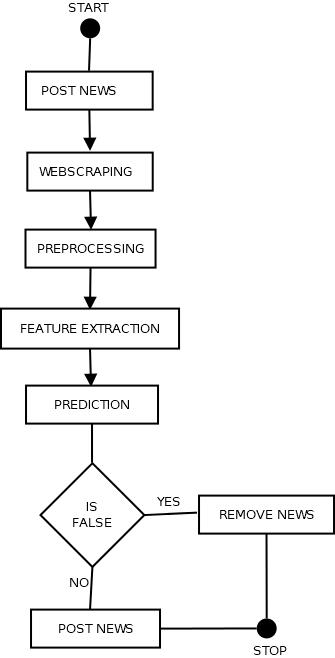
Usercanpostnews.
Usingwebscrapingprocessfeaturehasbeen extractedthroughpreprocessing.
Predictingthepostednewsisfakeornot.
Ifitisfakeitcan’tbeposted.
Enablingchatbotasafeaturehelpsin:
Engaginglargeno.ofpeople
Limitinghumaninterventions
creatinga morepersonalized,real-timeandtwowayexperience
Creating easier , friendly and instant to use communicationplatform
Itinvolvesthepre-processingstepsneededtohandleallthe input texts and feeds. Initially, it reads the train, test and validation data and performs the processing such as tokenization and stemming. The exploratory data analysis suchasresponsevariabledistributionanddataqualitychecks like missing values or null values are then accomplished. NULLValue:startdatapre-processingwithcheckingthenull values. We need to tackle with missing values during data analysis phase. So, handling the missing values is most importantaspectbeforestartingtoworkondata.However, before doing anything about missing values, we need to understand the pattern of missing values occurring. The techniquesareusefulintheearlyphasesoftheanalysisof exploratorydata.
AmongtheensemblelearningtechniquesisRandomForest, aflexibleandpotentmachinelearningalgorithm.Tocreate forecasts,itsynthesizestheresultsofseveraldecisiontrees. Essentially, Random Forest makes use of decision trees, which produce predictions for each region by recursively dividingtheinputspaceintoregionsaccordingtothevalues of input attributes. Feature randomness and Bootstrap Aggregating (Bagging) are two methods that provide randomnesstothealgorithm,guaranteeingvariationwithin thedecisiontreesandavoidingoverfitting.Everydecision tree undergoes independent training on a distinct bootstrappeddataset,andthefinaloutputisgeneratedby averaging(forregression)orvoting(forclassification)the predictionsmadebythetrees.Findingpertinentfeaturesin thedatasetismadeeasierwiththehelpofRandomForest, which offers a measure of feature relevance. It is widely utilized in many different sectors due to its scalability, robustness,andcapacitytohandledifferentformsofdata.
International Research Journal of Engineering and Technology (IRJET) e-ISSN: 2395-0056
Volume: 11 Issue: 05 | May 2024 www.irjet.net p-ISSN: 2395-0072
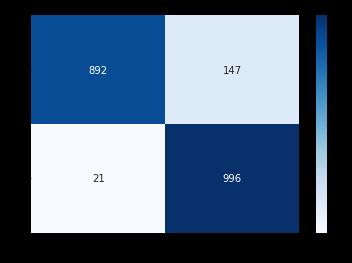
Random forest classifier creates many trees by utilising features of subsets. It is extension of bagging and simply merges the output of multiple decision trees. It can be used for classification and regression issues as well as unsupervisedlearning.Theaccuracyscoreof92%,92%F1score,98%precisionand86%recalloftestingdataset
Itisone of the automated methodsapplied toobtainhuge datafromwebURLs.FollowingFigure4showswebscraping. As we can see that, the data present on the web URLs is formless. It helps to get this formless data and store it in a properform.Followingsomewaysbywhichscrapingtothe websitescanbedone:
1.Writingyourowncode.
2.APIs.
3.Onlineservices.
WhenopenwebscrapercodeisusedandruntotheURLthat you have copied, a request is sent to the server. The sever thensendsthedataandgrantyoutoreadtheHTMLorXML page, in the response of the request made by us. The code then,findsthedataandextractsit,parsestheHTMLorXML page. In this approach our own code is used for effective collectionofdataanditsgenuinenessfromseveralwebsites andsocialmediaplatforms.
Thereisnocommondefinitionfordescribingfakenews.Fake newscanbespreadovertheworld,whichcanbepropagated inanyfieldlikeCOVID-19,politics,e-commerce,marketing, and so on. So, there is a need of analyzing fake news to understand the real news in any particular field. However, someofthewriters,publishers,andvendors,postingnonauthentic online comments or any third-party monitoring onlinecommentswillactasrealcustomersandspreadsfake news on online social media for increasing product sales. Similarly, a vast number of users on social media can broadcastfakenewsbasedontheiropinions.Inthecaseof thetourismfield,tweetsonsocialmediamaypropagatefake news based on their imagination without spending at a destination(Dasetal.2021).Itmayleadtothelossofgenuine consumersduetofakenewsononlineplatforms.Ingeneral, fakenewsisconsideredoneofthehugethreatstofreedomof expression,journalism,anddemocracy.Italsoinfluencesthe politicalimpacts,fromwhichthefakenewsgenerationcanbe derivedduetothecomments,reactions,andsharespostedon Facebook, WhatsApp, Instagram, and common websites (BrenesPeralta etal.2021;Chang2021).Morespecifically, fakenewsdetectioncanbedividedintofourperspectiveslike source-based approaches, propagation-based approaches, style-based approaches, and knowledge-based approaches. Finally, recent advancements in “deep learning have been utilized for detecting” fake news from online social media
platforms.Deeplearninghasseveralfeaturesovermachine learning approaches, which are superior accuracy, the capability of extracting high-dimensional features, and “lightly dependent on data pre-processing”. Moreover, the recent broader “availability of data and programming schemeshasincreasedtherobustnessandutilizationofdeep learning-basedalgorithms”.Thus,inthepastyears,various research articles on fake news detection models have been implementedbasedondeeplearningtechniques.
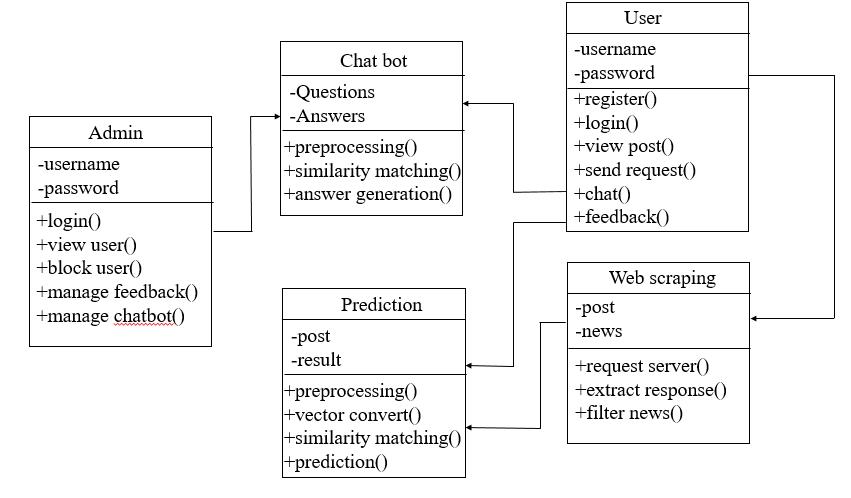
5.1
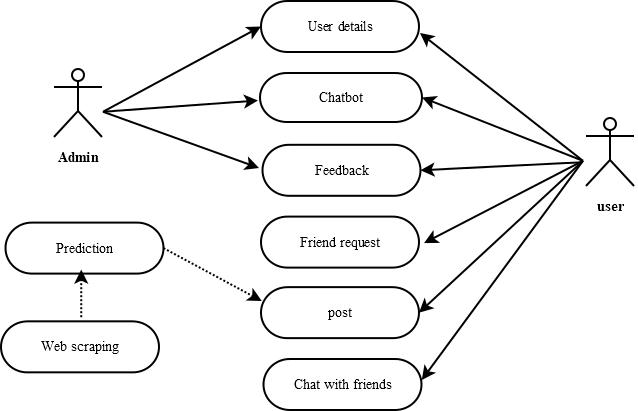
AdminandUseraretheactorspresentinthisuse caseDiagram.
AdmincancheckUserdetails,mangechatbot, analyzefeedback.
Usercanenteruserdetails,usechatbot,give feedback,givefriendrequest,postnews,andalso chatwithfriends.
Thenewsisonlypostedwhenitisnotfakeby predictedbywebscrapingmethod
International Research Journal of Engineering and Technology (IRJET) e-ISSN: 2395-0056
Volume: 11 Issue: 05 | May 2024 www.irjet.net p-ISSN: 2395-0072
ThereisAdminanduserpresentinthisdiagram.
There is also a prediction table for fake news detection
Theadminandusercanperformtheirfunctionsin theirlogins.
FakenewsisdetectedusingWebscraping.
LEVEL 0

Itistheoverallstructureofthesystem
Thereare2modulessuchasadminandUser.
ThesemodulesareconnectedtoFakenews detectionmodel.
Themodelwillpredictwhetherthenewsisfake ornot.
LEVEL 1.1
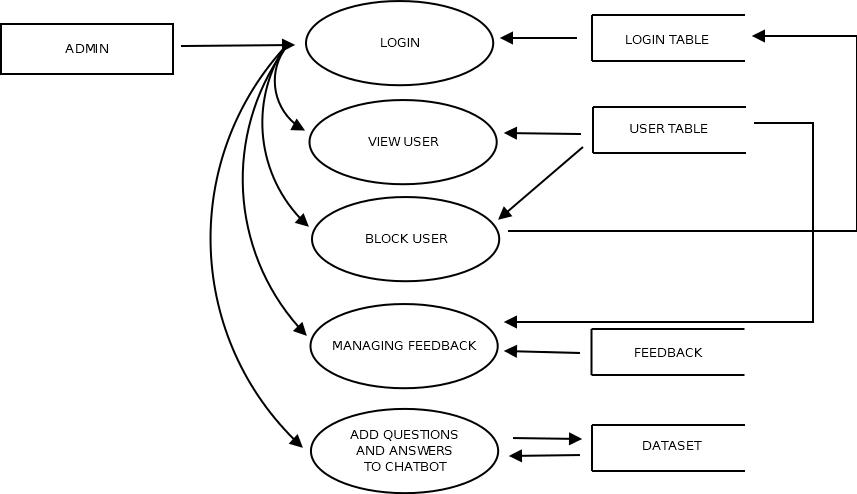
Adminhaveloginaccessestotheplatform.
Theycanviewuserdetails.
Canblockuserifthereisanyissuesoccurred.
Theycanmanagefeedbackfromuser.
Alsocanquestionandanswertothechatbot.
Eachofthefunctionwillstoredinrespective tablesinthedatabase.
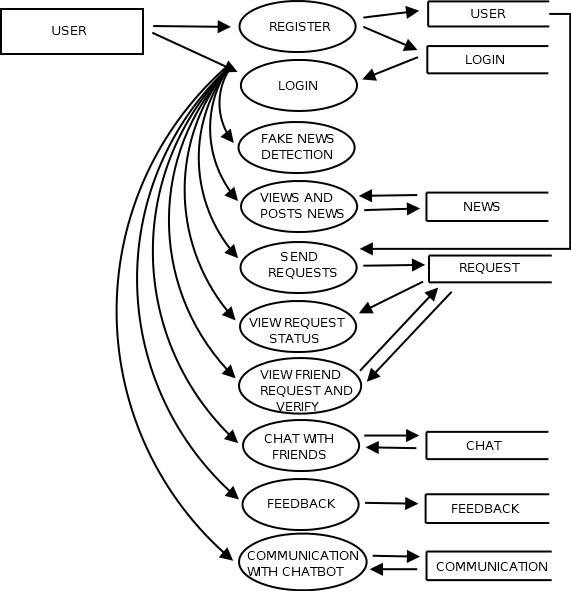
Usercandofollowingfunctionssuchas:
RegisterandLogin.
Viewandpostnews.
Sendandacceptfriendrequest.
Theycanchatwithfriendsandchatbot.
Cangivefeedbacks.
Abovementioneddataarestoredindatabase
Detectingfakenewsusingwebscrapinginvolvescollecting data from various online sources, analyzing content, and applyingmachinelearningornaturallanguageprocessing techniquestodeterminethecredibilityoftheinformation. Here's how you can structure the result and conclusion sectionforafakenewsdetectionprojectusingwebscraping.
Usedwebscrapingtechniquestogatherinformationfroma rangeofonlinesources,suchasforums,socialnetworking sites, and news websites. To assure the quality and consistency of the dataset, the acquired data underwent stringentpreprocessingprocedures,suchastextcleaning, tokenization,andtheremovalofHTMLtagsandstopwords. avarietyoffeatureswereextractedfromthetextdata,such aslinguistictraits,wordfrequency,n-grams,andsentiment analysisscores.
Experiments revealed promising results, with the bestperformingmodelsachievingaccuraciesabove90%onthe test dataset. Confusion matrices, ROC curves, and feature importanceplotswereutilizedtovisualizeandinterpretthe
International Research Journal of Engineering and Technology (IRJET) e-ISSN: 2395-0056
Volume: 11 Issue: 05 | May 2024 www.irjet.net p-ISSN: 2395-0072
performance of the fake news detection models. These visualizations provided insights into the behavior of the models and highlighted key features contributing to the detectionoffakenewsarticles.
Theexperimentsdemonstratedvaryingperformanceamong thedifferentmodels,withsomeachievinghigheraccuracy and precision than others. Logistic regression exhibited simplicity and efficiency, while random forests showed robustness to overfitting. Support vector machines performedwellinseparatingtheclassesbutrequiredcareful parameter tuning. Ensemble methods such as stacking or boostingcouldpotentiallyimproveoverallperformanceby combining the strengths of multiple models.Analysis of featureimportancerevealedthatcertainlinguisticpatterns, sentiment indicators, and metadata attributes played significant roles in discriminating between real and fake news.
Featuresrelatedtosensationalism,inflammatorylanguage, and unreliable sources often correlated with fake news articles,highlightingtheimportanceofcontextandcontent analysis. Despite the promising results, our fake news detectionapproachfacesseveralchallengesandlimitations. Biases in the training data, limited generalization across differentlanguagesanddomains,andthedynamicnatureof online misinformation pose significant obstacles. Future research efforts should address these challenges through more comprehensive data collection, robust model architectures,andcross-disciplinarycollaborations.
Our study's conclusions have applications in the fields of digitalcitizenship,contentcontrol,andmedialiteracy.Users that are able to analyze material critically and make wellinformedjudgmentsonlinecanbeenabledbyeffectivefalse newsdetectionsystems.Scalableandsustainablesolutions must be implemented in conjunction with fact-checking groups,socialmediacompanies,andlegislators.
To sum up, our web scraping-based fake news detection studyoffersinsightful informationabouttheintricacies of online disinformation and the promise of computational methodstotacklethisurgentsocialproblem.Evenifthere are still obstacles to overcome, further study and developmentinthisareacouldleadtothedevelopmentofa morereliableandrobustinformationecosystem.
The study shows that machinelearning and web scraping techniquescanbeusedtodetectbogus news. The models created for this project perform well when it comes to differentiating between authentic and fraudulent news articles on different websites. The research's conclusions haveabigimpactoncontentmoderation,medialiteracy,and the battle against false information. We can enable consumerstomakeeducateddecisionsandslowthespread ofmisleadinginformationonlinebyimplementingefficient
fake news detection technologies. Notwithstanding the encouragingoutcomes,therearestillseveraldrawbacksto our fake news detection method, such as biases in the trainingsetanddifficultiesidentifyingsubtletypesoffalse information.Subsequentinvestigationshavetoconcentrate onresolvingtheseconstraintsandinvestigatinginnovative methods to enhance the precision and dependability of systemsdesignedtoidentifyfalsenews.Thinkofanumber of directions that future study could go, such as including multimedia content analysis, utilizing user comments and social network data, and investigating group learning strategies.Misinformationidentificationandpreventioncan befurtheradvancedthroughcollaborationswithacademic researchers, social media platforms, and fact-checking organizations. When developing and implementing fake news detection systems, ethical factors like privacy, censorship, algorithmic bias, and transparency must be properly taken into account. Promote ethical AI practices andstressthevalueofmaintainingmoralprinciplesinthe fightagainstonlinedisinformation.
[1] ANovelStackingApproachForAccurateDetection Of FakeNewsTaoJiang,JianPingLi,AminUl Haq,AbdusSaboor,AndAmjadAli.
[2] MachineLearning-BasedApproachforFakeNews DetectionH.L.Gururaj,H.Lakshmi,B.C.Soundarya ,FrancescoFlamminiandV.Janhavi.
[3] Big Data Ml-Based Fake News Detection Using Distributed Learning Alaa Altheneyan And Aseel Alhadlaq.
[4] AReviewOfMethodologiesForFakeNewsAnalysis MehediTajrian,(Member,IEEE),AzizurRahman, MuhammadAshadKabir,(Member,IEEE),AndMd. RafiqulIslam,(SeniorMember,IEEE).
[5] OPCNN-FAKE: Optimized Convolutional Neural Network For Fake News Detection Hager Saleh, AbdullahAlharbi,AndSaeedHamoodAlsamhi.
[6] YiminChen,NadiaKConroy,andVictoriaLRubin. “News in an online world: The need for an “automatic crap detector””. In: Proceedings of the AssociationforInformationScienceandTechnology 52.1(2015),pp.1–4.
[7] Mordechai Gordon and Andrea R English. John Dewey’s democracy and education in an era of globalization.2016.
[8] JorgeJPalop,LennartMucke,andErikDRoberson. “Quantifying biomarkers of cognitive dysfunction and neuronal network hyperexcitability in mouse modelsofAlzheimer’sdisease:depletionofcalcium-
International Research Journal of Engineering and Technology (IRJET) e-ISSN: 2395-0056
Volume: 11 Issue: 05 | May 2024 www.irjet.net p-ISSN: 2395-0072
dependent proteins and inhibitory hippocampal remodeling”. In: Alzheimer’s Disease and FrontotemporalDementia.Springer,2010,pp.245–262.
[9] Praveen Kumar Donepudi et al. “Artificial Intelligence and Machine Learning in Treasury Management:ASystematicLiteratureReview”.In: International Journal of Management (IJM) 11.11 (2020)
© 2024, IRJET | Impact Factor value: 8.226 | ISO 9001:2008 Certified Journal | Page1143