
International Research Journal of Engineering and Technology (IRJET) e-ISSN: 2395-0056
Volume: 11 Issue: 05 | May 2024 www.irjet.net p-ISSN: 2395-0072

International Research Journal of Engineering and Technology (IRJET) e-ISSN: 2395-0056
Volume: 11 Issue: 05 | May 2024 www.irjet.net p-ISSN: 2395-0072
Amit Kumar1 , Pramod Kumar2
12 Department of Physics, St. John’s College, Agra, Dr. Bhimrao Ambedkar University, Agra-282002 (UP) India
Abstract - In the present scenario of materials science and solid-state physics,thestudyofphotoconductivityhasemerged as an area of deep interest. This phenomenon, where a material's electricalconductivityis modulatedbylight,unfolds in a captivating narrative through the exploration of complex oxide hetero-structures. These structures, formed by growing film oxides hetro-structures of distinct oxide materials with unique electronic and optical properties, offer a rich playground for investigatingnovelelectronicphases,quantum phenomena, and optoelectronic behaviors. By manipulating interfaces and film thickness, researchers unlock thepotential for applications in electronics, spintronics, and energy conversion. This study delves into thecaptivatingproperties of LaAlO₃/SrTiO₃, LaNiO₃/SrTiO₃, LaVO₃/SrTiO₃, and LaTiO₃/SrTiO₃ compounds, where photoconductivity reveals its intriguing plane. LaAlO₃/SrTiO₃, for instance, boasts a conducting interface and a 2D electron gas, driven by polar discontinuityandchargetransfer.LaNiO₃/SrTiO₃,ontheother hand, exhibits a conducting interface with notable photo response, while LaVO₃/SrTiO₃ and LaTiO₃/SrTiO₃ offer their unique photoconductivity properties.The mechanismsdriving photoconductivity, from charge separation to carrier transport, are unraveled, offering insights into their intricate behaviors. Applications span a wide spectrum, from highmobility transistors to Photovoltaic cell, fuelcells,andbeyond, with each compound presenting a unique set of possibilitiesas we look to the future, the promise of these compounds shines brightly, with ongoing research poised to enhance their properties and expand their horizons. The journey, markedby captivating narratives and intricate interplays, leaves us standing at the cusp of discovery, ready to revels the full potential of these materials in the realm of optoelectronics.
Key Words: Photoconductivity, Thin-film, LaAlO₃/SrTiO₃, LaNiO₃/SrTiO₃,LaVO₃/SrTiO₃,andLaTiO₃/SrTiO₃
Photoconductivity, a fascinating phenomenon where light alters a material’s electrical behavior, has intrigued researchersinmaterialsscienceandsolid-statephysics.The intricate makeup of complex oxide heterostructures has becomeacaptivatingrealmfordelvingintothemysteriesof photoconductivity, thanks to their special combination of electronic and optical properties. Complex oxide heterostructures have emerged as promising arenas for probing intotheenigmaofphotoconductivity,owingtotheirunique blend of electronic and optical characteristics [1]. These
intricate structures come to life by layering thin films or epitaxial layers of different oxide materials, each with its distinctcrystalstructureandelectronicbehavior[2].It'sat theboundariesbetweenthesematerialsthatmagicunfold, revealing emergent phenomena not witnessed within the individualcomponents[3].
These hetero-structures offer a rich playground for unravelingnovelelectronicphases,quantumpeculiarities, andthewondrousworldofoptoelectronicproperties[2].By masterfully crafting these interfaces and fine-tuning film thickness, researchers wield the power to manipulate electronictraits,givingbirthtofunctionalitiesunseeninbulk materials. This mastery holds promises spanning various domains,includingelectronics,spintronics,andtherealmof energy conversion. Among these complex oxide wonders, onestartakesthespotlight:theLaAlO₃/SrTiO₃(LAO/STO) system[4].Extensivelyexploredforitsbeguilingattributes, thisduoshowcasesaconductinginterfaceanda2Delectron gas (2DEG) brought to life by the charge transfer due to polardiscontinuityattheLAO/STOinterface[5].This2DEG in LAO/STO exhibits a splendid property of photoconductivity,withitselectricalconductanceswaying dramaticallyundertheinfluenceoflight'sgentlecaress[6].
Thisintriguingresponsetophotonsisaresultofacomplex interplayinvolvingtheinjectionofphotogeneratedcarriers, their entrapment and liberation, and transformative alterations to the electronic band structure, all choreographed by the whims of light [7]. LAO/STO holds withinitthepromiseofilluminatingoptoelectronicdevices, such as photodetectors and solar cells [8]. But the stage doesn'tbelongsolelytoLAO/STO;there'sanotherdynamic duointhespotlight,theLaNiO₃/SrTiO₃(LNO/STO)system. LNO, with its impressive conductivity and a penchant for absorbing light in the visible and near-infrared spectrum, takescenterstage[9].WhenLNOelegantlylayersitselfonto theSTOsubstrate,aconductinginterfacegracesuswithits presence, boasting captivating photo response behavior LNO/STO's photoconductivity narrative begins with the absorption of photons, birthing electron-hole pairs that gracefullytraversetheinterface,harmoniouslycontributing totheoverallphotoconductivity[10].
ThisperformanceplacesLNO/STO firmlyonthemapas a promising candidate for photodetection and photovoltaic exploits [11]. Not to be overshadowed, the LVO/STO and LTO/STOhetero-structuresgracefullywaltzontothescene,
International Research Journal of Engineering and Technology (IRJET) e-ISSN: 2395-0056
Volume: 11 Issue: 05 | May 2024 www.irjet.net p-ISSN: 2395-0072
eachwith itsunique taleof photoconductivity [12]. In the LVO/STO duet, the photoconductivity narrative unfolds throughtheexchangeofchargesbetweenthelayersofLVO andSTO[13,14].Meanwhile,intheLTO/STOperformance, the story is interwoven with the modulation of carrier density and mobility at the interface [15]. The result is a tunablemetal-insulatortransitionthatfollowsthedictatesof externalfactorslikestrain,electricfields,andofcourse,the ever-intriguing light [16]. The unique qualities of photoconductivityexhibitedbyLVO/STOandLTO/STOopen doors to a realm of possibilities, spanning optoelectronic devicesandadvancedenergyconversiontechnologies[17]. In conclusion, our exploration of photoconductivity in LaAlO₃/SrTiO₃, LaNiO₃/SrTiO₃, LaVO₃/SrTiO₃, and LaTiO₃/SrTiO₃ compounds reveals not just scientific mysteries but also promising applications in the realm of optoelectronics[18].Complexoxidehetero-structuresgrant us the power to engineer and mold electronic and optical properties,allowingthecreationof innovative devicesfor light detection, energy transformation, and other exciting optoelectronic frontiers [19]. However, this journey is far fromitsfinalact;furtherresearchisessentialtounravelthe intricatemechanismsgoverningphotoconductivityinthese compounds, illuminating the path toward the design and fabricationofefficientandversatileoptoelectronicdevices.
Let's delve deeper into the fundamental principles that underpinourexploration:Photoconductivity,anintriguing phenomenon,ariseswhenamaterial'selectricalconductivity transformation upon exposure to light. Our protagonists, LaAlO₃/SrTiO₃, LaNiO₃/SrTiO₃, LaVO₃/SrTiO₃, and LaTiO₃/SrTiO₃,arehetero-structuresmeticulouslycraftedby layeringthinfilmsorepitaxiallayersofthesematerialsontoa SrTiO₃(001)substrate[13-18].
Thestudybeginswiththestarofourshow,LaAlO₃/SrTiO₃. Thiscaptivatingduohasgarneredsignificantattentiondueto itscaptivatingproperties.WhenathinlayerofLaAlO₃graces the SrTiO₃ substrate, it conjures a conducting interface, a phenomenonshroudedinmystery,giventhatbothmaterials are insulators in their bulk form [19-21]. This astonishing behavior is attributed to the polar discontinuity at the interface, birthing a two-dimensional electron gas (2DEG) thatdancestothetuneoflight[22].Theexactmechanisms driving photoconductivity in this enchanting performance remainanenigma,thesubjectofongoingresearch[3].
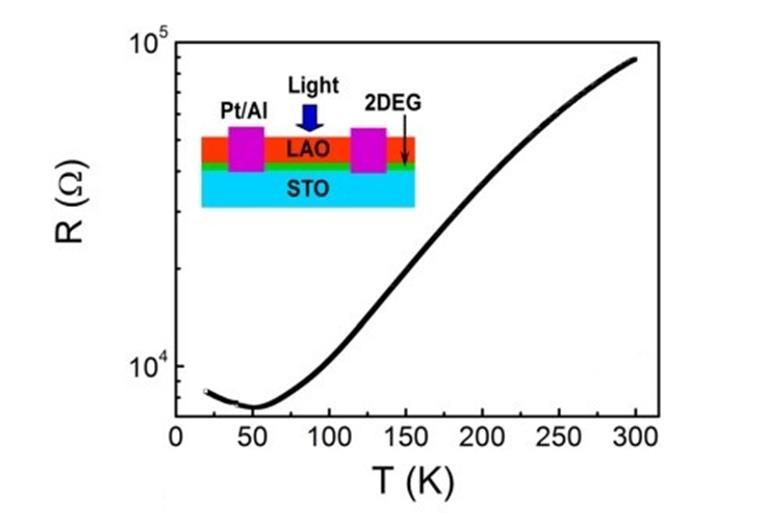
Figure: 1 Resistance-temperaturecurvesofthehetero interfaceindarkness,andtheinsetdisplaystheschematic illustrationoftheheterointerfaceforthephotoinduced measurement[23].
LaNiO₃/SrTiO₃hetero-structuresjointhenarrative,offering their unique electronic and catalytic prowess. LaNiO₃, a metalliccompound,takesonanewpersonawhengrownon an STO substrate, displaying enhanced conductivity and intriguingelectronictraits[24].theresistance-temperature curvesintherangebetween12-100Kbytheexpression[25].

(1)
Photoconductivity in this tale unfolds as a symphony of charge transfer and energy transfer processes. Light's entranceonthestagetriggersthebirthofphotogenerated carriers in the LaNiO₃ layer, making their journey to the SrTiO₃ layer through interfacial charge transfer processes [13].Energytransfersequencesadddepthtothenarrative,as the excited states ofLaNiO₃generouslyshare their energy withSrTiO₃,birthingadditionalchargecarriers.Thepresence of oxygen vacancies and defects adds an element of unpredictability to this performance [26]. In the realm of LaVO₃/SrTiO₃ hetero-structures, multi-functionality is the name of the game. LaVO₃, a Mott insulator, partners with SrTiO₃, a band insulator, to craft a mesmerizing interface [27].Thephotoconductivitytaleunfoldswithlight'sradiance as the backdrop. LaVO₃, under the influence of photons, promoteselectronsfromthevalencebandtotheconduction band [19]. These photogenerated electrons embark on a journey to the SrTiO₃ layer through interfacial charge transfer processes, with the efficient separation and transportmechanismsenhancingthephotoconductivity[28].
International Research Journal of Engineering and Technology (IRJET) e-ISSN: 2395-0056
Volume: 11 Issue: 05 | May 2024 www.irjet.net p-ISSN: 2395-0072
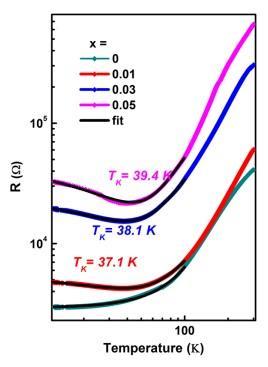
Figure 2 Temperaturedependenceoftheresistanceat LANO/STO(x=0,0.01,0.03,and0.05)heterointerfacesin darkness.Thesolidlinesarefittoeq1inthetemperature rangeof12−100K.Carrierdensity.
IntheLaTiO₃/SrTiO₃saga,uniqueelectronicpropertiesand potentialapplicationsinoxideelectronicstakecenterstage forthebetterhalfofcharacteristicsoftheinterfacebetween LTO/STOandLAO/STO,Researchersfoundextremelythin(~ 8nm)epitaxiallayerson(100)SrTiO3 substratebyapulsed laser deposition Technique using an excimer laser. Approximately~0.015nm/swasthegrowthrateofLaAlO3 andLaTiO3 epitaxialfilmsgrownlayer-by-layerat700,750, and 800 ˚C in 1 x 10⁻⁴ mbar of oxygen pressure.
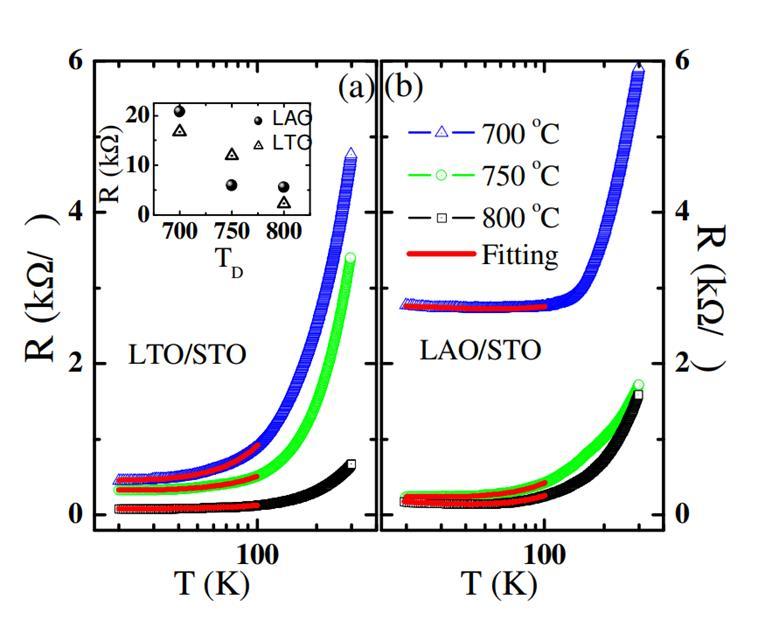
Figure: 3 Thetemperaturedependenceofsheetresistance of(a)LTOand(b)LAOfilmsdepositedon(001)STOat differentsubstratetemperatures.Inset(a)showsthe variationofresistancewithgrowthtemperatureat300K [28].
It is evident that, as compared to films deposited at lower temperatures, those developed at higher substrate temperatures have more metallicity. It is evident from the insetofFigure3thattheroomtemperatureresistance(R)of the LTO film is lower than that of the LAO film when comparingthetwofilmsthatweredepositedat800˚C[29].
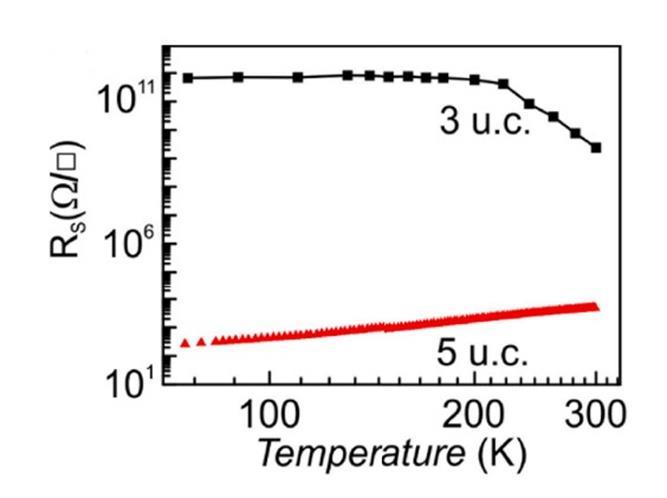
Figure: 4 showsthetemperaturedependenceofsheet resistanceforboththeinterfacesof3u.c.and5u.c.LVOSTOsamplesintheabsenceoflight.Completelyinsulating behaviourwasobservedfortheinterfaceof3u.c.LVO-STO sampleandthesheetresistanceapproachto677GΩ(at 76K).Theinterfaceof5u.c.thicksampleisconducting downto76Kas(colouronline)(a)Temperature dependenceofsheetresistanceof3u.c.and5u.c.LVO grownon(001)STOsinglecrystal[30].
LaTiO₃, an insulator with a charge-transfer gap, finds synergywithSrTiO₃,abandinsulator,attheirinterface[31]. Here, the photoconductivity narrative unfolds with light's entrance.Electron-holepairstaketheircuefromthelight's touch,withelectronstunnelingtotheSrTiO₃layer,craftinga 2DEG,whileholesfindsolaceintheLaTiO₃layer[32].The presence of oxygen vacancies and interface defects adds complexity to this tale, influencing the photoconductivity properties[33].Insummary,thephotoconductivitytalesof LaAlO₃/SrTiO₃, LaNiO₃/SrTiO₃, LaVO₃/SrTiO₃, and LaTiO₃/SrTiO₃ compounds dance to the rhythms of light absorption,chargeseparation,andcarriertransport.These tales unfold through a captivating interplay of material properties and the intricacies of their interfaces. As light's embrace spawns excitations, alters charge densities, and transformsconductivity,thecurtainfallsonthisact,leaving behind a tapestry of mysteries yet to be fully unraveled. Furtherresearchisneededtograspthesemechanismsand harnesstheirpotentialapplications.
Our quest for understanding takes us through a series of experimentalendeavors,eachapieceofthepuzzle:
The crafting of thin film samples of LaAlO₃/SrTiO₃, LaNiO₃/SrTiO₃, LaVO₃/SrTiO₃, and LaTiO₃/SrTiO₃, a
International Research Journal of Engineering and Technology (IRJET) e-ISSN: 2395-0056
Volume: 11 Issue: 05 | May 2024 www.irjet.net p-ISSN: 2395-0072
meticulous process orchestrated through the pulsed laser deposition(PLD)technique[34].Here,targetmaterialsare gracefully ablated by a high-energy laser, and delicately depositedontoatomicallysmoothSrTiO₃substratesunder precisegrowthconditions[35-36].Everydetail,fromlaser fluence to substrate temperature and oxygen pressure, is meticulouslyhonedtoensurethebirthofhigh-qualitythin films.
Withthefilmsintheirglory,thetimeforstructuralrevelation comes through X-ray diffraction (XRD) measurements. A high-resolution diffractometer steps into the spotlight, capturing XRD patterns that hold the secrets of lattice parameters and film orientation [37], adding depth to our understandingoftheseenchantingstructures.
3.3
Thequesttounderstandthephotoconductivityofthesethin filmsleadsustotherealmofelectricalcharacterization.Hall effectmeasurementsbecomeourguidinglight,revealingthe intricacies of carrier concentration, mobility, and conductivity within the samples. As light graces the stage, thesemeasurementsunveilthephotoconductivityproperties, offeringaglimpseintothemagic[38].
Spectroscopictechniquesstepintopainttheopticalcanvas. Photoluminescence (PL) measurements probe the recombination processes of photoexcited charge carriers, while UV-visible spectrophotometry unveils absorption spectra,sheddinglightonthematerials'affinityforlight.This optical ballet provides insights into the light absorption propertiesofourprotagonists[21].
Thisisnotanoverviewofthecurrentworkinthisarea, butratherahighlightofelementaryprocessesofformingthin films, structural revelations through XRD, a remarkable change with electrical measurements, and a symphony of optical revelations. These meticulous procedures lay the foundationforcomprehendingthestructural,electrical,and optical aspects of LaAlO₃/SrTiO₃, LaNiO₃/SrTiO₃, LaVO₃/SrTiO₃, and LaTiO₃/SrTiO₃ thin films, helping us deciphertheirphotoconductivityproperties.
4. Mechanism of Photoconductivity:
Themechanismsthatpropelourphotoconductivitytalestake centerstage,eachoneauniqueperformance:
In the realm of LaAlO₃/SrTiO₃ heterostructures, where electronicmarvelsgracetheinterface,thephotoconductivity taleisoneofmanyfacets[21].Asphotonsweavetheirmagic, electron-hole pairs emerge, guided by the built-in electric field, a gift from the polar discontinuity [39]. These
photoexcitedcarrierstraversetheconductiveSrTiO₃layer, leadingtoacrescendoinconductivity.
LaNiO₃/SrTiO₃ systems unfurl their photoconductivity narrative, a fusion of charge transfer and energy transfer. Light's touch sets the stage, triggering the birth of photogenerated carriers in the LaNiO₃ layer [40]. These carriers embark on a journey to the SrTiO₃ layer through interfacialchargetransfer,whileenergytransferprocesses adddepthtotheperformance[41].Thepresenceofoxygen vacanciesanddefectsaddsintriguetothistale[38].
InLaVO₃/SrTiO₃compounds,lightabsorptionsetsthestage forthephotoconductivitymechanism.LaVO₃'sabsorptionof photons elevates electrons from the valence band to the conduction band [42]. These photogenerated electrons gracefully traverse to the SrTiO₃ layer through interfacial charge transfer, where efficient separation and transport mechanismsenhancethephotoconductivity[43].
TheLaTiO₃/SrTiO₃duet,characterizedbychargeordering, magnetism, and metal-insulator transitions, unfolds its photoconductivity mechanism with light's gentle embrace [29].Aslighttouchesthesurface,electron-holepairsmake theirdebutintheLaTiO₃layer.Electrons,followingthescript, tunneltotheSrTiO₃layer,craftinga2DEG,whileholesfind solaceintheLaTiO₃layer.Thepresenceofoxygenvacancies andinterfacedefectsaddscomplexitytothisnarrative[43].
In summary, the mechanisms underpinning photoconductivity in LaAlO₃/SrTiO₃, LaNiO₃/SrTiO₃, LaVO₃/SrTiO₃, and LaTiO₃/SrTiO₃ compounds blend light absorption, charge separation, and carrier transport. This intricate dance unfolds through the interplay of material properties and the nuances of their interfaces. As light orchestratesthebirthofexcitations,alterschargedensities, and transforms conductivity, the curtain falls on this act, leaving us with an array of mysteries awaiting discovery. Furtherresearchisneededtofullygraspthesemechanisms andharnesstheirpotentialapplications.
Ourjourneytakesaturntowardapplicationsandthepromise ofthefuture:
LaAlO₃/SrTiO₃ hetero-structures emerge as stars in the worldofoxideelectronics.The2DEGattheinterface,agift from their captivating performance, finds applications in high-mobilitytransistors,superconductingdevices,memory devices,andmore.Theabilitytocontrolconductivitythrough electricfieldsmakesthemidealforfield-effectdevicesand memristiveapplications.Moreover,thesehetero-structures revealtheirpotentialinphotodetectionandphotocatalysis, offering a ray of hope in solar cells and water-splitting endeavors.
International Research Journal of Engineering and Technology (IRJET) e-ISSN: 2395-0056
Volume: 11 Issue: 05 | May 2024 www.irjet.net p-ISSN: 2395-0072
LaNiO₃/SrTiO₃systemscasttheirspellinvariousdomains, thanks to their electronic and catalytic prowess. LaNiO₃'s conductivenaturemakesitavaluableassetinsolidoxidefuel cells,electrolyzers,andbatteries.Themagneticpropertiesat theLaNiO₃/SrTiO₃interfaceaddintrigue,beckoningtoward spintronicdevicesandmagneticmemoryapplications.Their catalytic activity tantalizes with the promise of water splitting,photocatalysis,andgassensing.
In the realm of electronic devices and energy conversion, LaVO₃/SrTiO₃ compounds don their armor. The unique electronicandmagneticpropertiesofLaVO₃findapplications inspintronicdevices,magneticsensors,andmemorydevices. The interface's hidden treasures, including ferroelectricity and multiferroicity, promise data storage and logic applications.Moreover,theirpotentialinthermoelectricand photovoltaic endeavors beckons, courtesy of their tunable bandgapandexcellentchargetransport.
LaTiO₃/SrTiO₃ hetero-structures, with their captivating electronicproperties,findtheircallinginfieldssuchasfieldeffecttransistors,resistiveswitchingdevices,andmemory applications.Theabilitytocontrolconductivityandmetalinsulator transitions presents opportunities waiting to be harnessed.Furthermore,theirexplorationofphoto-catalysis and energy storage applications hints at their potential in thesedomains.
Aswegazeintothefuture,theprospectsforLaAlO₃/SrTiO₃, LaNiO₃/SrTiO₃, LaVO₃/SrTiO₃, and LaTiO₃/SrTiO₃ compounds shine brightly. Advancements in material synthesis and device fabrication hold the promise of enhancing their properties and expanding their horizons. Future research endeavors may navigate towards more efficient and stable devices based on these compounds, optimizingtheirperformanceforspecificapplications,and unveiling novel functionalities within their interfaces and heterostructures. Integrating these compounds with other materials and exploring hybrid systems opens doors to technologicalmarvelsyettobeenvisioned.
Our exploration of photoconductivity in LaAlO₃/SrTiO₃, LaNiO₃/SrTiO₃, LaVO₃/SrTiO₃, and LaTiO₃/SrTiO₃ compoundshasunraveledcaptivatingtaleswovenfromthe interplayofmaterialpropertiesandthesecretsheldwithin theirinterfaces.Thesecomplexoxidehetero-structureshave introducedustoaworldofelectronicmarvels,2DEGs,charge transferprocesses,andcarrierdynamics.Aslight'sembrace spawnsexcitations,alterschargedensities,andtransforms conductivity,westandatthethresholdofdiscovery,withthe fullcomprehensionofthesemechanismsyettobeunveiled. Our journey holds significant implications for the developmentofefficientoptoelectronicdevices,fromhighmobility transistors to solar cells. Understanding the underlying mechanisms is the key to optimizing device performanceanddesigninginnovativeapplicationsbasedon
these remarkable materials. Thus, our voyage continues, seeking to unravel the fundamental physics governing photoconductivity in these compounds and forge a path towardthedesignandfabricationofefficientandversatile optoelectronicdevices.
[1] S.Thieletal.;Tunablequasi-two-dimensionalelectron gasesinoxideheterostructures.Science3131942–1945 (2006).https://doi.org/10.1126/science.1131091
[2] H. Kum et al. Epitaxial growth and layer-transfer techniquesforheterogeneousintegrationofmaterials for electronic and photonic devices. Nat. Electron. 2, 439–450(2019).https://doi.org/10.1038/s41928-0190314-2
[3] H Hwang et al.; Emergent phenomena at oxide interfaces. Nature Mater 11, 103–113 (2012). https://doi.org/10.1038/nmat3223
[4] Reinle-Schmittetal.;TunableConductivityThresholdat Polar Oxide Interfaces. Nat. Commun. 3, 932. (2012). https://doi.org/10.1038/ncomms1936
[5] A.Annadietal.;AnisotropicTwo-DimensionalElectron GasattheLaAlO3/SrTiO3(110)Interface,Nat.Commun. 4,1838(2013).https://doi.org/10.1038/ncomms2804
[6] J Zha et al. Infrared Photodetectors Based on 2D Materials and Nanophotonics. Adv. Funct. Mater. 32, 2111970 (2022). https://doi.org/10.1002/adfm.202111970
[7] N López et al.; Engineering the electronic band structureformultibandsolarcells.Phys.Rev.Lett.106, 028701 (2011). https://doi.org/10.1103/PhysRevLett.106.028701
[8] V Aswin et al.; Photo-resistive properties of LaAl0.6Cr0.4O3/SrTiO3 heterostructures: a comparative study with LaAlO3/SrTiO3," Opt. Lett. 41, 1134-1137 (2016).https://doi.org/10.1364/OL.41.001134
[9] K Han et al.; Controlling Kondo-like Scattering at the SrTiO3-based Interfaces. Sci. Rep. 6, 25455 (2016). https://doi.org/10.1038/srep25455
[10] EMZdancewiczetal.;Currentstateofphotoconductive semiconductorswitchengineering.Opto-Electron.Rev. 26(2) 92–102 (2018). https://doi.org/10.1016/j.opelre.2018.02.003
[11] S Li et al.; Perovskite Single-Crystal MicrowireArrayPhotodetectorswithPerformanceStabilitybeyond 1 Year.Adv. Mater. 32, 2001998 (2020). https://doi.org/10.1002/adma.202001998
International Research Journal of Engineering and Technology (IRJET) e-ISSN: 2395-0056
Volume: 11 Issue: 05 | May 2024 www.irjet.net p-ISSN: 2395-0072
[12] A Grillo et al.; Coexistence of Negative and Positive Photoconductivity in Few-Layer PtSe2 Field-Effect Transistors. Adv. Funct. Mater. 31 2105722 (2021). https://doi.org/10.1002/adfm.202105722
[13] HYanetal.Thicknessdependenceofphotoresponsive propertiesatSrTiO3-basedoxideheterointerfacesunder different strains. J Mater Sci 54, 108–115 (2019). https://doi.org/10.1007/s10853-018-2823-1
[14] H L Lu et al.; Photoelectrical properties of insulating LaAlO3–SrTiO3interfaces.Nanoscale6736–740(2014). https://doi.org/10.1039/C3NR05162E
[15] C Ge et. al.; Toward switchable photovoltaic effect via tailoring mobile oxygen vacancies in perovskite oxide films.ACSApplMaterInterfaces834590–34597(2016). DOI:10.1021/acsami.6b13203.
[16] ZRisticetal.;Photodopingandin-gapinterfacestates acrossthemetal–insulatortransitioninLaAlO3/SrTiO3 heterostructures. Phys Rev B 86 045127 (2012). https://doi.org/10.1103/PhysRevB.86.045127
[17] V K Guduru et al.; Optically excited multi-band conduction in LaAlO3/SrTiO3 heterostructures. Appl Phys Lett 102 051604 (2013). https://doi.org/10.1063/1.4790844
[18] ZHuanget.al.;Biaxialstrain-inducedtransportproperty changes in atomically tailored SrTiO3-based systems. Phys Rev B 90 125156 (2014). https://doi.org/10.1103/PhysRevB.90.125156
[19] ARastogietal.;Electricallytunableopticalswitchingof amottinsulator–bandinsulatorinterface.AdvMater22 4448–4451 (2010). https://doi.org/10.1002/adma.201001980
[20] ZHuangetal.;Theeffectofpolarfluctuationandlattice mismatchoncarriermobilityatoxideinterfaces.Nano Lett 16 2307–2313 (2016). https://doi.org/10.1021/acs.nanolett.5b04814
[21] Di Gennaro et al.; Persistent Photoconductivity in 2D ElectronGasesatDifferentOxideInterfaces.Adv.Opt. Mater. 1 834 (2013). https://doi.org/10.1002/adom.201300150
[22] N.YChanetal.;PalladiumNanoparticleEnhancedGiant Photoresponse at LaAlO3/SrTiO3 Two-Dimensional Electron Gas Heterostructures. ACS Nano 7, 8673 (2013).https://doi.org/10.1021/nn4029184
[23] K.X.Jinetal.;Photoinducedmodulationandrelaxation characteristics in LaAlO3/SrTiO3 heterointerface Scientific Reports 5 8778 (2015). DOI: 10.1038/srep08778
[24] YZChenetal.;ExtremeMobilityEnhancementofTwo Dimensional Electron Gases at Oxide Interfaces by Charge-transfer-inducedModulationDoping.Nat.Mater. 14,801(2015).https://doi.org/10.1038/nmat4303
[25] H Yan et al.; Modulated Transport Behavior of TwoDimensional Electron Gas at Ni-Doped LaAlO3/SrTiO3 HeterointerfacesACSAppl.Mater.Interfaces9,3901139017(2017).DOI:10.1021/acsami.7b11727
[26] N.Nakagawa,H.Y.HwangandD.A.Muller,Nat.Mater.5 204(2006).https://doi.org/10.1038/nmat1569
[27] R. Tomar et al.; Adv. Mater. Interfaces 7 1900941 (2019).https://doi.org/10.1002/admi.201900941
[28] A.Rastogi,Z.HossainandR.C.Budhani.;Acomparative study of photoconductivity in LaTiO3/SrTiO3 and LaAlO3/SrTiO3 2-DEGheterostructuresAIPConference Proceedings1512638(2013).doi:10.1063/1.4791199
[29] A. Rastogi et al. Opt. Lett. 37 317 (2012). https://doi.org/10.1364/OL.37.000317
[30] S Goyal et al.; Persistent photoconductivity at LaVO3–SrTiO3 interface Solid State Communications 113930 316-317 (2020). https://doi.org/10.1016/j.ssc.2020.113930
[31] S. Okamoto et al. Nature 427 423 (2004). https://doi.org/10.1103/PhysRevLett.105.027201
[32] J.A.S.JamesandS.Hotwitz.;FilmNucleationandFilm GrowthinPulsedLaserDepositionofCeramicsinPulsed LaserDepositionofThinFilms,JohnWiley&Sons,Inc. 229-254 (1994). https://doi.org/10.1007/978-3-54044838-9_36
[33] D.H.A.B.GuusRijnders,GrowthKineticsDuringPulsed Laser Deposition, in Pulsed Laser Deposition of Thin Films:Applications-LedGrowthofFunctionalMaterials, R.Eason,Ed.,edHoboken:JohnWiley&Sons,Inc.,177190 (2007). https://doi.org/10.1002/9780470052129.ch8
[34] B.X.Wuetal.;High-intensitynanosecond-pulsedlaserinduced plasma in air, water, and vacuum: A comparativestudyoftheearly-stageevolutionusinga physics-basedpredictivemodelAppliedPhysicsLetters 93(2008).https://doi.org/10.1063/1.2979704
[35] M.R.JamesandJ.B.Cohen.Adv.inX-RayAnalysis,201 (1977).https://doi.org/10.1154/S0376030800011903
[36] KSreedharetal.;J.ElectronicPropertiesoftheMetallic PerovskiteLaNiO3:CorrelatedBehaviorof3dElectrons. Phys. Rev. B 46, 6383 (1992). https://doi.org/10.1103/PhysRevB.46.6382
International Research Journal of Engineering and Technology (IRJET) e-ISSN: 2395-0056
Volume: 11 Issue: 05 | May 2024 www.irjet.net p-ISSN: 2395-0072
[37] P Zubko et al.; Interface physics in complex oxide heterostructures.Annu.Rev.Cond.Matt.Phys.2141–165 (2011). https://doi.org/10.1146/annurevconmatphys-062910-140445
[38] J Z Li et al.; Persistent photoconductivity in a twodimensional electron gas system formed by an AlGaN/GaN heterostructure. J. Appl. Phys. 82 1227 (1997).https://doi.org/10.1063/1.365893
[39] YZChenetal.;ExtremeMobilityEnhancementofTwoDimensional Electron Gases at Oxide Interfaces by Charge-transfer-inducedModulationDoping.Nat.Mater. 14, 801 (2015). https://doi.org/10.1002/adom.201300150
[40] A.Kalabukhovetal.;EffectofOxygenVacanciesinthe SrTiO3 Substrate on the Electrical Properties of the LaAlO3/SrTiO3 Interface.Phys.Rev.B:Condens.Matter Mater. Phys. 75, No. 121404 (2007). https://doi.org/10.1103/PhysRevB.75.121404
[41] N. Wadehra Phys. Rev. B 96 115423 (2017). https://doi.org/10.1103/PhysRevB.96.115423
[42] J. Biscaras et al. Nat. Comm. 1 89 (2010). https://doi.org/10.1038/ncomms1084
[43] H. L. Lu et al. Reversible insulator-metal transition of LaAlO3/SrTiO3 interface for nonvolatile memory. Sci. Rep. 3, 2870 (2013). https://doi.org/10.1038/srep02870