
International Research Journal of Engineering and Technology (IRJET) e-ISSN: 2395-0056
Volume: 11 Issue: 05 | May 2024 www.irjet.net p-ISSN: 2395-0072
International Research Journal of Engineering and Technology (IRJET) e-ISSN: 2395-0056
Volume: 11 Issue: 05 | May 2024 www.irjet.net p-ISSN: 2395-0072
Dr. H K Chethan P1 , Ms. Preethi K D2 , Ms. R Vaishnavi 3 , Mr. Karthik G T4, Mr. Tejas K 5
1Professor, Dept. of Computer Science and Engineering, Maharaja Institute of Technology, Thandavapura 2,3,4,5Students, Dept of Computer Science and Engineering, Maharaja Institute of Technology, Thandavapura
Abstract - The milk is the food liquid secreted by the mammaryglandinhighlyevolvedanimalssuchasmammals. Better thickness and release from adulterants are two attributes of premium milk. The most profitable product offeredbylocalretailersandgeneralretailersaswell.Inany case,someadulterantsareaddedinlocalareastoincrease yield, which may have an impact on the milk's nutritional value.Usingtaintedmilkresultsinserioushealthproblems andisamajorworryforthefoodindustry. Therefore,itis essential to ensure milk by determining the kind and quantityofadulterantsintroducedtothemilk.Toreallydo this work, an Arduino Uno-microcontroller is used. The sensorsareintegratedintoaflexibleframeworkthatbreaks downthepropertiesofmilkintoseveralassessments,which arethenshownonanLCDscreenandanInternetofThings platform.Itispossibletopreventtheproblemthatpeople and little diaries are pointing out by understanding the natureofmilkandthewaysinwhichitiscontaminated.
Key Words: Arduino,pHsensor,Temperaturesensor,LCD, TDSsensor,4*4Hexakeypad
1. INTRODUCTION
Because of its nutritional importance, milk is one of the staplemealsthatpeopleconsumeeverywhereintheglobe. 3.3%protein,5%lactose,87%water,and3.9%lipidsareall foundinmilk.Adulterationofcowmilkwithmilkfromother animals is one of the most common forms of adulteration within the dairy sector. This concerns not just the authenticityandqualityoftheproduct,butalsothesafetyof thecustomerforthosewhohavecowmilkallergies.Inorder togeneratemorerapidincome,storesareadulteratingfood thesedays.Mealscanbeadulteratedbymixingingredients likestarchandcurrypowder,blendingpapaya seedswith darkpepper,orripeningmangoes. On a long shot, people suffer from this attempt at adulteration. Approximately 77.68 million metric tons of liquidcowmilkareproducedinIndiaannually.Toextend the milk's realistic shelf life, adulterants are frequently added.Formalinandacidaretwoadditionsthatareaddedto milkasadulterantstoextendtheproduct'sshelflife.
Itisimperativetostrictlymaintainfoodquality,particularly milk quality, in order to ensure proper food management and human welfare. Thus, it is essential to develop quick,
sensitive, trustworthy, and astute methods and sensor frameworks for monitoring food quality and early detection/identification of microorganisms. The most pressing specialized need in the dairy industry now is pathogendistinguishingproof.Machinelearningalgorithms can be used by consumers and regulatory agencies to analysespectraldataandprovideusefulinformationabout thecompositionandqualityofmilk.
Theprojectaimstoenlightenconsumersaboutthequalityof milk and empower them to make decisions based on knowledge.Givingcustomersknowledgeaboutadulterants andthedifferencesbetweenA1andA2milkmightenable themtomakesaferandhealthierdecisions.
Itcanbeveryinspiringtotakeonaprojectlike"IoT-based Adulteration Detection for Milk Quality Assurance and Testing Samples for A1 and A2 Milk" for a number of reasons.Publichealthisstronglyimpactedbymilkquality. Milkadulterationcancausemajorhealthproblems.Youare helpingtoensurethatpeopleareconsumingmilkinasafer mannerbycreatingamechanismtoidentifyadulteration
There are lots of chances for innovation in this project. CreatinganInternetofThingssolutionrequirescombininga numberofdifferenttechnologies,includingdataanalytics, machine learning algorithms, and sensors. It might be intellectuallyfascinatingtotackletheproblemofdeveloping adependableandeffectivesystem.
Afundamentalfoodconsumedallaroundtheworldismilk. Itsqualityassurancehasmajorfinancialramifications.You canprotectthelivelihoodsofdairyfarmersandupholdthe integrityofthedairysectorbyidentifyingadulterationand differentiatingbetweenA1andA2milk.
Electrical Methods for the Detection of Bacteria: A few traditional methods for locating bacteria include the bacterial list, which identifies degradation when a shaded arrangementbecomesdullduetoenlargeddigestingcaused by replicating tiny organisms. One such model is the
International Research Journal of Engineering and Technology (IRJET) e-ISSN: 2395-0056
Volume: 11 Issue: 05 | May 2024 www.irjet.net p-ISSN: 2395-0072
methylene blue reduction test. Nevertheless, there are a numberofdocumentedflawsinthistest,suchaslaborious and repetitive processes and an inability to distinguish betweendifferentbacterialspecies.Leeandassociates[1]. attempted to improve the methylene blue lowering technique by adding an amperometric sensor while maintaining its points of interest. Current change is measuredbyanamperometricsensor,whichisconstructed fromacircuitconsistingofapotentiostatandafewcathodes. Amperometricsensorsaresmallandinexpensive,andthey havebeenusedtodetectalterationsinmicroorganisms,such as Escherichia coli, in a variety of media. Lee et al. administeredENTandmilk E.colivaccinations.Thereare two types of Coli structures that exhibit a clean state: aerogenes.Athirdmodelhasmethyleneblueandmilkinit. Methylenebluecannotstopbeingblueuntilanorganism's metabolicdevelopmentcausesittoloseitsabilitytoconceal itself.Asaresult,theE.coli'sbacterialdigestionreducedthe amount of methylene blue in the three models and also broughtaboutashiftinthecurrent.Anyexistingvariation greaterthan0.05μAwasidentifiedusingtheamperometric sensorandrecorded.measurementoftheinitialestimated populationofmicroorganismsintheexample.confirminga reversestraightrelationshipwithgreatexactnessbetween the bacterial fixation logs in opposition to the discovery time. The growth of microorganismshasbeenlinkedexponentiallyacrosstime, from vaccination to the underlying small alteration in the present. The outcomes were favorable. This technique's highlightsincludeanexceptionallybroadrecognitionscope of 102 - 104 CFU/mL and a discovery time that is 0.5 - 2 hoursquickerthanthatobtainedwiththemethyleneblue reduction procedure. Furthermore, the amperometric sensor could record the dataonitsown,butthemethylenebluereductiontechnique needed constant supervision and inspections every thirty minutes. The final tactic was typically crucial and reasonable;accuracywasalsounimportant.However,this approach is unable to distinguish between cells that are appropriateandthosethatarenot.Furthermore,acertain type of identification of microscopic creatures was insufficient. When other bacteria, like B. subtilis, Lactobacillus sp., Saccharomyces sp., and Staph. Aureus, weretested,theamperometricsensorcouldonlydetectthe coliforms of E. Coli and Ent. Aerogenes; these germs producedaninsignificantcurrentchange.
Usingdistantinquiryinnovationtodetectmilkspoilageisa growingareaofresearchknownas"RemoteDetectionand Monitoring of Milk Spoilage." A detachable, strip-like magnetoelasticthick-filminconjunctionwithacompoundor biochemical detecting layer for instance, a catalyst that reverberates at a distinctive frequency makes up the remote-inquirymagnetoelasticsensorstage[2].
AmperometricbiosensorshavebeenshownbyConzueloet al.[3]toidentifythelactosecomponentofmilk.Acommon
coresignforevaluatingmilkqualityandidentifyingareasof deviationfromthenormislactosefocus.Ithasbeenfound that the milk from cows with mastitis has a low lactose content. The chemical-based amperometric biosensor is a highly selective, versatile device that may be operated by faculty members who lack the necessary skills. The bioelectrode's structure is based on a self-assembled monolayer, a particular catalyst, and other synthetic materials.Thelactosefixation-correspondingamperometric signalisofferedbythecompoundresponseasanascent.
Rennyetal.[4]haverevealedapiezoelectricsensorthatcan identify milk's urea concentration. It is an impetus-based sensorthatdetectstheweightofthegasthatisproducedin the model when the urease process takes place. Potentiometric electronic tongues that use lipid/polymer layers are able to classify a wide variety of constituent substancesintoseveralgroups,someofwhicharepresentin thenaturalsystems'tastegroup.Caponeetal.[5]usedanEnose to measure the progression of rancidity in UHT and purifiedmilkoverthecourseofeightandthreedaysusing fivedifferentSnO2thinfilmsthatwereorganizedusingsolgel technology.Asit is,the sensorsareableto distinguish betweenthetwotypesofmilkanddeterminetheirlevelof rancidity.
The global dairy sector is a major contributor to the vital nourishmentthatconsumersreceive.However,adulteration techniques frequently impair the integrity of milk quality, puttingconsumers'healthatseriousdanger.Furthermore, there is an increasing demand for accurate techniques to detectanddifferentiatebetweenA1andA2milkduetothe growing practice of doing so in order to potentially reap healthadvantages.
The lack of a reliable, scalable, and real-time method for identifyingmilkadulterationanddistinguishingbetweenA1 andA2milktypesisthemainissuethisresearchattemptsto solve. Conventional techniques for testing milk are insufficient to guarantee the safety and quality of milk products since they are frequently labour-intensive, timeconsuming,andpronetomistakes.Furthermore,it'spossible thatthecurrenttechnologyfordifferentiatingbetweenA1 andA2milkaretooexpensiveordifficulttousewidely.
International Research Journal of Engineering and Technology (IRJET) e-ISSN: 2395-0056
Volume: 11 Issue: 05 | May 2024 www.irjet.net p-ISSN: 2395-0072
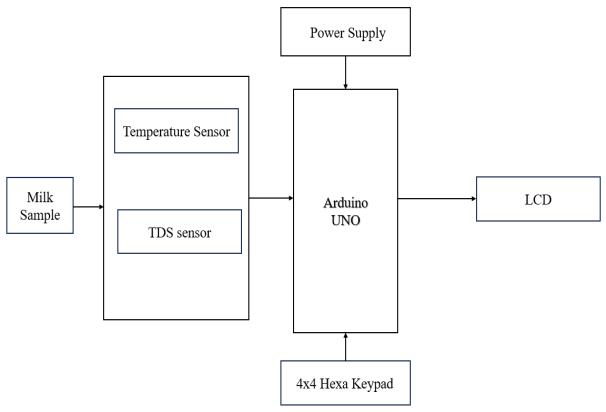
ProposedIoTbaseddeviceformilkadulterationdetection consistsofseveralmajorcomponents,namely,theGravity AnalogV2pHsensor;DS18B20liquidtemperaturesensor; TDS Sensor; 20 × 4 alphanumeric LCD screen; 5V Power Supply;ArduinoMega2560microcontroller;anda4×4hex keypadareshowninfig1.Schematicsoftheoverallsystem canbevisualizedin
3.1 Temperature Sensor
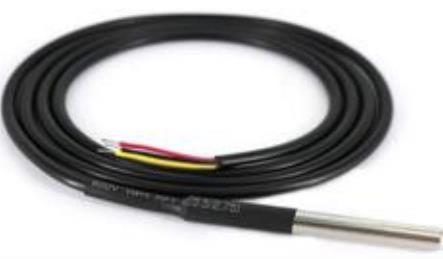
Milk has its own temperature standards which oughttobekeptupduringstockpiling,regardlessofwhether the milk is blended in with water or with any harmful materialsthetemperatureofthemilkwon'tbeinthetypical range. For the most part milk will be sheltered at the standard temperature go above or beneath which the development of microscopic organisms happens and subsequently not fit for utilization. The overview will be completedonasafetemperaturezoneasperwhichtheLCD willshowthenatureofmilk.Fig 2showsthetemperature sensormodelds18b20,whichisusedinthisproject.Ithasto bedippedinthemilksampleduringtesting.
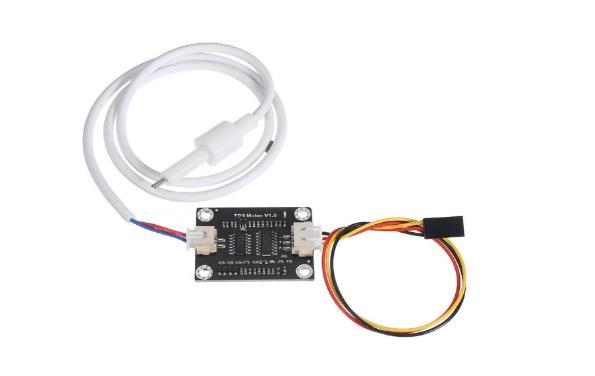
An electrical tool called a TDS (Total Dissolved Solids) sensor is used to determine how much dissolved solids are present in a liquid overall. Fig. 3 shows TDS
sensorswhichmeasuretheliquid'selectricalconductivity.A liquid'sconductivityincreasesinthepresenceofdissolved particles. The conductivity is measured by the sensor and correlatedwiththeTDSconcentration,whichisoftengiven inmilligramsperlitre(mg/L)orpartspermillion(ppm).
4. Methodology
International Research Journal of Engineering and Technology (IRJET) e-ISSN: 2395-0056
Volume: 11 Issue: 05 | May 2024 www.irjet.net p-ISSN: 2395-0072
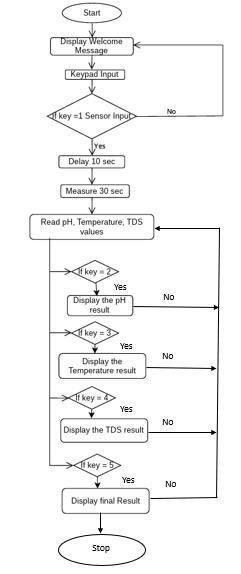
Thegoalofthisstudyistoidentifyanycontaminantsinmilk, suchasurea,salt,water,detergent,etc.Theadditionofthese materials to milk causes a change in pH, which can be detectedusingapHsensorthatproducesananalogoutput. This analog output is then sent to the ESP32's analog pin, whichinterfaceswiththemicrocontrollerasshowninthefig 4.Afterperformingcertainmathematicaloperations,thepH of the milk is determined and displayed on LCD displays. Similar to temperature and TDS sensors, electrical conductivityismeasuredforadditionalparameters,andthe resultsareshownonanLCD.
5. Result
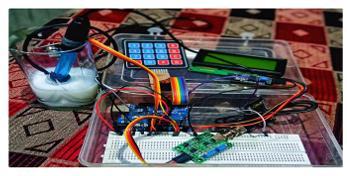
In this study, we designed an Arduino UNO18F4520 microcontroller-based Internet of Things system. All of the sensors are connected to a minimal, flexible framework that groups and divides the characteristics of milk into different assessments, with the final yield being displayedontheLCDscreen.Theproblemthatindividuals andtinykidsconfrontcanbeavoidedbyunderstandingthe composition of milk and recognizing when it has been adulteratedtoavoidspreadingdeadlydiseases.
Thisprojectmaybecompletedinthefutureforstate-of-theartmilkanalyzersinbothsmallandlargemilkdairies.Itis anticipated that DBMS and IoT will be implemented for a charging framework. Each client will have a database containinginformationabouttheamountofmilkconsumed; paymentswillbemadeusingchargeorMastercard’s,andthe systemwilloperateonamonthlybasis.Theadministration will alsousethisframework totrack milk productionand advertising.All data,from milk productiontoshowcasing, willbestoredontheexecutives'website,whichisaccessible toanyclientwitharecordinthatcompany.
We wish to express our deepest appreciation to our esteemedProjectGuide,DrHKChethan,whoseinvaluable guidanceandsuggestionshavepropelledourprojectbeyond ourexpectations.Weextendourheartfeltgratitudetoour
Project Coordinator, Dr. H K Chethan, for his unwavering supportanddedicationinhelpinguscompletethisproject withinatighttimeframe.Wewouldalsoliketoacknowledge our Head of Department, Dr. Ranjit KN, for fostering an environment that encourages innovation and practical applicationofouracademiccurriculum.Finally,weextend oursincerestthankstoourPrincipal,Dr.YTKrishneGowda, for providing us with a golden opportunity to carry out project on the topic of 'Brain Tumor Detection using 3D CNN',andforhisunwaveringsupportinourresearchand learningendeavors.
[1] Y. G. Lee, H. Y. Wu, C. L. Hsu, C. J. Liang, H. D. Yuan.“A RapidAndSelectiveMethodforMonitoringTheGrowthOf ColiformsInMilkUsingTheCombinationOfAmperometric Sensor And Reducing Of Methylene Blue,” Sensors And ActuatorsB:Chemical,Vol.141,no.2,2020,pp.575-580.
[2]S.Huang,S.Ge,L.He,Q.Cai,andC.A.Grimes,"ARemote Query Sensor For Predictive Indication Of Milk Spoilage," biosensors and bioelectronics, Vol. 23, no. 11, 2008, pp. 1745-1748S.Huang,S.Ge,L.He,Q.Cai,andC.A.Grimes,"A Remote-Query Sensor For Predictive Indication Of Milk Spoilage," biosensors and bioelectronics, Vol. 23, no. 11, 2021,pp.1745-1748.
[3]F.Conzuelo,M.Gamella,S.Campuzano,M.A.Ruiz,A.J. Reviejo,andJ.M.Pingarron,JournalofAgricultureandFood Chemistry58,7141(2022).
[4]E.F.Renny,D.K.Daniel,A.I.Krastanov,C.A.Zachariah, andR.Elizabeth,Biotechnol.Equip.19,198(2021)
[5]S.Capone,M.Epifani,F.Quaranta,P.Siciliano,A.Taurino, andL.Vasanelli,SensorsAndActuatorsB:Chemical78,174 (2022).