
International Research Journal of Engineering and Technology (IRJET) e-ISSN:2395-0056
Volume: 11 Issue: 05 | May 2024 www.irjet.net p-ISSN:2395-0072
International Research Journal of Engineering and Technology (IRJET) e-ISSN:2395-0056
Volume: 11 Issue: 05 | May 2024 www.irjet.net p-ISSN:2395-0072
Rahul Thanvi1, Gaurav Mishra2, Yogesh Govari3 ,Vrushal Bagwe4, Prof. Nidhi Chitalia5
1BE student, Department of Information Technology St. Francis Institute of Technology Mumbai, India
2BE student, Department of Information Technology St. Francis Institute of Technology Mumbai, India
3BE student, Department of Information Technology St. Francis Institute of Technology Mumbai, India
4BE student, Department of Information Technology St. Francis Institute of Technology Mumbai, India
5Professor, Department of Information Technology St. Francis Institute of Technology Mumbai, India
Abstract - In the face of evolving digital landscapes, the 'Visual Assist' project addresses the critical need for inclusivity through innovative usecases of machine learning and computer vision. This systemempowers individuals with visual impairments by combining the advanced object detection capabilities ofthe YOLOv5algorithm andthe userfriendly audio generation of Google Text-to-Speech (gTTS). Recognizing the limitations imposed by visual impairments, Visual Assist aims to connect the information gap and foster independent engagement with the environment. Leveraging the real-time processing power and accuracy of YOLOv5, Visual Assist analyzes visual input from cameras, swiftly identifies objects within the user's surroundings, and conveys this information through clear and concise auditory descriptions generated by gTTS. This seamless translation of visual data into readily-understandable audio empowers users to perceive and navigate their surroundings independently andconfidently.
Deployable across various platforms, including smartphones, Visual Assist grants individuals with visual impairments greater autonomy in navigating not only public environments but also their personal environments. Real-world testing and user feedback play a essential role in refining the system to ensure it effectively meets the needs of users. The potential impact of Visual Assist extends beyond enhanced mobility; it cultivates a feeling of self-assurance and independence for individuals with partial visual impairments, empowering them to confidently venture into their surroundings and discover newexperiences.
Key Words: Visual impairment; Assistive technology; Object Detection; Computer vision; Machine learning; Accessibility; Inclusivity
In the swiftly changing technological environment, the convergenceofcomputervisionandmachinelearninghas become instrumental inaddressingreal-world challenges. These cutting-edge fields leverage sophisticated algorithms and state-of-the-art technologies, influencing diverse sectors such as self-driving cars, healthcare,
entertainment, and notably, accessibility. This study explores the profound significance of accessibility within this evolving landscape, representing the combination of computer vision, machine learning, and artificial intelligence to create solution that enable people with disabilities to feel empowered. These solutions aim to close the divide between limitations and possibilities, particularlyfocusingonthechallengesfacedinthedomain ofaccessibility.
Within the realm of accessibility, the project identifies majorchallenges,includingthedigitaldivideinfluencedby socioeconomic factors, standardization and interoperability issues in assistive technologies, ethical considerationssurroundingprivacyandbiasinAI,andthe performance optimization challenge for real-time applications such as Visual Assist. The rationale behind thisresearchendeavorstemsfromadeepcommitmentto improvingthelivesofindividualswithvisualimpairments in a technologically dominated world. Embracing the principlethattechnologyoughtbeabridgeinsteadbeinga barrier, the project utilizes advanced machine learning and computer vision, specifically the YOLOv5 object detection algorithm and gTTS library, to provide audio feedback for objects in the environment. The overarching goalistoredefineaccessibility,positioningtechnologyasa methodthatgetpastbarrierandoffersnewopportunities, guided bya visionof empowermentandinclusivityfor all individuals,regardlessofvisuallimitations.
ThedescribedAIpoweredvisualassistanceandcombined reading support present a novel system for individuals completely blind, utilizing the RP3 Model B+ for its costeffectiveness and compact design. The system incorporates a camera, obstacle avoidance sensors, and advanced image processing algorithms for object detection. Additionally, it features an image-to-text converter using ultrasonic sensors for distance measurement. While the technology offers real-time feedback through an eSpeak speech synthesizer, it has limitations, such as potential inaccuracies in crowded
International Research Journal of Engineering and Technology (IRJET) e-ISSN:2395-0056
Volume: 11 Issue: 05 | May 2024 www.irjet.net
environments due to reliance on sensors and limited computational capabilities of the Raspberry Pi for advanced deep learning algorithms. The system lacks sophisticated features like wet-floor and staircase detection, and its efficiency is impacted by the trade-off between speed and accuracy, particularly in detecting smaller or uniquely scaled objects using the SSDLite model. The overall functionality requires a physical module, and despite its advantages, the system currently lackscertainadvancedcapabilities.[1]
In [2], The architecture of T-YOLO, a type of YOLO-v5 tailored for tiny vehicle detection, can be delineated into three distinct sections. Firstly, the backbone comprises conventional convolutional neural network (CNN) operations and a streamlined forwarding mechanism. Subsequently, the neck integrates and amalgamates the different characteristics derived from diverse convolutional layers. Lastly, the head encompasses convolutionallayersdedicatedtoboundingboxregression and class predictions. The study conducted training sessions using multiple T-YOLO models on a proprietary dataset, juxtaposing their precision and recall metrics against those of YOLO-v5 models pretrained on the COCO dataset. Notably, the focus of this system is specific, concentrating solely on detecting vehicles within parking lots.
In [3],The proposed mobile application, "OpenCV Basics," serves as an educational tool designed to facilitate the teaching of fundamental Computer Vision concepts. By leveragingbuilt-inOpenCVlibraries,theapplicationoffers students hands-on experience and practical examples to supplement theoretical coursework. Unlike traditional approaches, the application does not rely on external datasets, utilizing instead the robust capabilities of OpenCV for object detection. While its primary aim is educational, offering insights into the main principles of computer vision, it does not address real-world challenges. Rather, it presents as a pedagogical aid, providing a controlled environment for learning and experimentation. The implementation's simplicity in user interaction, achieved through restricted modifiable parameters, may limit its flexibility. While this design choice enhances usability, it may hinder exploration of nuanced algorithm configurations. Consequently, users may encounter difficulties when attempting to tailor the application to specific Computer Vision tasks requiring intricate parameter adjustments. Thus, while "OpenCV Basics" offersa valuableeducational resource,itsreliance on predefined parameter settings may pose limitations in addressingmorecomplexscenarios.
[4] The proposed system harnesses the strengths of both YOLO and Fast R-CNN models to achieve heightened
p-ISSN:2395-0072
accuracyinobjectdetection tasks.Notably, YOLO exhibits a significant reduction in background errors compared to Fast R-CNN, laying a strong foundation for improved performance.ByintegratingYOLOtofilteroutbackground detectionsfromFastR-CNNresults,thesystemachievesa substantial enhancement in overall accuracy. One of the key advantages of the system lies in its simplicity, as the model can be constructed easily and trained directly on full images. While Fast R-CNN contributes to a 2.3% improvementin performance whencombined with YOLO, it encounters challenges in accurately localizing objects. However, the incorporation of YOLOv5 ensures real-time detectionspeed,whiletherefinementprovidedbyFastRCNN enables precise localization and contextual understanding for each detected object. This synergistic approach capitalizes on the strengths of both models, resulting in a system that excels in both accuracy and efficiency.
[5] This study seeks to explain. the difficulty in object detectionutilizingConvolutionalNeuralNetworks(CNNs), with a particular focus on the YOLO algorithm developed by researchers. It systematically explores various iterations of the YOLO algorithm, addressing the limitations of each version in subsequent iterations. Beginning with an understanding of the fundamental principles. of CNNs, the paper delves into the specific components and terminology associated with this family of algorithms. It provides a detailed explanation of the types of layers utilized in each algorithm, providing understanding of how they function. and contributions to theoverallarchitecture.Asignificantbenefithighlightedin the paper is the efficacy of CNNs in expressing and extracting features from input data, owing to their robust mathematical framework. However, despite their effectiveness,CNNsarenot withoutchallenges.Thepaper discussesissuesrelatedtointerpretability,stemmingfrom the complex internal representations of CNNs. Furthermore, the computational demands of machine learning models pose obstacles to real-time deployment, particularly on resource-constrained devices. These considerations underscore the necessity for continuous research. and development to address overcome these obstacles and release the complete capabilities of CNNbasedobjectdetectionsystems.
The proposed Object Detection system uses YOLOv5 algorithm with Google Text-to-Speech. The said system is implemented using pytorch library in Python. The model required for system was trained in Jupyter Notebook and was finally deployed using website developed in Flask Framework.
International Research Journal of Engineering and Technology (IRJET) e-ISSN:2395-0056
Volume: 11 Issue: 05 | May 2024 www.irjet.net
TheproposedsystemutilizestheCOCO(CommonObjects inContext)dataset,asitisextensivelyemployedfortasks like identifying objects, segmentation, and captioning in the field of computer vision. It encompasses a diverse collection of images illustrating intricate scenes featuring multiple objects within different contexts. The collection ofimagesisdesignedtocapturethechallengesassociated withunderstandingobjectswithintheirsurroundings.The collectionofimagesconsistsof80objectcategories.
An additional 3000 images were collected from other datasetsandlabelledusingRoboFlow,aservicethatoffers resources for managing, annotating, and preprocessing imagedatasetsforcomputervisionprojects.
TheproposedsolutioninvolvestheintegrationofYOLO,a state-of-the-art object detection algorithm, to recognize andlocalizeobjectswithintheuser'senvironment.
Fig1showstheworkingoftheGeneralYOLOarchitecture
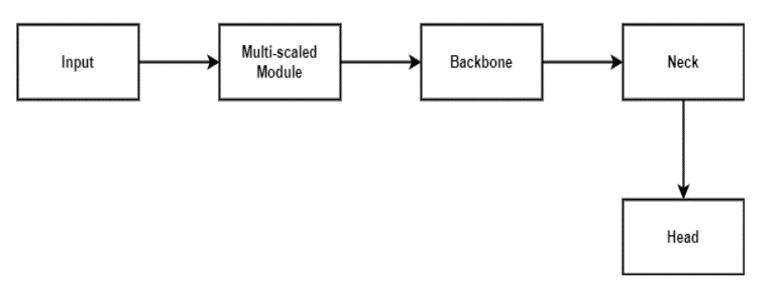
Fig -1: YOLOv5GeneralArchitecture.
The structure of YOLOv5 comprises of three key components, each playing an essential role in the network'sfunctionality:
1.Backbone (CSPDarknet):
The backbone of YOLOv5 is based on the CSPDarknet architecture, which stands for Cross Stage Partial (CSP) connections within the Darknet framework. CSPDarknet serves as the foundation of the network, in charge of taking features extracted from the input data. This procedureincorporatesseverallevelsofconvolutionsand poolingoperations,allowingthenetwork toprogressively captureandabstractinformationfromtheinputimage.
2.Neck (PANet):
Following feature extraction by the backbone, the intermediate representations are passed through the PANet module. PANet, also known as Path Aggregation Network, enables the integration of features extracted from various levels of the network hierarchy. This fusion
p-ISSN:2395-0072
process enables the network to leverage both local and global context information, enhancing its ability to understandandinterpretcomplexvisualscenes.
3.Head (Yolo Layer):
The final stage of the YOLOv5 architecture is the Yolo Layer, where the detection results are generated. This component utilizes the fused features from the PANet moduletopredictboundingboxes,classprobabilities,and confidence scores for the detected objects in the input image. The Yolo Layer applies a set of convolutional operations to produce these predictions, which include information about the class labels, confidence scores indicating the likelihood of detection, and precise spatial coordinates defining the location and dimensions of the identifiedobjects.
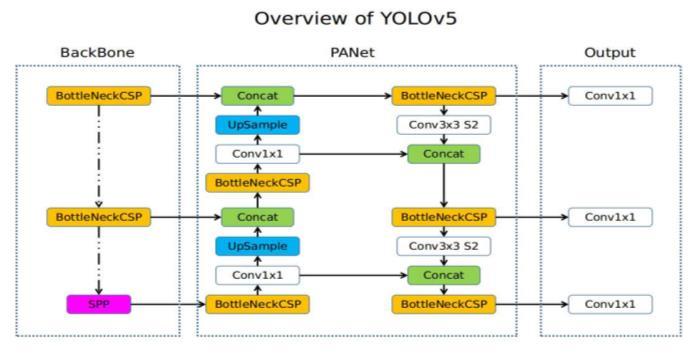
In summary, YOLOv5's network architecture follows a hierarchical structure, with the Backbone responsible for feature extraction, the Neck for feature fusion, and the sectiondedicatedtoobjectdetectionandlocalization.This adaptable structure allows efficient processing of input data and robust detection of objects in various visual environments.
3.3 gTTS (Google Text-to-Speech)
gTTS (Google Text-to-Speech), a Python library used to interface with Google Translate’s text-to-speech API. The libraryisusedtowritespokenmp3datatoafile,afile-like object (bytestring) for further audio manipulation. It featuresflexiblepre-processingandtokenizing.
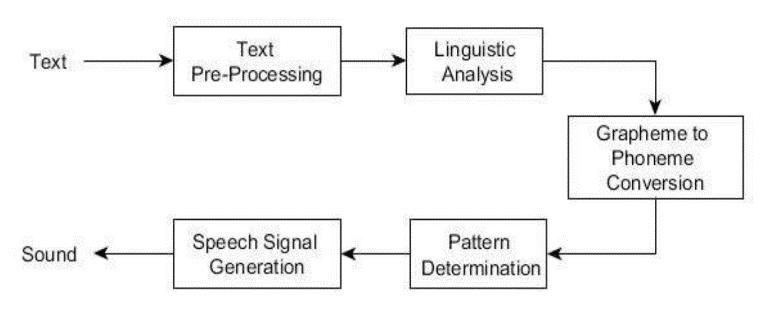
Fig -3: gTTSArchitecture.
International Research Journal of Engineering and Technology (IRJET) e-ISSN:2395-0056
Volume: 11 Issue: 05 | May 2024 www.irjet.net
The system ingests textual input and employs natural language processing methodologies to comprehend its linguistic intricacies. Subsequently, it engages in logical inference on the parsed text. Following this, the text undergoes digital signal processing, where diverse algorithms and transformations are applied. Finally, the processedtextissynthesizedintospeechformat.
Fig 4 illustrates a flowchart outlining the training phase fortheproposedsystem.Theprocesscommenceswiththe collectionofimagesfromvariousdatasets,whichservesas the foundation to train the model in object detection. Subsequently, preprocessing is performed to prepare the imagesforfurtherprocessingbylabelling.Next,asuitable YOLO model is selected based on factors like accuracy, speed,andprecision.Thechosenmodelisthentrainedon the preprocessed image dataset. This training incurs significant computational resources and can take several hoursordaystocomplete,dependingonthedataset'ssize and model complexity. Following training, the model is testedonthevalidationsettorefinethemodel'saccuracy during training. Upon completion of training and tuning, themodel'sperformanceisevaluatedonafreshdatasetof images to examine its accuracy and identify potential areas for improvement. Furthermore, hyperparameter tuning is employed to maximize the model's training process by adjusting its governing settings. The final modelthenidentifiesanddetectsitemsinthegiveninput. Then, the GTTS library, responsible for text-to-speech conversion in Python, is integrated with the model to provideaspeechoutputforthedetectedclass.
Thefinaloutcomeisdeliveredtotheuserinstantlyviathe webapplication.
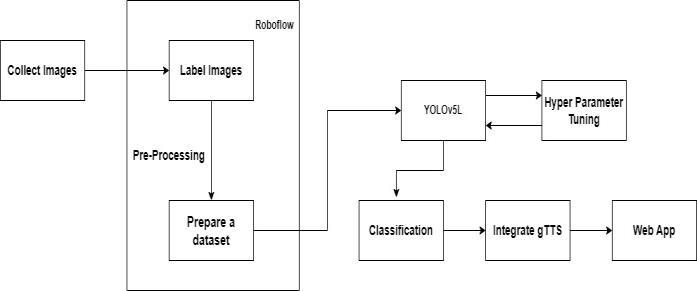
The outlined object detectionsystem follows a systematic approach:itbeginsbyaccumulatingavarieddatasetusing the collection of images provided by COCO and Roboflow for annotation. The dataset is carefully analyzed using Roboflow to examine confidence scores and overlapping boundingboxes,ensuringannotationquality.TheYOLOv5 modelisthentrainedusingthecollecteddataset,withthe
p-ISSN:2395-0072
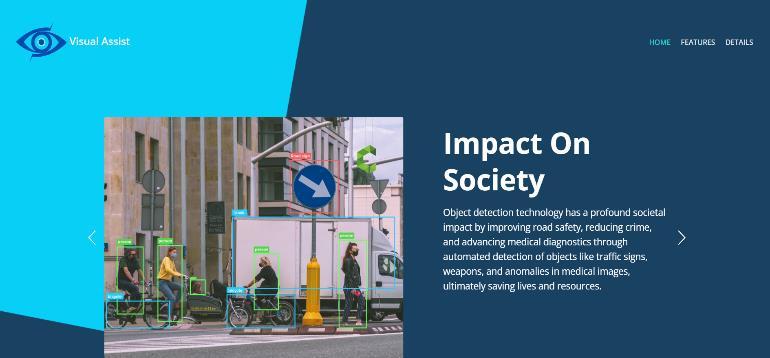
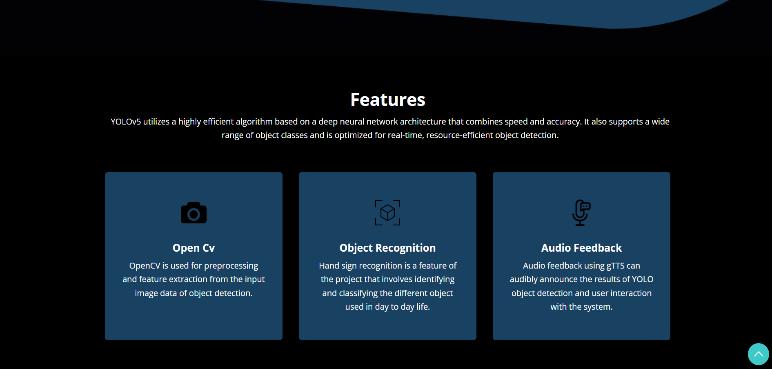
YOLOv5L variant chosen based on computational resources and accuracy requirements. After successful training, the model is integrated with GTTS to deliver auditory responses regarding identified objects. in realtime. A web application is developed using Flask to serve as the user interface, allowing users to access the camera feed, view detected objects, and receive audio feedback seamlessly. The system is deployed using Ngrok as it provides secure tunnels to our local server, allowing externalaccesswithout exposingourlocalmachinetothe internet.
Thisworkpresentsan machinelearningmodeltoidentify objectsachievingmoderatetohighaccuracy,measuredby mAP scores ranging from 49.0% to 67.3%. However, a crucial aspect to consider is the trade-off between accuracy and inference speed. While the model shows acceptable accuracy levels across both CPUs and V100 GPUs, its performance is significantly faster on the latter. Thishardwaredependencyunderscorestheimportanceof carefullyselectinghardwareduringdeploymenttoensure optimal performance. Furthermore, the model demonstrates potential for scalability, particularly on GPUs. Utilizing larger batch sizes (b32) on V100 GPUs leads to noticeably faster inference times compared to smaller batches (b1). This scalability potential suggests the model could handle increased workloads efficiently whenproperlyconfigured.
International Research Journal of Engineering and Technology (IRJET) e-ISSN:2395-0056
Volume: 11 Issue: 05 | May 2024 www.irjet.net p-ISSN:2395-0072
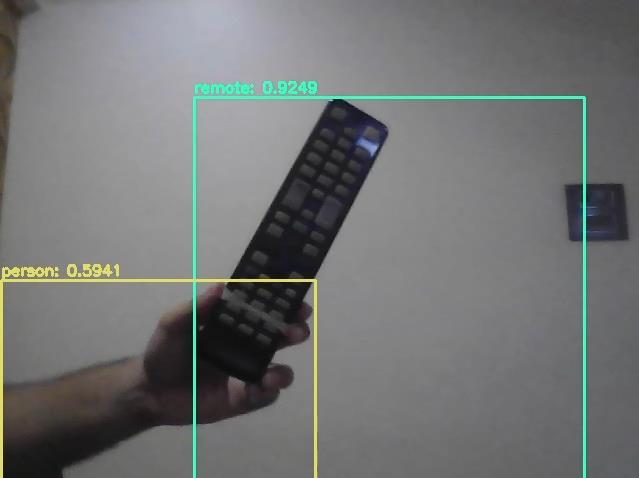
Fig-7: Multipleoverlappingobjectsdetected simultaneously
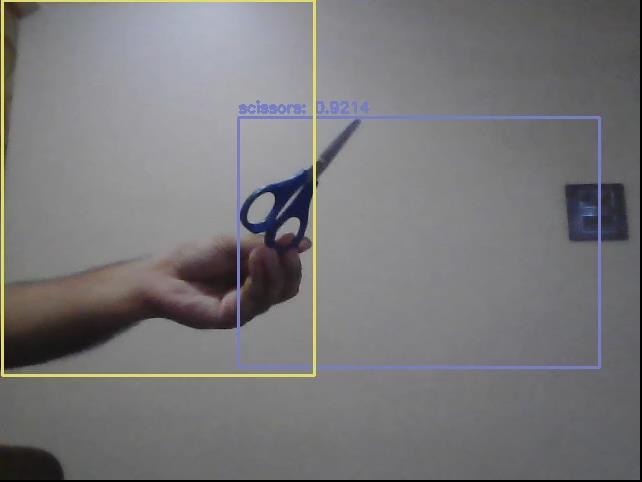
Fig-8: Anindividualscissordetectedwithaboundingbox
Despite delivering moderate accuracy, the model's architecture remains relatively lightweight, boasting only 46.5 million parameters. Additionally, its computational complexity, measured in FLOPs, is moderate, demonstrating efficient resource utilization during inference. This efficiency contributes to the model's realtime capabilities, particularly evident on V100 GPUs. The abilityto processframes rapidlymakesitAppropriatefor uses such as video monitoring or autonomous navigation systems, where timely response is crucial. However, opportunitiesforfurtheroptimizationexisttoenhancethe model's performance across different hardware configurations while maintaining its accuracy. Exploring techniqueslikemodelpruning,quantization,orhardwarespecific optimizations could potentially lead to improved inference speeds on a wider variety of platforms, making the model even more adaptable to various deployment scenarios.
Table -1:PerformanceMatrix
In conclusion, the proposed system represents a significant breakthrough in accessibility technology, poweredbytheintegrationofYOLOv5andgTTS.YOLOv5, astate-of-the-artobjectdetectionalgorithm,servesasthe backbone of the system, leveraging its exceptional accuracy and real-time processing capabilities to identify objects within the user's environment swiftly and accurately. The YOLOv5l model was trained on a combination of the COCO dataset and 3000 other images processed using Roboflow to obtain weights better suited fortheproposedsystem.
Complementing YOLOv5's advanced object detection capabilities is the integration of gTTS, a powerful text-tospeechsynthesistechnology.ThroughgTTS,theproposed system converts detected objects into clear and concise auditory cues. This integration empowers users with visual impairments to delve into their surroundings confidently and independently, offering a seamless transitionfromvisualtoauditoryperception.
The continued advancement and refinement of object detection models hold immense promise for further enhancingtheproposedsystem'sefficacyandusability.As technology continues to evolve, the proposed system stands poised to redefine the landscape of accessibility technology, empowering individuals with visual impairments to delve into their surroundings with confidenceandindependence.
[1] M.A.Khan,P.Paul,M.Rashid,M.HossainandM.A.R. Ahad,"AnAI-BasedVisualAidWithIncorporatedReading Assistant for the Fully Blind," in IEEE Transactions on Human-Machine Systems, vol. 50, no. 6, pp. 507-517, Dec. 2020,doi:10.1109/THMS.2020.3027534.
[2] D.PadillaCarrasco,H.A.Rashwan,M.Á.GarcíaandD. Puig,"T-YOLO:TinyVehicleDetectionBasedonYOLOand Multi-Scale Convolutional Neural Networks," in IEEE Access, vol. 11, pp. 22430-22440, 2023, doi: 10.1109/ACCESS.2021.3137638.
International Research Journal of Engineering and Technology (IRJET) e-ISSN:2395-0056
Volume: 11 Issue: 05 | May 2024 www.irjet.net p-ISSN:2395-0072
[3] J. Sigut, M. Castro, R. Arnay and M. Sigut, "OpenCV Basics: Mobile Application to Support the Teaching of Computer Vision Concepts," in IEEE Transactions on Education, vol. 63, no. 4, pp. 328-335, Nov. 2020, doi: 10.1109/TE.2020.2993013.
[4] J. Redmon, S. Divvala, R. Girshick and A. Farhadi, ”YOLO: Unified, Real Time Object Detection,” 2016 IEEE Conference on CVPR, Las Vegas, NV, USA, 2016, pp. 779788,doi:10.1109/CVPR.2016.91.
[5] J. Du, “Understanding of object detection based on CNN family and Yolo,” Journal of Physics: Conference Series, vol. 1004,p.012029,2018.doi:10.1088/17426596/1004/1/01 2029
[6] Ultralytics, “Overview of model structure about Yolov5 ·issue280·ultralytics/yolov5,”GitHub,https://github.com/ ultralytics/yolov5/issues/280(accessedAug.29,2023).
BIOGRAPHIES




Rahul Thanvi, Student, Dept. of Information Technology, St. Francis Institute of Technology, Mumbai,Maharashtra,India
Gaurav Mishra, Student, Dept. of Information Technology, St. Francis Institute of Technology, Mumbai,Maharashtra,India

Nidhi Chitalia, Asst. Professor, Dept. of Information Technology, St. Francis Institute of Technology, Mumbai, Maharashtra,India
Yogesh Govari, Student, Dept. of Information Technology, St. Francis Institute of Technology, Mumbai,Maharashtra,India
Vrushal Bagwe, Student, Dept. of Information Technology, St. Francis Institute of Technology, Mumbai,Maharashtra,India