
International Research Journal of Engineering and Technology (IRJET) e-ISSN:2395-0056
Volume: 11 Issue: 05 | May 2024 www.irjet.net p-ISSN:2395-0072
International Research Journal of Engineering and Technology (IRJET) e-ISSN:2395-0056
Volume: 11 Issue: 05 | May 2024 www.irjet.net p-ISSN:2395-0072
Nitya Modupalli
3rd year student, Dept. Of Computer science Engineering, Sir M Visvesvaraya Institute of Technology, Karnataka, India.
Abstract - The term "cybercrime" refers to illegal activities that aim to harm or steal data from a computer or network. Additionally, it covers the use of computers for illegal purposes, including as facilitating the trade or sale of illicit goods like narcotics or weapons online. [1] Cybercrime changes as technology does, figuring out ways to get around current security measures. Early versions first surfaced as email-based viruses and scams in the 1980s. The emergence of AI-powered phishing and social engineering, ransomware as a service (RaaS), commercial spyware, and extortionware are some of the current trends in cybercrime[2].And we must be aware of the security risks and breaches that occur, as well as how to protect ourselves against such cybercrimes
Key Words: Security breach, data, theft, cybercrime, malware, hacker.
What does a security breach entail? Any event that permits unauthorized access to computer data, applications, networks, or devices is referred to as a security breach. Unauthorized access to information results from this. It usually happens when an intruder manages to get past security measures. [3] The seven primaryformsofsecuritybreachesarelistedbelow:
An attacker who inserts himself into a communication between a user and an application with the intention of eavesdropping or pretending to be one of the parties and creating the impression that a regular information flow is taking place is known as a man in the middle (MITM) attack.Thepurposeofanattackistoobtainpersonaldata, including credit card numbers, account information, and login credentials. Users of financial apps, SaaS companies, e-commerce websites,and other websites requiringlogins are usually the targets. In general, a Man-in-the-Middle (MITM) attack can be compared to the mailman reading your bank statement, noting your account information, resealing the package, and having it delivered to your door.[4] HowareMitMattacksconducted?Cybercriminals stoop down in the middle of internet communications or data exchanges during MiTM attacks. The attacker can easilyaccesstheuser'swebbrowserandthedata itsends and receives during transactions by spreading malware. Duetotheirrequirementforsecureauthenticationusinga
public and private key, online banking and e-commerce websites are often the focus of Man-in-the-Middle (MitM) attacks,whichallowattackerstoobtainsensitivedatasuch aslogincredentials.[5]
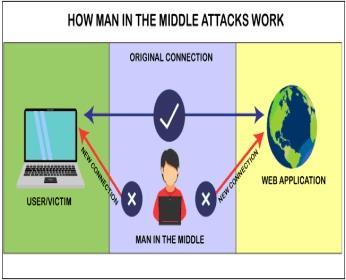
1: Representationofhowmaninthemiddleattack
An attack known as a denial-of-service (DoS) aims to bring down a computer or network so that the intended users cannot use it. DoS attacks achieve this by transmitting information that causes a crash or by overloadingthetargetwithtraffic.Thedenialofserviceor resourcetolegitimateusers,suchasemployees,members, or account holders, is the result of a denial of service assault in both cases. DoS attack victims frequently target the web servers of well-known businesses, including banks, media, and commerce firms, as well as trade associations and governmental bodies. Even though DoS assaultsseldomresultinthelossortheftofimportantdata orotherassets,theycanbeextremelyexpensiveandtimeconsuming for the victim to deal with[6] DoS attacks typicallyfallin2categories:
Attacks using buffer overflow a kind of attack whereamachinecanrunoutofRAM,harddisk space, or CPU time due to a memory buffer overflow.Thistypeofexploitfrequentlycauses system crashes,sluggishness, orother harmful server behaviors, which leads to denial-ofservice.[7]
International Research Journal of Engineering and Technology (IRJET) e-ISSN:2395-0056
Volume: 11 Issue: 05 | May 2024 www.irjet.net p-ISSN:2395-0072
Attacks by floods A malicious actor can oversaturate server capacity and cause a denial-of-service by flooding a targeted server withanexcessivenumberofpackets.MostDoS flood attacks require the malicious actor to havemoreavailablebandwidththanthetarget inordertosucceed.[8]
How to recognize a DDoS attack? DDoS attack symptoms can resemble computer problems, such as sluggishwebsitefileaccess,websiteinaccessibility,oreven internetconnectiontroubles.Nevertheless,thereareafew primary signs that a denial of service assault may be occurring,andusingwebsitemonitoringtoolsmightassist you in identifying them. One or more of the following indicatorscould indicatethat youare the targetofa DDoS attack.
Phishing is a type of email attack when a hacker poses as a representative of a reliable company in order to get users' sensitive information fraudulently through electronic contact. Attackers deliberately craft emails to target a certain group, and clicking on a link in an email installsharmful code on the computer. Spear phishing isa kind ofemail attack when a particular individual orgroup is the target. In spear, a phishing attacker deceives the victim into clicking on links that download malicious programsandlettheattackertoaccessprivatedataonthe targetsystemornetwork.[10]Examples:ThePuertoRican governmentfellvictimtoaspearphishingattackthatstole more than $4 million. Ubiquity Networks Inc. Lost $46.7 millionasaresultofspoofemails.AttackersStartedaZeroDay Exploit by Sending Skillfully Crafted Emails to Junior StaffatEMCCorp.[11]
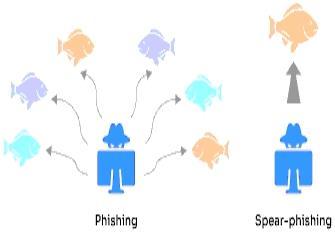
Fig 2: GeneralrepresentationofPhishingandSpearphishingattack.
Cybersecurity password attacks call for specialized methodsandtools.Ifyouareincloseproximitytoahacker, they might attempt to guess your password by combining names,interests,significantyears,ornumbers.Intheevent that it fails, they employ sophisticated software that goes through a list of frequently used terms as passwords. Remarkably, more than 75% of people who use the internet create passwords that are limited to the first 500 characters. [12] Password attacks leverage automated passwordattacktoolsthatexpeditetheprocessofguessing and cracking passwords, along with a compromised authorizationvulnerabilityinthesystem.Theattackeruses a range of strategies to obtain credentials from an authorized user, expose them, and assume their identity and privileges. One of the earliest methods of account authentication that is known to exist is the usernamepasswordcombination.Adversarieshavehadtimetocome up with a number of strategies for getting easily guessed passwords. Additionally, programs that depend only on password authentication are susceptible to password attackssincetheirflawsarewidelyknown.[13]
Password Whena hacker intercepts, removes, or alters information being exchanged between two devices, it is known as an eavesdropping assault. Sniffing, snooping, and eavesdropping all rely on unprotected network connections to obtain data that is being transferred betweendevices.
If someone joins to a network where traffic is not encrypted or secured, they are usually "attacked with eavesdropping" when they communicate confidential businessinformationtoacolleague.Sincethedataisbeing transferredviaanopennetwork,thereisachancethatan attackerwill be able to take advantage ofa weaknessand intercept it in several ways. Eavesdropping assaults are frequently hard to identify. In contrast to other types of cyberattacks, the performance might not be negatively impacted by the existence of a bug or listening device.Password.[14]
Let’s look at the general steps in order to launch an eavesdroppingattack
Findinganindividualorgrouptoattackisthefirststepin the process. The attacker begins to gather information about the target as soon as it has been identified. The communication systems and exploitable flaws are among thevaluabledatatheattackerhopestoobtain.
Selecting a suitable approach to ensure the attack is carriedoutsuccessfullyisthenextstage.Anattackerhasa variety of techniques at their disposal. A few instances include employing hardware devices, employing malware
International Research Journal of Engineering and Technology (IRJET) e-ISSN:2395-0056
Volume: 11 Issue: 05 | May 2024 www.irjet.net p-ISSN:2395-0072
to access a device, and intercepting communications via unprotectednetworks.
The selected method must now be implemented in the targetsysteminordertointercepttargetcommunications. Ultimately, the assailant examines the intercepted correspondence and retrieves important data. Additionally, they could discard or exfiltrate data for additionalstudy.[15]
Injection attacks known as Cross-Site Scripting (XSS) occur when malicious scripts are inserted into websites that are otherwise trustworthy and safe. XSS attacks happenwhenahackersendsmaliciouscode typicallyas akindofabrowsersidescript toadifferentenduservia an internet application. The vulnerabilities that facilitate the success of these attacks are fairly pervasive and arise each time user input is incorporated into a web application without verifying or encoding it in its output. Anunknowingusermayreceiveamaliciousscriptfroman attacker using XSS. The script will run because the end user's browser is unable to determine that it is not reliable. Because the malicious script thinks it is from a trustworthy source, it can access any cookies, session tokens,orothersensitivedatathatthebrowserstoresand uses with that website. These scripts have the ability to modifytheHTMLpage'scontent.
HowtoDetermineIfYouAreVulnerable
It might be challenging to find and fix XSS vulnerabilities in a web application. The best method to identify vulnerabilities is to do a security assessment of the code andlookforanypossiblepointsofentryforinputfroman HTTP request into the HTML output. Be aware that a maliciousJavaScriptcanbetransmittedthrougharangeof differentHTMLtags.Whiletheycanonlylookforsurfacelevel issues, Nessus, Nikto, and other tools can assist in scanning a website for these vulnerabilities. It's highly likely that a website has further issues if even one componentisweak.[16]
A typical cyberattack, malware is a catch-all word for a variety of malicious programs that are installed and distributed on servers and end-user computers. Cybercriminalsutilizetheseattacks,whichareintendedto damageacomputer,server,orcomputernetwork,inorder tocollectdataforfinancialbenefit.[17]
Most malware types can be classified, enter one of the subsequentcategories:
1. Virus: A computer virus can spread by altering other programs and adding its malicious code when it is executed. It is one of the hardest malware kinds to get rid of andthe onlyone that hastheabilityto"infect"otherfiles.
2. Worm: By traveling from one system to another, wormscanswiftlyinfectlargenetworksandhave the ability to replicate themselves without the assistanceofendusers
3. Trojan: One of the hardest kinds of malware to identify is Trojan software, which poses as a trustworthy application. When the victim executes the harmful code and instructions contained in this sort of malware, it can continue tofunctioncovertly.Itisfrequentlyusedtoallow malwareofvariouskindstoinfectthesystem.
4. Hybrid malware: These days, most malware is "hybrid," or a mix of different kinds of harmful software.Forinstance,"bots" initiallymanifestas Trojans and subsequently become worms when they are executed. They are commonly employed in larger-scale network-wide cyberattacks to targetspecificusers..
5. Adware: Adware is software that shows users intrusive and unsolicited advertisements, such as pop-upwindows.
6. Malvertising: This technique spreads malware to end-user computers by using genuine advertisements.
7. Spyware: Spyware eavesdrops on unwary users, gathering passwords, browser history, and other personalinformation.
8. Ransomware: Machines are infected with ransomware, which encrypts files and withholds the necessary decryption key until the victim pays. Rising ransomware assaults that target businesses and government agencies cost victims millions of dollars, with some having to pay the attackerstogettheircriticalsystemsbackupand running.Loky,Petya,andCyptolockerareafewof the most well-known and prevalent ransomware families.[18]
International Research Journal of Engineering and Technology (IRJET) e-ISSN:2395-0056
Volume: 11 Issue: 05 | May 2024 www.irjet.net p-ISSN:2395-0072
No matter how big or small a business is, everyone is susceptible to a data leak or cyberattack. Cybercriminals and hackers devise new methods every day to obtain private or private information that they might sell or demand a ransom for. In 2023 and beyond, a lot of cyber security specialists think this number will keep going up.[19]
Date:March2020
Impact:10.88billionrecords.
Over10billiondatawereexposedduetoacompromisein ElasticsearchontheadultvideostreamingwebsiteCAM4.
Sensitivedatafromthecompromisedrecordsincludedthe following:
o Fullnames
o Emailaddresses
o Sexualorientation
o Chattranscripts
o Emailcorrespondencetranscripts
o Passwordhashes
o IPaddresses
o Paymentlogs
Email addresses that have been made public frequently refer to cloud storage providers. Hackers may have more intimate access to private images and company data if they were to carry out successful phishing attempts on theseusers.[20]
Date:November2019
Impact:1.1billionpiecesofuserdata.
A developer employed by an affiliate marketer used his owncrawlersoftwaretoextractuserinformation,suchas usernames and cell numbers, from Taobao, the Chinese Alibaba shopping website, over the course of eight months. Although both the developer and his company receivedthree-yearprisonsentences,itappearstheywere gathering the information for their personal use rather thansellingitontheblackmarket.[21]
Date:2013-2016
Databreached:3billionuseraccounts
Based on data breach statistics, Yahoo!'s multi-year data breachisthebiggestdatabreachinhistory.Inadditionto being the largest breach in terms of the total number of impacted users, the volume of headlines makes it seem muchmoresignificant.Theoutlookforthesecuritybreach became even more dire when it was found that Russian operatives had compromised the organization. Due to a class action lawsuit and settlement payments made to impactedconsumers,thelargestdatabreachinhistoryhas madeacomebacktothenews.[22]
Disclosuredate:May2019
Recordscompromised:885million.
885 million files belonging to First American Financials were reportedly exposed on the insurance company's website in May 2019, according to security expert Brian Krebs. The documents, which went back to 2003, containedphotocopiesofdriver'slicenses detailson bank accounts, Social Security numbers, mortgage paperwork, andtaxrecords.Therewasnopasswordneededtoaccess thefilesonthewebsite.[23]
Date:June2021
Impact:700millionusers.
In June 2021, professional networking company LinkedIn discovered that 700 million of its users' data had been exposed ona dark web forum,affectingalmost90%of its user base. under abusing the site's (and others') API, a hacker going under the handle "God User" employed data scrapingtechniquesto releasea firstinformationdata set that included over 500 million consumers. They boasted that they were selling the entire 700 million client database after that While LinkedIn contended that the incidentwasa breachofitstermsofserviceratherthana data breach because no sensitive, private personal data was exposed, the UK's NCSC warned that a scraped data samplepostedbyGodUsercontainedinformationsuchas email addresses, phone numbers, geolocation records, genders,andothersocialmediadetailsthatwouldprovide malicious actors with plenty of material to craft convincing, follow-on social engineering attacks following thedisclosure.[24]
International Research Journal of Engineering and Technology (IRJET) e-ISSN:2395-0056
Volume: 11 Issue: 05 | May 2024 www.irjet.net p-ISSN:2395-0072
Date:October2016
Impact: 412.2millionaccounts
Cybercriminalsstole20years'worthofuserdatafromsix databasesoftheadult-orientedsocialnetworkingsiteThe Friend Finder Network in October 2016. The company provides adult content and casual hookup websites such as Adult Friend Finder, Penthouse.com, and Stripshow.com. Because these are sensitive services, the breach of data from over 414 million accounts, which includednames,emailaddresses,andpasswords,couldbe especially damaging to the victims. Furthermore, by the timeLeakedSource.compublisheditsstudyofthedataset onNovember14,2016,99%oftheleakedpasswordshad been cracked. This was due to the fact that the vast majority of the passwords had been hashed using the infamouslyweakSHA-1method.[25]
o In 2023, the typical price of a security breach reachedarecordhighof$4.45million.(IBM)
o Human error accounts for 74% of cyber security breaches.(Verizon)
o Abreachtakes207daysonaveragetofind.(IBM)
o A breach typically takes 277 days to identify, contain,andresolve.(IBM)
o Itisanticipatedthatthereisa0.05percentchance that a cybercrime entity will be found and prosecuted in the United States. (Foreign EconomicForum)
o A human factor was implicated in 74% of breachesin2023.(Verizon)
o TheFederalTradeCommissionreceivedover1.1 million identity theft reports in 2022 (US News).Securitybreachesincreasedin2021by68 percent.(CNET)
o Apathy towards taking proactive measures to guard against cyberattacks, often known as cyberfatigue, impacts up to 42% of businesses. (Cisco)
o Of all Americans, 64% have never looked up if theywereimpactedbyadataleak.(Vacronis)
o In2020,theUnitedStateswasthesubjectof46% of cyberattacks, more than twice as many as any othernation.(Microsoft).
o 56% of Americans are unsure about the steps to takeintheeventofadatabreach.(Vacronis)
o SincethebeginningoftheRussia-Ukrainewarin 2022, 97% of enterprises have noticed an increaseincyber(Accenture).[26]
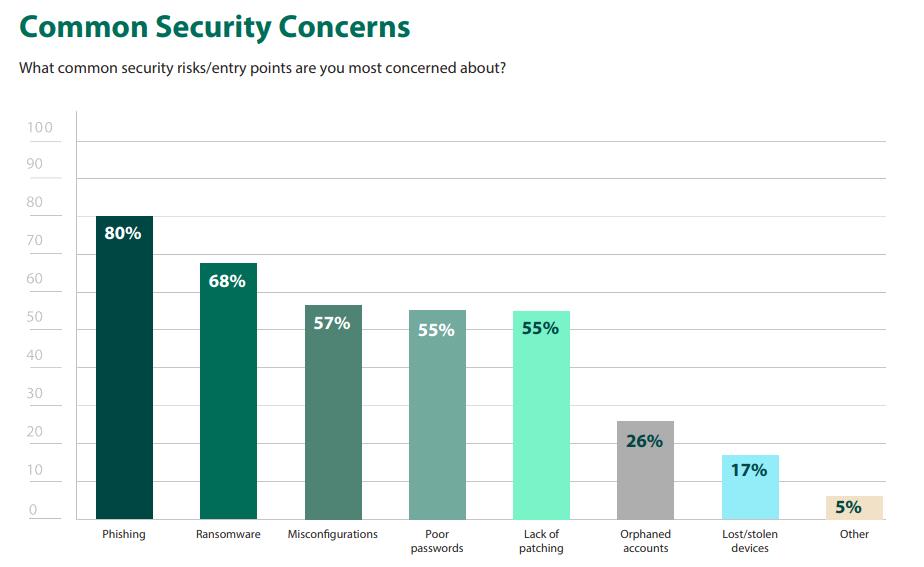
3: Graphicalrepresentationofdifferenttypesof securitybreaches.
The graph depicted above compares several security breachtypes,withthePrishingkindofbreachoccurringat arateof80percentonaverage.
After examining the various attack types, let's investigate ways to stop these security lapses from happening.
o Usestrongpasswords:
Weak passwords are still the most frequent source of data breaches because they allow hackerstoobtainusercredentialsandgainaccess to company networks. Additionally, since passwords are frequently recycled or reused across several accounts, attackers can use bruteforce assaults to break into additional accounts. Use strong passwords to stop hackers from stealing login credentials. Don't forget to use a passwordmanager.27]
o Updatesoftwareregularly:
Expertsadviseupdatingoperatingsystemsandall application software on a regular basis. When a patch is available, install it. When programs are not routinelypatchedandupdated, your network becomes insecure. Baseline Security Analyzer, a software from Microsoft, may now be used to periodically verify that all programs are patched and up to date. This is a reasonably simple and
International Research Journal of Engineering and Technology (IRJET) e-ISSN:2395-0056
Volume: 11 Issue: 05 | May 2024 www.irjet.net p-ISSN:2395-0072
affordable method to fortify your network and thwartattacksbeforetheyoccur.[28]
o Avoiddatahoarding:
When you find it difficult to get rid of data, you may engage in data hoarding. This is physically represented in episodes of Hoarders, if you've everwatchedthem.Althoughthereisalegitimate concern of data loss, not everything needs to be kept. In actuality, there is a higher risk of exposure if personal data is never deleted. For instance, the outdated records may contain password suggestions that you currently use. Such kind of theft of obsolete data is one of the numerous reasons that data breaches occur as regularlyastheydo.[29]
o Restrictaccesstoyoursystems:
It may surprise you to learn that legitimate physical access to computers can result in significant data breaches. Imagine that anybody could enter your workplace, insert a malicious USB key into your computer, and have full access tothewholenetwork.[30]
o WifiSecurity:
Evenwithuniversalwifiin2021,thereisalwaysa risk of cyberattacks. Any connected device has the potential to get infected. In exchange, the entire enterprise's data will be seriously jeopardized if this gadget is connected to a businessnetwork.Itisessential tosafeguardyour wifi network in order to prevent data breaches because multiple devices will connect to it. To learn more about protecting your wifi network, get in touch with a reputable Melbourne corporateITsupportprovider.[31]
o Createaresponseplan:
Businesses need a reaction strategy in case the worst happens, as cybercriminals are growing moreskilledandcyberattacksarebecomingmore frequent.Theymusthavea clearplaninplacefor the actions that must be taken, as well as know who is in charge of informing the proper authorities about the attack. Finding out what informationwastakenandofwhatkind,updating and fortifying passwords, and keeping an eye out forhostilebehavioronnetworksandsystemsare allnecessarystepsinthisprocess.[32]
o Elevate Your Security Using Advanced Security MonitoringTools:
Using cutting-edge security solutions to keep an eye on your infrastructure is a crucial additional securitymeasureforyourdata.Becausenetworks and information technology are more sophisticated than ever, even highly skilled security experts mayfall victimtohackers if they don't have the appropriate software. These days, IT specialists use artificial intelligence (AI) and systems that track network traffic variations to find anomalies and alert security experts to any observeddeviations.[33]
As technology advances, more complex cyberthreats have emerged. By addressing potential cyberattacks and the various methods that hackers can obtain access to privileged or private data, we can avoid and raise awarenessofthesefrauds.Cyberattackscanbeavoidedby installing many antivirus programs and adhering to a few security precautions. Taking everything into account, this study highlights the importance of cyber security and the needforadditionalresearchinthisfield.
Myheartfeltappreciationgoesouttoeveryonewhohelped me finish my research paper successfully. First and foremost I would like to convey my appreciation to Dr. SavitaChoudhary,mysupervisor,forhersteadfastsupport and importantcounsel overthe wholestudy process.Iam incredibly grateful to Sir MVisvesvaraya Institute of Technology for giving me the tools and direction I needed to finish the project successfully.Finally, but just as importantly, I want to sincerely thank my family for their unwavering affection and assistance. Their support and empathyhavebeeninvaluabletomeduringthisresearch's difficult stages.This study article is the result of a team effort, and I am appreciative of everyone who helped to makeithappen.
[1]https://www.gao.gov/blog/u.s.-less-prepared-fightcybercrime-it-could-
be#:~:text=Cybercrime%20generally%20includes%20cri minal%20activities,like%20illegal%20drugs%20or%20w eapons.
[2]https://www.cisco.com/site/us/en/learn/topics/secur ity/what-is-cybercrime.html
[3]https://www.kaspersky.com/resourcecenter/threats/what-is-a-security-breach
[4]https://www.imperva.com/learn/applicationsecurity/man-in-the-middle-attackmitm/#:~:text=App%20SecurityThreats-
Volume: 11 Issue: 05 | May 2024 www.irjet.net p-ISSN:2395-0072
,What%20is%20MITM%20attack,exchange%20of%20info rmation%20is%20underway.
[5]https://www.techtarget.com/iotagenda/definition/ma n-in-the-middle-attack-MitM
[6]https://www.paloaltonetworks.com/cyberpedia/whatis-a-denial-of-service-attackdos#:~:text=A%20Denial%2Dof%2DService%20(,informa tion%20that%20triggers%20a%20crash.
[7]and
[8]https://www.cloudflare.com/learning/ddos/glossary/ denial-of-service/#:~:text=of%2Dservice%20attack%3F,A%20denial%2Dof%2Dservice%20(DoS)%20attack%20i s%20a,interrupting%20the%20device's%20normal%20f unctioning.
[9]https://blog.sucuri.net/2023/03/how-to-know-ifyour-site-is-under-ddos-attack.html#how-to-tell-if-youare-being-DDoSed
[10]https://www.geeksforgeeks.org/difference-betweenphishing-and-spear-phishing/
[11]https://easydmarc.com/blog/seven-examples-ofspear-phishing-attacks/
[12]https://securityboulevard.com/2022/05/what-is-apassword-attack-in-cyber-security/
[13]https://www.educative.io/answers/what-is-apassword-attack
[14]https://www.fortinet.com/resources/cyberglossary/ eavesdropping
[15]Eavesdropping Attack https://www.baeldung.com/cs/eavesdroppingattack#:~:text=Some%20common%20eavesdropping%20 attacks%20are,intercepts%20communication%20betwee n%20two%20parties
[16]Overview and How to Determine If You Are Vulnerable https://owasp.org/wwwcommunity/attacks/xss/#:~:text=Overview,to%20a%20d ifferent%20end%20user.
[20]https://www.upguard.com/blog/biggest-databreaches
[21] and [22]https://dataprot.net/articles/biggest-databreaches/
[23]https://www.techtarget.com/searchsecurity/feature/ 10-biggest-data-breaches-in-history-and-how-to-preventthem
[24]https://www.csoonline.com/article/534628/thebiggest-data-breaches-of-the-21st-century.html
[25]https://www.csoonline.com/article/534628/thebiggest-data-breaches-of-the-21st-century.html
[26]https://www.varonis.com/blog/cybersecurity statistics#:~:text=The%20global%20average%20cost%2 0of,(IBM).
[27]https://www.fortinet.com/resources/cyberglossary/ data-breach
[28]https://techsupportofmn.com/6-ways-to-preventcybersecurity-breaches
[29]https://surfshark.com/blog/how-to-prevent-databreaches
[30]https://www.telcoict.com.au/8-ways-to-preventcyber-attacks-and-data-breaches/
[31]https://www.telcoict.com.au/8-ways-to-preventcyber-attacks-and-data-breaches/
[32]https://www.fortinet.com/resources/cyberglossary/ data-breach
[33]https://www.globalsign.com/en/blog/preventingdata-breaches
[Fig 1]https://www.javatpoint.com/cyber-security-mitmattacks
[Fig 2]https://www.valimail.com/guide-tophishing/spear-phishing-vs-phishing/
[Fig 3] https://terranovasecurity.com/blog/cybersecurity-statistics/ International Research Journal of Engineering and Technology (IRJET) e-ISSN:2395-0056
[17]Malware Definition https://www.proofpoint.com/us/threatreference/malware
[18]Types of Malware Attacks https://www.cyberark.com/what-is/malware/ [19]https://www.upguard.com/blog/biggest-databreaches-us