
International Research Journal of Engineering and Technology (IRJET) e-ISSN: 2395-0056
Volume: 11 Issue: 05 | May 2024 www.irjet.net p-ISSN: 2395-0072
International Research Journal of Engineering and Technology (IRJET) e-ISSN: 2395-0056
Volume: 11 Issue: 05 | May 2024 www.irjet.net p-ISSN: 2395-0072
Asst.Professor T Santosh, G Sagar, P Lalitha, S Jaya Prakash
1Lecturer, Dept. of EEE, Visakha Institute of Engineering & Technology, A.P, India
2Student, Dept. of EEE, Visakha Institute of Engineering & Technology, A.P, India
3Student, Dept. of EEE, Visakha Institute of Engineering & Technology, A.P, India
4Student, Dept. of EEE, Visakha Institute of Engineering & Technology, A.P,
ABSTRACT :
This research paper presents a comprehensive study on transient stability assessment in power systems utilizing MATLAB-basedsimulationtechniques.Transientstabilityis a crucial aspect of power system operation, ensuring the system's ability to withstand disturbances and maintain synchronismfollowinglargedisturbancessuchasfaultsor sudden load changes. The paper outlines the theoretical backgroundoftransientstabilityanalysisandintroducesthe methodologyformodelingpowersystemcomponentsand simulating transient events using MATLAB. Various simulation scenarios are presented, including fault simulations, generator tripping, and load disturbances, to analyze system behavior under different conditions. The results obtained from the simulations demonstrate the capability of MATLAB-based tools in assessing transient stabilityandidentifyingpotentialinstabilityissuesinpower systems.
Key Words : Transientstability,blockdiagram,simulation, faultanalysis,applicationsoftransientstability.
1.INTRODUCTION
Transient stability is a cornerstone of power system reliability, focusing on how the system reacts to sudden disturbances.Transientstablilityinvolvethedetermination ofwhetherornotsynchronismismaintainedaftersudden disturbance in the system. The reliable operation of power systems is essential for meeting the growing demandforelectricity.Transientstabilityplaysacrucial role in maintaining grid resilience, particularly during transienteventssuchasfaultsorsuddenloadchanges.This paperaimstoinvestigatetransientstabilityusingMATLABbased simulations, offering insights into system dynamics andcontrolstrategiesforenhancingstability.Loadchangeor Understanding its fundamental principles is crucial for maintaining grid stability. Mathematical models and simulationtoolsplayapivotalroleinaccuratelyassessing transient stability, accounting for various factors such as fault types, system parameters, and control mechanisms. Faults,whethertheybeshort-circuitsorotherdisturbances, can significantly impact transient stability, making fault analysis a critical aspect of system reliability. System parameterslikeinertia,damping,andreactancealsoheavily
influence transient stability, necessitating their careful considerationinmodelingandanalysis.
Advanced control strategies are essential for enhancing transient stability in real-time grid operation. These strategies leverage sophisticated algorithms and control mechanismstoswiftlycounteractdisturbancesandrestore stability to the system. Implementing such strategies requiresacomprehensiveunderstandingoftheunderlying dynamicsandcharacteristicsofthepowersystem,aswellas robustreal-timemonitoringandcontrolinfrastructure.By designing and deploying advanced control strategies, operators can effectively mitigate the impacts of disturbances and ensure the continued reliability of the powergrid,eveninthefaceofunforeseenevents.
• Numerous factors affect transient stability, including fault types, fault locations, system parameters,controlstrategies,andgridtopology.
• Control strategies are essential for enhancing transient stability. Research in this area includes investigations into excitation control, governor control,andthedevelopmentofadvancedcontrol devices like FACTS (Flexible AC Transmission Systems).
• Theliteratureontransientstabilityencompassesa richhistoryofresearchandpracticalapplications. Ongoing developments in modeling, simulation, control strategies, and emerging technologies are criticalformaintainingthereliabilityandresilience ofelectricalpowersystems.
System Modeling:
Develop a dynamic model of the power system using MATLAB.Includegenerators,transmissionlines,loads,and otherrelevantcomponents.Ensurethatthemodelcaptures thenonlineardynamicsandinteractionsbetweendifferent systemelementsaccurately.
International Research Journal of Engineering and Technology (IRJET) e-ISSN: 2395-0056
Volume: 11 Issue: 05 | May 2024 www.irjet.net p-ISSN: 2395-0072
Simulation Setup:
Set up transient stability simulations in MATLAB. Define initial system conditions, such as generator and load settings,andspecifythetypeandlocationofdisturbances (e.g., faults, sudden load changes). Use appropriate simulationtechniques,suchastime-domain simulation or eigenvalueanalysis,dependingonthenatureoftheproblem.
Stability Analysis:
Conduct transient stability analysis using MATLAB simulations.Monitorsystemvariablessuchasrotorangles, voltages, and frequencies to identify any deviations from stable operation. Analyze simulation results to pinpoint potentialstab
• Large Disturbances: Largedisturbancessuch as faults, suddenchanges in load demand, or thetrippingoftransmissionlinescandisrupt the balance between generation These disturbances can cause rapid changes in system dynamics, including generator rotor angles and voltages, which may exceed the stabilitylimitsofthesystem.
• System Imbalance: Transient stability problems can occur due to an imbalance between generation and load, especially during contingency events such as generator or transmission line outages. If thesystemdoesnothavesufficientreservecapacity compensateforthelossofgenerationorload,itmay experience stability issues during and after the disturbance.
• Weak Grid Conditions: Weak grid conditions, characterized by low system inertia, low shortcircuit ratios, or inadequate voltage support, can exacerbate transient stability problems. In weak grids,disturbancespropagatemorerapidly,andthe system may struggle to maintain synchronism followingadisturbance.
• System Reliability: Transient stability ensures thatthepowersystemremainsoperationalevenin theeventofdisturbances.It preventswidespread blackoutsbyenablingthesystemtorecoverquickly fromfaultsorsuddenchanges.
• Prevention of Cascading Failures: A lack of transient stability can lead to cascading failures, where the disturbance propagates through the system,causingfurtherdisruptionsandpotentially leading to a complete system collapse. By maintainingtransientstability,theriskofcascading failuresisreduced.
• Protection of Equipment:Suddendisturbances can subject power system equipment to severe stress.Transientstabilitymechanismshelpprotect expensiveequipmentlikegenerators,transformers, and transmission lines from damage by ensuring thattheyoperatewithinsafelimitsduringandafter disturbances.
• Economic Impact: Power system disruptions, especially widespread blackouts, can have significant economic consequences, affecting industries, businesses, and individuals. Transient stabilityhelpsminimizetheseimpactsbyallowing thesystemtoquicklyrecoverandresumenormal operation.
• Grid Integration of Renewable Energy:Withthe increasingintegrationofrenewableenergysources like wind and solar power, maintaining transient stability becomes more challenging due to the variability and intermittency of these sources. Properly managing transient stability is essential forensuringthereliableoperationofthegridwhile maximizingtheuseofrenewableenergy.
• System Planning and Operation: Transient stabilityanalysisiscrucialforsystemplanningand operation.Ithelpsengineersandoperatorsassess thestabilityofthesystemunderdifferentoperating conditions, identify potential vulnerabilities, and implementmeasurestoenhancestability.
• Regulatory Compliance: Many regulatory bodies require power utilities to maintain certain levels of system stability, including transient stability,toensurethereliabledeliveryofelectricity tocustomers.Compliancewiththeseregulationsis essential for utilities to avoid penalties and maintaintheiroperatinglicenses.
• System Planning and Design: Transient stability analysis is used during the planning and designstagesofpowersystemstoensurethatthe system can withstand and recover from transient disturbances such as faults, switching operations,
International Research Journal of Engineering and Technology (IRJET) e-ISSN: 2395-0056
Volume: 11 Issue: 05 | May 2024 www.irjet.net p-ISSN: 2395-0072
and generator trips. Engineers use transient stability studies to optimize the placement and sizing of equipment such as generators, transformers, and protective devices to enhance systemstability.
• Operational Planning:Powersystemoperators use transient stability analysis to assess the transient stability of the system under various operating conditions and contingencies. This information helps operators make informed decisionsaboutgenerationdispatch,transmission switching,andsystemreconfigurationtomaintain stabilityandreliability.
• Emergency Control and Remedial Action:In theeventofadisturbanceorfault,operatorsrelyon transientstabilityanalysistoidentifyappropriate emergencycontrolactionsandremedialmeasures to prevent system collapse. These actions may include generator tripping, load shedding, and reconfiguration of the network to stabilize the systemandmaintaingridintegrity.
• Generator and Excitation Control:Transient stability analysis is used to design and optimize control systems for generators and excitation systemstoenhancetransientstabilityperformance. Advanced control strategies such as adaptive excitationcontrol,fast-valvingschemes,andpower systemstabilizers(PSS)areemployedtoimprove generatordampingandtransientstabilitymargins.
• Renewable Energy Integration: With the increasingpenetrationofrenewableenergysources such as wind and solar power, transient stability analysisbecomesessentialforassessingtheimpact of these variable and intermittent resources on system stability. Engineers use transient stability studies to evaluate the dynamic behavior of renewableenergyconvertersandtheirinteractions withthegridduringtransientevents.
• HVDC System Operation: High Voltage Direct Current (HVDC) systems play a vital role in interconnecting asynchronous AC grids and transmitting bulk power over long distances. Transient stability analysis is used to assess the dynamicresponseofHVDCconvertersandcontrol systemsduringtransientevents,ensuringthestable operationofinterconnectedAC-DCsystems.
Improving transient stability involves various methodsaimedatenhancingtheabilityofapowersystemto
withstand and recover from transient disturbances while maintaining stability. Here are some key methods used to improvetransientstability:
• Generator Excitation Control: Optimizing generator excitation control systems can significantlyimprovetransientstability.Excitation controlregulatesthefieldcurrentofsynchronous generators,influencingtheirreactivepoweroutput and damping capability. Advanced excitation control schemes, such as Automatic Voltage Regulators (AVRs) with supplementary power systemstabilizers(PSS),canenhancethedamping of electromechanical oscillations and improve transientstabilitymargins.
• Generator Prime Mover Control: Proper tuningofgovernorandturbinecontrolsystemscan enhancetheresponseofsynchronousgeneratorsto transientdisturbances.Governorcontrolregulates the mechanical power input to generators, influencing their speed and hence their ability to maintain synchronous operation. By adjusting governor settings and response characteristics, operators can improve the transient stability performanceofgenerators.
• Power System Stabilizers (PSS): Power system stabilizers are supplementary control devices installed on synchronous generators to improve theirdampingcharacteristicsandtransientstability performance.PSSmeasuresystemoscillationsand inject additional stabilizing signals into the generator excitation control system to dampen oscillations and enhance stability. Proper tuning and coordination of PSS with excitation control systemsareessentialforeffectivetransientstability enhancement.
• FACTS Devices: Flexible Alternating Current Transmission Systems (FACTS) devices such as StaticVarCompensators(SVCs),StaticSynchronous Compensators (STATCOMs), and ThyristorControlledSeriesCapacitors(TCSCs)canimprove transient stability by providing fast and flexible controlofvoltageandreactivepower.Byadjusting thevoltageprofile andreactivepowerflowinthe system, FACTS devices can help stabilize system voltagesandenhancetransientstabilitymargins.
• Dynamic Line Rating (DLR): Dynamic Line Rating systems use real-time monitoring and weatherforecastingtoadjustthethermalratingof transmission lines based on environmental conditions.Byincreasingthetransmissioncapacity oflinesduringfavorableweatherconditions,DLR systems can reduce congestion and improve
International Research Journal of Engineering and Technology (IRJET) e-ISSN: 2395-0056
Volume: 11 Issue: 05 | May 2024 www.irjet.net p-ISSN: 2395-0072
transientstabilitybyprovidingadditionaltransfer capabilityforpowerflowfollowingdisturbances.
• Energy Storage Systems (ESS):Batteryenergy storage systems (BESS) and other energy storage technologiescanprovidefast-actingreactivepower supportandvoltagestabilizationduringtransient events.Byinjectingorabsorbingreactivepoweras needed, ESS can help dampen system oscillations andimprovetransientstabilityperformance.
• Advanced Control and Protection Systems : Implementing advanced control and protection systems,suchasWide-AreaMonitoring,Protection, and Control (WAMPAC) systems, can enhance transient stability by providing real-time monitoring,control,andcoordinationofgridassets. WAMPACsystemsusesynchronizedmeasurements fromPhasorMeasurementUnits(PMUs)todetect disturbances quickly and implement corrective actionstopreventcascadingfailuresandmaintain stability.
• System Planning and Grid Resilience: Incorporatingtransientstabilityconsiderationsinto system planning and design processes can help improve overall grid resilience. By assessing transient stability constraints and vulnerabilities during system expansion and reinforcement projects,engineerscanmitigaterisksandenhance the robustness of the power system against transientdisturbances.
By applying these methods and strategies, power system operators and planners can improve the transientstabilityperformanceofthegrid,enhance reliability, and ensure the secure operation of electricalnetworksundertransientdisturbances.
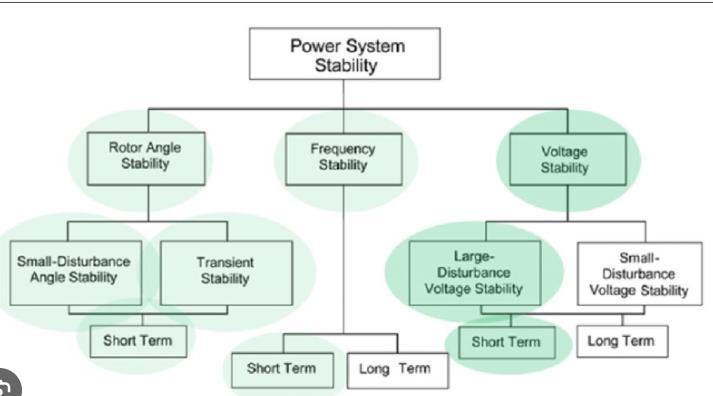
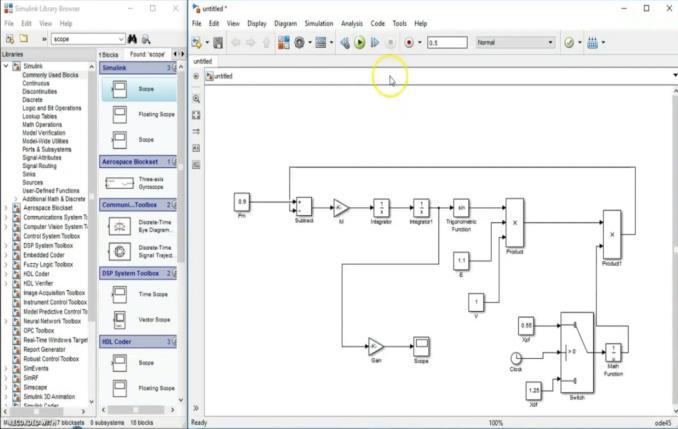
BLOCK DIAGRAM
5.2 Simulation
5.3 EQUATION
• SwingEquation:Theswingequationdescribesthe rateofchangeofthegeneratorrotorangle(δ)and is the fundamental equation used in transient stabilityanalysis:
• M d² δ/dt² = Pm Pe
• Where:
• M isthegenerator'sinertiaconstant.
• d² δ/dt² is the second derivative of the rotor ngle withrespecttotime.
• Pm isthemechanicalpowerinputtothegenerator.
• Pe istheelectricalpoweroutputfromthegenerator.
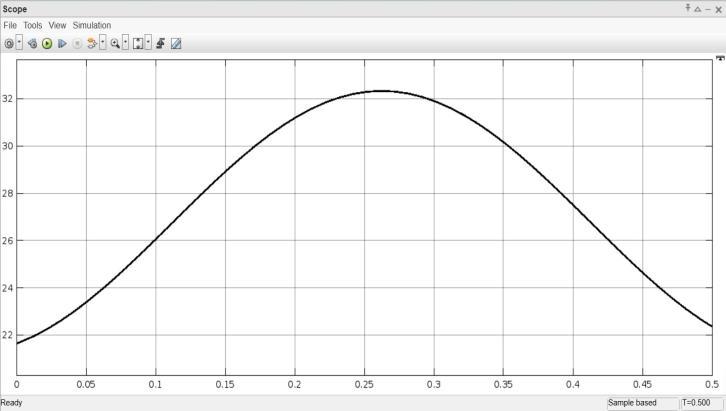
Figure 5.4 output
6.CONCLUSION
• Generator inertia is critical for stability Network topologyandconnectivityinfluencestability.Fastactingcontrolsystemsareessentialformaintaining
International Research Journal of Engineering and Technology (IRJET) e-ISSN: 2395-0056
Volume: 11 Issue: 05 | May 2024 www.irjet.net p-ISSN: 2395-0072
stability.Integrationofrenewableenergysources poses challenges. Load dynamics, such as rapid changes, can affect stability. Monitoring and Mitigation:Wide-AreaMonitoringSystems(WAMS) provide real-time data for assessment Protection and control systems are crucial for managing disturbances.DistributedEnergyResources(DERs) can support grid stability. Advanced simulation toolsandanalysisareusedtomodelandmitigate transientstabilityissues.
7.REFERENCES
1. Sarajcev,P.;Kunac,A.;Petrovic,G.;Despalatovic,M. PowerSystemTransientStabilityAssessmentUsing Stacked Autoencoder and Voting Ensemble. Energies 2021, 14, 3148. [Google Scholar][CrossRef]
2. Perilla,A.;Papadakis,S.;RuedaTorres,J.L.;vander Meijden, M.; Palensky, P.; Gonzalez-Longatt, F. TransientStabilityPerformanceofPowerSystems withHighShareofWindGeneratorsEquippedwith Power-AngleModulationControllersorFastLocal Voltage Controllers. Energies 2020, 13, 4205. [Google Scholar][CrossRef]
3. Tina,G.M.;Maione,G.;Licciardello,S.Evaluationof TechnicalSolutionstoImproveTransientStability in Power Systems with Wind Power Generation. Energies 2022, 15, 7055. [Google Scholar][CrossRef]
4. Kundur,P.;Paserba,J.;Ajjarapu,V.;Andersson,G.; Bose, A.; Canizares, C.; Vittal, V. IEEE/CIGRE Joint Task Force on Stability Terms and Definitions, Definition and Classification of Power System Stability. IEEE Trans. Power Syst. 2004, 19, 1387–1401.[Google Scholar]
5. Stott, B. Power system Dynamic response calculation. Proc.IEEE 1979, 67,219–241.[Google Scholar][CrossRef]
6. Chow, J.H. Power System Coherency and Model Reduction; Springer: New York, NY, USA, 2013. [Google Scholar]
7. Osipov, D.; Sun, K. Adaptive nonlinear model reduction for fast power system simulation. IEEE Trans. Power Syst. 2018, 33, 6746–6754. [Google Scholar][CrossRef]
8. Milano, F. Power System Modeling and Scripting; Springer Science and Business Media: Berlin/Heidelberg, Germany, 2010. [Google Scholar]
9. Gurrala,G.;Dimitrovski,A.;Pannala,S.;Simunovic, S.; Starke, M. Parareal in Time for Fast Power System Dynamic Simulations. IEEE Trans. Power Syst. 2015, 31, 1820–1830. [Google Scholar] [CrossRef]
10. Zadkhast, S.; Jatskevich, J.; Vaahedi, E. A multidecomposition approach for accelerated time domain simulation of transient stability problems. IEEE Trans. Power Syst. 2015, 30,2301–2311.[Google Scholar][CrossRef]
11. Aristidou, P.; Fabozzi, D.; Cutsem, T.V. Dynamic Simulation of Large Scale Power Systems Using a ParallelSchur-Compelement_BasedDecomposition Method. IEEE Trans.Parallel Distrib.Syst. 2014, 25, 2561–2570.[Google Scholar][CrossRef]
12. Liu, C.; Wang, B.; Sun, K. Fast power system simulationusingsemi-analyticalsolutionsbasedon Pade approximation. In Proceedings of the 2017 IEEE Power & Energy Society General Meeting, Chicago,IL,USA,16–20July2017;pp.1–5.[Google Scholar]
13. Liu,C.;Wang,B.;Sun,K.FastpowersystemDynamic Simulation Using Continued Fractions. IEEE Access 2018, 6, 62687–62698. [Google Scholar] [CrossRef]
14. Wang, B.; Duan, N.; Sun, K. A Time-Power Series BasedSemi-AnalyticalApproachforPowerSystem Simulation. IEEE Trans. Power Syst. 2019, 34,841–851.[Google Scholar][CrossRef]
15. Liu,Y.;Sun,K.;Yao,R.;Wang,B.PowerSystemTime Domain Simulation Using a Differential Transformation Method. IEEE Trans. Power Syst. 2019, 34, 3739–3748. [Google Scholar] [CrossRef]
16. Liu, Y.; Sun, K. Power System Simulation Using a Differential Transformation Method. Ph.D. Thesis, UniversityofTennessee,Knoxville,TN,USA,2022. Available online: https://trace.tennessee.edu/utk_graddis s/7073 (accessedon28August2022).
17. Sanchez-Gasca, J.J.; D’aquila, R.; Price, W.W.; Paserba,J.J.Variabletimestep,implicitintegration for extended-term power system dynamic simulation. In Proceedings of the Power Industry ComputerApplicationsConference,SaltLakeCity, UT, USA, 7–12 May 1995. [Google Scholar] [CrossRef]
18. Kim,S.;Overbye,T.J.OptimalSubintervalSelection Approach for Power System Transient Stability
International Research Journal of Engineering and Technology (IRJET) e-ISSN: 2395-0056
Volume: 11 Issue: 05 | May 2024 www.irjet.net p-ISSN: 2395-0072
Simulation. Energies 2015, 8, 11871–11882. [Google Scholar][CrossRef]
19. Laugier, A.J.C. Adaptive Time Step for Fast Converging Dynamic Simulation System. In Proceedings of the IEEE/RSJ International ConferenceonIntelligentRobotsandSystems,IROS ’96, Osaka, Japan, 8 November 1996. [Google Scholar][CrossRef]
20. Liu, Y.; Sun, K. Solving Power System Differential Algebraic Equations Using Differential Transformation. IEEE Trans. Power Syst. 2020, 35, 2289–2299.[Google Scholar][CrossRef]
21. El-Zahar,E.R.AnAdaptiveStep-SizeTaylorSeries Based Method and Application to Nonlinear Biochemical Reaction Model. Trends Appl. Sci. Res. 2012, 7,901–912.[Google Scholar]
22. El-Zahar, E.R. Applications of Adaptive Multi Step Differential Transform Method to Singular Perturbation Problems Arising in Science and Engineering. Appl. Math. Inf. Sci. 2015, 9,223–232. [Google Scholar][CrossRef]
23. Ahmet, G.; Mehmet, M.; Ahmet, Y. Adaptive multistepdifferentialtransformationmethodtosolving nonlineardifferentialequations. Math. Comp. Mod. Sci 2012, 55,761–769.[Google Scholar]
24. Bég,O.A.;Keimanesh,M.;Rashidi,M.M.;Davoodi,M.; Branch,S.T.Multi-stepDTMSimulationofMagnetoPeristaltic Flow of a Conducting Williamson Viscoelastic Fluid. Int. J. Appl. Math Mech. 2013, 9, 22–40.[Google Scholar]
25. Pukhov, E.; Georgii, G. Differential transformation method and circuit theory. Int. J. Circuit Theory Appl. 1982, 10, 265–276. [Google Scholar] [CrossRef]
26. Available online: http://www.esat.kuleuven.be/electa/tea ching/matdyn/ (accessedon26May2020).
27. MATLAB,T.M.I.2017b;TheMathWorksInc.:Natick, MA,USA,2017.
28. Zimmerman, R.D.; Murillo-Sanchez, C.E.; Thomas, R.J.MATPOWER:Steady-StateOperations,Planning, andAnalysisToolsforPowerSystemsResearchand Education. IEEETrans.PowerSyst. 2011, 26,12–19. [Google Scholar][CrossRef]
29. Yang,D. PowerSystemDynamicSecurityAnalysisvia Decoupled Time Domain Simulation and Trajectory Optimization;IowaStateUniversity:Ames,IA,USA, 2006.[Google Scholar]
© 2024, IRJET | Impact Factor value: 8.226 | ISO 9001:2008
|