
International Research Journal of Engineering and Technology (IRJET) e-ISSN: 2395-0056
Volume 11 Issue 05, May 2024 www.irjet.net p-ISSN: 2395-0072
International Research Journal of Engineering and Technology (IRJET) e-ISSN: 2395-0056
Volume 11 Issue 05, May 2024 www.irjet.net p-ISSN: 2395-0072
AL Khaled Muhsen
Master Degree Student at Beijing university of Technology- Chemistry and life science college -Beijing, China
研究生-北京工业大学-化学与生命科学学院-生物医学工程
Abstract
This study examined the influence of chronic stress on cognitive functions over the lifespan, drawing on a large, richly characterized pool of participants in the UK Biobank. Participants were grouped according to their own reported stress levels during childhood and adulthood and were categorized into one of four groups: low childhood, high to middle adulthood stress; low stress in both childhood and adulthood; high to middle stress in both childhood and adulthood; high to middle childhood and low adulthood stress. Cognitive performance was assessed with measures of memory, problem-solving, and fluid intelligence, among other indices. A one-way ANOVA with a Tukey post hoc honest significance difference test was used to determine the differential effect of stress on cognitive outcome. Statistically significant differences were found between the high stress group and the low stress group in regard to their cognitive performance, with those who had high stress during both childhood and adulthood faring the worst. Conversely, drops in stress across time from childhood to adulthood seemed to buffer some of the deleterious cognitive effects but not to the level of individuals with consistently low stress. The results provide a critical piece of information on the role of timing and intensity of exposure to stress on cognitive functions and suggest that timely and sensitive interventions might be of critical importance in buffering against the long-term adverse impact of stress. The study will extend knowledge on how chronic stress affects cognitive resilience and inform strategies to promote cognitive health across the lifespan.
Key Words: Stress, Cognitive Function, Lifespan Psychology, Neurobiology, UK Biobank, Chronic Stress, CognitiveResilience,MentalHealth
Chronic stress is a key public health challenge and affects several features of human health across the lifespan. This study aims to leverage a large epidemiological data set available through the Biobank to clarify the nuanced implications of stress on cognitive performance and mental health. In addition, this study will address the gap in existing research on possibly sex-specific reactions to stress and the possibly mediating impact of neurobiological changes in response to stress. Previously, chronic stress had been linked to several conditions,
including mental health, cardiovascular disorders, and a decrease in cognitive function [1][2]. Its detrimental impact has been well elaborated in most of the life stages on subjects of both sexes, except in the case of cognitive and neurological outcomes, where its effects were found to be different according to some studies, proposing that gender may be a factor influencing the physiological and psychological responses to stress [3][4]. Studies from neuroimaging have also shown that stress may facilitate changes in brain structure and functioning that underlie the observed differences in cognitive performance across lifestages[5][6].
Understanding the effects of stress across different stages of life is critical, primarily due to the profound and varied impacts stress can have on brain health and cognitive functions.Stressexperiencedduringcriticaldevelopmental periods, such as childhood or adolescence, can influence thetrajectoryofbraindevelopmentandhavelastingeffects on neural structures and functions. These changes can, in turn, affect cognitive abilities, mental health, and overall qualityoflife.
The methodology of this study involved a comprehensive analysisusingdatasourcedfromtheUKBiobank,whichis a large-scale biomedical database and research resource containing in-depth genetic and health information from approximately 500,000 participants across the United Kingdom. The data includes a wide range of biomarkers, health outcomes, and self-reported information, which allows for a robust examination of the links between stress,brainhealth,andcognitivefunctions.
2.1
ParticipantsfromtheUKBiobank werecategorizedbased on self-reported stress levels during childhood and adulthood into four groups: Low Childhood, High to Middle Adulthood Stress; Low Stress in Both Childhood and Adulthood; High to Middle Stress in Both Childhood andAdulthood;HightoMiddleChildhood,LowAdulthood Stress.Thesecategorizationsfacilitateananalysisofstress
International Research Journal of Engineering and Technology (IRJET) e-ISSN: 2395-0056
Volume 11 Issue 05, May 2024 www.irjet.net
impacts over different life stages on cognitive and mental healthoutcomes.
Participants were categorized into four groups based on their self-reported stress levels during two pivotal life stages childhoodandadulthood.Thecategorizationisas follows:
Low Childhood, High to Middle Adulthood Stress: Participants who reported low stress levels during childhood and high to middle stress levels during adulthood.
LowStressinBothChildhoodandAdulthood:Participants withlowreportedstresslevelsduringbothstages.
High to Middle Stress in Both Childhood and Adulthood: Participants experiencing high to middle stress levels duringbothchildhoodandadulthood.
High to Middle Childhood, Low Adulthood Stress: Participants with high to middle stress levels during childhoodfollowedbylowstressduringadulthood.
These groups provide a framework for analyzing the differential impacts of stress timing on cognitive and mental health outcomes, highlighting the critical periods thatmayinfluencelong-termhealthtrajectories.
Cognitive performance was evaluated using metrics such as Maximum Digits Remembered Correctly, Number of Puzzles Solved, Fluid Intelligence Score, Number of Word Pairs Correctly Associated, and Number of Symbol Digit MatchesMadeCorrectly.Theseassessmentscoverarange ofcognitivefunctionsincludingmemory,problem-solving, andprocessingspeed.
Data Preprocessing
The initial step in the statistical analysis involved comprehensive data cleaning and preprocessing. This process addressed the handling of missing values and outliersandensureddatanormalizationwherenecessary. Properdatapreparationisessentialtoensuretheintegrity androbustnessofthesubsequentstatisticalanalyses.
Toaccuratelyassesstheimpactofstressoncognitiveand mental health outcomes, linear regression models were employed to adjust for potential confounding variables. These variables included age, sex, and other sociodemographic factors that could influence the outcomes. Thisadjustmentiscrucialforisolatingtheeffectsofstress from other potentially influential factors, thereby enhancingthevalidityofthefindings.
p-ISSN: 2395-0072
ANOVAwasutilizedtodetermineiftherewerestatistically significant differences in cognitive and mental health outcomes across the four defined stress groups. This analysis method is particularly useful for comparing multiple groups simultaneously and can help identify whether the mean differences among groups are greater than would be expected by chance. The results from the ANOVA also informed the need for further post-hoc analysestoexplorespecificgroupdifferencesindetail.
Multiple regression analysis was conducted to delve deeper into the relationships between lifespan stress (categorized by childhood and adulthood stress levels) and cognitive scores, with separate analyses for male and female participants. In these models, stress levels were treated as categorical predictors. This approach allowed for the exploration of how different levels and timing of stressimpactcognitivefunctionwithineachgendergroup. The categorization of stress levels enabled the examinationofnuancedeffectsandprovidedinsightsinto how varying stress exposures might influence cognitive and mental health outcomes differently for males and females.
Our analysis began with regression models for each cognitive metric across the four stressgroups, controlling for age and sex. The results consistently indicated significant effects from both factors across most cognitive scores, highlighting their substantial influence on cognitive outcomes. This necessitated adjustments of cognitivescorestoisolatetheimpactofstresslevelsfrom theseconfoundingeffects.
The analysis of variance (ANOVA) was conducted to investigate differences in cognitive scores across the four stress groups, revealing significant disparities. This result underscores the critical roles that both the intensity and timing of stress play in influencing cognitive functions. Notably, the findings remained statistically significant even after implementing False Discovery Rate (FDR) corrections for multiple comparisons, highlighting the robust and substantial influence of stress on cognitive performance.
Subsequent post-hoc analysis employing Tukey’s Honest SignificantDifference(HSD)testprovidedfurtherinsights intospecificpairwisedifferencesamongthestressgroups,
International Research Journal of Engineering and Technology (IRJET) e-ISSN: 2395-0056
Volume 11 Issue 05, May 2024 www.irjet.net p-ISSN: 2395-0072
delineating the differential impacts of stress based on its timingandintensity:
High Stress in Both Childhood and Adulthood (HH Group): This group consistently exhibited the lowest performance across all assessed cognitive metrics, including fluid intelligence, memory, and problem-solving abilities. The pronounced disparities in performance between the HH group and the Low Stress in Both Life Stages (LL) group accentuate the severe and enduring negative impacts of sustained high stress across different lifestagesoncognitivefunctions.
Transitional Stress Effects:
High Childhood, Low Adulthood Stress (HL Group): Participants in this group generally demonstrated better cognitive outcomes compared to those in the Low Childhood, High Adulthood Stress (LH) group. This observation suggests that a reduction in stress levels during adulthood may partially alleviate the detrimental effects of high stress experienced during childhood. Nonetheless, the cognitive performance of the HL group did not attain the levels observed in the LL group, indicatingsomepersistenteffectsofearlylifestress.
Low Childhood, High Adulthood Stress (LH Group):The cognitivescoresforthisgrouprevealthattheonsetofhigh stress during adulthood can significantly impair cognitive functions, despite less stressful conditions during childhood. This finding highlights the potential vulnerability of adult cognitive functions to new or increasingstresslevels.
Multiple Regression Analyses on the Impact of Stress
InfluenceofChildhoodStressonCognitivePerformance
Theimpactofchildhoodstressoncognitivefunctionswas found to be generally negative across both genders, particularlyaffectingmemory-relatedtasks:
•Males: Notable declines were observed in the scores for DigitsRememberedand WordPairs,suggestingthatearly life stress significantly impairs memory functions. However, an intriguing pattern emerged in Fluid Intelligence, where males showed a slight positive effect. This unexpected result could indicate a form of cognitive compensation or resilience, where increased cognitive flexibility and problem-solving abilities develop as adaptiveresponsestoearlystress.
•Females: Similar to males, females showed detrimental effects of childhood stress on Digits Remembered. Unlike males, the positive effect on Fluid Intelligence in females was more pronounced. This stronger positive response may reflect more robust compensatory mechanisms in females, potentially facilitating better resilience in cognitive flexibility and problem-solving under the pressuresofearlylifestress.
ImpactofAdulthoodStressonCognitiveFunctions
Adulthood stress appeared to have more uniformly negative effects on complex cognitive tasks, with some nuanceddifferencesbetweengenders:
•Males: The adverse impacts were especially pronounced in tasks requiring complex cognitive processing, such as Puzzles Solved, Puzzles Correct, and Symbol Matches. These findings suggest that stress encountered in adulthood may disrupt cognitive functions that involve problem-solving, abstract reasoning, and attentional processes.
•Females: Similar to males, females experienced negative effects of adulthood stress on Puzzles Solved and Fluid Intelligence, indicating difficulties in problem-solving and reasoning. Interestingly, a small positive effect was observed in Digits Remembered, which might suggest an adaptive enhancement in specific types of memory tasks under stress. This could be an indication of selective cognitive resilience, where certain memory processes are strengthenedasacopingmechanisminresponsetostress.
Table-1:comprehensiveviewofthedemographic compositionacrossthedifferentstressgroups.
This study underscores the profound impact of stress on cognitive functions, emphasizing the importance of the timing of stress exposure. Findings suggest that early interventions might be crucial in mitigating the long-term cognitive detriments associated with chronic stress. Furthermore, gender-specific analyses indicate differing resilience or vulnerability to stress, which could guide tailoredpreventativeandtherapeuticstrategies.
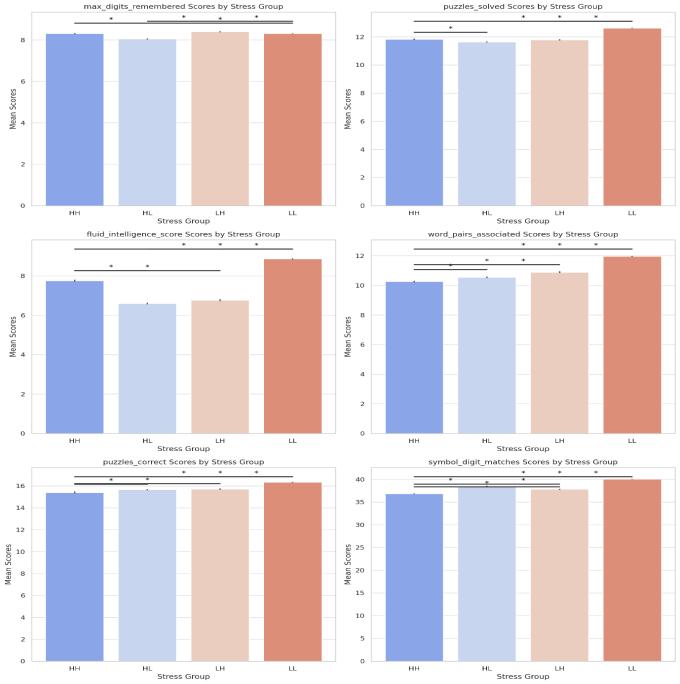
Chart -1:comparesthefourstressgroupsthemeanscores andstandarddeviationsforeachsignificantcognitivetest
The findingscontribute significantlytounderstanding the complexrelationshipsbetweenstress,brainstructure,and cognitive health. Insights into how chronic stress influences cognitive resilience and mental health could lead to improved clinical practices and health policy strategies, aimed at enhancing individual and community healthoutcomes
[1] McEwen, B. S. (2006). Stress,adaptation, and disease: Allostasis and allostatic load. Annals of the New York Academy of Sciences,840,33-44.
[2] Lupien, S. J., McEwen, B. S., Gunnar, M. R., & Heim, C. (2009).Effectsofstressthroughoutthelifespanonthe brain, behaviour and cognition. Nature Reviews Neuroscience,10(6),434-445.
[3] M Becker, J. B., Monteggia, L. M., Perrot-Sinal, T. S., Romeo, R. D., Taylor, J. R., Yehuda, R., & Bale, T. L. (2016). Stress and diseases of aging: sex-specific effects on neural plasticity and memory. Frontiers in Neuroendocrinology,41,1-16.
Male Digits
Rememb ered
Fluid Intelligen ce
Childh ood -0.272 <0.000 01 Negat ive
Childh ood 0.239 0.018 Positi ve
Word Pairs Childh ood
Puzzles Solved Adulth ood
0.0003 Negat ive
<0.000 1 Negat ive
Symbol Matches Adulth ood -2.623 <0.000 1 Negat ive
Digits Rememb ered Childh ood -0.213 <0.000 001 Negat ive
Fluid Intelligen ce Childh ood 0.452 <0.000 1 Positi ve
Digits Rememb ered Adulth ood 0.091 0.034 Positi ve
Puzzles Solved
Fluid Intelligen ce
<0.000 1 Negat ive
<0.000 1 Negat ive
[4] Becker, J. B., Monteggia, L. M., Perrot-Sinal, T. S., Romeo, R. D., Taylor, J. R., Yehuda, R., & Bale, T. L. (2016). Stress and diseases of aging: sex-specific effects on neural plasticity and memory. Frontiers in Neuroendocrinology,41,1-16.
[5] Becker, J. B., Monteggia, L. M., Perrot-Sinal, T. S., Romeo, R. D., Taylor, J. R., Yehuda, R., & Bale, T. L. (2016). Stress and diseases of aging: sex-specific effects on neural plasticity and memory. Frontiers in Neuroendocrinology,41,1-16.
[6] Liston, C., Miller, M. M., Goldwater, D. S., Radley, J. J., Rocher,A.B.,Hof,P.R.,Morrison,J.H.,&McEwen,B.S. (2009). Stress-induced alterations in prefrontal cortical dendritic morphology predict selective impairments in perceptual attentional set-shifting. Journal of Neuroscience,29(30),9447-9454.