
International Research Journal of Engineering and Technology (IRJET) e-ISSN: 2395-0056
Volume: 11 Issue: 05 | May 2024 www.irjet.net p-ISSN: 2395-0072
International Research Journal of Engineering and Technology (IRJET) e-ISSN: 2395-0056
Volume: 11 Issue: 05 | May 2024 www.irjet.net p-ISSN: 2395-0072
Srikantha L1 , Kumaraswamy S2
1Student, Computer Science and Engineering, University of Visvesvaraya College of Engineering
2Assistent Professor, Computer Science and Engineering, University Visvesvaraya College of Engineering
Abstract - Pneumonia is a serious lung sickness, usually triggered by streptococcus pneumonia bacteria. It affects people worldwide. Right now, doctorscheck forit bylooking at chest X-rays, but this can take a while and might not alwaysbe accurate. To address this challenge, we proposeanautomated system utilizing Convolutional Neural Networks (CNNs), specifically Inception models, trained on chest X-ray images sourced from Kaggle. Our approach aims to provide a costeffective and efficient solution for pneumonia identification, crucial for timely treatment and improved patient outcomes. By harnessing the power of deep learning, our research contributes to advancing pneumonia diagnosis, promising enhanced healthcare delivery and patient care
Key Words: Pneumonia Detection,ConvolutionalNeural Network (CNN), Flask web application chest X-ray images.
Pneumoniaisstillabigproblemforglobalhealth,causinga lotofsicknessanddeath.Itaffectsmanypeopleandleadsto a high number of deaths, Pneumonia is a major worry for healthworldwide,especiallyforthosewhoaremoreatrisk like kids, older adults, and people with weaker immune systems [1]. According to the World Health Organization (WHO), pneumonia causes about 2.5 million deaths every year,effectsaleadingcauseofmortalityworldwide[2].The burden of pneumonia extends beyond its direct health impacts, encompassing economic costs associated with healthcare expenditures and loss of productivity. In developingcountries,whereaccesstohealthcareresources may be limited, pneumonia poses an even greater threat, exacerbatingexistinghealthdisparitiesandsocioeconomic challenges[3].
Beforeyoubegintoformatyourpaper,firstwriteandsave thecontentasaseparatetextfile.Keepyourtextandgraphic files separate until after the text has been formatted and styled.Donotusehardtabs,andlimituseofhardreturnsto onlyone returnatthe endof a paragraph. Donotaddany kindofpaginationanywhereinthepaper.Donotnumbertext heads-the template will do that for youEarly diagnosis of pneumoniaiscrucialforinitiatingpromptandappropriate treatment, which can significantly to make better patient health outcomes and reduce the risk of complications and
mortality[4].Delayeddiagnosisormisdiagnosiscanleadto progression of the infection, worsening of symptoms, and increased likelihood of severe complications, including respiratory failure and sepsis. Timely identification of pneumoniaallowsfortimelyinterventionwithantibioticsor othertherapeuticmeasures,therebyreducingtheseverityof the illness and minimizing the risk of adverse outcomes. Additionally,earlydetectionofpneumoniafacilitatestargeted publichealthinterventions,suchas vaccinationcampaigns and infection control measures, aimed at preventing the spreadofthediseasewithincommunities[5].
Methodsfordiagnosingpneumoniaprimarilyrelyonclinical assessment,physicalexamination,andradiologicalimaging, suchaschestX-rays[6].WhilechestX-raysarewidelyused for identifying pulmonary abnormalities indicative of pneumonia,theirinterpretationcanbesubjectiveandprone to variability among radiologists. Moreover, manual interpretation of chest X-rays is time consuming and may delaythe processofdiagnosis,where in resource limited settings, access to expert radiologists is limited. Furthermore, chest X-rays may lack sensitivity and specificityfordetectingcertaintypesofpneumonia,suchas viral or atypical pneumonia, leading to diagnostic inaccuraciesandsuboptimalpatientcare[7].
Inresponseoflimitationsoftraditionalpneumoniadiagnosis methods,computer assisteddiagnostic(CAD)systemshave emerged as promising tools for improving diagnostic accuracyandefficiency.CADsystemsleverageadvancedAI techniques to automate the detection, classification of pneumonia from medical image data [8]. Deep learning models,particularlyCNNs,haveindicateremarkablesuccess from various image analysis tasks and including medical imageinterpretation[9].BytrainingCNNmodelsonlarge datasets of chest x-ray images, CAD systems able to learn complex patterns, features associated with pneumonia, enabling accurate and rapid diagnosis. The importance of this study lies in its potential to revolutionize pneumonia diagnosis,offeringascalableandcost-effectivesolutionfor healthcareproviders.ByharnessingthepowerofCNNs,our goal is not only improving diagnostic accuracy but also enhances the efficiency and accessibility in pneumonia detection. The integration of Flask web application
International Research Journal of Engineering and Technology (IRJET) e-ISSN: 2395-0056
Volume: 11 Issue: 05 | May 2024 www.irjet.net p-ISSN: 2395-0072
implementation and deployment of the automated pneumonia detection system, providing an intuitive user interfaceforhealthcareprofessionalstoeasilyuploadand analyze chest X-ray images. This approach significantly improves the efficiency and effectiveness of pneumonia diagnosis,highlightingthesignificanceofFlaskinhealthcare technologyapplications.
Mostofstudieshavegiventheapplicationmethodofdeep learning techniques, particularly CNNs, for pneumonia detectioninCXRimages[9]developingaCNNmodeltrained on large dataset, chest radiographs to detect common thoracic pathologies, including pneumonia. Their model achieved competitive performance, demonstrating the potentialofDLindiseasedetection.[9]
2.1
Uses pre-trained CNN modelsfor certain tasks,has gained popularityinpneumoniadetectionresearch.[9]usedtransfer learning with the DenseNet design to create a pneumonia detectionmodel.TheytraineditusingavariedsetofchestXray images. Through refining the pre-trained model, they attainedexcellentprecisioninpinpointingpneumoniacases. Thisunderscorestheefficacyoftransferlearninginmedical imagingendeavors.[11]
2.1
Ensemble learning methods have also been explored for improvingpneumoniadetectionaccuracy.[12]proposedan ensemble of deep CNN models, each trained on different imageresolutions,tomakethedetectionsystemstrongerand more adaptable. Their ensemble approach outperformed individual models, demonstrating the efficacy of ensemble methodsinmedicalimageanalysis.[11]
Computer-aided diagnosis systems are helpful for radiologistsinfindingpneumonia.[2]madeoneusingamix ofdeeplearningandothermethods.Theirsystemwasreally goodatspottingpneumonia,showinghowthesesystemscan helpdoctorsinreal-lifesituations.
Computer-aided diagnosis systems are helpful for radiologistsinfindingpneumonia.[2]madeoneusingamix ofdeeplearningandothermethods.Theirsystemwasreally goodatspottingpneumonia,showinghowthesesystemscan helpdoctorsinreal-lifesituations.

Detecting pneumonia, which is really important for diagnosinglungproblems,hasgottenalotbetterthanksto deep learning methods, especially CNNs [9]. CNNs have shownthey'rereallygoodatfiguringoutdifferentthingsin pictures,eveninmedicalimages.Before,doctorsusedtorely a lot on looking at X-ray pictures themselves to spot pneumonia. [6]. However, this approach is limited by subjectivity and can be time-consuming, particularly in settingswithhighpatientvolumes.Incontrast,CNNsoffera promisingalternativebyautomatingthedetectionprocess, potentially reducing diagnostic errors and improving efficiency.NewresearchshowsthatCNNsarereallyhelpful in finding pneumonia in X-ray pictures [11]. These fancy learningmodelscanpickupondetailedsignsofpneumonia from big sets of data, enabling accurate and consistent diagnoses. Moreover, CNNs have shown remarkable generalizationcapabilities,performingwellacrossdiverse patient populations and imaging conditions Publicly available datasets such as ChestX-ray14 and the RSNA Pneumonia Detection Challenge dataset have served as valuable resources for training and evaluating CNN-based pneumonia detection models [4]. Benchmark studies conductedonthesedatasetshaveshowcasedthesuperiority of CNNs over traditional machine learning methods, highlighting their potential for clinical implementation. DespitethesuccessofCNNsinpneumoniadetection,several
International Research Journal of Engineering and Technology (IRJET) e-ISSN: 2395-0056
Volume: 11 Issue: 05 | May 2024 www.irjet.net p-ISSN: 2395-0072
challengesremain[8].Classimbalance,inherentinmedical imagingdatasets,canaffectmodelperformanceandleadto biased predictions. Additionally, concerns regarding the interpretabilityofCNNspersist,hinderingtheirwidespread adoption in clinical practice. Addressing these challenges, ourapproachincorporatesseveralkeystrategiestoenhance theinterpretabilityofCNNsforpneumoniadetection.Firstly, byutilizingtransferlearningwithpre-trainedCNNmodels, oursystemleveragesexistingknowledgefromlargedatasets toimprovediagnosticaccuracy[11].Thismethodhelpsthe modellearnimportantfeaturesforfindingpneumoniawhile still being easy to understand by transferring knowledge from the pre-trained model. Secondly, the integration of Flaskforwebapplication.TheFlaskwebapplicationcanbea user-friendly interface for healthcare professionals to interactwiththeCNNmodelandinterpretitspredictions. Through the web interface, users can upload chest x-ray photosandvisualizethemodel'sresultincludingregionsof interest and probability scores for pneumonia detection. This transparency and user interaction contribute to the interpretability of the CNN model, enabling healthcare professionalstounderstandandtrustitspredictions.Recent advancementsinAIforpneumoniadetectionhavefocused on improving model performance, interpretability, and generalization. Studies have explored the use of attention mechanismsinCNNstohighlightrelevantregionsinX-ray images,aidingradiologistsininterpretingmodelpredictions [10]. Additionally, ensemble learning methods, combining multiple CNN models, have shown promise in enhancing diagnosticaccuracyandrobustness.
4.1
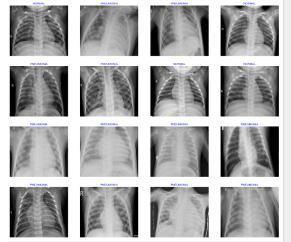
Thedatasetusedinthisprojectcomprised5216CXRdataset gotfromKaggle.Theseimagesweremeticulouslycuratedto includebothnormalandpneumoniacases,witheachimage annotatedtoindicatethewhetherpatienthaspneumoniaor Normal.Thediversityandrichnessofthedatasetallowedfor comprehensive training and evaluation of the pneumonia detectionsystem
4.2
WegothroughapproachofEfficientNetB3todetectanalysis x-ray.ThisincludedconvertingtheimagesformattoJPEGor PNGformat,enablingseamlessprocessingandintegration with deep learning frameworks. Additionally, the images were standardized to a predefined size and resolution, typicallysetto224x224pixels,usingrobustlibrariessuchas OpenCVorPIL.Normalizationofpixelvalueswasperformed to scale the intensity range to [0, 1], thereby enhancing consistencyandnumericalstabilityduringmodeltraining
CNNswerethecoreofourautomatedpneumoniadetection system.OurCNNdesignincludedlayersthatdetectdifferent featuresinchestX-rayimages,likeedgesorshapes,andthen poolthemostimportantinformation.Thisprocesshelpedus extractimportantfeaturesfromtheimages,makingiteasier to spot signs of pneumonia. Subsequent fully connected layersandactivationfunctionsfacilitatedtheclassificationof imagesintonormalandpneumoniaclasses,Inceptionwere fine-tuned to expedite model convergence and enhance performance.Thisstrategicapproachallowedforefficient utilizationofexistingknowledgeandresources,leadingto improvedmodelaccuracyandefficiency
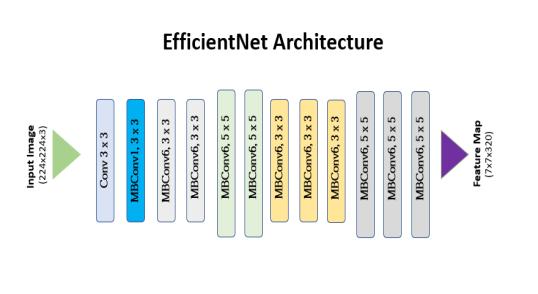
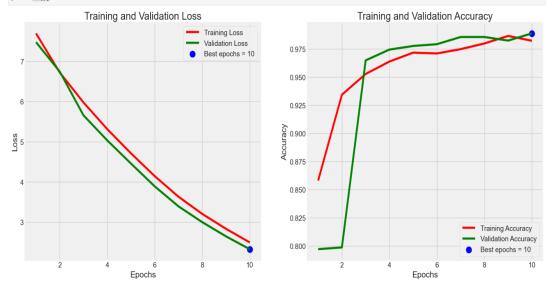
Duringthetrainingphase,ourneuralnetwork,basedonthe EfficientNetB3architecture,undergoesaseriesofstepsto enhanceitsabilitytounderstandandclassifyCXRimagesfor pneumoniadetection.Initially,batchesofinputdataarefed intothenetwork,andpredictionsaregeneratedbasedonthe currentsetofparameters.Thenetworkthenevaluateshow accuratethesepredictionsarecomparedtotheactuallabels usingametricknownasloss.Toimproveitsperformance, thenetworkadjustsitsparametersthroughaprocesscalled backpropagation,aimingtominimizetheloss.Additionally, techniques such as batch normalization and dropout are employed to ensure the stability and generalization capability of the model during training. Throughout the trainingprocess,themodel'sperformanceis continuously assessed on a separate validation dataset to prevent overfitting and ensure its effectiveness in real-world scenarios.Finally,oncetrainingiscompleted,themodelis evaluated on an independent test dataset to validate its ability to accurately classify chest x-ray images for pneumoniadetection.Thisiterativetrainingprocessenables ourmodeltoeffectivelylearnandextractrelevantfeatures fromtheinputdata,ultimatelycontributingtoitsrobustness andaccuracyinpneumoniadetection
International Research Journal of Engineering and Technology (IRJET) e-ISSN: 2395-0056
Volume: 11 Issue: 05 | May 2024 www.irjet.net p-ISSN: 2395-0072
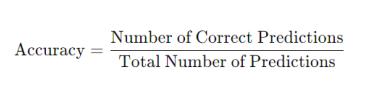
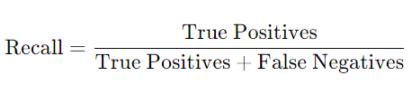
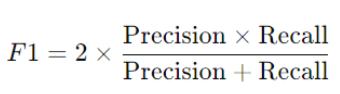
Inthefinalstageofourmodeldevelopmentprocess,known asmodelevaluation,werigorouslyassesstheperformance of our trained neural network on previously unseen data. This unseen data, termed the testing dataset, ensures an unbiasedevaluationofthemodel'scapabilities.Leveraging the knowledge acquired during training, our model generates predictions for the examples within the testing dataset.Thesepredictionsarethencomparedwiththetrue labels of the data to determine the model's accuracy and effectiveness. By calculating various performance metrics, such as accuracy, precision, recall, and F1-score, we gain valuableinsightsintothemodel'sabilitytocorrectlyclassify chestX-rayimagesforpneumoniadetection.It'simportant tonotethatourevaluationprocessisnotlimitedtoasingle metricbutencompassesaholisticassessmentofthemodel's performanceacrossmultipledimensions.
This comprehensive evaluation enables us to confidently validatethereliabilityandrobustnessofourtrainedneural networkforreal-worlddeploymentinpneumoniadetection tasks
Deployment In addition to model development and evaluation, a Flask web application was developed to facilitate user interaction with the pneumonia detection system.Thewebapplicationprovideduserswithanintuitive interface to upload chest X-ray images for pneumonia detection.Furthermore,userauthenticationfunctionalities were implemented to ensure secure access to the application,requiringuserstosignupfornewaccountsor log in with existing credentials. Session management
featureswereintegratedtomaintainusersessionssecurely, enhancing the overall usability and security of the application.
The performance of the developed pneumonia detection system,encompassingboththeCNNmodelandFlaskweb application, was comprehensively evaluated. Evaluation results were meticulously analyzed to assess the system's efficacy, reliability, and usability in clinical settings. Considerations were made for diagnostic accuracy, user experience, and computational efficiency, with a focus on real - world applicability and impact. Through thorough evaluation and analysis, insights were gained into the system's strengths, limitations, and areas for further improvement, guiding future research and development effortsinpneumoniadetectionandhealthcaretechnology.
Our model evaluation reveals promising results, with an accuracy ranging between 97% to 98% on the testing dataset.Thisindicatesahighlevelofaccuracyinclassifying CXR images for pneumonia detection. Such high accuracy levelsareindicativeofthemodel'srobustnessandsuitability for real-world applications in supporting healthcare professionalswithpneumoniadiagnosis
Forthe"NORMAL"class(indicatingabsenceofpneumonia), the precision is 97%, implying that out of all the images predicted as normal, 97% were truly normal. For the "PNEUMONIA"class(indicatingpresenceofpneumonia),the precision is 98%, indicating that out of all the images predictedaspneumonia,98%weretrulypneumoniacases
The F1-score, a balanced measure of the model's performanceencompassingbothprecisionandrecall,was calculatedseparatelyforthe"NORMAL"and"PNEUMONIA" classes.Forthe"NORMAL"class,theF1-scorewasfoundto beapproximately0.98,whileforthe"PNEUMONIA"class,it was approximately 0.97. These values indicate strong performance in accurately identifying both normal and pneumonia cases from chest X-ray images, demonstrating therobustnessofourmodelacrossdifferentclasses
5.3
Tosupportourfindings,wecalculatedtheF1-scoreforboth the "NORMAL" and "PNEUMONIA" classes. This metric providesabalancedmeasureofthemodel'sprecisionand recall, offering valuable insights into its performance. Our analysisyieldedanF1-scoreofapproximately0.98forthe "NORMAL" class and approximately 0.97 for the
International Research Journal of Engineering and Technology (IRJET) e-ISSN: 2395-0056
Volume: 11 Issue: 05 | May 2024 www.irjet.net p-ISSN: 2395-0072
"PNEUMONIA" class. These scores indicate strong performance in accurately classifying both normal and pneumonia cases from chest X-ray images, thereby supporting the effectiveness and reliability of our model acrossdifferentclasses.
The Flask web application served as a user friendly platform facilitating the seamless upload of CXR and the retrieval of automated pneumonia detection results. Throughintuitivedesign,userscouldeffortlesslysignupfor newaccountsorloginusingexistingcredentialstoaccess theapplication'sfeatures.Thisimplementationprioritized user convenience and accessibility, enhancing the overall experience of interacting with the pneumonia detection system.Uponsuccessfulauthentication,userscouldupload CXRimagesthroughthewebinterface.Theuploadedimages wereprocessedusingthetrainedCNNmodelforautomated pneumonia detection. Detection results, including the probability of pneumonia and visualizations highlighting regionsofinterest,weredisplayedtousersinreal-time
UserauthenticationfunctionalitiesimplementedintheFlask web application ensured secure access to the pneumonia detection system. Users were required to sign up for new accounts or log in with existing credentials to access the application. Password security measures, including password hashing and storage, protected user data and privacy. Flask-Login managed user sessions and provided mechanisms for session management, including session expirationandlogoutfunctionality
Theevaluationofourpneumoniadetectionsystemrevealed promising outcomes. With an accuracy ranging between 97%to98%onthetestingdataset,ourmodeldemonstrates robust performance in classifying chest X-ray images for pneumonia detection. This high level of accuracy underscorestheeffectivenessofourtrainedneuralnetwork inaccuratelyidentifyingpneumoniacases.Furthermore,our modelachievedaprecisionofapproximately98%,indicating thatwhenit identifiesanX-rayimageasshowing signs of pneumonia, it is correct about 97% of the time. This precision iscrucial in healthcareapplications, where false positives can have serious implications. The F1-score, a balanced measure of precision and recall, was calculated separately for the "NORMAL" and "PNEUMONIA" classes. OuranalysisrevealedanF1-scoreofapproximately0.97for the "NORMAL" class and approximately 0.96 for the "PNEUMONIA"class.Thesescoresdemonstratethemodel's robustness in accurately classifying both normal and pneumoniacasesfromchestX-rayimages.
AccuratelyOurstudy'sfindingscarrysignificantimplications forpneumoniadiagnosisandpatientcare.Theintegrationof AI-drivenpneumoniadetectionsystemsintoclinicalpractice has the potential to revolutionize diagnostic accuracy and efficiency.Byleveragingadvancedalgorithmsandmachine learningtechniques,thesesystemscanrapidlyanalyzechest X-ray images, aiding healthcare professionals in promptly identifyingpneumoniacases.Thisenhancedefficiencynot onlyexpeditesthediagnosticprocessbutalsoensurestimely intervention and treatment, ultimately improving patient outcomes.Furthermore,AI-drivensystemshavethecapacity toassisthealthcareprovidersbyreducingdiagnosticerrors and variability, leading to more reliable and consistent diagnoses.Byautomatingthedetectionprocess,healthcare providerscanexpeditediagnosis,leadingtoearlierinitiation of treatment and improved clinical outcomes for patients with pneumonia. Our study's findings carry significant implicationsforpneumoniadiagnosisandpatientcare.The integrationofAI-drivenpneumoniadetectionsystemsinto clinicalpracticehasthepotentialtorevolutionizediagnostic accuracyandefficiency.Byleveragingadvancedalgorithms andmachinelearningtechniques,thesesystemscanrapidly analyzechestX-rayimages,aidinghealthcareprofessionals in promptly identifying pneumonia cases. This enhanced efficiencynotonlyexpeditesthediagnosticprocessbutalso ensures timely intervention and treatment, ultimately improving patient outcomes. Furthermore, AI-driven systemshavethecapacitytoassisthealthcareprovidersby reducingdiagnosticerrorsandvariability,leadingtomore reliable and consistent diagnoses. Moreover, the implementationofuserauthenticationmechanismsensures secure access to the pneumonia detection system, safeguarding patient privacyand data integrity. Password security measures and session management protocols enhance the reliability and trustworthiness of the web application, instilling confidence in users regarding the confidentialityofsensitivemedicalinformation.
[1] Rudan I, Boschi-Pinto C, Biloglav Z, Mulholland K, Campbell H. Epidemiology and etiology of childhood pneumonia.BullWorldHealthOrgan.2008;86(5):408416.
[2] WorldHealthOrganization(WHO).Pneumonia.
[3] Walker CLF, Rudan I, Liu L, et al. Global burden of childhood pneumonia and diarrhoea. The Lancet. 2013;381(9875):1405-1416.
[4] Metlay JP, Waterer GW, Long AC, et al. Diagnosis and treatment of adults with community-acquired pneumonia.Anofficialclinicalpracticeguidelineofthe American Thoracic Society and Infectious Diseases
International Research Journal of Engineering and Technology (IRJET) e-ISSN: 2395-0056
Volume: 11 Issue: 05 | May 2024 www.irjet.net p-ISSN: 2395-0072
Society of America. Am J Respir Crit Care Med. 2019;200(7):e45-e67.
[5] HamborskyJ,KrogerA,WolfeS,eds.Epidemiologyand Prevention of Vaccine Preventable Diseases. 13th ed. WashingtonD.C.:PublicHealthFoundation;2015.
[6] Self WH, Courtney DM, McNaughton CD, et al. High discordanceofchestx-rayandcomputedtomography for detection of pulmonary opacities in ED patients: implications for diagnosing pneumonia. Am J Emerg Med.2013;31(2):401-405.
[7] ShahRM,VidalD,BarkerW,KanneJP.Imagingofacute respiratory distress syndrome. Respir Care. 2012;57(4):607-612.
[8] TingDSW,CarinL,DzauV,WongTY.Digitaltechnology andCOVID-19.NatMed.2020;26(4):459-461.
[9] RajpurkarP,IrvinJ,ZhuK,etal.CheXNet:Radiologistlevel pneumonia detection on chest X-rays with deep learning.arXivpreprintarXiv:1711.05225.2017.
[10] Pranaya,A.,Sowmya,D.V.,Poojitha,L.,Grace,P.,Bhavya, K.,&GanapathiRaju,N.V.(2023).PneumoniaDetection Using Deep Learning. E3S Web of Conferences, 391, 01067.
https://doi.org/10.1051/e3sconf/202339101067
[11] Rahman,T.,Chowdhury,M.E.H.,Khandakar,A.,Islam,K. R.,Islam,K.F.,Mahbub,Z.B.,Kadir,M.A.,&Kashem,S. (2020). "Transfer Learning with Deep Convolutional NeuralNetwork(CNN)forPneumoniaDetectionUsing Chest X-ray." Applied Sciences, 10(9), 3233. https://doi.org/10.3390/app10093233Learning. E3S Web of Conferences, 391, 01067. https://doi.org/10.1051/e3sconf/202339101067
[12] Li,S.,Wan,Y., Wang,K.,Li, S.,Yu,L.,&Zhu,H.(2020). Deeplearning-basedcomputer aideddiagnosissystem fordetectingCOVID-19usingdigitalchestradiography. ResearchSquar
BIOGRAPHIES


Description“ Srikantha L is CurrentlyStudying4thyearat UniversityVisvesvarayaCollege ofEngineering“
Description “Kumaraswamy S is currentlyworkingasanAssistant ProfessorintheDepartmentof of Computer Science and Engineering, University of Visvesvaraya College of Engineering,Bengaluru. “