
International Research Journal of Engineering and Technology (IRJET) e-ISSN:2395-0056 p-ISSN:2395-0072

Volume:11Issue:05|May2024 www.irjet.net


International Research Journal of Engineering and Technology (IRJET) e-ISSN:2395-0056 p-ISSN:2395-0072
Volume:11Issue:05|May2024 www.irjet.net
Akshada Tari1
1Student, Department of Information Technology and Engineering, Goa College of Engineering, Farmagudi, Goa, India
Abstract - FederatedLearning(FL)isamachinelearning technique that decentralizes the training process across multiple devices or servers, each holding its own local dataset. This approach contrasts with traditional centralized machine learning techniques where all data is combined into one central point for training. In FL, an aggregator,typicallyacentralserver,playsacrucialrole.It is responsible for collecting model updates from all participating nodes (clients), aggregating these updates, and then distributing the aggregated model back to the nodes.Inourresearch,weconductedacomparativeanalysis of federated learning aggregation techniques for Alzheimer’s disease diagnosis. We used the Flower framework to trainthe Machine Learning(ML) model. The aggregators used in this research include FedAvg (Federated Averaging), FedYogi (Adaptive Federated Optimization using Yogi), FedOpt (Federated Optim strategy), FedMedian (Configurable FedMedian strategy), FedTrimmedAvg (Federated Averaging with Trimmed Mean). These aggregators were applied on the Alzheimer MRI Preprocessed Dataset. Among these, FedTrimmedAvg yieldedthebestaccuracyresult.
Key Words: Federated learning, aggregator, CNN, alzheimer’s disease
Federated learning, also known as collaborative learning, is a groundbreaking approach that has revolutionized the way machine learning models are trained. Unlike traditional centralized methods, federated learning operates on a decentralized paradigm, eliminating the need for exchanging raw data between client devices and global servers. This novel methodology enhances data privacy by conducting model training locally on edge devices, utilizing the raw data present on each individual device. The shift from traditional centralized server models to federated learning is driven by several critical issuesassociatedwiththeformer.Centralizedapproaches often face challenges such as data privacy concerns, computational power limitations, security risks, and vulnerabilitytosinglepointsoffailure.Federatedlearning addressesthesechallengesdirectly,offeringamoresecure andprivacy-preservingalternative.

One of the key advantages of federated learning is its abilitytooperatewithoutthenecessityoftransferringraw data to a central server. This feature is crucial in maintaining the confidentiality of sensitive information, making federated learning particularly attractive in scenarioswheredataprivacyisofutmostimportance.The decentralization of model training in federated learning not only enhances data privacy but also mitigates concerns related to computational power limitations. By distributing the training process across edge devices, federated learning leverages the collective computing powerofanetworkofdevices,enablingmoreefficientand scalablemachinelearningmodeltraining.
Security risks associated with centralized models are also alleviated through federated learning. The decentralized nature of this approach reduces the likelihood of a single point of failure compromising the entire system. This makes federated learning more resilient to attacks and ensures the robustness of the overall system. The transformative potential of federated learning is particularlyevidentinitsapplicationtohealthcare,where issues of data privacy and security are paramount. In the context of Alzheimer's disease diagnosis, federated learning offers a promising solution. By allowing model trainingtooccuronlocaldevices,thesensitivehealthdata involved in Alzheimer's diagnosis can be kept on individual devices, minimizing the risk of unauthorized accessandensuringpatientprivacy.
Thispaper[1]exploresandinvestigatesseveralfederated learning aggregation strategies, algorithms, concept, advantages and disadvantages. It also explains the working of federated learning. This study [2] replicates
experiments using four clients and 2482 chest X-ray images from the Kaggle repository. The dataset is divided into training and testing parts, with each client receiving 25%oftheentiredata.Theaccuracyratesontestingdata are assessed after each federated learning round. The decentralized and distributed nature of the training process results in significant variation in accuracy compared to typical existing learning models. The model with federated learning compromises performance and is ahead regarding privacy. The loss function evaluates the

International Research Journal of Engineering and Technology (IRJET)
Volume:11Issue:05|May2024 www.irjet.net
performance in identifying COVID-19, and implementing federated learning significantly decreases it, increasing accuracyandprecision.TheproposedlinearCNNmodelis intendedforfederatedlearningimplementation,achieving a global accuracy of 92.754%. Future federated models andprovidingexplanationsforthemodel'sdecisions.This paper [3] used the dataset diabetic retinopathy from Kaggle,theobjectivewasto detectdiabeticretinopathy in patients. They did a comparison between two federated learning aggregators i.e FedAvg and FedSDG and a simple CNN. The global accuracy obtained by FedAvg was 96.46%, FedSDG was 97.87% and simple CNN was 95.02%.FedSGDachievedthehighestglobalaccuracywith lowestgloballoss.
The proposed research aims to conduct a comprehensive comparison of various Federated Learning Aggregation Techniques with a specific focus on their applicability to the diagnosis of Alzheimer's disease. In the burgeoning field of machine learning, Federated Learning presents a decentralized alternative that safeguards data privacy by conductingmodeltraininglocallyonedgedeviceswithout theneedforcentralizeddataexchange.Thisstudyseeksto evaluate and contrast different Federated Learning Aggregation Techniques, such as FedAvg (Federated Averaging), FedYogi (Adaptive Federated Optimization using Yogi), FedOpt (Federated Optim strategy), FedMedian (Configurable FedMedian strategy), FedTrimmedAvg (Federated Averaging with Trimmed Mean). The primary objective is to identify the most effectiveaggregationtechniqueforenhancingtheaccuracy and reliability of machine learning models employed in Alzheimer's diagnosis. By scrutinizing factors like model performance, computational efficiency, and privacy preservation, this research aspires to contribute valuable insights that can optimize and advance the use of federated learning in the context of Alzheimer's disease diagnosis, potentially leading to more robust and privacypreservingdiagnostictools.
4.
4.1 Framework
The frameworks used in this research were Pytorch and Flower. The Pytorch framework was used to define and traintheCNNmodel.Theflowerframeworkwasused for creating a client and server architecture for federated learningtraining.
4.2 Dataset
The dataset utilized in this research consists of Alzheimer's MRI images with a resolution of 128 x 128 pixels, obtained directly from Kaggle. The images have undergone preprocessing, including resizing to 128 x 128 pixels, performed by the dataset contributors on Kaggle. The dataset is integral to the investigation and development of machine learning models for Alzheimer's Diseasediagnosis."
The dataset contains a total of 6400 images distributed amongstthefollowingclassesbasedonseverity
1. MildDemented
2. VeryMildDemented
3. NonDemented
4. ModerateDemeneted

International Research Journal of Engineering and Technology (IRJET) e-ISSN:2395-0056 p-ISSN:2395-0072
Volume:11Issue:05|May2024 www.irjet.net


Fig-2: ClassificationofMRIimageofthebrain

Fig-3: Distributionofimagesamongstclasses
5. NEURAL NETWORK MODEL
WehavedefinedaCNNmodelwithbelowconfiguration

Fig-4: CNNModelSummary
A combination of Stochastic Gradient Descent as the optimizer and the Cross-Entropy Loss function as the criterionusedformodeltrainingprocess.
InFederatedLearning(FL),aggregatorsplayacrucialrole in combining the knowledge learned by individual clients during their training processes. These functions are responsibleformergingthe model updatesorparameters received from different clients into a single, updated modelatthecentralserver.
Federated Averaging (FedAvg) is a popular algorithm used in Federated Learning (FL) for model aggregation. The principle of this approach is to aggregate models learned on distributed nodes to obtain a new, “average” model. This aggregator uses coordinate-wise averaging of themodelparametersforaggregation.
FedYogi, or Federated Yogi, is an adaptive federated optimization algorithm that is inspired by the Yogi optimizer. FedYogi is designed to handle non-convex optimization problems, which are common in deep learning. Theseproblems havemultiplelocal minima,and thegoalistofindtheglobalminimum.
Federated Optimization (FedOpt) is a distributed approach for collaboratively learning models from decentralized data, designed with privacy protection. It is based on adaptive optimizer which dynamically adjusts theparameterduringoptimizationprocess.
FedMedian is a configurable federated learning strategy. The FedMedian strategy accepts failures, which means it can still aggregate if there are failures. This is particularly useful in real-world scenarios where some nodes might fail to return their updates within a given timeframe.
FedTrimmedAvg is a variant of the Federated Averaging (FedAvg) algorithm. It introduces a new aggregation rule, Tmean(), which is derived from the
Mean() function by trimming some of the values before averagingthem.Theserverthentrimsacertainportionof the highest and lowest updates, The remaining updates areaveragedtocomputetheglobalupdate.
International Research Journal of Engineering and Technology (IRJET) e-ISSN:2395-0056 p-ISSN:2395-0072
Volume:11Issue:05|May2024 www.irjet.net
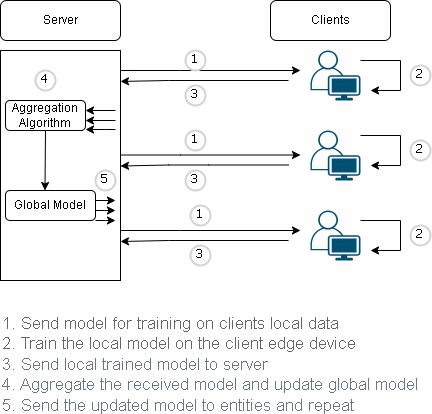
The sequence diagram below illustrates how the model learnswithoutsharingdatawiththeserver

Fig-5: WorkingofProposedmodel
1. The server initially generates random model parameters/weights and shares them with connectedclients.
2. Clients use these initial model parameters/weights to start training with their local data, following the instructions defined in theclientcode.
3. Aftercompletingthetraining,theclientssharethe trainedparameters/weightsbackwiththeserver.
4. Upon receiving the trained parameters/weights from all connected clients, the server performs aggregationusingadefinedaggregationfunction.
5. The aggregated parameters/weights are then used to evaluate the model accuracy on the server,utilizingalocaltestdataset.
6. The newly aggregated parameters/weights are sent to clients for the next round of training, and thecyclecontinuesforNrounds.
It's worth noting that there are two main approaches to evaluating models in federated learning systems: centralized (or server-side) evaluation and federated (or client-side) evaluation. In this implementation, we have optedforthecentralizedapproachforitssimplicity.
To establish a baseline for comparison with Federated Learning (FL) approaches, we trained the same model on the entire datasetfromclients1and2usinga centralized approach. After 70 epochs, we achieved an accuracy of 94.77% on the evaluation dataset. This result serves as our baseline. It's important to note that we haven't optimizedthecentralizedtrainingtoyieldbetteraccuracy, asourprimary goal isto demonstrate thatwithfederated learning, the same level of accuracy can be achieved withoutcompromisingprivacy.
Thefollowingresultswereobtainedbytrainingthemodel for 20 Federated Learning (FL) rounds, totaling 100 epochs. In comparison to centralized training, we observed that an increase of 30 epochs was necessary during federated learning. This adjustment compensated for the loss incurred due to aggregation, ultimately allowingustoachievethesamelevelofaccuracy.
Table-1:ComparisonTable
The Federated Learning (FL) approach yielded accuracy comparabletothecentralizedtrainingofmodels.Although it required more epochs to reach a similar level of accuracy, this was anticipated due to the aggregationinducedloss.Importantly,thedataremainsontheclient's end,mitigatingprivacyrisks.Furthermore,amongthefive FL aggregators, we found that "FedTrimmedAvg" aggregationstrategyperformedthebestforthisparticular scenarioobtaininganaccuracyof94.44%.
International Research Journal of Engineering and Technology (IRJET) e-ISSN:2395-0056 p-ISSN:2395-0072
Volume:11Issue:05|May2024 www.irjet.net
[1] Mohammad Moshawrab ,Mehdi Adda ,ORCID, AbdenourBouzouane,HusseinIbrahim andAli Raad .Reviewing Federated Learning Aggregation Algorithms; Strategies, Contributions, Limitations and FuturePerspectives”,mdpi2023
[2] Paleru Pravallika ,Vemireddy Gnanasri ,Makineni Gireesh ,Avuthu Avinash Reddy ,Vadlamudi Kalpana ,Jasthi Sumitha Chowda. Enhanced COVID-19 detection and privacy preserving using Federated Learning(2023)2023 5th International Conference on Inventive Research in Computing Applications (ICIRCA)|©2023IEEE.
[3] Nadzurah zainal abidin,Amelia Ritahani Ismail, Federated learning for automated detection of diabetic retinopathy(2022) IEEE 8th International Conference on Computing, Engineering and Design (ICCED)
[4] Adnan Ben Mansour , Gaia Carenini ,Alexandre , Duplessis , David Naccache, Federated Learning Aggregation: New Robust Algorithms with Guarantees,arXiv:2205.10864v2[stat.ML]18Jul2022
[5] Dr.Jm. Nandhini ,Ms.SoshyaJoshi, Ms.K.Anuratha, Federatedlearningbasedpredictionofchronickidney diseases 2022 1st international conference on computationl science and technology(ICCST)|@2022 IEEE
[6] G. Pradeep Reddy ,Y. V. Pavan Kumar A Beginner's Guide to Federated Learning 2023 Intelligent Methods, Systems, and Applications (IMSA) ©2023 IEEE
[7] Flower, https://flower.dev/docs/framework, 2024.