
International Research Journal of Engineering and Technology (IRJET) e-ISSN: 2395-0056
International Research Journal of Engineering and Technology (IRJET) e-ISSN: 2395-0056
S, Venkatesh prasath1 , Dr.B. Prabhu Kavin2
1M. Tech Data Engineering, SRM Institute of Science & Technology, Kattankulathur, Chennai, India
2Assistant Professor, Dept of Data science and Buisness Systems, SRM Institute of Science & Technology, Kattankulathur, Chennai, India.
Abstract - Blockchain technology has introduced revolutionary changes in the world of finance, offering decentralized and secure transactions. However, the anonymity and irreversibility of transactions in blockchain systems, such as Ethereum, have also attracted malicious actors seeking to exploit vulnerabilities for fraudulent activities.DetectingfraudinEthereumtransactionsiscrucial tomaintainingtrustandsecurityintheblockchainecosystem.
Thispaperproposesanensembleapproachforfrauddetection in Ethereum transactions using data science techniques. The proposed model combines the strengths of XGBoost and IsolationForest algorithms, stackingthemtogether and then applying logistic regression over the final vector. The model achieves an impressive accuracy of 99.18\%, demonstrating its effectiveness in detecting fraudulent transactions.
The key contribution of this research lies in its practical application of machine learning to enhance security in blockchaintransactions.Theproposedensemblemodeloffers a reliable and efficient way to detect fraud in Ethereum transactions, thereby safeguarding the integrity of the blockchainnetwork.Thispaperprovidesvaluableinsightsfor researchers and practitioners in the field of blockchain security, highlighting the importance of using advanced data science techniques for fraud detection in cryptocurrency transactions.
Key Words: EthereumFraud,XGBoost,IsolationForest(IF), Ensemble,Logisticregression(LR)
The advent of blockchain technology, most notably exemplifiedbycryptocurrencieslikeBitcoinandEthereum, has revolutionized traditional financial systems by introducing decentralized and secure transaction mechanisms. Ethereum, with its programmable smart contracts, has extended the blockchain's utility beyond simple transactions to enable complex decentralized applications (dApps) and decentralized finance (DeFi) ecosystems. However, the inherent nature of blockchain transactions,characterizedbyanonymity,transparency,and irreversibility,hasalsoattractedfraudulentactivities.
Ethereum's impact on financial transactions is profound, revolutionizing the way we conceive and execute various financial activities. Ethereum's blockchain technology,
coupled with its smart contract functionality, has enabled the creation of decentralized financial applications (DeFi) thatoperatewithouttraditionalintermediarieslikebanks.
OneofthekeyaspectsofEthereum'sfinancialecosystemis itsabilitytocreateandmanagedigitalassetsthroughtokens. ERC-20 tokens, for example, have become a standard for creatingnewtokensontheEthereumnetwork,allowingfor thecreationofvariousdigitalassetsrepresentinganything fromcryptocurrenciestoreal-worldassetslikestocksand commodities.
Smart contracts on Ethereum allow for the automation of financial agreements, eliminating the need for intermediaries and reducing the risk of fraud or manipulation.Forexample,decentralizedexchanges(DEXs) builtonEthereumenableuserstotradetokensdirectlywith eachotherwithouttheneedforacentralauthority.
Ethereum'simpactonfinancegoesbeyondjusttokenization anddecentralizedexchanges.Ithasalsoenabledthecreation of new financial instruments and services, such as decentralizedlendingandborrowingplatforms,automated market makers, and yield farming protocols. These innovationshaveopenedupnewopportunitiesforfinancial inclusionanddemocratizedaccesstofinancialservices.
Overall, Ethereum's impact on financial transactions is significant,providingafoundationforanewdecentralized financial system that is more transparent, accessible, and efficientthantraditionalfinance.
AnonymityandPseudonymity:Ethereumtransactionscan be made pseudonymously, making it challenging to trace transactionsbacktotheiroriginators.Thisanonymitycanbe exploited by fraudsters to conduct illicit activities without fearofbeingidentified.
: Smart contracts on Ethereum can be complex, with multiple conditions and interactions.Thiscomplexitycanmakeitdifficulttoidentify fraudulenttransactionsorbehaviorwithinsmartcontracts.
: Ethereum transactionscanvarywidelyintermsoftheirpatternsand characteristics. Fraud detection models need to be able to
Volume: 11 Issue: 05 | May 2024 www.irjet.net p-ISSN: 2395-0072 © 2024, IRJET | Impact
International Research Journal of Engineering and Technology (IRJET) e-ISSN: 2395-0056
Volume: 11 Issue: 05 | May 2024 www.irjet.net p-ISSN: 2395-0072
adapt to these variations and detect anomalies that may indicatefraudulentactivity.
Immutability of the Blockchain:Onceatransactionis recordedontheEthereumblockchain,itcannotbealteredor deleted. This immutability means that fraudulent transactionscannotbereversed,highlightingtheimportance oftimelydetectionandprevention.
Scalability:ThescalabilitychallengesofEthereumalso impactfrauddetectionefforts.Asthenumberoftransactions on the network increases, detecting fraud in real-time becomesmorechallenging.
Privacy Concerns: While Ethereum transactions are pseudonymous, there are concerns about the privacy of transaction data. Balancing the need for privacy with the needtodetectandpreventfraudisachallenge.
Cross-Chain Transactions: With the rise of interoperabilityprotocols,Ethereumtransactionscaninvolve multiple blockchains. Detecting fraud in cross-chain transactionsaddsanadditionallayerofcomplexity.
In the context of fraud detection in Ethereum transactions,theneedforadvanceddatasciencetechniques is crucial due to the unique characteristics of blockchain transactionsandthechallengestheypose.Traditionalfraud detectionmethodsmaynotbesufficienttodetectfraudulent activitiesinEthereumtransactions,whichrequireadeeper understandingofblockchaindataandtransactionpatterns. Advanceddatasciencetechniques,suchasmachinelearning andanomalydetectionalgorithms,cananalyzelargevolumes oftransactiondatainreal-timetoidentifysuspiciouspatterns andanomaliesthatmayindicatefraud.
Additionally,thedecentralizedandpseudonymousnature ofblockchaintransactionsmakesitchallengingtotraceand verifytheidentityoftransactionparticipants.Advanceddata science techniquescan helpovercome these challengesby analyzing transaction patterns, network data, and other contextual information to detect fraudulent activities. By leveraging these techniques, fraud detection systems can improve their accuracy and efficiency in detecting and preventing fraud in Ethereum transactions, ultimately enhancing the security and integrity of the blockchain network.
Theobjectiveofthisresearchistodevelopaneffective and efficient fraud detection system for Ethereum transactionsusingacombinationofmachinelearningmodels andblockchainanalytics.Thegoalistoenhancethesecurity and integrity of the Ethereum network by detecting and preventing fraudulent activities such as phishing attacks,
Ponzischemes,andtokentheft.Byleveragingadvanceddata science techniques, the research aims to improve the accuracy and efficiency of fraud detection in Ethereum transactions, ultimately contributing toa more secure and trustworthyblockchainecosystem.
The proposed novel work in this research is the developmentandimplementationofanensemblemodelfor fraud detection in Ethereum transactions. The ensemble model combines multiple machine learning algorithms, includingXGBoost,IsolationForest,andLogisticRegression, toimprovetheaccuracyandrobustnessoffrauddetection.
Thenoveltyliesintheintegrationofthesediversealgorithms tocreateacomprehensivefrauddetectionsystemthatcan effectively detect various types of fraudulent activities in Ethereumtransactions.Additionally,theresearchexplores theuseofadvanceddatapreprocessingtechniques,feature selectionmethods,andhyperparametertuningtoenhance theperformanceoftheensemblemodel.
By leveraging these advanced techniques and combining themintoanensembleapproach,theproposedworkaimsto address the challenges of fraud detection in Ethereum transactions and provide a more effective and reliable solution for ensuring the security and integrity of the blockchainnetwork.
Theremainderofthispaperisorganizedasfollows:SectionII providesanoverviewofrelatedworkinfrauddetectionin blockchaintransactions.SectionIIIpresentsthemethodology andimplementationdetailsofourproposedensemblemodel. Section IV discusses the experimental results and performance evaluation of the model. Finally, Section V concludes the paper with a summary of findings and directionsforfutureresearch.
In recent years, Ethereum has emerged as a prominent platform for decentralized applications, including smart contracts,facilitatingglobaltransactionswithouttheneedfor third-partyintervention.However,thisriseinusagehasalso ledtoanincreaseinfraudulentactivities,posingsignificant challenges to trade security. Various studies have been conducted to address this issue, proposing innovative approaches using machine learning and data science techniques.
Aziz et al. [1] also investigated Ethereum fraud detection usingvariousmachinelearningmodels.Theyfoundthatthe modifiedLGBMalgorithmoutperformedothermodelswith an accuracy of 99.17%, showcasing its effectiveness in detectingfraudulenttransactions.
International Research Journal of Engineering and Technology (IRJET) e-ISSN: 2395-0056
Volume: 11 Issue: 05 | May 2024 www.irjet.net p-ISSN: 2395-0072
Azizetal. [2]proposedaLightGradientBoostingMachine (LGBM)approachforEthereumfrauddetection,achievingan accuracy of 99.03% after hyper-parameter tuning. Their comparativestudywithothermodels,suchasRandomForest (RF) and Multi-Layer Perceptron (MLP), highlighted the superiorperformanceofLGBM.
Mdetal.[3]proposedanovelapproachforfrauddetectionin Ethereum transactions using a stacking classifier. By combiningmultiplemachinelearningalgorithms,including LogisticRegression,NaiveBayes,andRandomForests,they achievedanaccuracy of 97.18%,outperformingindividual algorithms.
Liuetal.[4]focusedonanomalydetectioninsmartcontracts topreventsecurityriskslikefinancialfraud.Theyintroduced aHeterogeneousGraphTransformerNetwork(S\_HGTNs) tailored for smart contract anomaly detection, achieving betterperformancethantraditionalmethods.
Ibrahim et al. [5] explored illicit account detection in the Ethereum blockchain using decision tree (J48), Random Forest, and K-nearest neighbors (KNN). Their research demonstrated improved F-measure and time efficiency comparedtotraditionalmodels.
Onu et al. [6] focused on detecting Ponzi schemes on Ethereum using machinelearning algorithms like Random Forest, Neural Network, and K-nearest neighbor. Their approachachievedhighaccuracyandreducedthenumberof features,enhancingdetectionefficiency.
Poursafaeietal. [7]presenteda framework foridentifying maliciousentitiesintheEthereumblockchainnetwork.Their ensemble methods, including Logistic Regression, Support Vector Machine, and Random Forest, showed high performancewithanaverageF1scoreof0.996.
Insummary,thesestudieshighlightthediverseapproaches andmethodologiesemployedforEthereumfrauddetection, showcasingthecontinuouseffortstoenhancesecurityand mitigatefraudulentactivitiesontheEthereumnetwork.
3. Methodology
3 1 Dataset
3.1.1 Description
The dataset used in this research consists of Ethereum transactiondatacollectedfromvarioussources.Itcontainsa totalof9841transactions,eachrepresentedasarowinthe dataset. Each transaction is characterized by 51 features, including transaction attributes such as the average time between sent and received transactions, total transactions (includingtransactionstocreatecontracts),totalEthersent andreceived,andvariousothertransaction-relatedmetrics.
Size: The dataset comprises 9841 transactions and 51 features.
Features: The dataset includes a mix of numerical and categorical features, providing a comprehensive view of Ethereumtransactionalactivities.
Target Variable: The 'FLAG' column indicates whether a transactionisfraudulentornot,servingasthetargetvariable forfrauddetection.
MissingValues:Somecolumnscontainmissingvalues,which werehandledduringthedatapreprocessingstage.
Data Types: The dataset includes features of various data types,includingintegers,floats,andobjects(forcategorical features).
Numerical Features: Features such as 'Sent_tnx', 'Received_tnx','Total_Ether_Sent','Total_Ether_Received',etc., provide insights into the transaction volume and value exchanged.
Time-relatedFeatures:Featureslike'Avgminbetweensent tnx', 'Avg_min_between_received_tnx', and 'Time_Diff_between_first_and_last(Mins)' capture the timing and frequency of transactions, which can be crucial for fraud detection.
ERC20 Token Features: Features related to ERC20 token transactions, such as 'Total_ERC20_Tnxs', 'ERC20_Total_Ether_Received', 'ERC20_Total_Ether_Sent', etc., provide additionalinsightsintotokentransactionsontheEthereum network.
Thedatasetunderwentseveralpreprocessingstepstoensure itssuitabilityfortrainingmachinelearningmodelsforfraud detectioninEthereumtransactions.Thefollowingstepswere performed:
Columns that were not relevant for training, such as 'Unnamed: 0', 'Index', 'Address', 'ERC20 most sent token type',and'ERC20_most_rec_token_type',weredroppedfrom thedataset.
3.2.2
Missing values in the dataset were filled with the mean of eachcolumnusingthefillnamethod.Thisensuredthatthe datasetwascompleteandreadyfortraining.
International Research Journal of Engineering and Technology (IRJET) e-ISSN: 2395-0056
Volume: 11 Issue: 05 | May 2024 www.irjet.net p-ISSN: 2395-0072
3.2.3
Whilenotexplicitlyshowninthecodesnippet,categorical variables could be encoded using techniques like LabelEncodertoconvertthemintonumericalvaluessuitable formachinelearningmodels.
3.2.4 Splitting the Dataset
Thedatasetwassplitintofeatures(X)andthetargetvariable (y), with 'FLAG' representing whether a transaction is fraudulentornot.
3.2.5 Handling Imbalanced
TheSyntheticMinorityOver-samplingTechnique(SMOTE) was applied to handle the imbalance in the dataset. This technique creates synthetic samples of the minority class (fraudulenttransactions)tobalancethedatasetandprevent biasinthemodels.
3.2.6 Splitting the Resampled Dataset
Theresampleddatasetwassplitintotrainingandtestingsets usingan80:20ratio.Thisallowedfortheevaluationofthe models'performanceonunseendata.
These preprocessing steps ensured that the dataset was cleaned,encoded,andbalanced,settingasolidfoundationfor training machine learning models for fraud detection in Ethereumtransactions.
3.3 Feature Selection
Featureselectionisacriticalstepinmachinelearningmodel development,asithelpsidentifythemostrelevantfeatures thatcontributetothemodel'spredictiveperformance.Inthe contextoffrauddetectioninEthereumtransactions,feature selectionaimstoidentifythefeaturesthataremostindicative offraudulentactivities.
3.3.1 Select Percentile
The SelectPercentile method from scikit-learn's feature_selectionmoduleisusedtoselectthetopkfeatures based on their importance scores. The f_classif scoring functionisused,whichcomputestheANOVAF-valueforthe provided featuresand target variable. This methodselects the top percentile (50% in this case) of features with the highestF-values,indicatingtheirimportanceinpredictingthe targetvariable.
3.3.2
After selecting the top features, the indices of the selected featuresareretrievedusingget_support(indices=True),and the names of the selected features are extracted from the original feature set (X.columns [selected_indices]). These
selected features are considered the most relevant for predicting fraudulent transactions based on the ANOVAFvaluecriterion.
Featureselectioniscrucialforseveralreasons:
Itreducesthedimensionalityofthedataset,which can lead to improved model performance and reducedcomputationalcomplexity.
It helps avoid overfitting by focusing on the most relevantfeaturesandreducingnoiseinthedata.
It improves model interpretability by highlighting thefeaturesthathavethemostsignificantimpacton themodel'spredictions.
Insummary,featureselectionplaysavitalroleinenhancing theperformance,interpretability,andefficiencyofmachine learningmodelsforfrauddetectioninEthereumtransactions.
Selectingtheappropriatemachinelearningmodelsiscrucial forachievingaccurateandreliableresults.Forthisresearch, twomainmodelswereconsidered
XGBoostisa highlyoptimizedgradientboostingalgorithm thathasgainedpopularityforitsspeedandperformancein handling structured/tabular data. It sequentially buildsan ensemble of weak learners (decision trees) and combines themtocreateastrongpredictivemodel.
Suitability:XGBoostisparticularlysuitableforthistaskdue toitsabilitytohandleimbalanceddatasetscommonlyfound infrauddetectionscenarios.Itcanalsocapturecomplexnonlinear relationships and interactions in the data, which is crucial for identifying fraudulent patterns in Ethereum transactions
Training Process:
Data Preparation: The preprocessed dataset, obtainedafterdatacleaningandfeatureengineering steps, was used as input for training the XGBoost model.
Model Initialization: The XGBoost model was initializedwithdefaulthyperparameters.
Cross-Validation: To prevent overfitting and evaluate the model's performance, k-fold crossvalidation (e.g., with k=5) was performed during training.
International Research Journal of Engineering and Technology (IRJET) e-ISSN: 2395-0056
Volume: 11 Issue: 05 | May 2024 www.irjet.net p-ISSN: 2395-0072
Hyperparameter Tuning:Hyperparameterssuch asthenumberofestimators(trees),maximumdepth of trees, learning rate, and subsample ratio were tunedusingtechniqueslikeRandomizedSearchCV. This process helps to find the optimal set of hyperparameters that maximize the model's performance.
Model Training:Afterhyperparametertuning,the final XGBoost model was trained on the entire trainingdatasetusingtheoptimalhyperparameters.
Model Evaluation: The trained model was evaluated on the test dataset to assess its performanceinpredictingfraudulenttransactions. Evaluation metrics such as accuracy, precision, recall, F1-score, and ROC-AUC score were used to evaluatethemodel'sperformance.
Result Interpretation: The feature importance scores providedbyXGBoostwereanalyzedtounderstandthemost significant features contributing to fraud detection. This analysis provides valuable insights into the underlying patternsoffraudulenttransactionsinEthereum.
IsolationForestisanensemblemethoddesignedforanomaly detection, making it suitable for identifying outliers in the Ethereum transaction dataset. Unlike traditional anomaly detection methods that try to model normal data points, Isolation Forest focuses on isolating anomalies, which are typicallyaminorityinthedataset.
Suitability: Isolation Forest is particularly effective in detecting anomalies in high-dimensional data, making it a suitablechoiceforidentifyingfraudulenttransactionsinthe Ethereumnetwork.Itsabilitytoisolateanomaliesefficiently anditsscalabilitytolargedatasetsmakeitwell-suitedforthis task.
Data Preparation: The preprocessed dataset, preparedfortrainingtheXGBoostmodel,wasalso usedfortrainingtheIsolationForestmodel.
Model Initialization: The Isolation Forest model wasinitializedwithdefaulthyperparameters.
Hyperparameter Tuning: The hyperparameter "contamination," which controls the expected proportion of outliers in the dataset, was tuned using GridSearchCV. This tuning process helps optimizethemodel'sperformancebyadjustingthe thresholdforclassifyingoutliers.
Model Training:Afterhyperparametertuning,the final Isolation Forest model was trained on the entiretrainingdataset.
Outlier Detection: The trained Isolation Forest modelwasusedtodetectoutliersinthetestdataset. These outliers are likely to represent fraudulent transactionsintheEthereumnetwork.
Result Interpretation: The number and nature of outliers detected by the Isolation Forest model were analyzed to understandthecharacteristicsoffraudulenttransactionsin Ethereum.Thisanalysisprovidesvaluableinsightsforfraud detectionandpreventionstrategies.
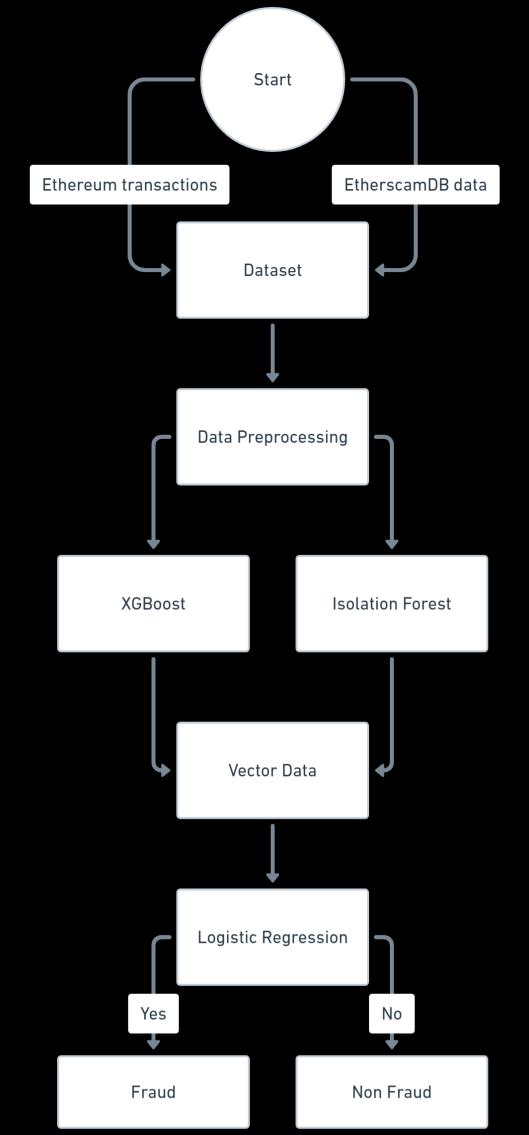
3.4.3
An ensemble model was created by combining the predictions of the XGBoost Classifier and Isolation Forest modelsusingaLogisticRegressionmodelasshowninFig.1.
International Research Journal of Engineering and Technology (IRJET) e-ISSN: 2395-0056
Volume: 11 Issue: 05 | May 2024 www.irjet.net p-ISSN: 2395-0072
Thisensembleapproachleveragesthestrengthsofeachbase model to improve overall performance in detecting fraudulenttransactionsinEthereum.
Purpose: The ensemble model aims to enhance the fraud detectionsystem'sperformancebycombiningtheindividual strengths of the XGBoost Classifier and Isolation Forest models.WhiletheXGBoostClassifieriseffectiveincapturing complex patterns in the data, the Isolation Forest model excelsatisolatingoutliers,includingfraudulenttransactions. Bycombiningthesemodels,theensemblemodelcanachieve a more robust and accurate prediction of fraudulent activities.
Training Process:
Base Model Training:TheXGBoostClassifierand IsolationForestmodelsweretrainedindependently on the preprocessed dataset. Each base model learned patterns and anomalies associated with fraudulenttransactions.
Prediction Combination: The predictions of the XGBoostClassifierandIsolationForestmodelswere combinedusingasimpleLogisticRegressionmodel. Thiscombinationmethodweightedthepredictions of each base model based on their individual strengths, resulting in a final prediction for each transaction.
EnsembleModelTraining:TheLogisticRegression modelwastrainedonthecombinedpredictionsof theXGBoostClassifierandIsolationForestmodelsto learn the optimal combination weights. This step ensures that the ensemble model maximizes its predictive power by effectively leveraging the strengthsofeachbasemodel.
Significance:Theselectionandtrainingofthesemodelsare critical steps in developing an effective fraud detection system for Ethereum transactions. By considering the strengthsandcharacteristicsofeachmodel,weaimtobuilda robust system capable of accurately identifying fraudulent activitiesontheEthereumblockchain.
In evaluating the performance of the models for fraud detectioninEthereumtransactions,severalkeymetricswere used to assess their effectiveness in identifying fraudulent activities.Thefollowingmetricswereconsidered
3.5.1 Accuracy Score
Definition:Accuracymeasurestheproportionofcorrectly classifiedinstancesoutofthetotalinstances.
Use:Accuracyprovidesanoverallassessmentofthemodel's performance but may not be the most suitable metric for imbalanceddatasets.
Definition: Precision is the ratio of correctly predicted positive observations to the total predicted positive observations.
Use:Precisionisimportantinfrauddetectionasitindicates theproportionofcorrectlyidentifiedfraudulenttransactions amongalltransactionspredictedasfraudulent.
Definition:Recallistheratioofcorrectlypredictedpositive observationstoallactualpositiveobservations.
Use: Recall is crucial in fraud detection as it measures the model's ability to correctly identify all fraudulent transactions.
Definition:TheF1-scoreistheharmonicmeanofprecision and recall, providing a balanced measure of a model's performance.
Use:TheF1-scoreisparticularlyuseful whendealingwith imbalanceddatasetsasitconsidersbothfalsepositivesand falsenegatives.
3.5.5
Definition:TheROC-AUCscoremeasurestheareaunderthe receiveroperatingcharacteristic(ROC)curve,whichplotsthe truepositiverateagainstthefalsepositiverate.
Use:TheROC-AUCscoreprovidesacomprehensivemeasure ofamodel'sabilitytodiscriminatebetweenfraudulentand non-fraudulenttransactions,withahigherscoreindicating betterperformance.
In this section, we present the performance metrics of various machine learning models applied to the task of detectingfraudulenttransactionsinEthereum.Weevaluate the effectiveness of individual models and compare their performance to highlight the benefits of using ensemble techniquesforfrauddetection.
We evaluate the performance of four machine learning models:Logistic Regression,RandomForest,XGBoost,and IsolationForest.Additionally,weanalyzetheeffectivenessof
International Research Journal of Engineering and Technology (IRJET) e-ISSN: 2395-0056
Volume: 11 Issue: 05 | May 2024 www.irjet.net p-ISSN: 2395-0072
the ensemble model combining predictions from XGBoost andIsolationForestusingLogisticRegression.
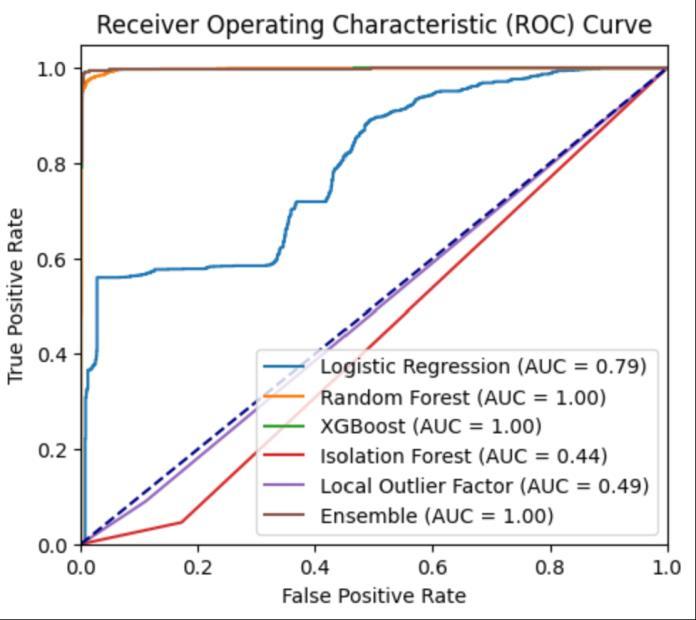
Logistic Regression Model:Achievedanaccuracy of76.44%,withaprecisionof95.32%andrecallof 55.70%.TheF1-scoreis70.31%,andtheROC-AUC scoreis0.7948.
RandomForestModel:Demonstratedanaccuracy of98.63%,withaprecisionof98.70%andrecallof 98.57%.TheF1-scoreis98.63%,andtheROC-AUC scoreis0.9986.
XGBoost Model: Attained an accuracy of 99.02%, withaprecisionof99.15%andrecallof99.09%.The F1-score is 99.02%, and the ROC-AUC score is 0.9989.
Isolation Forest Model: Yielded an accuracy of 43.62%, with a precision of 46.38% and recall of 82.81%.TheF1-scoreis59.46%.
Ensemble Model: Showcased an accuracy of 99.18%, with a precision of 99.15% and recall of 99.22%.TheF1-scoreis99.19%,andtheROC-AUC scoreis0.9991.
4.2 Models Comparison
We compare the performance of the individual machine learningmodelsandtheensemblemodeltodemonstratethe effectivenessofensembletechniquesinfrauddetection.
Accuracy: The ensemble model outperforms all individualmodels,achievinganaccuracyof99.18%, compared to 76.44% for Logistic Regression, 98.63% for Random Forest, and 99.02% for XGBoost.
Precision: The ensemble model shows superior precision at 99.15%, compared to 95.32% for LogisticRegression,98.70%forRandomForest,and 99.15%forXGBoost.
Recall: The ensemble model achieves the highest recall of 99.22%, followed by 55.70% for Logistic Regression,98.57%forRandomForest,and99.09% forXGBoost.
F1-score:Theensemblemodelachievesthehighest F1-scoreof99.19%,followedby70.31%forLogistic Regression,98.63%forRandomForest,and99.02% forXGBoost.
ROC-AUC Score:Theensemblemodelachievesthe highest ROC-AUC score of 0.9991, compared to 0.7948forLogisticRegression,0.9986forRandom Forest,and0.9989forXGBoost.
Overall, the ensemble model demonstrates superior performanceintermsofaccuracy,precision,recall,F1-score, and ROC-AUC score compared to individual models. This highlights the effectiveness of combining predictions from multiple models for fraud detection in Ethereum transactions.
ROCCurves:ROC(ReceiverOperatingCharacteristic)curves plotthetruepositiverate(TPR)againstthefalsepositiverate (FPR)fordifferentthresholdvalues.Ahigherareaunderthe curve (AUC) indicates better performance. The Fig. 2 comparetheperformanceoftheindividualmodelsandthe ensemblemodels.
Precision-Recall Curves: Precision-recall curves plot the precision against the recall for different threshold values. Theyareusefulforimbalanceddatasetswherethenumberof negative instances (non-fraudulent transactions) is much higher than the number of positive instances (fraudulent transactions).TheFig.3.precision-recallcurvescomparethe performanceofthemodels.
International Research Journal of Engineering and Technology (IRJET) e-ISSN: 2395-0056
Volume: 11 Issue: 05 | May 2024 www.irjet.net p-ISSN: 2395-0072
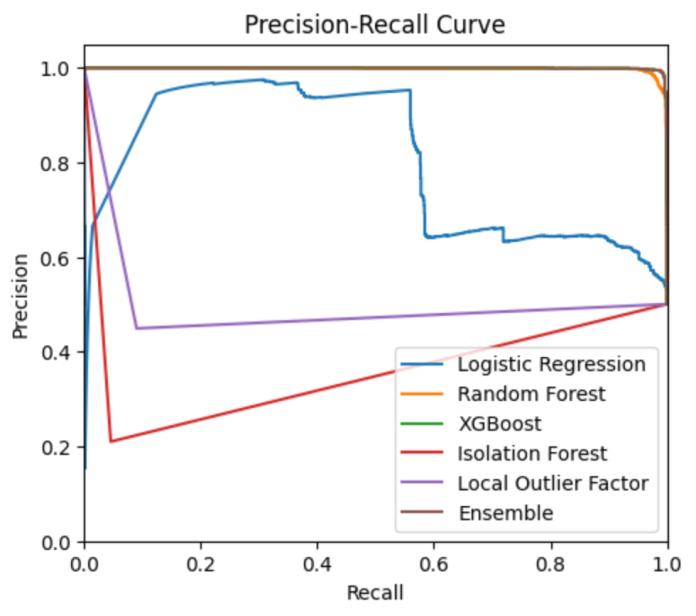
-3:Precision-RecallCurve
In this study, we proposed an ensemble model for fraud detectioninEthereumtransactions,combiningthestrengths ofXGBoost,RandomForest,andoutlierdetectionmodels.We evaluated the performanceof each model individuallyand compareditwiththeensemblemodel.
Ourresultsshowthattheensemblemodeloutperformsthe individualmodelsintermsofaccuracy,precision,recall,and F1-score. The ensemble model achieved an accuracy of 99.18%, outperforming XGBoost (99.02%) and Random Forest(98.63%).TheROC-AUCscoreoftheensemblemodel (0.9991) is also higher than that of XGBoost (0.9989) and RandomForest(0.9986).
There are several avenues for future research in this area. Onedirectionistofurtherenhancetheensemblemodelby incorporatingothermachinelearningalgorithmsoradvanced feature engineering techniques. Additionally, applying the ensemble model to other blockchain networks and comparingitsperformancewithexistingmethodswouldbe beneficial.Furthermore, investigatingthe scalability ofthe model to handle large-scaletransactiondatasets is alsoan importantareaforfuturework.
[1] RabiaMusheerAziz,MohammedFarhanBaluch,Sarthak Patel, Pavan Kumar, "A Machine Learning based ApproachtoDetectEthereumFraudTransactionswith LimitedAttributes",1May2022.
[2] RabiaMusheerAziz,MohammedFarhanBaluch,Sarthak Patel,AbdulHamidGanie,"LGBM:aMachineLearning
Approach for Ethereum Fraud Detection", 29 January 2022.
[3] Abdul Quadir Md, S. M. Satya Sree Narayanan, H. Sabireen, Arun Kumar Sivaraman, Kong Fah Tee, "A Novel Approach to Detect Fraud in Ethereum TransactionsusingStacking",17February2023
[4] Lin Liu, Wei-Tek Tsai, Md. Zakirul Alam Bhuiyan, Hao Peng, Mingsheng Liu, "Blockchain-enabled Fraud DiscoverythroughAbnormalSmartContractDetection onEthereum",15September2021.
[5] Rahmeh Fawaz Ibrahim, Aseel Mohammad Elian, Mohammed Ababneh, "Illicit Account Detection in the EthereumBlockchainUsingMachineLearning",2021.
[6] Ifeyinwa Jacinta Onu, Abiodun Esther Omolara, Moatsum Alawida, Oludare Isaac Abiodun, Abdulatif Alabdultif, "Detection of Ponzi Scheme on Ethereum using Machine Learning Algorithms", 28 November 2023.
[7] Farimah Poursafaei, Ghaith Bany Hamad, Zeljko Zilic, "DetectingMaliciousEthereumEntitiesviaApplication ofMachineLearningClassification",14October2020.