
International Research Journal of Engineering and Technology (IRJET) e-ISSN: 2395-0056
Volume: 11 Issue: 05 | May 2024 www.irjet.net p-ISSN: 2395-0072
International Research Journal of Engineering and Technology (IRJET) e-ISSN: 2395-0056
Volume: 11 Issue: 05 | May 2024 www.irjet.net p-ISSN: 2395-0072
Arkajit Banerjee
Department of Statistics , Acharya Prafulla Chandra College , Kolkata , West Bengal , India ***
Abstract - In this study, we conducted an in-depth investigation intosentimentanalysisofAmazonAlexaproduct reviews using a publicly available dataset sourced from Kaggle. Our research journey commenced with a meticulous ExploratoryDataAnalysis(EDA),unearthingnuancedinsights and patterns inherent within the dataset. Leveraging visualization techniques, we illuminated key trends, sentiments, andcorrelations withintheAmazonAlexareviews landscape. A pivotal aspect of our analysis involved the generation of word clouds, distinguishing between positive and negative sentiments. Through these visual representations, we meticulously showcased prevalent words that drove specific sentiments, enhancing the interpretability of our findings. Moving forward, we undertook rigorous data pre-processingsteps,encompassingstemmingusingthePorter Stemmer algorithm and uniform conversion of all characters to lowercase. Subsequently, we ventured into the realm of sentiment analysis model development,employingthreeofthe most renowned machine learning algorithms:Decision Trees, Random Forests, and XGBoost. Finally, we arrived at a pivotal stage of our study, wherein we evaluated the performance of our sentiment analysis models. Utilizing confusion matrices, we conducted a comprehensive comparative analysis, scrutinizing the accuracy and efficacy of the Decision Trees, Random Forests, and XGBoost models. Our findings shed light on the strengths and limitations of each model, providing invaluableinsights for future sentiment analysisendeavors.In summary, our researchnot onlycontributestotheburgeoning field of sentiment analysis but also offers actionable insights for businesses and stakeholders seeking to comprehend and leverage consumer sentiments within the Amazon Alexa product ecosystem.
Key Words: NaturalLanguageProcessing,BagofWords, PorterStemmer,DecisionTree,XGBoost,RandomForest Classifier
Intoday'sdigitalage,wherevastvolumesoftextualdataare generateddailyacrossvariousonlineplatforms,theneedto extract valuable insights from this data has become paramount. In the ever-evolving landscape of natural languageprocessing(NLP),sentimentanalysisemergesasa critical facet, unraveling the intricate layers of human expressionembeddedintextualdata..Sentimentanalysis,a subfieldofNLP,involvestheautomatedidentificationand classification of sentiments expressed in text, enabling
organizationsandindividualstounderstandpublicopinion, consumersentiment,andmarkettrends.ByleveragingNLP techniques, sentiment analysis algorithms analyze text at scale,uncoveringvaluableinsightsthatcaninformdecisionmakingprocessesacrossamyriadofdomains.Frommarket research and brand sentiment analysis to social media monitoring and customer feedback analysis, sentiment analysis finds applications in diverse fields, including marketing, finance, customer service, politics, and healthcare.Understandingthenuancesofsentimentanalysis andharnessingthepowerofNLPtechniquesareessential for unlocking actionable insights from textual data and gainingacompetitiveedgeintoday'sdata-drivenlandscape.
ThispaperaimstoshedlightontheimperativeroleofNLP techniquesinsentimentanalysisanditsfar-reachingimpact oncustomerreviewsofAmazonAlexaReviews.Sentiment analysis plays a crucial role in understanding user interactions and feedback within voice-activated virtual assistants like Amazon Alexa. As one of the most popular virtual assistants on the market, Amazon Alexa interacts withmillionsofusersdaily,processingvoicecommandsand providing responses to queries across a diverse range of tasks,includingsettingreminders,playingmusic,controlling smart home devices, and providing weather updates. SentimentanalysisofuserinteractionswithAmazonAlexa can provide valuable insights into user satisfaction, preferences,andareasforimprovement,enablingAmazon andthird-partydeveloperstoenhancetheuserexperience and tailor responses to better meet user needs. By integratingrobustmachinelearningtechniqueslikeDecision Trees,RandomForests,andXGBoostintotheanalysisofuser sentimentinteractionswithAmazonAlexa,stakeholderscan gaindeeperinsightsintousersentimentandbehaviorinthe rapidlyevolvinglandscapeofvoice-activatedtechnology.
The key take-aways from the paper will be the rigorous exploratory data analysis (EDA) as well as the modelling approach.Therestofthepaper’sstructureisdelineatedas follows:Section2delvesintothepertinentbackgroundand literature survey. In Section 3, the experimental methodologyisexpounded,encompassingtheelucidationof theories, methods, approaches employed. Section 4 elucidates the results and graphs derived from the experimental procedures. Section 5 provides insights into theConclusionandFuture Plans. Thelastsectionisabout references.
International Research Journal of Engineering and Technology (IRJET) e-ISSN: 2395-0056
Volume: 11 Issue: 05 | May 2024 www.irjet.net p-ISSN: 2395-0072
Sentiment analysis is useful for businesses to make wellinformed decisions because it helps to understand customers' opinions and sentiments towards products. Amineetal[1]provideathoroughcomparisonofsentiment analysismethodsusedonAmazonproductreviewsinthis article.Inparticular,AmineetaluseRandomForest,Support Vector Machines (SVM), and Logistic Regression three well-liked machine learning algorithms. Their research focuses on assessing these algorithms' performance for sentiment classification in terms of F1 score, accuracy, precision, and recall. They make use of a meticulously selected dataset of Amazon product reviews that encompasses a wide variety of products and customer opinionsandevaluatethebenefitsanddrawbacksofeach algorithmforextractingsentimentfromthereviewsthrough in-depthtestingandanalysis.Thestudy'sconclusionsshed important light on how well Random Forest, SVM, and LogisticRegressionworkwhenanalyzingthesentimentof Amazonproductreviews.
The quick growth of e-commerce websites has forced consumerstoshopinnewways.Inadditiontoconvenience, onlineshoppingoffersusers"suggestions."Additionally,alot of customer reviews are constantly available on shopping websites, which aids in decision-making and provides additionalinformationabouttheproduct.Xuetal[2]used three models in this paper to represent the sentiment analysisofAmazonreviews: RandomForest,NaiveBayes, andSVM.Toimprovecomparisons,thesemodelsaretrained usingtokencountsandtermfrequency-inversedocument frequency (TF-IDF) features. The dataset containing information about Amazon reviews is explored, and classification performances are assessed using precision, recall,andF-1scores.Thefindingsdemonstratethatwhile SVMandRandomForestmodelsperformwellonpositivelabeleddata,theyperformpoorlyonnegative-andneutrallabeleddata.Forallthreecategories,NaiveBayesperforms thebestoverall.Classifications,however,couldbeskewedin the analysis. As a result, additional advancements in this fieldofstudyareanticipatedinordertoproduceoptimaland moreaccurateoutcomes,aswellastheimplementationof moremachinelearningmodels.
InordertodeterminetheeffectivenessofChatGPT,reviews from individuals of diverse ages and educational backgroundsareanalysedbyBharatietal[3] todetermine people'ssentiment.Fourdistinctmachinelearningmodels andtwohybridmodelsthatcombinedSVM+DecisionTree and Random Forest + Logistic Regression were used in a comparativeanalysis.Thepollalsoexaminedthedifferent impactsofChatGPTuse,includinghowitmakespeoplefeel more drowsy and impairs their capacity for reasoned thoughtandproblem-solving
Numerous strategies have attempted to use the feature ensemble method to enhance the performance of tweet sentiment analysis techniques. The majority of earlier approaches,however,focusedonmodelingwordsyntactic informationratherthantakingintoaccountthesentiment context of the words. Furthermore, few studies have discussedtheeffectsofphraseswithambiguoussentiment ortheplacementofwords.Inordertoaddresstweetswith fuzzysentiment,Huyenetal[4]suggestedanovelmethod based on a feature ensemble model that takes into consideration word elements like lexical, word type, semantic, position, and sentiment polarity. Experiments usingrealdatashowthatthesuggestedmethodiseffective inenhancingtweetsentimentanalysisperformanceinterms oftheF1score.
Inthisproject,PraveenKumaretal[5]shedlightonthefact that data produced by textual comments in addition to ratingshelpwitheffectivedataclassificationratherthanjust ratingsalone,andtheyalsogetavarietyofinsightsfromthe analysis.Whensomeonewantstopurchaseaproduct,they typically look up reviews first before deciding whether or nottobuy.Toputitanotherway,theuseronlylooksatthe ratingbeforechoosing.Sinceweareawarethatratingscan occasionallymisleadconsumersandshouldnotbetheonly factorconsideredwhenmakingadecision,theauthorsare comparing ratings with comments to improve the effectivenessandveracityofproductreviews.
In this paper, Ayesha et al.[6] employed machine learning algorithmssuchasSVM,randomforest,andnaivebayesto solve the sentiment analysis problem on any Amazon product.Followingpreprocessing,thequalifyingdatasetsare classified using the SVM and naive bayes algorithms to removesuperfluousdatapoints,suchasconjunctions,verbs, and punctuation. The accuracy offered by these existing algorithms was insufficient. The SVM, random forest, and naive bayes algorithms were applied in this work. The quantity of reviews a product receives indicates how accurateitis.
ThedatasetusedinthispaperwasgatheredbySadhasivam etal [7]from the official productwebsites. Thesereviews must first be pre-processed to eliminate unnecessary information like conjunctions, stop words, verbs, and punctuations.Followingpre-processing,thetraineddataset isclassifiedusingtheSVMandNaiveBayesalgorithms.The accuracy that these current algorithms produced was insufficientlyvaluable.Asaresult,anensembleapproachhas beenusedtoimprovethereviews'accuracy.Anensembleis a classification strategy that combines two or more algorithms and determines the mode value for each algorithmbyusingthevotereference.Thispapercombines theensemblealgorithm,SVM,andNaiveBayes.Comparedto the current algorithm, the authors proposed an Ensemble method that helps provide better accuracy. The user is
International Research Journal of Engineering and Technology (IRJET) e-ISSN: 2395-0056
Volume: 11 Issue: 05 | May 2024 www.irjet.net p-ISSN: 2395-0072
advisedtopurchasethespecificproductaftertheaccuracy hasbeendeterminedbasedonthereviews.
Data Description : Nestledwithinthevastexpanseofdigital repositories lies the Amazon Alexa customer reviews dataset, a treasure trove of invaluable insights awaiting discovery.SourcedfromKaggle,thisdatasetisatestamentto therichtapestryofconsumerexperienceswithintherealm ofvoice-activatedtechnology.Comprisingfivecolumns,each imbuedwithuniquesignificance,itoffersapanoramicview of customer sentiments and interactions. The "rating" column stands as a beacon, illuminating the spectrum of customersatisfactionwithnumericalprecision,rangingfrom ahumble1toaresplendent5.Meanwhile,the"date"column servesasatemporalcompass,guidingusthroughtheebb and flow of consumer sentiment over time. As for "variation," it unveils the diverse array of Amazon Alexa productsthathavecapturedtheimaginationofconsumers worldwide, each variation a testament to the boundless innovation within the realm of smart devices. The "verified reviews" column, a treasure trove of descriptive prose, unveils the heartfelt musings and candid critiques penned by customers, offering a glimpse into their experiencesandperceptions.However,thenarrativedoes notendthere;astrokeofingenuitygracesthisdatasetwith the addition of an "length" column. Crafted by the author, this column bears witness to the power of computational analysis,quantifyingtheessenceofeachreviewintheform ofcharactercounts.Throughthelensofthe“len”function, eachreview'slengthismeticulouslyrecorded,providinga nuancedperspectiveonthedepthandbreadthofconsumer feedback.Inessence,thisdatasettranscendsmererowsand columns,embodyingtheessenceofconsumersentimentand technologicalinnovationinthedigitalage.
:
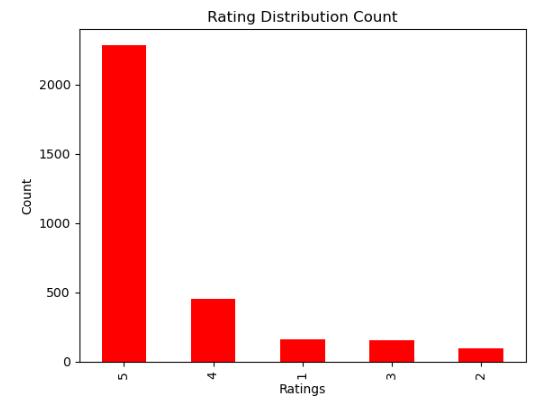
A bar graph displays the distribution of ratings, showcasingthefrequencyofeachrating(yaxis)to ratings(xaxis)categorytoprovideinsightintothe distributionofcustomersentiments.
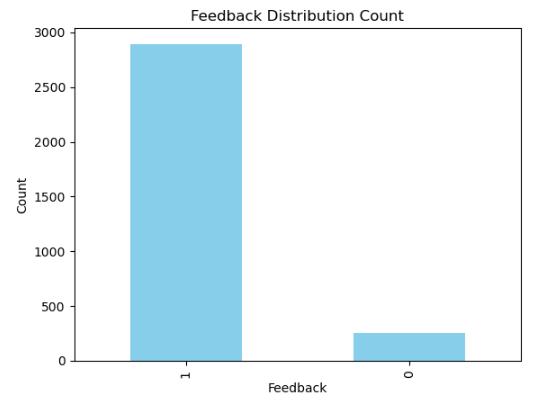
Afeedbackvs.countbargraphwascraftedtounveil the distribution of feedback within the dataset, showcasingthefrequencyofeachfeedback.Here, feedback 1 signifies positive reviews, while feedback0denotesnegativesentiments
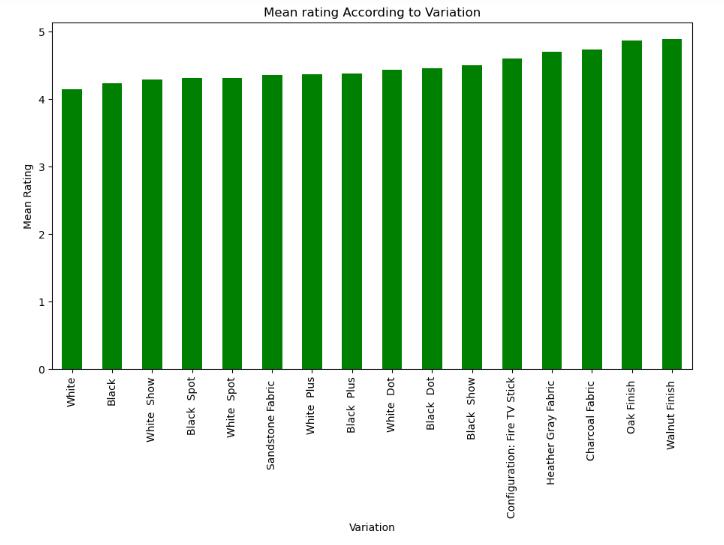
A bar graph was created to illustrate the mean ratingacrossdifferenttypesofAlexaproducts,with variationsdepictedonthex-axis.
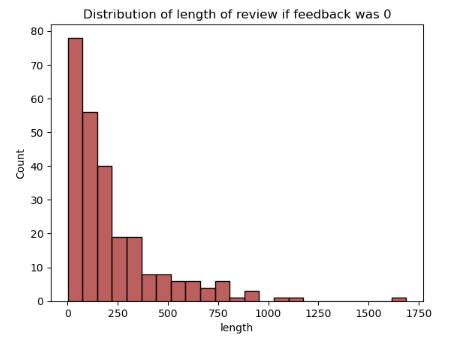
Distributionoflengthofreviews(bothpositiveand negative)havealsobeenplotted.
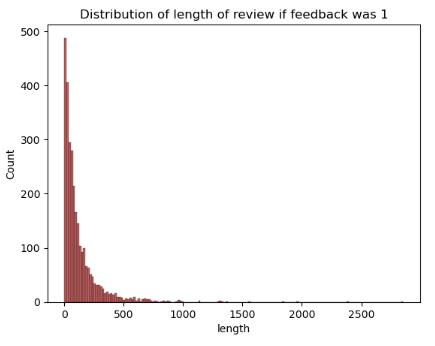
was1(positive)
International Research Journal of Engineering and Technology (IRJET) e-ISSN: 2395-0056
Volume: 11 Issue: 05 | May 2024 www.irjet.net p-ISSN: 2395-0072
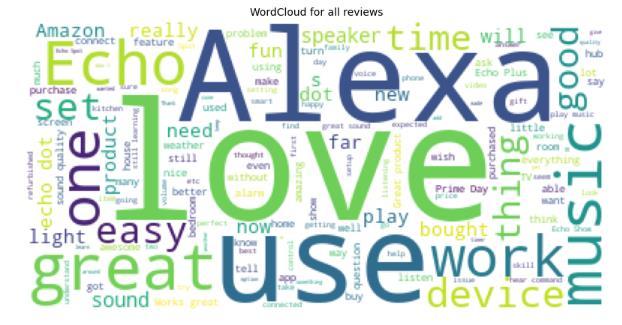
A wordcloud was drawn for all reviews with maximum wordsof150.Someofthehighlightedwordswere“Alexa”, “Love”,“Use”,“Echo”
In preparation for our sentiment analysis, we begin by constructingacorpusfromthe"verifiedreviews"columnof our dataset. A corpus, in the context of natural language processing,referstoacollectionoftextdocumentsordata used for linguistic analysis. To ensure uniformity and consistency in our textual data, we perform a series of preprocessing steps. Firstly, we replace any non-alphabet characters with a space, ensuring that only alphabetic charactersremaininourcorpus.Subsequently,weconvert alltexttolowercasetostandardizethetextrepresentation andmitigatetheimpactofcasesensitivity.Followingthis,we tokenize the text by splitting it into individual words, facilitatingfurtheranalysisatthewordlevel.Torefineour corpusandstreamlinesubsequentanalyses,weemploythe Porter Stemmer algorithm a widely used stemming algorithm in NLP. The Porter Stemmer algorithm reduces words to their base or root form, effectively removing inflections and suffixes. This process aids in consolidating semantically similar words, thereby enhancing the interpretabilityandefficiencyofouranalyses.Byiteratively applyingthePorterStemmeralgorithmtoeachwordinour corpus and excluding stopwords commonly occurring
words with minimal semantic value we curate a refined andstandardizedcorpuspoisedforcomprehensiveanalysis.
FollowingtheapplicationofthePorterStemmeralgorithm to refine our corpus, we proceed to employ the CountVectorizer technique for feature extraction and representation. CountVectorizer, a pivotal component in natural language processing, transforms our textual data into a numerical format suitable for machine learning algorithms. The CountVectorizer technique operates by constructing a "bag of words" representation a fundamental concept in NLP. The bag of words model represents each document as a vector, where each dimensioncorrespondstoauniquewordinthevocabulary, andthevalueofeachdimensionrepresentsthefrequencyof thatwordinthedocument.CountVectorizeraccomplishes thisbyfirstconstructingavocabularyofalluniquewordsin the corpus and then converting each document into a numerical vector based on the count of words in the vocabulary. This process yields a document-term matrix, where rows correspond to documents and columns correspondtowords,witheachcellcontainingthecountof thecorrespondingwordinthedocument.Subsequently,to facilitate future analyses and ensure reproducibility, we serializetheCountVectorizerobjectusingthePythonpickle module. Pickle enables us to save Python objects, such as CountVectorizer,todiskinabinaryformat,preservingtheir state and structure. By storing the serialized CountVectorizerobjectin"models/countVectorizer.pkl,"we can easily reload and reuse it in subsequent analyses or deploy it in production environments, streamlining the processoftransformingnewtextdataintoasuitableformat formachinelearningtasks.30%datawillbeusedfortesting.
Wenowmovetothemodeldescriptionandbuildingstage.
Amongthesupervisedlearningmethodsisthewell-known machine learning algorithm Random Forest [8]. It can be applied to ML problems involving both classification and regression.Itsfoundationistheideaofensemblelearning, whichistheprocessofmergingseveralclassifierstosolvea challengingissueandenhancethemodel'sfunctionality.If there are more trees in the forest, accuracy is higher and overfittingisavoided.
Two assumptions required for better Random Forest Classifier are : (i) for the classifier to forecast accurate resultsinsteadofaguess,thefeaturevariableofthedataset needs to contain some real values and (ii) each tree's predictionsneedtohaveextremelylowcorrelations.
LetsunderstandhowtheRandomForestclassifierworks:
Dataset Preparation: Begin with a labeled dataset containing features (independent variables) and correspondingtargetlabels(dependentvariable). Random
International Research Journal of Engineering and Technology (IRJET) e-ISSN: 2395-0056
Volume: 11 Issue: 05 | May 2024 www.irjet.net p-ISSN: 2395-0072
Sampling: Randomly select a subset of the dataset with replacement (bootstrapping) to create multiple training datasets. Feature Selection: Randomly select a subset of featuresfromthedatasettotraineachdecisiontreeinthe forest.Thispromotesdiversityamongthetreesandreduces correlationbetweenthem. Decision Tree Construction:For each training dataset, construct a decision tree using a subsetoffeatures.Ateachnodeofthetree,choosethebest split based on a criterion such as Gini impurity or informationgain. Ensemble Creation:Repeatsteps2-4to createaspecifiednumberofdecisiontrees(ensemble).
Prediction:Tomakepredictionsfornewdata,passthedata througheachdecisiontreeintheensemble.Forclassification tasks,eachtreecastsa"vote"forthepredictedclass,andthe majority class is selected as the final prediction. For regressiontasks,thepredictionsfromalltreesareaveraged to obtain the final prediction. Evaluation: Evaluate the performanceoftheRandomForestmodelusingappropriate evaluation metrics such as accuracy, precision, recall, F1score, or mean squared error, depending on the task. Feature Importance:Assesstheimportanceoffeaturesin making predictions by analyzing how much each feature contributes to the model's accuracy. This can be done by calculating feature importance scores based on measures such as mean decrease in impurity or mean decrease in accuracy. Tuning Parameters:Fine-tunetheparametersof the Random Forest model, such as the number of trees (n_estimators),maximumdepthoftrees(max_depth),and minimum number of samples required to split a node (min_samples_split), through techniques like crossvalidationtooptimizeperformance. Deployment:Oncethe model is trained and evaluated satisfactorily, deploy it to makepredictionsonnew,unseendata.
XGBoost [9], short for Extreme Gradient Boosting, is a powerful and efficient machinelearning algorithm known foritsexceptionalperformanceinclassification,regression, and ranking tasks. It employs a gradient boosting framework,whereweaklearners(typicallydecisiontrees) aresequentiallyaddedtotheensemble,eachcorrectingthe errorsmadebythepreviouslearners.XGBoost'skeyfeatures include regularization techniques to prevent overfitting, parallel and distributed computing capabilities for scalability,andsupportforcustomlossfunctionstohandle diverse objectives. Its optimization algorithm efficiently findstheoptimaltreestructure,anditsflexibilityallowsfor fine-tuning of hyperparameters to optimize performance. XGBoost has garnered widespread adoption in various domainsduetoitsspeed,accuracy,andversatility,makingit ago-tochoicefordatascientistsandpractitionersseeking state-of-the-artmachinelearningsolutions.
LetsunderstandhowtheXGBoostClassifierworks:
Dataset Preparation: Begin with a labeled dataset containing features (independent variables) and correspondingtargetlabels(dependentvariable). Initialize Base Learner:Startwithaninitialbaselearner,typicallya decision tree, and fit it to the training data.Compute Residuals: Compute the residuals (the difference between the actual and predicted values) for each sample in the trainingdata. Fit a New Tree:Fitanewdecisiontreetothe residuals,aimingtominimizetheresiduals'error.Thistree is added to the ensemble, incrementally improving the model'spredictivepower. Update Predictions:Updatethe model's predictions by adding the predictions of the new treetothepreviouspredictions.Themodellearnsfromthe mistakesoftheprevioustrees,graduallyreducingtheoverall error. Regularization:Applyregularizationtechniques,such as tree pruning and feature subsampling, to prevent overfittingandenhancethemodel'sgeneralizationability. Repeat Steps 3-6: Iterate the process by computing residuals,fittingnewtrees,andupdatingpredictionsuntila predefined stopping criterion is met, such as reaching a specified number of trees or achieving satisfactory performance on a validation set. Predictions: To make predictionsfornewdata,passthedatathrougheachtreein the ensemble and aggregate the predictions to obtain the final prediction. For regression tasks, predictions are typically averaged across all trees, while for classification tasks,avotingmechanismisusedtodeterminethepredicted class. Evaluation:EvaluatetheperformanceoftheXGBoost model using appropriate evaluation metrics such as accuracy,precision,recall,F1-score,ormeansquarederror, dependingonthetask. Hyperparameter Tuning:Fine-tune the hyperparameters of the XGBoost model, such as the learningrate,maximumdepthoftrees,andregularization parameters, through techniques like cross-validation to optimizeperformance.
The Decision Tree [10] classifier is a versatile and interpretable machine learning algorithm used for both classificationandregressiontasks.Itoperatesbyrecursively partitioningthefeaturespaceintodistinctregionsbasedon thevaluesofinputfeatures,witheachpartitionrepresenting adecisionruleornode.Ateachnode,thealgorithmselects the feature that best splits the data, typically based on criteria such as Gini impurity or information gain, to maximize the homogeneity of the resulting subsets. This processcontinuesuntilastoppingcriterionismet,suchas reachingamaximumtreedepthorachievingpuritywithin theleafnodes.DecisionTreesoffertransparencyinmodel interpretation, as the resulting tree structure provides insightintothedecision-makingprocess.However,theyare prone to overfitting with complex datasets, necessitating techniqueslikepruningandregularizationtomitigatethis risk. Despite their simplicity, Decision Trees serve as
International Research Journal of Engineering and Technology (IRJET) e-ISSN: 2395-0056
Volume: 11 Issue: 05 | May 2024 www.irjet.net p-ISSN: 2395-0072
foundationalmodelsinmachinelearning,formingthebasis for more complex ensemble methods like Random Forest andGradientBoosting.
LetsunderstandhowtheDecisionTreeClassifierworks:
Dataset Preparation: Begin with a labeled dataset containing features (independent variables) and correspondingtargetlabels(dependentvariable). Feature Selection: Identify the feature that best splits the dataset intohomogeneoussubsetsbasedonachosencriterion,such asGiniimpurityorinformationgain. Node Creation:Create anoderepresentingthechosenfeatureanditssplitcriterion, partitioningthedatasetintotwoormorechildnodesbased on the feature's values. Recursive Splitting: Repeat the featureselectionandnodecreationprocessrecursivelyfor each child node until a stopping criterion is met, such as reachingamaximumtreedepth,achievingpuritywithinthe leafnodes,orexceedingaminimumnumberofsamplesper leaf. Leaf Node Assignment: Assign a class label or regression value to each leaf node based on the majority classoraveragetargetvalueofthesampleswithinthenode.
Prediction:Tomakepredictionsfornewdata,traversethe decisiontreefromtherootnodetoaleafnodebasedonthe valuesoftheinputfeatures.Thepredictionisthenbasedon theclasslabelorregressionvalueassignedtotheleafnode reached. Evaluation: Evaluate the performance of the DecisionTreemodelusingappropriateevaluationmetrics such as accuracy, precision, recall, F1-score, or mean squared error, depending on the task. Hyperparameter Tuning:Fine-tunethehyperparametersoftheDecisionTree model,suchasthemaximumtreedepth,minimumsamples perleaf,andcriterionfornodesplitting,throughtechniques likecross-validationtooptimizeperformance.
4.1 Evaluation
Aconfusionmatrixisapowerful toolusedtoevaluatethe performance of a classification model by presenting a comprehensive summary of the model's predictions comparedtotheactualclasslabelsinthedataset.Itprovides aclearandconcisebreakdownofthemodel'sclassification results, enabling the calculation of various performance metrics.
Here's how a confusion matrix helps evaluate a model's performance:
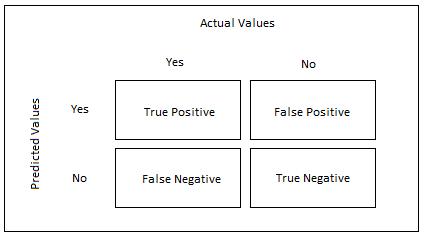
Fig7:StructureofaConfusionMatrix
True Positives (TP): Thecaseswherethemodelcorrectly predictsthepositiveclass.
False Positives (FP): Thecaseswherethemodelincorrectly predictsthepositiveclasswhenitisactuallynegative(Type Ierror).
True Negatives (TN): Thecaseswherethemodelcorrectly predictsthenegativeclass.
False Negatives (FN): The cases where the model incorrectly predicts the negative class when it is actually positive(TypeIIerror).
By organizing these four outcomes into a matrix, the confusion matrix provides a clear visualization of the model's performance across different classes. From this matrix,variousevaluationmetricscanbederived,including:
Accuracy:Theproportionofcorrectlyclassifiedinstances amongallinstances(TP+TN/Total).
Precision: The proportion of true positives among all instancespredictedaspositive(TP/(TP+FP)).
Recall (Sensitivity):Theproportionoftruepositivesamong allactualpositiveinstances(TP/(TP+FN)).
F1-score: The harmonic mean of precision and recall, providingabalancedmeasureofamodel'sperformance.
Specificity: The proportion of true negatives among all actualnegativeinstances(TN/(TN+FP))
False Positive Rate (FPR): Theproportionoffalsepositives amongallactualnegativeinstances(FP/(FP+TN)).
International Research Journal of Engineering and Technology (IRJET) e-ISSN: 2395-0056
Volume: 11 Issue: 05 | May 2024 www.irjet.net p-ISSN: 2395-0072
The confusion matrix corresponding to each machine learningalgorithmisstatedbelow:
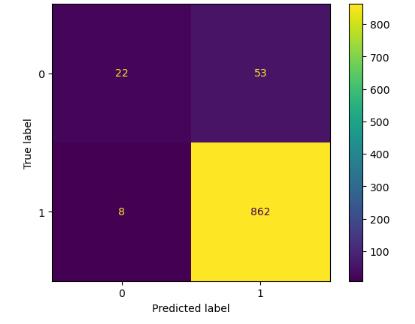
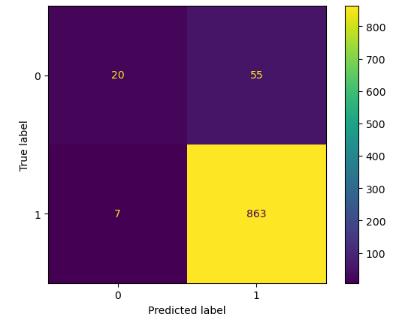
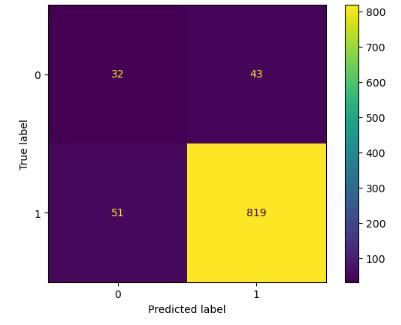
TheaccuracyvaluescorrespondingtoTrainandTestDataset areshownbelowforeachcorrespondingalgorithm:
Table -1: ComparisonofTrainDataAccuracyforthe differentalgorithms Algorithm
RandomForestClassifier 0.9941043083900227
XGBoostClassifier 0.9700680272108844
DecisionTreeClassifier 0.9941043083900227
Interpretation:
TheRandomForestandDecisionTreeclassifiersachieved similarhighlevelsofaccuracy 99.41%each,indicatingthat theyperformedexceptionallywellonthetraindataset.
TheXGBoostclassifierachievedaslightlyloweraccuracyof 97.01%comparedtotheRandomForestandDecisionTree classifiers, but still demonstrated strong predictive performance.
Table -2: ComparisonofTestDataAccuracyforthe differentalgorithms Algorithm
RandomForestClassifier 0.9354497354497354
XGBoostClassifier 0.9343915343915344
DecisionTreeClassifier 0.9037037037037037
Interpretation:
TheRandomForestandXGBoostclassifiersachievedsimilar levels of accuracy on the test dataset, with accuracies of approximately93.54%and93.44%,respectively.
The Decision Tree classifier achieved a slightly lower accuracy compared to the Random Forest and XGBoost classifiers,withanaccuracyofapproximately90.37%.
Both the Random Forest and XGBoost classifiers outperformedtheDecisionTreeclassifieronthetestdataset, demonstratingtheirsuperiorpredictiveperformance.
Basedontheseaccuracyscores,boththeRandomForestand XGBoostclassifiersperformsimilarlywellonthetestdataset. However,theRandomForestclassifierhasaslightlyhigher accuracycomparedtotheXGBoostclassifier,indicatingthatit mayperformslightlybetterinthisparticularscenario
International Research Journal of Engineering and Technology (IRJET) e-ISSN: 2395-0056
Volume: 11 Issue: 05 | May 2024 www.irjet.net p-ISSN: 2395-0072
Inconclusion,thisstudydelvedintosentimentanalysisof AmazonAlexacustomerreviews,employingthreedistinct machinelearningalgorithms:RandomForest,XGBoost,and DecisionTreeclassifiers.Theevaluationofthesemodelson the test dataset revealed promising accuracies, with the Random Forest and XGBoost classifiers demonstrating particularly robust performance, achieving accuracies of approximately 93.54% and 93.44%, respectively. These findings underscore the efficacy of machine learning techniquesindiscerningsentimentfromcustomerreviews, offering valuable insights into consumer perceptions of AmazonAlexaproducts.
Movingforward,thereexistintriguingavenuesforfurther explorationandenhancementofthiswork.Futureresearch endeavorscouldexploretheintegrationofadvancednatural languageprocessingtechniques,suchasdeeplearning-based approaches, to capture more nuanced sentiments and improve model performance. Additionally, incorporating sentiment analysis of multimedia content, such as images and audio reviews, could provide a comprehensive understanding of customer sentiment across diverse modalities,enrichingtheinsightsgleanedfromthisanalysis. By embracing these future directions, researchers can continue to advance the field of sentiment analysis and contribute to a deeper understanding of consumer sentiments in the context of emerging technologies like AmazonAlexa.
[1] Amine, El & Zouhair, Abdelhamid. (2024). Sentiment Analysis Based on Machine Learning Algorithms: ApplicationtoAmazonProductReviews.10.1007/9783-031-48573-2_38.
[2] Xu, Beiyu & Gan, Hongwu & Sun, Xinyue & Shao, Xiaoying.(2023).SentimentanalysisofAmazonproduct reviews. Applied and Computational Engineering. 6. 1673-1681.10.54254/2755-2721/6/20230831.
[3] Bharati, Alokam & Bhargavi, Motamarri & Harshith, K.V.N.D. & K, Srinivasa. (2023). A Comparative SentimentAnalysisonChatGPTReviewsusingMachine Learning Models1-6 10.1109/ICCCNT56998.2023.10306609.
[4] Huyen Trang Phan, Dosam Hwang “Improving the PerformanceofsentimentanalysisofTweetsContaning Fuzzy Sentiments Using the feature Ensemble Model” IEEEAccess,Volume8,Feb2020.
[5] Praveen Kumar, T. & Pamulaparty, Mr. (2023). SentimentAnalysisofOnlineProductsusingRatingsand Reviews,14thInternationalConferenceonAdvancesin
Computing, Control, and Telecommunication Technologies,Hyderabad
[6] Naureen, Ayesha & Siddiqa, Ayesha & Devi, Pothereddypally. (2022). Amazon Product Alexa’s SentimentAnalysisUsingMachineLearningAlgorithms. Inbook:InnovationsinElectronicsandCommunication Engineering10.1007/978-981-16-8512-5_57.
[7] Sadhasivam, Jayakumar & Babu, Ramesh. (2019). SentimentAnalysisofAmazonProductsUsingEnsemble Machine Learning Algorithm. International Journal of Mathematical,EngineeringandManagementSciences.4. 508-520.10.33889/IJMEMS.2019.4.2-041.
[8] Khaled Fawagreh, Mohamed Medhat Gaber & Eyad Elyan(2014)Randomforests:fromearlydevelopments to recent advancements, Systems Science & Control Engineering, 2:1, 602-609, DOI: 10.1080/21642583.2014.956265
[9] Chen, Tianqi & Guestrin, Carlos. (2016). XGBoost: A Scalable Tree Boosting System.22nd ACM SIGKDD International Conference 785-794. 10.1145/2939672.2939785.
[10] Quinlan,J.R.Inductionofdecisiontrees. Mach Learn 1, 81–106(1986).ttps://doi.org/10.1007/BF00116251
[11] Darshan,K&Samuel,Jerusha&Swamy,Manjunatha& Koparde, Prashant & Shivashankara, N. (2024). NLPPowered Sentiment Analysis on the Twitter. Saudi Journal of Engineering and Technology. 9. 1-11. 10.36348/sjet.2024.v09i01.001.

Arkajit Banerjee is an Undergraduate student at the DepartmentofStatistics,Acharya PrafullaChandraCollege,Kolkata. He has been associated with several research projects under supervision of professors from premierinstituteslikeIITIndore, IIM Indore , IIIT Ranchi , IIM Ranchi.Heisanactivememberof JadavpurUniversityMathematical Societyalso.Hisresearchinterests include Copula Theory , GARCH Models,RecommendationSystems , and real life application of ML techniques in various business domains.