
International Research Journal of Engineering and Technology (IRJET) e-ISSN:2395-0056
Volume: 11 Issue: 05 | May 2024 www.irjet.net p-ISSN:2395-0072
International Research Journal of Engineering and Technology (IRJET) e-ISSN:2395-0056
Volume: 11 Issue: 05 | May 2024 www.irjet.net p-ISSN:2395-0072
Dr. Sonali Dhokpande 1 , Mrudula Mane 2, Prajakta Diwale 3 , Rutika Patil4
1Professor, Department of Chemical Engineering, Datta Meghe College of Engineering, Navi Mumbai, Maharashtra, India
2,3,4 UG Student, Department of Chemical Engineering, Datta Meghe College of Enineering , Navi Mumbai, Maharashtra, India
Abstract – This study aims to investigate the influential properties affecting Residence Time Distribution (RTD) in a series of Continuous Stirred Tank Reactors (CSTRs). The parameters under consideration include flow rate, choice of tracer material, mixing efficiency, and inlet concentration. The research is motivated by the critical role RTD plays in determining the efficiency and effectiveness of chemical reactions within reactor systems. By systematically varying these parameters, this study seeks to provide insights into how they impact the distribution of residence times, which, in turn, influences the overall performance of the reactor series. The predicted outcomes of this investigation will give a valuable insight of effect of influential factors on the resulting RTD profiles. By knowing how alterations in these parameters affect the distribution of residence times, this study helps to contribute important knowledge that can useful to improve reactor system designs and operational practices. Ultimately, this will lead to enhanced efficiency and effectiveness across a wide range of chemical processes, happening in various industries and different applications. This project employs tracer materials to monitor reactant movement within the series of Continuous Stirred Tank Reactors (CSTRs). Through careful selection, these tracers provide valuable insights into residence time distributions (RTD). Tracer concentrations will be accurately detected using a titration process, enabling the construction of detailed concentration profiles. This combined approach enhances the precision of our analysis, forming a solid foundation for drawing meaningful conclusions from the experimental data
Key Words: Residence Time Distribution1, Continuous Stirred Tank Reactors2, Flow Rate, Tracer Material3, Mixing Efficiency4, inlet concentration5
1.INTRODUCTION
In the field of chemical engineering, understanding the behavior of reactants within reactors is of importance for optimizingtheindustrialprocesses.Onecrucialparameter in this regard is the Residence Time Distribution (RTD), which serves as a tool in informing us about the duration eachcomponentofamixturespendsinsideareactor.This distributionisnecessaryin determiningtheefficiencyand effectiveness of chemical reactions. Essentially, RTD
enables us to understand how reactants travel through a reactor system, making it an vital tool in designing and refiningchemicalprocesses.[1][8][9]
Residence Time Distribution is particularly significant in the context of Continuous Stirred Tank Reactors (CSTRs). CSTR reactor is a large mixing vessel that continuously blendsreactantsandconverttheminto the products. This reactor type is widely used in industries where precise controloverreactionsisimperative.WhenmultipleCSTRs are connected in series, it creates a sequential flow of reactants, where the output of one reactor becomes the inputofthenext.UnderstandinghowRTDinteracts witha series of CSTRs is important in determining the overall efficiency and yield of chemical reactions in complex systems. By connecting CSTRs in series, we essentially create a controlled environment for reactions to progress in stages, enabling more complex chemical transformations. This arrangement finds widespread application in industries where precise control over reactionpathwaysandoutcomesisessentialforproducing high-quality products. Understanding the interplay between RTD and CSTRs in series is pivotal in optimizing reactor design and operational conditions for specific chemicalprocesses.[6][7]
Industries such as chemical manufacturing, petrochemical refining, pharmaceuticals, environmental engineering, food and beverage production, and biotechnology utilize Residence Time Distribution (RTD) in Continuous Stirred Tank Reactors (CSTRs) in series. This configuration ensuresprecisecontroloverreactionsandproductquality in processes like polymerization, catalytic cracking, drug synthesis, wastewater treatment, fermentation, and more. RTD analysis is particularly valuable in optimizing chemical reactions and ensuring consistent, high-quality outputsacrossarangeofindustrialsectors.[3]
1.1 Objective of project
• InvestigatetheimpactofflowrateonRTDina seriesofCSTRs.
• Evaluate the effect of mixing efficiency on RTD.
• Assess the influence of inlet concentration on RTD.
Volume: 11 Issue: 05 | May 2024 www.irjet.net p-ISSN:2395-0072
• WhichparameterhasmaximumeffectonRTD inseries.
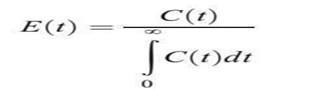
In a CSTR system, by pulse input experiment, a tracer substance is introduced as a sudden concentration spike and this provides valuable information about the flow patterns, mixing, and residence time distribution in CSTR systems. Theoretical graphs are developed to describe the behaviorofthetracersubstanceintheCSTRsystem.These graphs consider factors such as dispersion, mixing, and residencetimedistribution.Thiscanbeusedtopredictthe expected concentration profiles and residence time distribution curves for both pulse input experiments. The resultscanhelpoptimizethereactorconfiguration,suchas the number of reactors in series, their volumes, and the flow rates. Tracer studies and the comparison of experimental results can aid in process optimization and scale-up of CSTR systems. By understanding the flow behaviour and mixing characteristics, process parameters can be adjusted to achieve desired reaction kinetics and product quality. The insights gained from tracer studies canalsofacilitatethescaling-upofCSTR systemstolarger production capacities while maintaining efficient mixing and residence time distribution. These studies contribute to the understanding and improvement of CSTR systems for various applications, ranging from fine chemical synthesis to industrial-scale production processes. There are different formulas which are used to calculate the tracer tests and they are given as, For tracer pulse tests, the response will be a concentration profile, C(t), that has the same shape as the residence time distribution, E(t). The RTD can be calculated by normalizing the concentrationprofilebytheareaunderneaththeprofile:
2.1
The reactor setup consists of three Continuous Stirred Tank Reactors (CSTRs) arranged in series. Each reactor is equipped with inlet and outlet ports to facilitate the continuous flow of reactants and products through the system. Within each reactor, mixing apparatus such as impellers ensures thorough agitation and homogenization ofthereactionmixture.Thereactorsareinterconnectedin suchawaythattheoutletofonereactorfeedsdirectlyinto the inlet of the next, creating a sequential flow path. This configuration allows for the observation of how reactants progress through each reactor in succession, experiencing different residence times and mixing conditions. By controlling parameters such as flow rates, mixing
efficiency, and inlet concentrations helps to investigate their influence on the Residence Time Distribution (RTD) within the system. The setup is designed to provide insights into the behavior and performance of CSTRs in series,whichisessentialforoptimizingreactordesignand operationinvariouschemicalprocesses.[1][3][12]
A tracer is chemically inactive substance which is used to track the flow of feed through a reactor. Various tracer materialswillbechosenbasedontheircompatibility with thereactantsandeaseofdetection.Tracershave different properties such as density, ionic strength, ability to disperse in fluid. The tracer concentration provides valuableinformationabouttheresidencetimedistribution (RTD) and mixing behavior within the reactors. KCl or NaCl used as chemical tracer for stability, solubility, feasibility readily available. Hence, monitoring the tracer concentration, it is possible to determine the mean residence time into the system. In this experiment. This tracers are commonly used tracer in residence time distribution (RTD) studies due to its high solubility, low cost, and ease of detection using a conductivity meter.[2][3][8]
To initiate the experiment, a Continuous Stirred-Tank Reactor (CSTR) is primed with 250 ml of deionized water toestablishinitialconditions,guaranteeingcomprehensive mixingto achievehomogeneity. Subsequently,theCSTR is injected with a 0.05 M NaCl tracer solution at an initial flow rate of 150 ml/min. Over a total duration of 60 minutes, conductivity meter readings are meticulously recorded at 5-minute intervals to track the behavior and dispersionofthetracerwithinthesystem.[9][12]
Multiple iterations of the experiment will be executed under diverse conditions to evaluate the impacts of varying parameters on the Residence Time Distribution (RTD) curves for both NaCl and KCl tracers. Parameters under scrutiny include flow rate, mixing efficiency, and tracer concentration. Each iteration will strictly adhere to the identical procedure to uphold consistency and reliability of results. Conductivity meter readings will be takenacross a spectrum of conditions, encompassing 0.01 Mand0.05Mmixtures,flowratesof150ml/minand140 ml/min,andagitationspeedsof100rpmand200rpm.It's noteworthy that while parameters are manipulated, all otherexperimentalconditionsremainconstantthroughout each iteration. After collecting the data, calculate and plot RTD curves for each set of conditions tested was carried out. Analysis of the RTD curves will involve determining keycharacteristic suchasconcentrationchangeandmean residence time determination. By comparing RTD curves obtained under different conditions, we'll gain insights intotheimpactofeachparameteronreactorperformance. International Research Journal of Engineering and Technology (IRJET) e-ISSN:2395-0056
International Research Journal of Engineering and Technology (IRJET) e-ISSN:2395-0056
Volume: 11 Issue: 05 | May 2024 www.irjet.net p-ISSN:2395-0072
By analyzing the concentration-time data, and RTD-time curve,theRTDofthereactorcanbedetermined.TheRTD provides information about the distribution of residence timesoffluidelementswithinthereactor.[3][12]
Table -1: Concentration at different conditions for NaCl tracer
30
Table 2: Concentration at different conditions for KCl tracer
3. Resultant Graph and Analysis
3.1 NaCl TRACER:
3.1.1 INITIAL CONCENTRATION:
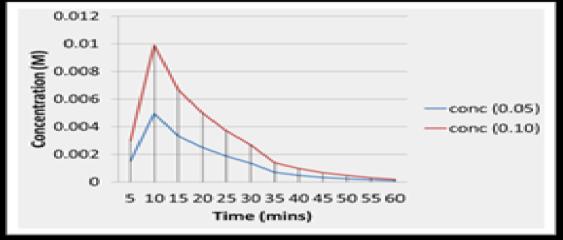
Chart -1:ConcentrationvsTimegraphfor initial concentrationparameterofNaCltracer
The RTD curve for NaCl displays sharper peaks and a shorter tail due to its status as a strong electrolyte. In water, NaCl readily dissociates into sodium (Na⁺) and chloride (Cl⁻) ions, enhancing its ionic strength. This characteristic enables NaCl to rapidly mix and disperse throughout the solvent. The sharp peaks signify uniform residence times within the reactor, indicating efficient mixing and dispersion of NaCl. Overall, NaCl's strong electrolytic properties facilitate rapid and thorough mixing, underscoring its effectiveness as a tracer material forstudyingreactordynamics.[2][4][5]
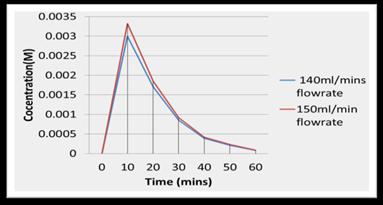
Chart-2:ConcentrationvsTimegraphforflowrate parameterofNaCltracer
At a higher flow rate of 150 ml/min, NaCl experiences shorter residence times within the Continuous Stirred Tank Reactors (CSTRs), leading to accelerated mixing and dispersionthroughoutthesystem.Theincreasedflowrate facilitates a more rapid turnover of reactants within the reactor, reducing the time they spend inside. Consequently, there's less time for reactants to remain in stagnant zones, promoting more vigorous mixing and dispersion of NaCl throughout the reactor volume. This results in a more homogeneous distribution of NaCl, contributing to efficient process performance. Conversely, atalowerflowrateof140ml/min,NaClencounterslonger residencetimeswithintheCSTRs,leadingtoslowermixing and dispersion. With reduced flow rates, the reactants spend more time within the reactor, allowing for greater interaction and mixing.. This can result in slower dispersion of NaCl and less uniform reaction conditions, potentially impacting process efficiency and product quality. Therefore, the flow rate plays a crucial role in determining the residence time and mixing dynamics within the CSTR, influencing the overall performance of thesystem.[5][10][11]
International Research Journal of Engineering and Technology (IRJET) e-ISSN:2395-0056
Volume: 11 Issue: 05 | May 2024 www.irjet.net p-ISSN:2395-0072
3.1.3 MIXING EFFICIENCY:
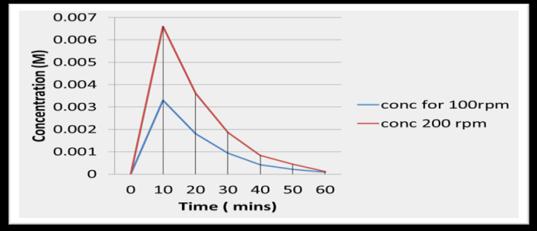
Chart -3:ConcentrationvsTimegraphformixing efficiencyparameterofNaCltracer
At a higher mixing efficiency of 200 rpm, NaCl undergoes more vigorous mixing within the Continuous Stirred Tank Reactors(CSTRs),resultinginshorterresidencetimesand enhanced dispersion throughout the system as increased agitationfacilitatesfasterandmorehomogenizationofthe tracer thoroughout solvent, promotingrapiddispersion of tracer material. Consequently, tracer experience shorter residence times within the reactor, leading to efficient reaction kinetics and improved process performance. Conversely, at a lower mixing efficiency of 100 rpm, NaCl encounters less vigorous mixing, leading to longer residence times and slower dispersion. The reduced agitationresultsinlesseffectivemixingofNaClwithinthe reactor, leading to uneven distribution and slower dispersion throughout the system, potentially affecting reaction efficiency and product quality. Therefore, mixing efficiencyplaysacriticalroleindeterminingtheresidence timeanddispersiondynamicswithintheCSTR,influencing theoverallperformanceofthesystem.[1][4][6]
3.2.1 INITIAL CONCENTRATION:
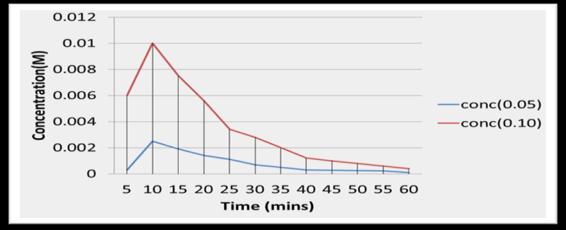
Chart-4:ConcentrationvsTimegraphforinitial concentrationparameterofKCltracer
The RTD (Residence Time Distribution) curve for KCl demonstratesbroaderpeaksandalongertailcomparedto NaCl. This characteristic can be attributed to the properties of KCl as a slightly weaker electrolyte with lowerionicstrength.UnlikeNaCl,whichreadilydissociates into sodium and chloride ions, KCl exhibits slower dissolution kinetics due to its weaker electrolytic nature. As a result, KCl ions disperse more slowly within the solvent, leading to less efficient mixing and dispersion
throughout the system. The broader peaks in the RTD curve indicate less uniform residence times within the reactor, suggesting uneven distribution of KCl. Additionally, the longer tail signifies prolonged residence times or delayed dispersion of KCl, potentially due to its slowerdissolutionkinetics.Overall,theweakerelectrolytic properties of KCl result in slower mixing and dispersion dynamics within the CSTR, influencing the shape of the RTD curve and potentially impacting process efficiency andperformance.[2][7][11]
3.2.2 FLOWRATE:
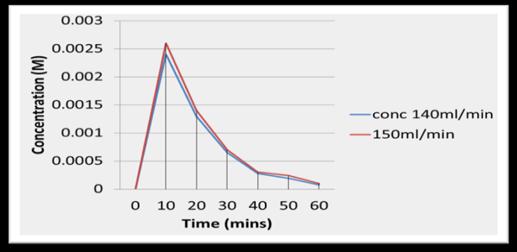
Chart-5:ConcentrationvsTimegraphforflowrate parameterofKCltracer
3.2.3 MIXING EFFICIENCY:
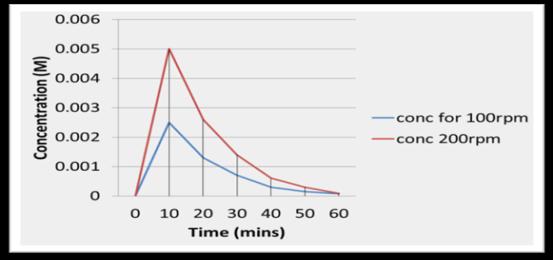
Chart -6:ConcentrationvsTimegraphformixing efficiencyparameterofKCltracer
Despite sharing the same mixing rates as NaCl (100 rpm and 200 rpm), KCl is anticipated to exhibit a slower decrease in concentration over time due to its weaker properties.TheweakerelectrolyticnatureofKClresultsin slower dissolution and dispersion kinetics within the system, leading to a slower rate of uniform distribution throughouttheCSTRs.Asa consequence, KCl takeslonger to reach a homogeneous distribution within the reactor system, resulting in prolonged residence times and reduced overall process efficiency. This delayed and less uniformdistributionofKCl underscorestheimportanceof considering the electrolytic properties of tracers in CSTR systemsandhighlightstheneedfortailoredapproachesto optimize mixing dynamics and enhance process performance.[10][11][12]
International Research Journal of Engineering and Technology (IRJET) e-ISSN:2395-0056
Volume: 11 Issue: 05 | May 2024 www.irjet.net p-ISSN:2395-0072
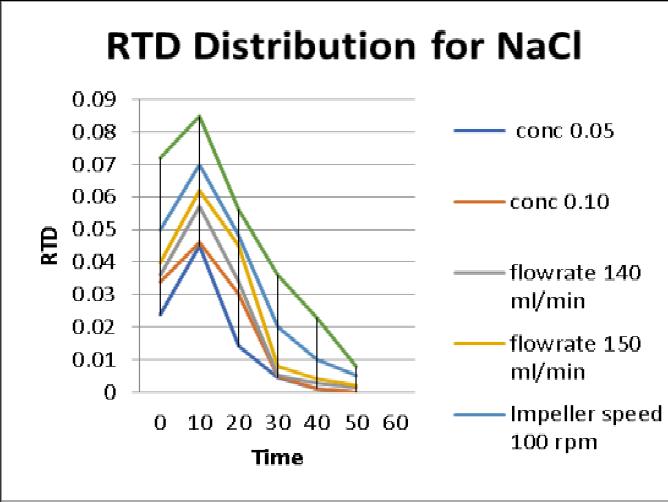
Chart-7: RTDgraphforallthevariantsofallthe parametersforNaCltracer
The combined RTD graph illustrates how different parametersimpactthedistributionofresidencetimesand mixingefficiencywithinthereactorsystemusingNaClasa tracer. When comparing mixing efficiencies of 200 rpm and 100 rpm, the RTD curve at 200 rpm exhibits a narrowerandtallerpeak,indicatingmoreeffectivemixing andfastermaterialturnover.Incontrast,theRTDcurveat 100 rpm shows a broader and shorter peak, suggesting lessefficient mixing and longer residence times. Similarly, varyingflowratesof150ml/minand140ml/minresultin distinct RTD curves. The higher flow rate (150 ml/min) leads to a broader and shorter peak, indicating faster material turnover and shorter residence times, while the lower flow rate (140 ml/min) shows a narrower peak, suggesting slower flow and potentially longer residence times. Additionally, differences in initial concentrations of 0.1 M and 0.05 M influence the shape of the RTD curve. The higher initial concentration (0.1 M) results in a steeper and taller peak, reflecting faster dispersion and reaction rates, whereas the lower initial concentration (0.05 M) exhibits a gentler slope and lower peak height, indicating slower dispersion and reaction kinetics.[2][3][5][6]
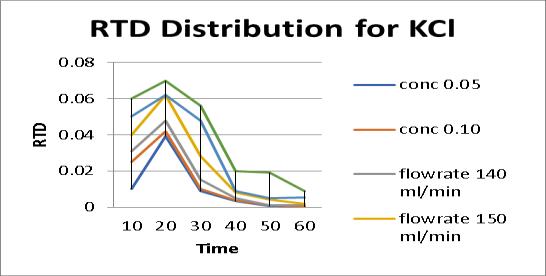
Chart-7: RTDgraphforallthevariantsofallthe parametersforKCltracer
After conducting experiments with KCl as a tracer and varying mixing efficiency, flow rate, and initial concentration, the combined RTD graph reveals insightful patterns. Comparing mixing efficiencies of 200 rpm and 100 rpm, the RTD curve at 200 rpm tends to exhibit a narrowerandtallerpeak,indicatingmoreeffectivemixing and faster material turnover within the reactor system. Conversely, the RTD curve at 100 rpm typically shows a broader and shorter peak, suggesting reduced mixing efficiency and potentially longer residence times for KCl tracer. Similarly, variations in flow rates of 150 ml/min and140ml/minresultindistinctshapesoftheRTDcurve. Thehigherflow rate(150 ml/min)leadstoa broader and shorter peak, reflecting faster material turnover and shorterresidencetimes,whereasthelowerflowrate(140 ml/min)resultsinanarrowerpeak,indicatingslowerflow and potentially longer residence times for KCl dispersion. Additionally, differences in initial concentrations of 0.1 M and 0.05 M influence the RTD curve's characteristics. A higher initial concentration (0.1 M) typically results in a steeperandtallerpeak,representingfasterdispersionand reactionrates,whilealowerinitialconcentration(0.05M) shows a gentler slope and lower peak height, suggesting slower dispersion and reaction kinetics for KCl tracer. [3][8]
While the general trends in RTD curves were similar for KCl and NaCl tracers under varying experimental parameters, subtle differences arose due to specific properties of each tracer. KCl, being a slightly weaker electrolyte compared to NaCl, exhibited differences in dissolution rates and dispersion behavior within the reactorsystem.Thesedifferenceshighlighttheimportance of considering tracerspecific characteristics when analyzing RTD behavior and optimizing reactor performance in chemical engineering applications. [3][9][12]
In conclusion, our project underscores the critical importance of mixing efficiency as the most influential parameter impacting Residence Time Distribution (RTD) within a Continuous Stirred Tank Reactor (CSTR) system. The findings reveal that variations in mixing efficiency exerted the most substantial effect on RTD compared to flow rate and initial concentration adjustments. Manipulating mixing efficiency allows for precise control over residence times and material dispersion within the reactor,leadingtooptimizedreactionkineticsandproduct quality.
Following mixing efficiency, the project highlighted the significant impact of flow rate on RTD characteristics. Changes in flow rate influenced material turnover rates and residence times within the reactor, affecting overall processefficiency.
International Research Journal of Engineering and Technology (IRJET) e-ISSN:2395-0056
Volume: 11 Issue: 05 | May 2024 www.irjet.net p-ISSN:2395-0072
Whileinitialconcentration variationsalsoinfluencedRTD, their impact was comparatively less pronounced than mixing efficiency and flow rate as the effect of initial concentrationof feedvanishesasthemixingbegins.So by strategicallymanipulatingmixingefficiency,flowrate,and initialconcentration,operatorscanachieveprecisecontrol over process dynamics and reactor performance. Optimizing these parameters enhances process efficiency, reducesproductioncosts,andimprovesproductqualityby ensuring uniform mixing, controlled residence times, and efficientutilizationofreactants.
Wearethankful to,Dr.Mrs. SONALI.R.DHOKPANDE,our project guide for mentoring us throughout the course and forsharinghervaluableknowledgeandtime.Shehasbeen a constant source of motivation, never expecting anything lessthanthebestefforts.Withoutherconcern,adviceand motivation it would have been difficult to complete the project. Weare also gratified to the Chemical Engineering Department,DattaMegheCollegeofEngineeringforgiving ustheopportunitytoconductthisproject.
[1] Cherkasov, Nikolay and Adams, Samuel J. and Bainbridge, Edward G. A. and Thornton, Jonty A. M. Continuous stirred tank reactors in fine chemical synthesis for efficient mixing, solids-handling and rapid scale-up. Chem. Eng.2023, Volume 8, Issue 2, Page 266-277. Published by "The Royal Society of Chemistry”.
[2] BushraKhatoon, ShoaibKamil Hitesh Babu, M. SirajAlam. Experimental analysis of Cascade CSTRS with step and pulse inputs. Volume 78, Part 1, Pages 40-47.Availableonline23November2022,Versionof Record20March2023.
[3] Eze P. C. Jonathan, A. Emmanuel, Okoronkwo, Emmanuel A, Akin, M. Phillips. Improving the Transient Response Performance of CSTR Using MRAC.IREJournals,Volume3,Issue1,July2019.
[4] D. Rajavathsavai, A. Khapre and B. Munshi. Study Of Mixing Behavior OfCSTR UsingCFD. Brazilian Journal of Chemical Engineering. Vol 31, Issue 01, Page 119179,January-March,2014.
[5] Hurtado, F.J.; Kaiser, A.S.; Zamora, B. (March 2015). "Fluid dynamic analysis of a continuous stirred tank reactor for technical optimization of wastewater digestion". Water Research. Volume 7 Issue 1, 15 March 2015, Pages 282-293. Received 18 September 2014, Revised: 26 November 2014, Accepted: 28 November2014,Available:9December2014.
[6] P. Toson, P. Dos, D. Jajcevic, Explicit residence time distribution of a generalised cascade of continuous stirred tank reactors for a description of short recirculation time (bypassing). Processes 2019, 7(9), 615.Received:30July2019,Revised:22August2019, Accepted: 5 September 2019, Published: 10 September2019
[7] Michael R. Chapman's, Maria H. T Kwans, Georgina Kings Katherine E Jolleys Mariam Hussain, ShahedHussain, Ibrahim E Salama, Carlos Gonzalez Niño, Lisa A. Thompsons, Mary E. Bayana, Adam D. Clayton,BaoNNguyen,NicholasJ.Turner,NikilKapur, and A. John Blacker. Simple and Versatile Laboratory ScaleCSTRforMultiphasicContinuousFlowChemistry and Long Residence Times. Organic Process Research & Development 2017. Volume 21, Issue (9), Pages 1294-1301.PublicationDate:June28,2017.
[8] Mimi Zhu, Linan Zhang, Benduan Cheng, Mingmin Zhang, Qiuhan Lin. Synthesis process optimization of 4,4′-azobis(1,2,4-triazole)inacontinuousstirredtank reactor(CSTR). FirePhysChem,2023,ISSN26671344.
[9] Mo, Yiming and Jensen, Klavs F. A miniature CSTR cascade for continuous flow of reactions containing solids. Reaction Chemistry & Engineering. Volume 1, Issue 5, pages 501-507, Year: 2016. Publisher : The RoyalSocietyofChemistry.
[10] Hessel V, Kralisch D, Kockmann N, Noël T, Wang Q. Novelprocesswindowsforenabling,accelerating,and uplifting flow chemistry. ChemSusChem. Volume 6, Issue(5),Pages:746-789, 2013May.Epublication18 april2013.
[11] Minister E. Obonukut,1Uwem E. Inyang, Perpetua G. Bassey and Benjamin R. Etuk. Journal of Multidisciplinary Engineering Science Studies. ISSN: 2458-925XVol.3Issue5,May -2017ResidenceTime DistributionofThreeStirredTankReactorsinSeries
[12] Dewan, Lillie & Shantanu, Chatterji & Sharma, Rishi. (2017). Experimental Analysis of Process Faults of CSTR.