
International Research Journal of Engineering and Technology (IRJET) e-ISSN: 2395-0056
Volume: 11 Issue: 05 | May 2024 www.irjet.net p-ISSN: 2395-0072
International Research Journal of Engineering and Technology (IRJET) e-ISSN: 2395-0056
Volume: 11 Issue: 05 | May 2024 www.irjet.net p-ISSN: 2395-0072
Omkar Dengi , Assistant Professor, Dept. of Computer Science, Dr. D.Y. Patil ACS
College Pimpri
Pune, Maharashtra, India
Abstract - Face detection and recognition are essential components of computer vision with wide-ranging applications in security, surveillance, biometrics, and humancomputer interaction. This paper provides a thorough comparative analysis of classicalandmodernmethodsforface detection andrecognition.Traditionalapproaches,foundedon predefined rules and handcrafted features, established the groundwork for contemporaryalgorithms.Techniquessuchas Viola-Jones, HOG, Eigenfaces, Fisherface, LBP, and ASM are adept at extracting relevant features for face detection. Meanwhile, machine learning-based methods like SVM, k-NN, and Decision Trees excel in classifying regions for recognition tasks. In contrast, modern methodologiesharnessthepowerof deep learning and sophisticated techniques for superior performance. Models like RetinaFace, BlazeFace, ArcFace, CenterFace, InsightFace, DeepFace, FaceNet, SphereFace,and DeepID leverage deep neural networks to achieve enhanced accuracy and efficiency. Additionally, this paper delves into emerging trends such as 3D face recognition and cloud-based solutions like Amazon Rekognition. Overall, modern based methods outperform classical techniques in terms of accuracy andefficiency, especiallywhendealingwithlargedatasetsand challenging conditions.
Key Words: Face detection , Face recognition, RetinaFace, BlazeFace, ArcFace, CenterFace, InsightFace, DeepFace, FaceNet, SphereFace, Machine learning, Amazon Rekognition, Deep Learning
Facedetectionandrecognitionareintegralcomponentsof computervisionsystemsdesignedto identifyandanalyze faces within images or video streams. One of the most interestingandsuccessfulapplicationsofpatternrecognition and image analysis is face recognition, which stands as a prominent biometric authentication technique. Face detection and recognition are fundamental tasks in computervisionwithwidespreadapplicationsinsecurity, surveillance,human-computerinteraction,andmore.This paperpresentsacomprehensiveoverviewoftheevolution offacedetectionandrecognitiontechniques,fromclassical methodstomoderndeeplearning-basedapproaches.
Face recognition system has two main tasks: Face detection and Face recognition
Face detection istheprocessoflocatinghumanfaceswithin imagesorvideoframes.Thegoalistoidentifythepresence and location of faces, typically represented as rectangular bounding boxes around detected faces. Face recognition goes beyond face detection, identifying and verifying individualsbasedontheiruniquefacialfeatures.Itinvolves comparingdetectedfaceswithadatabaseofknownfacesto determinetheiridentity.Facerecognitionsysteminvolves verification and identification process. Face verification means a 1:1 match that compares a face images against a templatefaceimageswhoseidentityisbeingclaimed.Face identificationinvolvescomparingaqueryfaceimageagainst all image templates in a face database, which is a 1: N problem.
TheprocessoffacerecognitioncanbeillustratedinFig1.
Fig1: Face Recognition Process
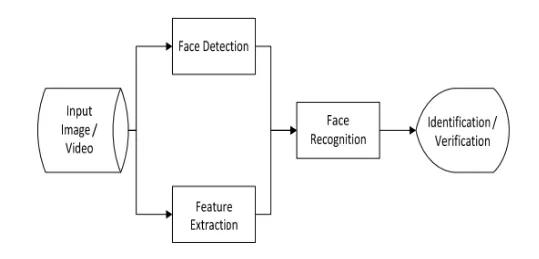
Inanyfacerecognition system,thefirststepistodetecta face in an image. The main goal of face detection is to determineifthereareanyfacespresentintheimage.
Ifafaceisdetected,thesystemreturnsthelocationofeach faceintheimage.Inthefacerecognitionprocess,theinput image, also known as a probe, is compared with the database, referred to as a gallery. A match report is generated, followed by classification to determine the subpopulationtowhichnewobservationsbelong.
International Research Journal of Engineering and Technology (IRJET) e-ISSN: 2395-0056
Volume: 11 Issue: 05 | May 2024 www.irjet.net p-ISSN: 2395-0072
This paper provides a comprehensive overview of the evolution of face detection and recognition techniques, tracingtheirdevelopmentfromclassicalmethodstomodern deeplearning-basedapproaches.
Classical face detection methods, characterized by predefined rules and handcrafted features, laid the foundationforsubsequentadvancementsinthefield.These methods,includingtheViola-Jonesalgorithm,Histogramof Oriented Gradients (HOG), Eigenfaces, Fisherface, Local Binary Patterns (LBP), and Active Shape Models (ASM), focusedonextractingdiscriminativefeaturestodetectfaces within images. While template matching methods offered simplicity and robustness, they faced challenges in scalabilityandnoisetolerance.Templatematchingmethods, though simple and robust, struggled with scalability and noisetolerance.
The advent of machine learning revolutionized face detectionandrecognition.SupportVectorMachines(SVM), k-Nearest Neighbors (k-NN), and Decision Trees offered robust classification capabilities. The advent of machine learningmarkedasignificantmilestoneinfacedetectionand recognition. Support Vector Machines (SVM), k-Nearest Neighbors (k-NN), and Decision Trees introduced robust classification capabilities, paving the way for more sophisticatedtechniques.
Modern face detection and recognition methods leverage deep neural networks to achieve superior performance. Techniques such as RetinaFace, BlazeFace, ArcFace, CenterFace,InsightFace,DeepFace,FaceNet,SphereFace,and DeepIDutilizesophisticatedarchitecturesandlossfunctions to attain state-of-the-art accuracy and efficiency. Additionally,emergingtrendssuchas3Dfacerecognition, whichleveragesdepthinformationforenhancedrobustness, andcloud-basedsolutionslikeAmazonRekognition,offering scalable and intelligent image and video analysis, further propelthefieldforward.
Importance of face detection and recognition in various applications
They serve various applications ranging from security surveillance and access control to personalized user experiences in digital environments. Various applications leverage face recognition for security, surveillance, video conferencing,identityverification,criminaljustice, andmultimediainterfaces.
Forsecurity,it'susedinaccesscontrol,surveillance systemstomonitorforknownindividuals,andfor general identity verification such as electoral registration or banking. Criminal justice systems employ it for mug-shot databases and forensics, whileimagedatabasesassistininvestigationsFace detectionandrecognitionhasmanyapplicationsin avarietyoffieldssuchassecuritysystems,
In"SmartCard"applications,facialtemplatesstored in cards are matched with live images for authentication.Facerecognitionalsofindsutilityin adaptive human-computer interfaces, video indexing, and behavior monitoring in various environments such as childcare or eldercare centers.
Classicalandtraditionalfacedetectionmethodsrefertothe foundational techniques that laid the groundwork for modernfacedetectionalgorithms.Thesemethodstypically rely on predefined rules, handcrafted features, and mathematical algorithms to detect faces within images or videoframes.
Some examples of classical and traditional face detection methods include:
a. Feature-Based Methods – Itinvolveextractingrelevant features from images and using them to identify faces. This approach includes classical techniques like the Viola-Jones algorithm and feature extraction methods suchasHaarcascades,HistogramofOrientedGradients (HOG),andLocalBinaryPatterns(LBP).
Viola-Jones Algorithm: Developed in 2001, this algorithm uses Haar-like features and a cascaded classifier to detect faces efficiently. It forms the basisformanyreal-timefacedetectionsystems.
Histogram of Oriented Gradients (HOG): HOG calculatesthedistributionofgradientorientations in an image and uses this information to detect objects,includingfaces.
Eigenfaces: Eigenfaces, introduced by Turk and Pentland in 1991, uses Principal Component Analysis (PCA) to represent facial features as vectors in a high-dimensional space. It then identifiesfacesbymeasuringthesimilaritybetween thesevectors.Eigenfacesisrclassicfacerecognition methodthatutilizesPrincipalComponentAnalysis (PCA) to represent face images in a lowerdimensional space. It extracts the principal components of face images to capture the main variationsinfacialappearanceandenableefficient facerecognition.
Fisherface: Fisherface is a another classic face recognition algorithm based on Fisher's Linear Discriminant Analysis (FLDA). It projects face images into a lower-dimensional subspace while maximizingtheratioofbetween-classvarianceto within-class variance, aiming to enhance the discriminativepowerofthefeatures.
International Research Journal of Engineering and Technology (IRJET) e-ISSN: 2395-0056
Volume: 11 Issue: 05 | May 2024 www.irjet.net p-ISSN: 2395-0072
Local Binary Patterns (LBP): LBPextractstexture featuresfromimagesbycomparingeachpixelwith its neighboring pixels. It's commonly used in face detectionduetoitssimplicityandefficiency.
Active Shape Models (ASM): ASMcombinesshape modelsandappearancemodelstodetectfacesby iterativelyfittingamodeltoimagefeatures.
b. Template Matching Methods –Templatematchingisa technique used in computer vision for detecting and recognizingobjectsorpatternsinimagesbycomparingthem with a predefined template or reference image. In the context of face recognition, template matching methods involve comparing facial features or patterns with a referencetemplatetodeterminethepresenceorabsenceof aface.Templatematchinginvolvescomparingareference templatewithimageregionsusingcorrelationandsimilarity metricslikenormalizedcross-correlation,SSD,andMSE.It's simple to implement, robust to variations in controlled environments, and suitable for real-time processing. However,it'ssensitivetovariationsinpose,expression,and illumination,struggleswithscalabilitytolargedatasets,and lacksrobustnesstonoise,limitingitsapplicabilityindiverse scenarios.Thismethodinvolvescomparingatemplateimage of a face with different regions of an input image to find matches. It's a straightforward approach but can be computationallyintensive.
c. Machine Learning-Based Methods - Machinelearning algorithms, such as Support Vector Machines (SVM), kNearest Neighbors (k-NN), and Decision Trees, are commonly used for face detection and recognition tasks. SVM learns to separate facial and non-facial regions by findinganoptimalhyperplaneinahigh-dimensionalfeature space.k-NNclassifiesregionsbasedonthemajorityclassof their nearest neighbors, while Decision Trees recursively partitionthefeaturespacetoclassifyregions.
RetinaFace: RetinaFace is a state-of-the-art face detection method that utilizes a multi-task loss functionandanovelanchormechanismtohandle faces at different scales and aspect ratios. It achieveshighaccuracyandefficiencyacrossvarious datasetsandchallengingconditions.
BlazeFace: BlazeFaceisalightweightandefficient face detection model designed for mobile and embedded devices. It achieves real-time performance while maintaining high accuracy by employing a lightweight neural network architectureandefficientinferenceoptimizations.
ArcFace: ArcFace is a deep learning-based face recognition method that learns discriminative featuresbyintroducinganovelangularmarginloss function. It achieves state-of-the-art accuracy on
benchmarkfacerecognitiondatasetsbyenhancing the intra-class compactness and inter-class discrepancyoffeatureembeddings.
CenterFace: CenterFaceisafacedetectionmethod that utilizes keypoint localization and centerness predictiontoimprovedetectionaccuracy,especially for small faces. It achieves high performance on challenging datasets with crowded scenes and occlusions.
InsightFace: InsightFaceisadeeplearning-based face recognition framework that incorporates various modules such as feature extraction, alignment, and classification. It achieves state-ofthe-artaccuracybyemployingadvancedtechniques likelarge-scaletraininganddataaugmentation.
DeepFace: DeepFaceisadeeplearning-basedface recognition system developed by Facebook. It employs a deep convolutional neural network to extractfacialfeaturesandachievehighaccuracyin faceverificationtasks.
FaceNet: CreatedbyGoogleresearchers,FaceNetis adeeplearningmodelthatlearnsembeddingsfor face images using a siamese neural network architecture.Itmapsfacesintoahigh-dimensional featurespacewheredistancesbetweenembeddings correspondtosimilaritiesbetweenfaces.FaceNetis adeeplearning-basedfacerecognitionmethodthat learns a mapping from face images to a highdimensional feature space, where distances betweenfacesdirectlycorrespondtofacesimilarity.
SphereFace: SphereFace is a face recognition model proposed by researchers at the Chinese UniversityofHongKong.Itintroducesanangular softmaxlossfunctiontoenhancethediscriminative powerofdeepfeaturesforfacerecognition,aiming tolearnafeaturespacewherefacesfromthesame identityareclosertogether.
DeepID: DeepIDisaseriesofdeeplearning-based facerecognitionmodelsdevelopedbyresearchers at the Chinese University of Hong Kong. These modelsemploydeepconvolutionalneuralnetworks (CNNs) to learn hierarchical representations of facial features and achieve high accuracy in face recognitiontasks.
3D face recognition is an emerging field within biometrics that utilizes three-dimensional facial geometrytoidentifyindividuals.Unliketraditional 2Dfacerecognitionmethods,whichrelyonimages captured from a single viewpoint, 3D face recognition captures facial shape and depth information, providing additional robustness to variationsinlighting,pose,andfacialexpressions. Utilizing 3D sensors, this method collects data on facial shape, enabling the identification of distinctivefacialfeatureslikeeyesocketcontours, noseshapes,andchinstructure.Unliketraditional techniques, 3D human face recognition remains
International Research Journal of Engineering and Technology (IRJET) e-ISSN: 2395-0056
Volume: 11 Issue: 05 | May 2024 www.irjet.net p-ISSN: 2395-0072
unaffected by variations in lighting conditions, ensuringconsistentaccuracy.
Amazon Rekognition isacloud-basedcomputer vision service by Amazon Web Services (AWS), offering various image and video analysis capabilities:FaceDetection,FaceRecognition,Facial Analysis, Text Detection, Content Moderation ,Custom Labels and Seamlessly integrates with other AWS services for scalable and intelligent applicationdevelopment.
3. PERFORMANCE ANALYSIS AND DISCUSSION
Inthispartwewilldiscussabout PerformanceAnalysisof Classical and Modern Face Detection and Recognition Methods
Table1: Analysis of Classical Face Detection and Recognition Methods
Feature-Based Methods:
These methods, including Viola-Jones algorithm,HOG,Eigenfaces,Fisherface,LBP, and ASM, rely on predefined features and mathematical algorithms. While they offer decent accuracy, they may struggle with variations in lighting, pose, and facial expressions.Theyarefoundationalbutmay not be as robust in challenging conditions compared to modern deep learning-based methods.Feature-basedmethodsofferagood starting point and understanding of face detectionandrecognitionbutmaynotbeas effectiveinhandlingcomplexscenarios.
Template Matching Methods:
Machine LearningBased Methods:
Template matching is a simple yet effective technique for face detection. It compares a template image withdifferentregionsofan inputimagetofindmatches.Whileit'srobust in controlled environments, it may lack scalabilityandrobustnesstonoise.Template matchingmethodsaresimplebutmaynotbe suitable for complex scenarios with significant variations. Template matching methodsaresimpleandefficientbutmaylack scalabilityandrobustnesstonoise.
Machine learning-based methods, with proper training and dataset representation, offerrobustperformanceandaresuitablefor various real-world applications. They are oftenpreferredinmodernfacedetectionand recognitionsystemsduetotheiradaptability and effectiveness in handling complex scenarios.
Result And Discussion Conclusion I: Among the Classical models listed three categories, machine learningbasedmethods(SVM,k-NN,DecisionTrees) generally provide better accuracy and robustness compared to feature-based and templatematchingmethods.
Table2: Analysis of Modern Face Detection and Recognition Methods
Modern Face Detection and Recognition Methods:
RetinaFace: RetinaFace achieves high accuracy and efficiency across various datasets by utilizing a multi-task loss function and a novel anchor mechanism. It excels in handlingfacesatdifferentscalesandaspect ratios.
BlazeFace: Designedformobileandembeddeddevices, BlazeFace offers real-time performance without compromising accuracy. Its lightweightneuralnetworkarchitectureand efficient inference optimizations make it suitable for resource-constrained environments
ArcFace and CenterFace ArcFaceintroducesanangularmarginloss function to enhance the discriminative power of feature embeddings. It achieves state-of-the-artaccuracybyimprovingthe intra-class compactness and inter-class discrepancyoffeatures.
CenterFace utilizes keypoint localization and centerness prediction to improve detection accuracy, especially for small faces.Itperformswelleven inchallenging scenarios with crowded scenes and occlusions.
InsightFace: InsightFaceincorporatesadvancedmodules for feature extraction, alignment, and classification. It achieves state-of-the-art accuracythroughtechniqueslikelarge-scale traininganddataaugmentation.
DeepFace: Developed by Facebook AI, DeepFace employs deep convolutional neural networks to achieve high accuracy in face verificationtasks.Itsarchitectureistrained on large datasets to extract facial features effectively.
FaceNet: FaceNetlearnsembeddingsforfaceimages using a siamese neural network architecture. It maps faces into a highdimensionalfeaturespacewheredistances between embeddings correspond to similaritiesbetweenfaces,achievingstateof-the-artperformance.
SphereFace: SphereFace enhances the discriminative power of deep features by introducing an angular softmax loss function. It aims to learnafeaturespacewherefacesfromthe sameidentityareclosertogether,improving recognitionaccuracy.
DeepID: DeepID utilizes deep convolutional neural networks to learn hierarchical representations of facial features. It achieves high accuracy in face recognition tasks by capturing fine-grained details in facialimages.
Amazon Rekognition: Amazon Rekognition offers various image and video analysis capabilities, including face detection and recognition. Its cloudbased service seamlessly integrates with
International Research Journal of Engineering and Technology (IRJET) e-ISSN: 2395-0056
Volume: 11 Issue: 05 | May 2024 www.irjet.net p-ISSN: 2395-0072
other AWS services for scalable and intelligent application development, providingaccurateresults.
3DFace Recognition: 3D face recognition leverages threedimensional facial geometry to identify individuals, offering additional robustness to variations in lighting, pose, and facial expressions.Itprovidespromisingaccuracy evenfromdifferentviewingangles.
Result And Discussion Conclusion II: AmongtheModernmodels listed above , RetinaFace, ArcFace, InsightFace, FaceNet, and 3D Face Recognition stand out as highly accurate andeffectivemodelsforfacedetectionand recognition tasks. Their innovative approaches, robustness to various conditions, and state-of-the-art accuracy make them well-suited for real-world applications in security, surveillance, biometrics,andmore.
Among the Classical models ,machine learning-based methods & Modern methods are better accuracy than traditionalmethods.
The problem with fingerprint, iris, palm print, speech, and gaits is that they require the active cooperationoftheperson,whilefacerecognitionis a process that doesn’t require the active cooperation of a person; recognition is possible without instructing the person. Therefore, face recognitionofferssignificantadvantagescompared tootherbiometrics.Facerecognitiondemonstrates ahighidentificationorrecognitionrateofover90% forlargefacedatabasesunderwell-controlledpose andilluminationconditions.
Thefacerecognitionproblemcanbeformulatedas follows:Givenaninputfaceimageandadatabaseof faceimagesofknownindividuals,howcanweverify ordeterminetheidentityofthepersonintheinput image?
Security and authentication are paramount in businessoperations,withhumanfacerecognition emergingasakeysolution.
Humanfacerecognitionisoneofthosechallenging problems, and to date, there is no technique that providesarobustsolutiontoallsituations.
With the proliferation of data and information, ensuring high-security measures has become imperative. Face biometrics, serving as a nonintrusive authentication method, utilizes complex multidimensionalvisualmodelstorecognizefaces anddevelopcomputationalrepresentations.
Understanding the evolution of these methods is crucial for developing cutting-edge solutions to
address the ever-growing challenges in face analysis.
This study underscores the importance of biometrics and image processing techniques in enhancingsecurityprotocols.
Conclusion I: Among the Classical models listed three categories, machine learning-based methods (SVM, k-NN, Decision Trees) generally provide better accuracy and robustness compared to feature-based and template matchingmethods.
Conclusion II: Among the Modern models listed above , RetinaFace, ArcFace, InsightFace, FaceNet, and 3D Face Recognitionstandoutashighlyaccurateandeffective models for face detection and recognition tasks. Their innovative approaches, robustness to various conditions, andstate-of-the-artaccuracymakethemwell-suitedforrealworldapplicationsinsecurity,surveillance,biometrics,and more.
In final conclusion, basedonConclusionsIandII,thispaper has conducted a comprehensive examination of face detectionandrecognitionmethods,coveringbothclassical and modern approaches. Overall, modern methods have demonstratedsuperioraccuracyandefficiency,particularly with extensive datasets and challenging environments. Modern based methods outperform and surpass classical techniquesintermsofaccuracyandefficiency.However,the choiceofmethoddependsonthespecific requirements of theapplicationandtheavailablecomputationalresources. With widespread applications in security, surveillance, biometrics,andhuman-computerinteraction,facedetection and recognition continue to play a vital role in advancing computervisiontechnologyandenhancingvariousaspects ofhumanlife.
[1] M. Naeem,Imran Qureshi,Faisal Azam FACE RECOGNITION TECHNIQUES AND APPROACHES: A SURVEY
[2] Peter N. Belhumeur, Joao~ P. Hespanha, and David J. Kriegman(1997):“Eigenfaces vs. Fisherfaces: RecognitionUsingClassSpecificLinearProjection;IEEE Transactions on Pattern Analysis And Machine Intelligence
[3] Classicalandmodernfacerecognitionapproaches:
[4] acompletereview
[5] Classicalandmodernfacerecognitionapproaches:
[6] acompletereview
International Research Journal of Engineering and Technology (IRJET) e-ISSN: 2395-0056
Volume: 11 Issue: 05 | May 2024 www.irjet.net p-ISSN: 2395-0072
[7] L. Sirovich; M. Kirby (1987).”Low-dimensional procedure for the characterization of human faces”.JournaloftheOpticalSocietyofAmericaA
[8] R. Bruneli and T. Poggio(1993),“Face recognition: featuresversustemplatesIEEETrans.PatternAnalysis andMachineIntelligence
[9] Waqar Ali1,Wenhong Tian,Salah Ud Din, Desire Iradukunda Classical and modern face recognition approaches:acompletereview
[10] Abate AFNappi MRiccio DSabatino G2d and 3d face recognition: a surveyPattern Recogn Lett2007281418851906
[11] M.ShalimaSulthanaC.NagaRaj
[12] M.ShalimaSulthanaC.NagaRajASurveyonClassicaland ModernFaceRecognitionTechniques
[13] KrizhevskyA,SutskeverI,HintonGE(2017)Imagenet classificationwithdeepconvolutionalneuralnetworks. CommunACM60(6):84–90.
[14] NiallO’Mahony,SeanCampbell,AndersonCarvalho, DeepLearningvs.TraditionalComputerVision
BIOGRAPHIES

Omkar K Dengi , is serving as Assistant Professor for Dept. of ComputerScienceinDr.D.Y.Patil ACS College Pimpri Pune under Savitribai Phule Pune University, He obtained M.Sc.(Computer Science) from Rani Chennamma University,Belgaum,Karnataka He has2yearsofteachingexperience inthefieldComputerScienceand DataScience Hisareaofinterests are Deep learning, Machine learningandArtificialIntelligence