
International Research Journal of Engineering and Technology (IRJET) e-ISSN: 2395-0056
Volume: 11 Issue: 05 | May 2024 www.irjet.net p-ISSN: 2395-0072
International Research Journal of Engineering and Technology (IRJET) e-ISSN: 2395-0056
Volume: 11 Issue: 05 | May 2024 www.irjet.net p-ISSN: 2395-0072
Vijaya Lakshmi M1 , Dhakshayani S.V.M T2 , Yasaswini D3 , Bhavana P4
Department of Electronics and Communication Engineering, Sri Vasavi Engineering College, Tadepalligudem, West Godavari, Andhra Pradesh, India
Abstract -Thisprojectpresentsasophisticatedassistant robot designedtomeet variousadministrativeneedswithin educational institution. The robot handles it without any problems delivery of exam papers, circulars and other documents, increasing the efficiency of administrative tasks. Equipped with the tracking option that the robot uses on board cameras provide real-time monitoring and enhance securitymeasuresacrossthecampusoftheinstitute.Inclusion enables automatic control via a mobile application administrator to control the robot remotely for flexibility in their operations. Additionally, the incorporation of line detection technology allows the robot to navigate its surroundings precision, ensuring safe movement without obstacles. This all- a comprehensive solution means a technological leap forward, addressing many aspects of management and security challenges in the educational environment.
Key Words: Robotics, Real-time monitoring, Line detectiontechnology.
TheInternetofThings(IoT)referstothenetworkconnected devicesthatareequippedwithsensors,softwareandother technologiesthatenablethemtocollectandexchangedata over the Internet. These devices can reach from simple householditemstosophisticated industrial ones tools and aredesignedforcommunicationandinteractioneachother autonomously,withouthumanintervention.ThegoalofIoT istocreatemoreconnectedandefficientworldbyenabling devicestoshareinformationandcreateintelligentdecisions basedonthedatatheycollect.IoTdevices–alsoknownas “smart objects” – can range from simple "smart home" devicessuchassmartthermostatswearabledevicessuchas smartwatchesandRFID-enabledclothingcomplexindustrial machinesandtransportsystems.Technologistsevenenvision entire "smartcities" based on IoT technologies.IoTmakes themsmartdevicestocommunicatewitheachotherandwith eachotherdevicewithinternetconnection.Likesmartphones and gateways, creating a vast network of interconnected devices that can exchange data and perform various tasks independently.
Thiscaninclude:
monitoringenvironmentalconditionsinfarms
automotivedevices ofmachinesandprocessesinfactories trackingstocksandshipmentsinwarehouses
ThepotentialapplicationsoftheInternetofThingsarevast andvariedtheimpactisalreadybeingfeltacrossarangeof industries,includingmanufacturing,transport,healthcare, andagriculture.Likethenumberofdevicesconnectedtothe Internet IoTislikelytoplayanincreasinglyimportantrole animportantroleinshapingourworldHMImeansHuman MachineInterface,andasitsnamesuggests,itisafunctionor apartofadeviceorsystemthatallowsustointeract with that.HMIsareallaroundus–touchscreensarekeyboardsall HMIexamples!
In an industrial environment, HMIs play a particularly important role with Industry 4.0, or the fourth industrial revolution. In an increasingly digital context, HMIs are becoming irreplaceable as a control plane for industrial operationsandequipmentondifferentscales.
Research by ANIKETH GUJARATHI [1] brought that many robots are currently used in industries, homes, military applications,disastermanagement,etc.,allovertheworld. Advancesinroboticshavehasmadelifeeasierforpeoplein many ways and provides with a safer and more efficient alternativetoperformingtaskswhicharedifficultortimeconsuming for humans. Some of the Applications of autonomous robots include cleaning robots like Roomba, deliveryrobots,autonomousvehicles,andotherrobotsthat movefreelythroughphysicalspacewithouthumanguidance. Tomakearobotfullyautonomous,therobotmustbefully autonomous knowyoursurroundingsand must beableto perform actions based on the inputs it receives through varioussystemmodules.Inordertoachievethestatus full autonomy,therobotmustbeabletotakeinformationfrom sensors, perceive surroundings, locate in the world and finallycomeupwithanoptimalplanreachyourgoal.These instructions obtained from the above modules must be integratedbytherobotinrealtimeandwillbepassedtothe
International Research Journal of Engineering and Technology (IRJET) e-ISSN: 2395-0056
Volume: 11 Issue: 05 | May 2024 www.irjet.net p-ISSN: 2395-0072
control node to actually move system in the real world. Systempipinganautonomousrobot.
From ALEXANDER BUCHEGAR [2] Autonomous transport vehicles(ATVs)aredesignedtooperatewithouttheuseofa human impact, making them ideal for transport tasks extensive outdoor environments. These vehicles use advancedsensorssuchaslidar,radarandcamerasperceive yoursurroundingsandnavigateincomplexterrainsafe.ATVs can be deployed in a variety of scenarios including agricultural fields, construction sites and industrial complexes,totransportgoodsandmaterialseffectively.They can follow predefined routes or adapt to a dynamic environment,avoidobstaclesandoptimizeyourjourneysin realtime.Inaddition,theycanbequadbikesintegratedwith centralized control systems for coordination multiple vehicles, allowing them to collaborate and work together increaseoverallefficiency.Overall,thequadsofferpromise solutions for improving transport tasks in large scaling outdoorenvironments,increasingproductivityandreducing theneedforhumanintervention.
ByABRAR[3]Duringthecoronaviruspandemic,usingrobots todistributegoodscanbevaluablestrategiestominimizethe riskofvirustransmission.Theserobotscanbeequippedwith sensors and cameras for navigation indoor and outdoor environmentsautonomously,headdsgoodstocustomersor places without the need of a person Contact. By reducing humaninteractionduringchildbirththeriskofspreadingthe viruscanbesignificantreduced.Robotscanalsobeusedfor taskssuchassanitationofsurfacesanddeliveryofmedical equipment,furtherminimizetheriskofvirustransmission.
Additionally, using bots for distribution can help with maintenancesupplychainsandensurethatessentialgoods reach those needed, even in times of blockades and restrictions.Overall,wecansaythattheuseofrobotsforthe distributionofgoodsduringapandemiccanhelpprotectthe health and safety of both customers and workers while ensuringefficiencydeliveryofessentials.
a. Arduino Uno
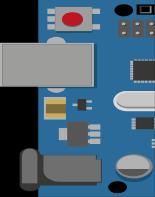
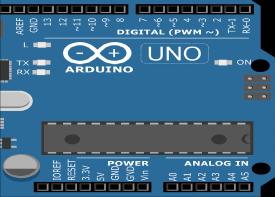
ArduinoUnoisanopen-sourcemicrocontrollerboardbased ontheMicrochipATmega328Pmicrocontroller(MCU)and developedbyArduino.ccandoriginallyreleasedin2010.The microcontroller board is equipped with sets of digital and analog input/output (I/O) pins that can be interface to various expansion boards (shields) and more circuits. The board has 14 digital I/O pins (6 capable PWM output), 6 analog I/O pins and is programmable with Arduino IDE (Integrated Development Environment), over USB type B cable. It can be powered by a USB cable or a cylindrical connectorthatacceptsvoltagesbetween7and20volts,such as a rectangular 9-volt battery. It has the same microcontroller like Arduino Nano board and the same
headersliketheLeonardoboard.Hardwarereferencedesign is distributed under Creative Commons Attribution ShareAlike2.5licenseandisavailableonArduinoWebsite.Layout and production files for some versions hardware is also available.
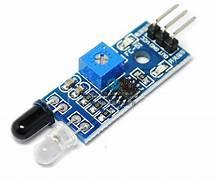
AnIRsensorisadevicethatusesinfraredtechnologyfor detectionobjectsorchangesintheenvironment.IRsensors can detect a wide range of physical properties such as temperature,movementandproximity.TheIRsensorisan electronicdevicewhichdetectstheIRradiationfallingonit. Proximity sensors (used in touchscreen phones and edgeavoidingrobots),contrastsensors(usedinanumberofrobot followers)andobstaclescounters/sensors(usedforcounting goods and during break-in alarms) are some applications involvingIRsensors.
Amotordriverisanintegratedcircuitchipthatistypically used to control motors in autonomous robots. The motor driveractsasaninterfacebetweentheArduinoandengines. ThemostcommonlyusedmotorcontrollerTheICsarefrom the L293 series as L293D, L293NE, etc. These ICs are designed to control 2 DC motors simultaneously.L293D consistsoftwohalfH-bridges.H-thebridgeisthesimplest lowsignalcontrolcircuitratedmotorcurrent.Wewillrefer totheenginDriverIConlyasL293D.TheL293Dhas16pins.
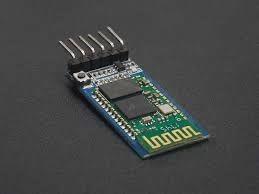
The Bluetooth module can be used over a short distance wireless communication, which can be divided into BluetoothmoduleandBluetoothvoicemoduleaccordingto its use. The Bluetooth module is the basis chipset with
International Research Journal of Engineering and Technology (IRJET) e-ISSN: 2395-0056
Volume: 11 Issue: 05 | May 2024 www.irjet.net p-ISSN: 2395-0072
integratedBluetoothfunctionsandwhichcanbeusedina wireless network transmission. We used bluetooth in our project module to send data to the bot to achieve its goal destination.TheHC-05hastwooperatingmodes,oneisdata mode in which it can send and receive data from other BluetoothdevicesandanotherisATCommandmodewhere youcandefaultdevicesettings
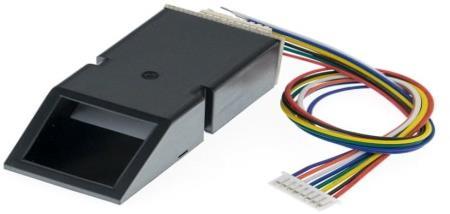
A fingerprint sensor is one type of sensor used in a fingerprintdetectiondevice.Thesedevicestheyaremainly built into the fingerprint detection module and is used for computersecurity.Mainfeaturesthisdevicemainlyincludes accuracy, better performance, robustness based on an exclusivefingerprintbiometrictechnology.Otherwise,both fingerprint sensors readers are extremely safe and convenient devices for security instead of a secret word. Because the password is easy to scan and also hard to remember.SobetteruseafingerprintreaderoraUSB-based scannerbiometricsoftwareforauthentication,identification and authentication that allows your fingerprints to be performed similar to digital passwords. These passwords cannotbeforgotten,lostotherwisealienated.
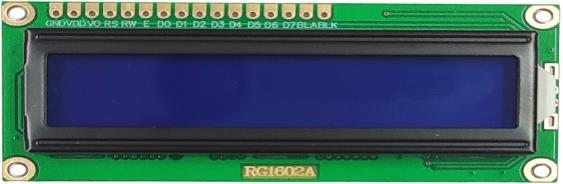
LCD(LiquidCrystalDisplay)isatypeofflatdisplay which usesliquidcrystals.
LCD is its primary form of operation. LEDs have a large a varioussetsofusecasesforconsumersandbusinesses,as they can be commonly found in smartphones, television computermonitorsand.LCDinstrumentpanelswerelarge leapintermsof the technologythey havereplaced,which includes light emitting diodes (LED) and gas-plasma displays.LCDdisplaysalloweddisplaystobemuchthinner than cathode ray tubes (CRT) technology. LCDs consume much less power than LED and gas displays because they
workonbasedontheprincipleofblockinglightratherthan emitting it. Where LED emits light, liquid crystal in LCD createsimageusingbacklight.AsanLCD,theyreplacedthe older ones display technology, LCDs began to be replaced newdisplaytechnologiessuchasOLEDs.
For a line-following robot, an IR sensor detects contrast betweenthelineanditssurroundingsbyemittinginfrared radiationlightandreflectionmeasurement.Thisallowsthe robot preciselyfollowa pre-defined path or line. Sensor it detectschangesinreflectivityandhelpstherobotadapttoit directionaccordinglytostayontrack.Inthefollowingline robot, IR sensors serve as eyes of the system, detection contrast between the line and its surroundings These are configuredinanarrayacrossthewidthoftherobotsensors emitinfraredlightontothesurfaceandmeasureintensityof reflected light. Calibration ensures their sensitivity is finetuned for line-to-line resolution and non-linear regions exactly.Tomitigatetheconsequencesambientlight,sensors
International Research Journal of Engineering and Technology (IRJET) e-ISSN: 2395-0056
Volume: 11 Issue: 05 | May 2024 www.irjet.net p-ISSN: 2395-0072
can use filters or modulatedIR signals. Sensor feedback is essentialforrobotcontrolsystemthatadjuststhespeedand directionoftherobotonsensordata.Algorithmsinvolving feedback mechanisms such as proportional or PID control finetunerobotmovementstostayoncourse.Additionally, integrationwithothersensorsallowstherobottonavigate complex environment while maintaining a precise line following,showcasingadaptabilityandrobustnessofthese systems.
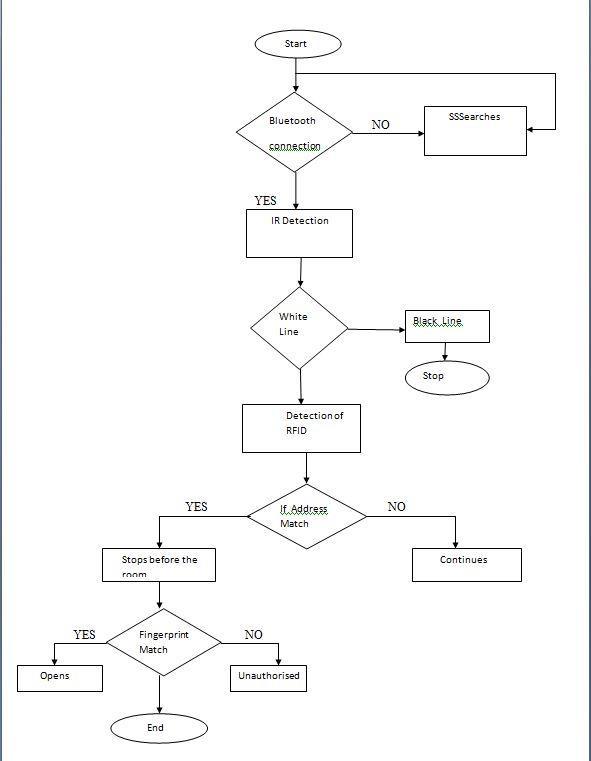
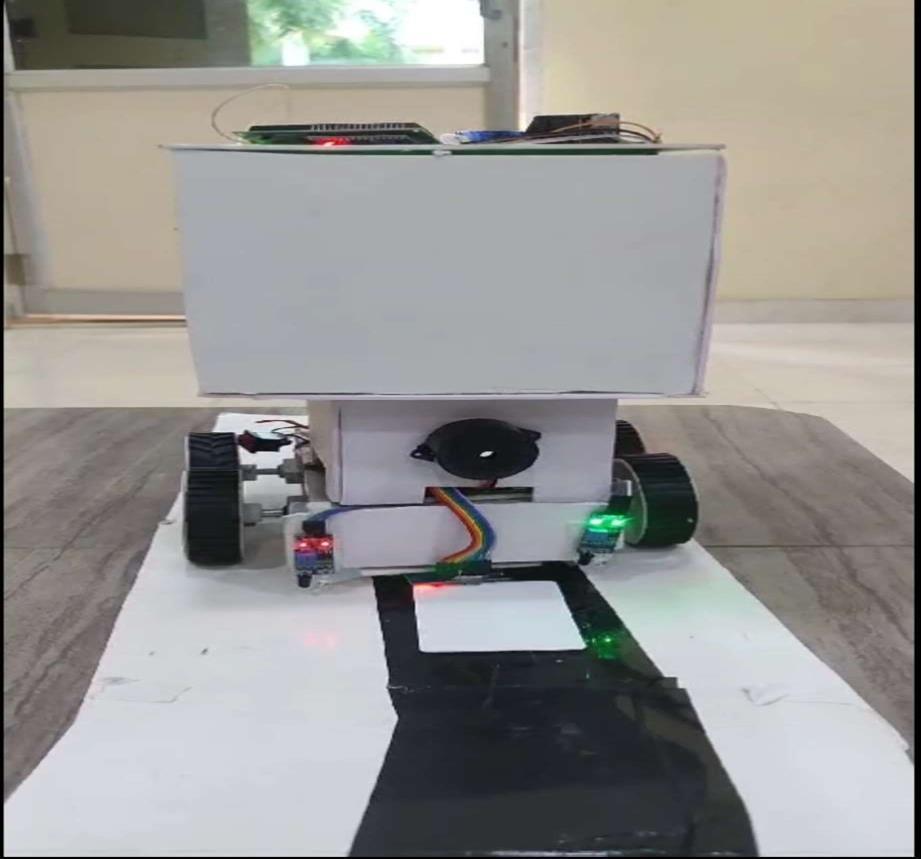
If the left and right infrared sensors are on top of white color,thenmovesforward.IfRightsensordetectsblackand theleftsensor detects none black line,then the robot will turnintherightdirection.Ifleft. Thesensordetectsblack andtherightsensordoesnotdetectsanyblackline,thenthe robotturnsleftdirection.IfbothIRsensorsdetecttheBlack linerobotmovementstops.Whenwesenddatato1robot goestoroom#1andidentifiestherfidtagatroomfromthe RFID reader present in it. The robot stops at room and makesabuzzingsoundandapersonintheroomshouldbe authorizedtocollectpapers.Ifthefingerprintcorresponds tothedatapresentinthefingerprintthemoduleopensthe box and the person can pick it up papers and boxes are automaticallyclosedafter2seconds.Afterpressingthereset button and entering data 2 to robot, goes to room #2 and processcontinues.
6. Results
7. Conclusion
Ourproject,Techpal–asmartassistantrobot,handlesthe deliveryofcirculars,papers,whichitreduceshumaneffort andimprovesefficiencyacrosseducationalinstitutions.And itcanworkautonomously,whicheliminatestheneedfora constantsupervision.Allinall,Techpal-SmartAssistantthe circular delivery robot represents the cost effective and efficientsolutionforeducationInstitute.
Delivery robots could become more adept navigating complexenvironments,suchasacrowdedenvironmentcity streets or indoor spaces using advanced sensors and Al algorithms.
UsingLORAorZigbeewecancontrolfromlongdistancetoo.
ForSurveillancewecanaddESP32Camfromwhichwecan followthemovementsof therobot mobile andadds more securityalongwithitfingerprintauthentication.
Thiswork is carriedoutbythe researchand development center,DepartmentofECE,SriVasaviEngineeringCollege(A), Tadepalligudem,WestGodavari,AndhraPradeshandIndia.
10. References
[1]G. Prause, I. Boevsky, "Delivery Robots forSmart Rural Development,"BulgarianJournalofAgriculturalEconomics and Management, vol.63, No.4,pp. 57-65,2018
[2]W.RahimanandZ.Zainal,"Anoverviewofdevelopment GPS navigation for autonomous car," 2013 IEEE 8th Conference on Industrial Electronics and Applications (ICIEA), Melbourne, VIC, 2013, pp. 1112-1118, doi: 10.1109/ICIEΑ.2013.656653
[3]https://docs.arduino.cc/hardware/uno-rev3/
[4]
https://robu.in/ir-sensorworking/#:~:text=IR%20sensor%20is%20an%20electronic ,some%20form%20of%20thermal%20radiation.
[5]https://www.electronicwings.com/sensorsmodules/bluetooth-module-hc-05-
[6]https://www.rajguruelectronics.com/Product/1276/R30 7%20Fingerprint%20Module.pdf
[7]Acceptanceofautonomousdeliveryvehiclesforlast-mile delivery in Germany – Extending UTAUT2 with risk perceptionshttps://sgs-tuev-saar.com/funktionalesicherheit/funktionale-sicherheit expertisen/automotive/automatisiertesfahren?gad_source=1&gclid=CjwKCAjwoPOwBhAeEiwAJuXR
International Research Journal of Engineering and Technology (IRJET) e-ISSN: 2395-0056
Volume: 11 Issue: 05 | May 2024 www.irjet.net p-ISSN: 2395-0072
h4QpmtBAfLnjIUv3fwXXq1_b3mxu93dKYqICbVI4skae_HdBo Swy_BoCiMgQAvD_BwE
BIOGRAPHIES




Ms. Vijaya Lakshmi M a Final Year B. Tech student in the Electronics & Communication Engineering Department,SriVasavi EngineeringCollege, Tadepalligudem,WestGodavari, AndhraPradesh,India.
Ms. Dhakshayani S.V.M T a FinalYearB.Techstudentinthe Electronics & Communication Engineering Department,SriVasavi EngineeringCollege Tadepalligudem,WestGodavari, AndhraPradesh,India.
Ms. Yasaswini D aFinalYear B. Tech student in the Electronics & Communication Engineering DepartmentSriVasavi EngineeringCollege
Tadepalligudem,WestGodavari, AndhraPradesh,India.
Ms. Bhavana P a Final Year B. TechstudentintheElectronics& Communication Engineering Department,SriVasavi EngineeringCollege Tadepalligudem,WestGodavari, AndhraPradesh,India.