
International Research Journal of Engineering and Technology (IRJET) e-ISSN: 2395-0056
Volume: 11 Issue: 05 | May 2024 www.irjet.net p-ISSN: 2395-0072
International Research Journal of Engineering and Technology (IRJET) e-ISSN: 2395-0056
Volume: 11 Issue: 05 | May 2024 www.irjet.net p-ISSN: 2395-0072
Divyani Ganphade1, Prof. Ganesh Mahalle2
1M.Tech Student, Structural and construction Engineering Department, Ballarpur Institute of Technology, Maharashtra, India
2Assistant Professor, Structural and construction Engineering Department, Ballarpur Institute of Technology, Maharashtra, India ***
Abstract – Long span bridges are essential pieces of infrastructure for transportation because they allow people and products to travel across great distances. However, the public's safety and the stability of the economy are seriously threatened by their susceptibility to seismic shocks. One of the most important ways to reduce this risk is through seismic retrofitting, which is the process of making existing structures more earthquake resistant. An overview ofseismicretrofitting methods designed especially for long span bridges is given in this abstract.
Long span bridge seismic retrofitting entails a thorough evaluation of structural weaknesses and the application of suitable measures to improve seismic resistance. Numerous retrofitting methods are used, such as installing seismic isolation systems, dampening devices, and reinforcing structural parts.
The main factors in the seismic retrofitting process such as structural analysis,materialchoice,andbuildingtechniques are highlighted in this abstract. It also goes overhowcrucialit is to use cutting-edge modeling and simulation methods in order to precisely forecast how retrofitted buildings would respond to seismic loads
Key Words: Seismic retrofitting, Long span bridges, Structural resilience, Seismic vulnerability, Retrofitting techniques
Longspanbridgesareessentialpartsofthetransportation network because they cross valleys, rivers, and other barriers to provide key connections. But in areas where earthquakes are common, these technical wonders face a seriousobstacle.Longspanbridges'safetyandoperationare seriouslythreatenedbyearthquakes,henceproactivesteps toincreasetheirseismicresistancearerequired.
One of the most important approaches to addressing the susceptibilityoflongspanbridgestoseismicoccurrencesis seismic retrofitting. Retrofitting is the process of altering already-existingstructurestomakethemmoreresilientto seismicpressures,whichlowersthepossibilityofcollapseor significantdamageduringanearthquake.Althoughseismic concerns may be incorporated into the design of new bridges,retrofittingprovidesanaffordablewaytoimprove
the functionality of aged infrastructure and lessen the possibleeffectsofseismichazards.
Long span bridge seismic retrofitting offers special opportunities and problems. Bridges are susceptible to complicateddynamicpressuresbecauseoftheirraisedand elongated shape, unlike typical constructions. Because of this,retrofitting methods need to be carefullydesigned to meet the unique vulnerabilities of long span bridge constructions,takingintoconsiderationelementsincluding ambientconditions,materialqualities,andstructurallayout.
This study seeks to give a thorough review of long span bridge seismic retrofitting techniques in this setting. The article will examine the many approaches and strategies used to improve the seismic resilience of these vital infrastructureassetsthroughareviewoftheresearchthat has already been published, case studies, and real-world examples. The significance of cutting-edge modeling and simulationmethodsintheretrofittingprocesswillalsobe coveredinthispresentation,alongwiththeuseofcuttingedgematerialsandtechnologiestomaximizeperformance andsaveconstructiontimeandexpense.
Engineerscan reducethehazardsassociatedwith seismic occurrences, protecting communities' well-being and transportationnetworks'safety, byimprovingtheseismic resilienceoflongspanbridgesthroughretrofittingmethods. Additionally, retrofitting initiatives help infrastructure systems become more resilient and sustainable overall, makingitpossibleforthemtofacethedifficultiespresented bynaturalcatastrophesandotheroutsidethreats.Weshall examine the effectiveness, advantages, and practical concerns of the seismic retrofitting methods designed especiallyforlongspanbridgesinthesectionsthatfollow.
International Research Journal of Engineering and Technology (IRJET) e-ISSN: 2395-0056
Volume: 11 Issue: 05 | May 2024 www.irjet.net p-ISSN: 2395-0072
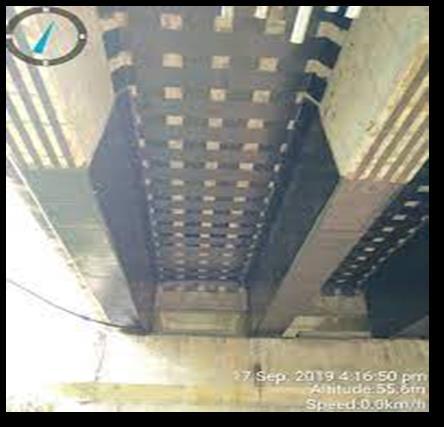
Whenseismicallyretrofittinglargespanbridges,avarietyof retrofittingapproachesarefrequentlyused.Byusingthese methods,bridges'structuralresiliencewillbeincreasedand theirsusceptibilitytoseismicforceswillbedecreased.The followingaresomeofthemaincategoriesofretrofittingfor longspanbridges:
StrengtheningofStructuralElements: Toincrease thebridge'sabilitytohandleseismicloads,important structural elements such columns, beams, and foundations must be strengthened. Concrete jacketing, the insertion of steel or carbon fiber reinforced polymer (FRP) wrapping, or the installationofadditionalstructuralcomponentsare examplesofstrengtheningtechniques.
SeismicIsolationSystems: Usingisolationbearings orbaseisolators,seismicisolation entailssevering the superstructure of the bridge from its substructure.Byallowingthebridgetomoveapart from its supporting piers during an earthquake, these devices lessen the amount of seismic stress that is transferred to the structure, minimizing damage.
Damping Devices: Withinthebridgeconstruction, damping devices are incorporated to disperse energyandlowertheamplitudeofvibrationscaused by seismic waves. Viscosity dampers, tuned mass dampers, and friction dampers are examples of commondampingdevicesthatabsorbanddistribute seismicenergytominimizedamageandstructural reaction.
BaseStrengtheningandFoundationRetrofitting: Theseismicperformanceofabridgeissignificantly influencedbyitsfoundation.Inordertoincreasesoilstructure interaction and stability during seismic
events, retrofitting solutions for foundations may involve deepening or enlarging foundation components, adding more piles or footings, or groutingexistingfoundations.
ExpansionJointRetrofitting: Bridgeconstructions' expansion joints are weak spots where large amountsofdamagecanoccurafteranearthquake. Retrofitting expansion joints might entail adding more damping or energy dissipation devices to already-existingjointstoenhancetheirperformance under seismic stress, or it can entail replacing antiquatedjointswithmorerecent,seismic-resistant designs.
StructuralRedundancyEnhancement:Toguarantee that alternative load channels are available in the event that key structural parts are damaged, retrofittingtoincreasestructuralredundancyentails adding redundant load paths or reinforcing connections within the bridge structure. This can enhance the overall structural strength and stop increasingcollapse.
Advanced Modeling and Analysis: Itiscrucialto apply sophisticated modeling and analytical methods,suchasperformance-basedseismicdesign and finite element analysis (FEA), in order to preciselyevaluatetheseismicperformanceoflong spanbridgesandcreateefficientretrofittingplans. Withtheuseofthesetools,engineersmayimprove retrofittingdesignsinaccordancewithperformance goalsandrestrictionsbysimulatingdifferentseismic situations.
Engineersmaysuccessfullyimprovetheseismicresistance of long span bridges and guarantee their continuous operation and safety in seismically active locations by combiningvariousretrofittingapproaches.Everyretrofitting strategy should be specifically designed to address the unique qualities and weaknesses of the bridge structure, accountingforelementslikeseismichazardlevels,materials, andgeometry.
TheultimateAimistoenhancethestructuralintegrityand seismicresilienceofanexistinglongspanbridgetomitigate thepotentialrisksposedbyseismicevents.Theobjectivesof thepresentstudyincludes:
a) To design a Retrofitting across pier and girder is to analyze its application in seismic retrofitting to improve resiliencebyusingfiberreinforcedpolymermaterials.
b)ToperformseismicanalysisofthesetwomodelsbyStaad softwareforZoneV.
c)Mainparametersfortheseismicanalysisarebaseshear (lateralforceduetoearthquakeonthebridge),fundamental
International Research Journal of Engineering and Technology (IRJET) e-ISSN: 2395-0056
Volume: 11 Issue: 05 | May 2024 www.irjet.net p-ISSN: 2395-0072
period,maximumdisplacementofthebridgeduetolateral load,maximumoverturningmomentofthebridge.
e) The models will also be analyzed based on the moving loadasperIRC 6Codeofthebridge.
f) Conduct an analysis of two bridge models, specifically examining seismic factors in order to enhance comprehensionofseismicperformance.
3. Methodology:-
Considering a Three dimensional finite element modelofbridge.
Consideringbridgespanof90m(longestfailedspan ofdaman-gangariver)
Bridgemodeltobeconsideredasbeambridgetype ofstructure.
Aftergeometricevaluationofstructuralmodelwill undergoanalysis.
Tocomputedesignseismicforces,thecoderequires taking into account elements like the Response Reduction Factor (R), Importance Factor (I), and ZoneFactor(Z).
Performing comparative Analysis ,comparison of resultfromboththeanalysisofstructurebeforeand after application of retrofitting on long span will takesplaceandtheconclusionwillbedrawn.
4. Indian Standard Code For Load:-
InthisProject,thereareseveralIndianstandardcodesused forloadcase,suchas
The Indian Standard Code 875 part-1 used for the self-weightofthebridge.
IndianRoadsCongress6:2017usedforthevehicle loadandvehicleconsideredasTrackedVehicle70R [9](Tracked)Vehicle.
Indian Standard Code used for the seismic load is 1893part-1:2016.
5. Geometrical Parameters Of Bridge Model
Geometry of Bridge Dimension
DimensionofthePier 1000mm*4500mm
Dimension of the Main Girder 1000 mm x 9000 mm
Dimension of the SupportingGirder 1000 mm x 5000 mm
TotalLaneWidthofBridge 9000mm
TotalSpanoftheBridge 90000mm
HeightoftheDeck 9000mm
Height oftheRailingfrom theDeck 2000mm
Distance between the SupportingGirder 5000mm
Cross section of the Side Girder IsectionISMB600
CrosssectionoftheRailing Tube75x75x4mm Retrofitting jacketed steel columnThickness 1000x1000mm
6. Modelling:-
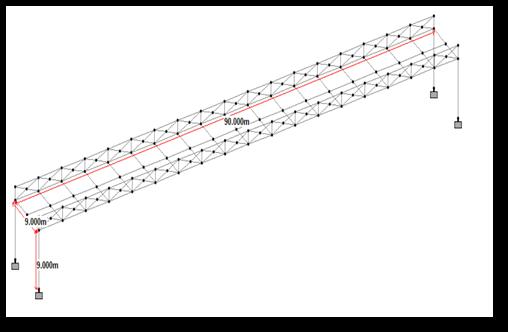
2:-Geometryofbridgewithoutretrofitting
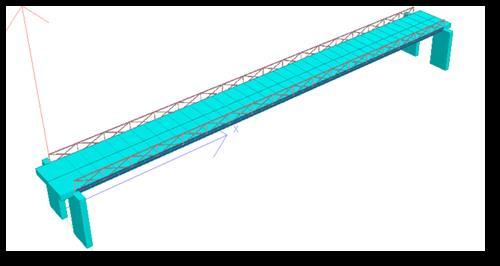
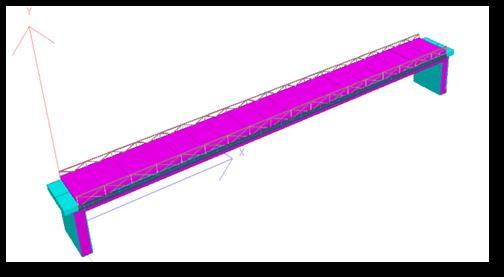
3:-3Dviewofbridgewithoutretrofitting
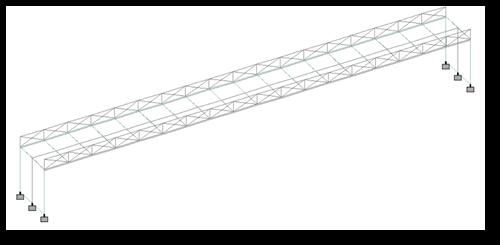
Fig4:-GeometryofBridgewithJacketingasa retrofitting
International Research Journal of Engineering and Technology (IRJET) e-ISSN: 2395-0056
Volume: 11 Issue: 05 | May 2024 www.irjet.net p-ISSN: 2395-0072
7. Loading Parameters:-
DeadLoad:-
1.Selfweight
2.FloorFinish:-1kN/m²
LiveLoad:-
TheLiveloadConsistoftwotypes
PedestalLoading
MovingLoading
1.PedestalLoading:- 2kN/m²
TwoTypesofMovingloadsareappliedtostructure
Class70Rloading
ClassALoading
8. Seismic Loading Parameters
ZoneFactor:-ZoneV(0.36)
ResponseReductionFactor:5(SMRF)
Importance Factor:- 1.5 (Important structure Bridge)
SoilType:-HardSoil
Type of Structure:- 3 (RCC and Steel Structure framing)
Damping:5%
9. RESULT:-
1. Lateral Displacement Result:-
Table1:- Maximum Displacement
Type of Structure Without Retrofitting With Steel Jacketing
Maximum Lateral Displacement
398 48
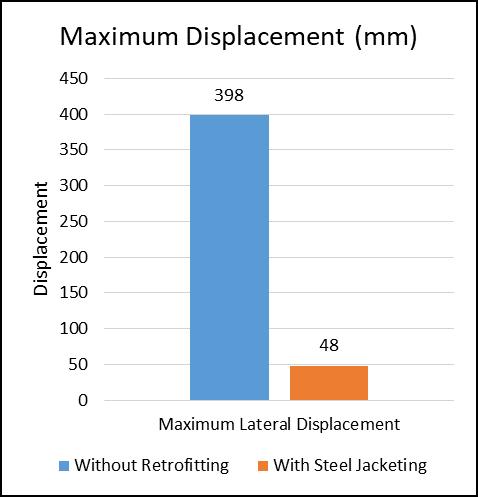
Fig6:-Comparisonofmaximumdisplacement.
2. Reaction:-
Table2:- Maximum Reaction
Type of Structure Without Retrofitting With Steel Jacketing
Maximum Reaction (kN) 55770 192446
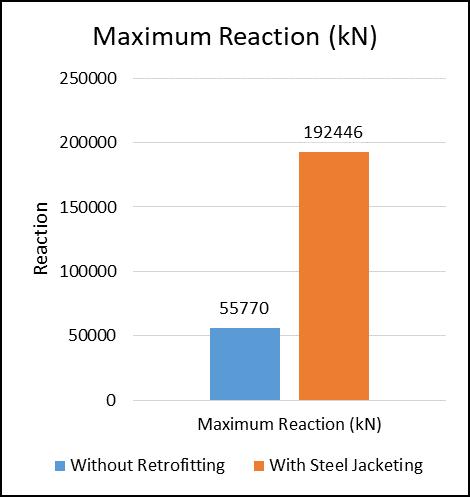
Fig7:-Comparisonofmaximumreaction
International Research Journal of Engineering and Technology (IRJET) e-ISSN: 2395-0056
Volume: 11 Issue: 05 | May 2024 www.irjet.net p-ISSN: 2395-0072
3. Overturning Moment:-
Table3:- Maximum Overturning Moment
Type of Structure Without Retrofitting With Steel Jacketing
Maximum Overturning Moment (kN-m)
99700 24628
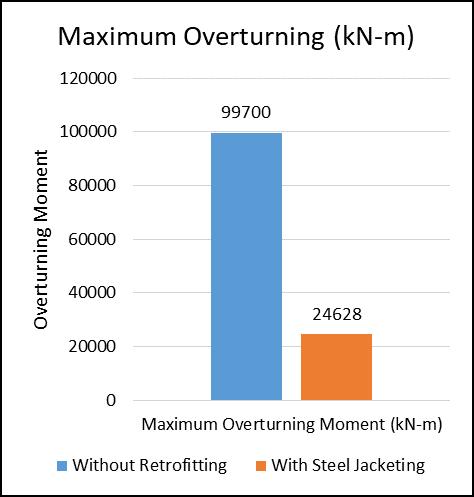
Fig8:-ComparisonofmaximumOverturningMoment
4. Shear Force:-
Table 4:- Maximum Shear Force
Type of Structure Without Retrofitting With Steel Jacketing
Maximum Shear Force (kN)
62406 27536
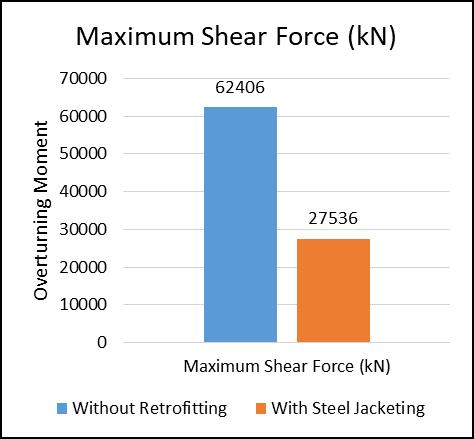
Fig9:-ComparisonofmaximumShearForce
5. Axial Force:-
Table 5:- Maximum Axial Force
Type of Structure Without Retrofitting With Steel Jacketing
Maximum Axial force(kN)
68627 38335
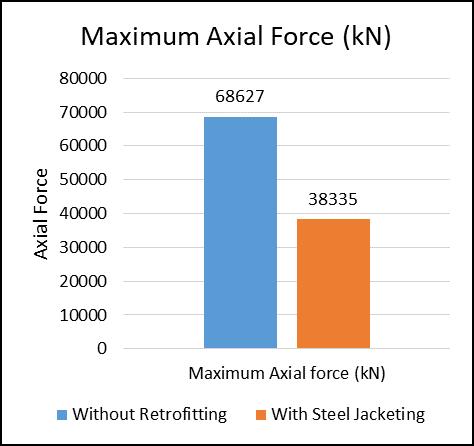
Fig10:-ComparisonofMaximumAxialForce
International Research Journal of Engineering and Technology (IRJET) e-ISSN: 2395-0056
Volume: 11 Issue: 05 | May 2024 www.irjet.net p-ISSN: 2395-0072
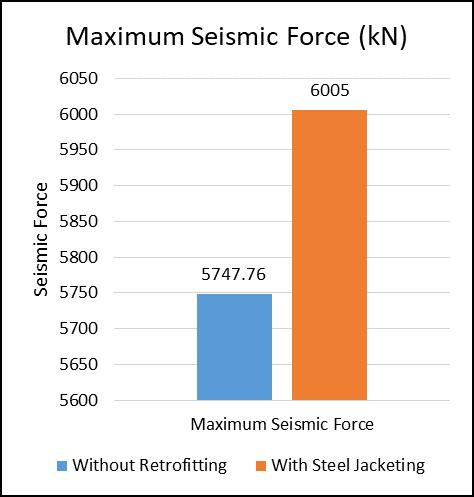
6. Seismic Force:-
Table 5:- Maximum Seismic Force
Type of Structure Without Retrofitting With Steel Jacketing
Maximum Seismic Force
5747.76 6005
CONCLUSION
FromtheAnalysisoftheBridgeforSeismicloadingfollowing conclusionwillhasbeenmade.
1.TheMaximumdisplacementforthenon-retrofittedbridge wasmuchgreaterandabovepermissiblerangewhileforthe retrofittedbridgehasthedisplacementwhichisunderthe permissible limit of 250mm. More than 85% reduction in retrofitting
2.TheBasereactionofretrofittedbridgeiscomparatively morethanthenon-retrofittedbridgebecauseoftheaddition ofappliedsteeljacketswhichincreasetheselfweightofthe structure.10%increaseinretrofittingweight
3.TheMaximumoverturningmomentgetsdecreaseswhen weappliedtheretrofitting whichgivesproperstrengthto thebaseofthebridge.50%reductioninretrofittedbridge
4.Shearforceandbendingmomentaredirectlyproportional tosteelreinforcementrequiredinthemembers.
5.Themaximumtimeperiodfortheboththestructureare samebutdifferinxandzdirectionbecauseofthechangein lengthandwidthofthebridge.
6.TheseismicforceisDL+0.5LL+Ah(seismicloadformula).
7.Overalltheprovidedretrofittinggaveaproperstrength and reduction in the forces to bring under permissible parameters which increased the strength by over 75% as comparedtononretrofittedstructure.
[1] Thecollapsemechanismofasubwaystationduring theGreatHanshinEarthquakeCem.Concr.Compos. (1997)
[2] Scalinglawsforshakingtabletestingofreinforced concretetunnelsaccountingforpost-crackinglining responseTunn.Undergr.Sp.Technol.(2020)
[3] Stiffness-baseddesign-orientedcompressivestressstrain model for large-rupture-strain (LRS) FRPconfinedconcreteCompos.Struct.(2019)
[4] Interpretation and back-analysis of the damage observed in a deep tunnel after the 2016 Norcia earthquake in Italy Tunn. Undergr. Sp. Technol.(2019)
[5] Behavior in compression of concrete cylinders externallywrappedwithbasaltfibers.
[6] Compos.B:Eng.(2015)
[7] Mechanical behavior of FRP confined rubber concrete under monotonic and cyclic loading Compos.Struct.(2021)
[8] Response of three Athens metro underground structuresinthe1999Parnithaearthquake
[9] SoilDyn.Earthq.Eng.(2005)
[10] Staticpushovertestofspring-undergroundstructure system for seismic performance analysis of undergroundstructureEng.Struct.(2022)