
International Research Journal of Engineering and Technology (IRJET) e-ISSN: 2395-0056
Volume: 11 Issue: 05 | May 2024 www.irjet.net p-ISSN: 2395-0072
International Research Journal of Engineering and Technology (IRJET) e-ISSN: 2395-0056
Volume: 11 Issue: 05 | May 2024 www.irjet.net p-ISSN: 2395-0072
Akshada Tari1
1Student, Department of Information Technology and Engineering, Goa College of Engineering, Farmagudi, Goa, India ***
Abstract - In the ever-evolving landscape of education, the demand for efficient and accurate assessment tools has grown exponentially. This paper explores the integration of Natural Language Processing (NLP) techniques to develop an Automatic Answer Checker (AAC) with a focus on enhancing the grading process. NLP, a subfield of artificial intelligence, offers a powerful set of tools for understanding and analyzing human language, making it an ideal candidate for automating the assessment of the responses. The proposed AAC system employs advanced NLP ML algorithms to evaluate and grade answers submitted by students. The system aims to streamline the grading process. As education transitions into a more technologically-driven era, the integration of innovative tools like the AAC system holds the potential to enhance the educational experience, ensuring fair and timely evaluation while promoting a deeper understanding of the subject matter.
Key Words: Natural Language Processing, Cosine Similarity, Sentence Transformer, Automatic Answer Checker
1.INTRODUCTION
Asthelandscapeofeducationevolves,theadoptionofonline tests and examinations has gained widespread popularity, aimingto alleviatethe burdens associated with traditional examinationevaluationprocesses.Whileonlineassessments typicallyfocusonobjectiveormultiple-choicequestions,the evaluation of subjective-based questions and answers has provenchallengingduetothecomplexitiesandinefficiencies inherentinthegradingprocess.
Recognizing thislimitation,there isa growing demand for innovative solutions that address the assessment of the responsesinonlineexams.Inresponsetothisneed,ourfocus turnstothedevelopmentofanAutomaticAnswerChecker (AAC)model,designedtoevaluatetheanswersandprovide grading.ThismodelincorporatesadvancedNaturalLanguage Processing (NLP) techniques to comprehend, analyse, and assignweightagetotheresponses,bridgingthegapbetween traditional human grading and the efficiency of online evaluation.
This paper explores the potential of the AAC model to revolutionizetheassessmentparadigm,offeringa solution thatensurestheaccuracyandreliabilityofgradingforthe questions inthemodern era of education. The subsequent overview delves deeper into the key components and functionalitiesofthisinnovativeapproach,sheddinglighton
howNLPcontributestotheefficiencyandeffectivenessofthe gradingprocess.
The rest of the paper is organized as follows: The method proposedwhichincludessentencetransformer,All-mpnetbase-v2,CosineSimilarityisgiveninSection2.TheLiterature surveyiscoveredinSection3.Conclusionsarediscussedin Section4.
[1]. Jagadamba G and Chaya Shree G proposed Artificial Intelligence-based answer verifier to do the job of examiner/evaluator. Artificial Intelligence-based Answer Verifier calculates the score of the student by combining variousparameterssuchaskeywords,propergrammar.The valueofkeywordsrangesfrom1to6where1isforExcellent and 6 is for Very Poor. The values of "grammar" attribute ranges from 0 which is for Improper and 1 which is for Proper. The system is more efficient for answers that are pointtopoint.Providesoverallaccuracyof80%.Themodule isdesignedandtestedforthe‘CosineSimilarity’algorithm. CosineSimilarityisusedtomeasurethesimilaritybetween twonon-zerovectorswhicharetheinnerproductspace.The measureisthecosineoftheanglebetweenthetwovectors i.e.,0°is1,andlessthan1foranyangleintheinterval(0,π) radians
[2].ShreyaSingh,Prof.UdayRote,OmkarManchekar,Prof. Sheetal Jagtap ,Ambar Patwardhan, Dr. Hariram Chavan proposedtheconceptof ArtificialIntelligence,OCR,andNLP to solve the problem. The answer sheets of the student is comparedtothemodelanswersheetbytheevaluatorand will then generate the final score based on multiple parameters(sentencesplitting,Jaccardsimilarity,grammar checkingandsentencesimilarity).Fortheimplementationof thesystem:cosinesimilarityandJaccardsimilaritywasused. The major setback of cosine similarity is it takes into consideration even the repetition of the same words. The measure of cosine similarity is higher primarily due to consideringtherepetitivesimilarwordsmultipletimes.This cangenerateagreatersimilaritylevelcompletelybasedon the number of times the word is repeated. Hence, Jaccard similarityisthebettermeasureofsimilarityforthesystem.
[3].PotsangbamSushilaDevi,SunitaSarkar,Takhellambam SonamaniSingh,LaimayumDayalSharma,ChongthamPankaj and Khoirom Rajib Singh proposed a system designed to evaluateandcheckidenticalandsemanticrelatedanswers
International Research Journal of Engineering and Technology (IRJET) e-ISSN: 2395-0056
Volume: 11 Issue: 05 | May 2024 www.irjet.net p-ISSN: 2395-0072
with the target answer by providing the similarity percentage.Theevaluationofsubjectiveanswersarecarried out using Bidirectional Encoder Representation Transformers(BERT)modeltounderstandrelatedanswers with the target answers. BERT has the capability to understandlanguageandnextpredictionsentencebyitspretrained model. The BERT model is used to generate the vectorsforeachwordinasentenceandpoolingmethodis applied to reduce the spatial matrix into vector for each sentence.Thecosinemethodisusedtocomparethetarget answersandrelatedanswers.Theresultisevaluatedtobe consideredforsubjectiveanswerscorrectionapproach.
[4]. Rishabh Kothari, Burhanuddin Rangwala, Kush Patel proposedthestudythatemploysMachineLearning(ML)and NaturalLanguageProcessing(NLP)toautomategrading.By comparing student answers with ideal ones provided by examauthorities,asimilarityscoreisgeneratedandmapped togrades.ThestudyoffersaDjango-basedwebapplication for online exams, providing near real-time grading. Administratorshavetheflexibilitytoadjustgradesasneeded, recognizingthatnoMLmodelisperfect.
[5]. Ragasudha,M.Saravananproposedasystemforsecure automaticquestionpapergenerationandsubjectiveanswer evaluation.Adminscreateaquestiondatabasecategorizedby Bloom'staxonomy,andwithaclick,questionsaregenerated. Cryptography ensures secure delivery of papers. Answer evaluationisautomatedusingkeywordmatchingalgorithms. This system reduces human error and saves time in both questiongenerationandanswerevaluation.
[6].AshutoshShinde,C.NishitNirbhavane,ShardaMahajan, VikasKatkar,SupriyaChaudharyproposedanidealsolution wouldinvolveasoftwareapplicationwithacomprehensive databaseofquestions,correspondinganswers,andassigned marks.Thisapplicationiscapableofverifyinguserresponses bycomparingthemwiththeprovidedanswers.Byemploying such a system, evaluators can significantly reduce their workloadandincreaseefficiency.
IntherealmofNaturalLanguageProcessing(NLP),thereare several methods used to check answer similarity, often drawing inspiration from techniques in information retrieval,machinelearning,andlinguistics.
Some of the prominent approaches are: cosine similarity, Word Embeddings, BERT-Based Methods, Semantic Text SimilarityModels,Graph-BasedMethods,EditDistance
Thesemethodsprovideabroadspectrumofapproachesto measuring answer similarity in NLP, each with its advantages and suitable applications. Depending on the natureofthedataandthespecificrequirementsofthetask, one or a combination of these methods may be more appropriate.
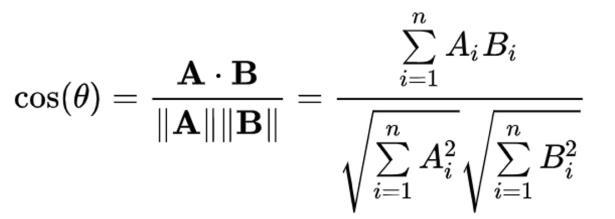
Cosine similarity measures the cosine of the angle betweentwovectorsinamulti-dimensionalspace.InNLP, eachanswercanberepresentedasavector,typicallyusing techniqueslikeTF-IDF(TermFrequency-InverseDocument Frequency)orwordembeddings.Cosinesimilarityiswidely usedbecauseit'sefficient,computationallyinexpensive,and insensitivetothevector'smagnitude.
Word embeddings represent words as dense, continuousvectorsinahigh-dimensionalspace,wherethe distance and direction between vectors encode semantic information. These embeddings are typically generated using unsupervised learning techniques like Word2Vec, GloVe,orfastText.Byaveragingorsummingtheembeddings ofwordsineachanswer,youcancomparetheirsimilarity usingcosinesimilarityorotherdistancemetrics
Word embeddings themselves are generated through trainingalgorithmslikeWord2VecorGloVe,andthere'sno specific formula for computing similarity, although cosine similarityisoftenused.
BERT (Bidirectional Encoder Representations from Transformers) and its variants are powerful pre-trained modelsforvariousNLPtasks.Fine-tuningBERTforanswer similarity tasks or extracting embeddings from BERT outputscaneffectivelycapturesemanticsimilarity.BERTis trained on large corpora with tasks like masked language modeling and next sentence prediction, enabling it to capture rich contextual information. Fine-tuning BERT involves training it on a specific downstream task (e.g., answersimilarity)withappropriatelossfunctions
These models are specifically trained to measure the similaritybetweentwotextinputsbycapturingfine-grained semantic information. Models like Siamese-CNN (Convolutional Neural Networks), Siamese-LSTM (Long Short-Term Memory), or transformer-based architectures (e.g., Siamese-BERT) are commonly used. These models learntogenerateembeddingsfortextinputsinsuchaway that similar inputs are mapped closer together in the embedding space. They involve training neural network
International Research Journal of Engineering and Technology (IRJET) e-ISSN: 2395-0056
Volume: 11 Issue: 05 | May 2024 www.irjet.net p-ISSN: 2395-0072
architectures to learn embeddings that capture semantic similarity.
Graph-basedmethodsrepresenttextasagraphwherenodes are words or phrases, and edges represent relationships (e.g.,syntacticorsemantic).Similarityiscomputedbasedon graphpropertieslikeshortestpathdistance,graphkernel,or node embeddings. These methods are particularly useful whencapturingstructuralrelationshipsbetweenwordsor phrases.
Graph-based methods utilize algorithms for graph comparison,suchasgrapheditdistanceorgraphsimilarity measures,whichinvolvecomplexgraphanalysisbutdon't havesingleformulas.
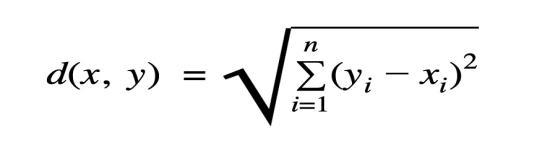
Editdistancemeasurestheminimumnumberofoperations (e.g., insertions, deletions, substitutions) required to transformoneanswerintoanother.It'ssimplisticbutcanbe effective for measuring similarity in certain contexts. Variants like Levenshtein distance, Damerau-Levenshtein distance,orJaccardsimilarityarecommonlyused.

Theformulavariesdependingonthespecificvariantofedit distance being used, such as the dynamic programmingbasedalgorithmforLevenshteindistance.
4.1
TheSentenceTransformerlibraryprovidesanefficientway to obtain contextualized embeddings for sentences using pre-trainedtransformermodels.Theseembeddingscapture richsemanticinformation,allowingforaccuratecomparison andanalysisofsentencemeanings.
It simplifies the process of working with transformer models, making it accessible to users without extensive knowledge of deep learning techniques. Additionally, it offers flexibility in choosing from a variety of pre-trained modelstosuitdifferentapplicationsandrequirements.
SentenceTransformerissuitablefortaskssuchassimilarity comparison, semantic search, paraphrase detection, and more, making it an excellent choice for automatic answer checking.
The "all-mpnet-base-v2" model is a specific pre-trained transformermodelprovidedbytheSentenceTransformer library. It is based on the MPNet architecture, which is known for its effectiveness in capturing contextual informationandgeneratinghigh-qualityembeddings.
This model is expected to provide robust contextual embeddingsforsentences,enablingaccurateassessmentof the semantic similarity between reference and student answers. Its usage within the Sentence Transformer frameworkensurescompatibilityandeaseofintegration.
MPNet-based models have demonstrated strong performanceinvariousNLPtasks,making"all-mpnet-basev2"areliablechoiceforgeneratingsentenceembeddings.
Cosinesimilarityisametriccommonlyusedtomeasurethe cosine oftheanglebetween twovectors.In thecontext of sentenceembeddings,itassessesthesimilarityindirection between the vectors, indicating how similar the two sentencesareinmeaning.
Cosine similarity provides a straightforward and intuitive way to compare the similarity of sentence embeddings. A cosine similarity score of 1 indicates identical vectors (perfectsimilarity),whilea scoreof0signifiesorthogonal vectors(nosimilarity).
Thecosinesimilarityscorecanbeeasilyinterpreted,making itsuitableforprovidingfeedbacktousersonthesimilarity betweenreferenceandstudentanswers.Italsoallowsfor thresholding to determine whether the answers are sufficientlysimilarornot.
International Research Journal of Engineering and Technology (IRJET) e-ISSN: 2395-0056
Volume: 11 Issue: 05 | May 2024 www.irjet.net p-ISSN: 2395-0072
5. Proposed Model
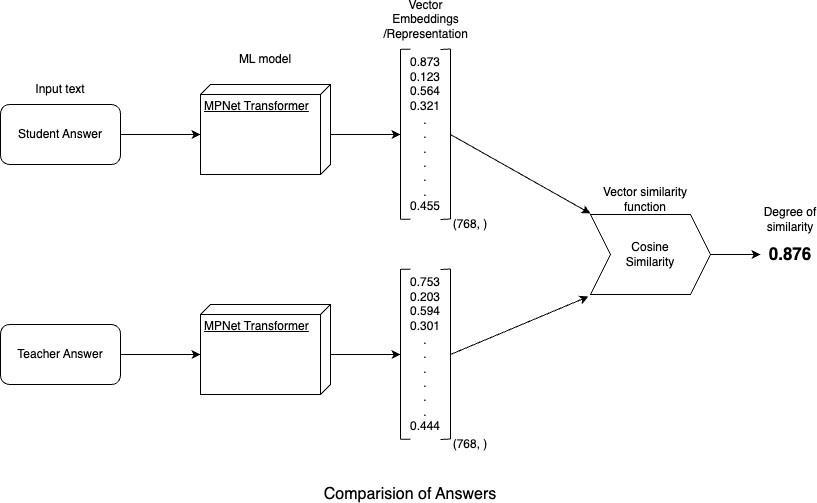
Fig -1:ComparisonofAnswers
Tocomparetheanswers,aMPNetbasedmodelcanbeused to convert the student answer and teachers answer into vectorembeddingsofsize768eachandfurtherprocessed usingcosinesimilaritytofindoutdegreeofsimilarity.
6. CONCLUSIONS
Inthispaper,weexploredmethodstocheckthecorrectness ofthestudentsanswerandteachersanswerusingvarious NLP techniques. Additionally, the paper also proposes an approachusingsentencetransformer.
The paper results its potential to streamline grading processes,relievingeducatorsofmanualefforts.Overall,the paper showcases the viability of NLP-driven automated gradingsystems,openingavenuesforcontinuedinnovation ineducationaltechnology.
[1] Jagadamba G and Chaya Shree G " Online Subjective answer verifying system Using Artificial Intelligence." ProcoftheFourthInternationalConferenceonI-SMAC (IoT in Social, Mobile, Analytics and Cloud) (ISMAC),IEEE2020
[2] ShreyaSingh,Prof.UdayRote,OmkarManchekar,Prof. Sheetal Jagtap ,Ambar Patwardhan,Dr. Hariram Chavan,”ToolforEvaluatingSubjectiveAnswersusingAI (TESA)”,©2021IEEE
[4] Rishabh Kothari ,Burhanuddin Rangwala ,Kush Patel “AutomaticSubjectiveAnswerGradingSoftwareusing Machine Learning” 7th International Conference on Trendsin ElectronicsandInformatics(ICOEI)©2023 IEEE2023|DOI:10.1109/ICOEI56765.2023.1012578
[5] Ragasudha, M.Saravanan “Secure Automatic Question PaperGenerationwiththeSubjectiveAnswerEvaluation System” International Conference on Smart Technologies and Systems for Next Generation Computing(ICSTSN) | ©2022 IEEE|DOI10.1109/ICSTSN53084.2022.9761323
[6] AshutoshShinde,C.NishitNirbhavane,ShardaMahajan, VikasKatkar,SupriyaChaudhary,“AIAnswerVerifier,” Int. Journal of Engineering Research in Computer ScienceandEngineering(IJERCSE),Volume5,Issue3, March2018.
[7] P. Pisat, D. Modi, S. Rewagad, G. Sawant and D. Chaturvedi, "Question paper generator and answer verifier," 2017 International Conference on Energy, Communication, Data Analytics and Soft Computing (ICECDS), Chennai, 2017, pp. 1074-1077, doi: 10.1109/ICECDS.2017.8389603.
[8] S.W.Yeh,L.K.Wang,andH.W.Cheng,"Automatedshort answer grading using machine learning techniques", IEEE International Conference on Information Reuse andIntegration(IRI),2017
[9] D. Kuznetsov, Y. S. Kolesova, and E. V. Kolesova, "AutomaticEvaluationofStudents'AnswersBasedon Word Embeddings" IEEE International Conference on AdvancedLearningTechnologies(ICALT),2018
[10] S.Yuan,W.Zhu,andD.Luo, "AutomatedShortAnswer GradingUsingSentenceSimilaritybasedonPretrained WordEmbeddings",IEEEInternationalConferenceon CognitiveInformatics&CognitiveComputing(ICCI*CC), 2019
[11] T. T. Nguyen, H. L. Nguyen, and Q. V. Nguyen, "Automated Short-Answer Grading with BERT"IEEE Access,2020
[12] S. Kumari and A. L. Sharma,"Automatic Short Answer Grading using Deep Learning Techniques" IEEE International Conference on Computing, Communication,andAutomation(ICCCA),2021
[13] S.M.Rahaman,R.T.P.Sooriamurthi,andC.E.Hughes, "Automated grading of short-answer questions using combination of feature-based techniques and neural networks",IEEETransactionsonLearningTechnologies, 2018
[3] PotsangbamSushilaDevi,SunitaSarkar,Takhellambam SonamaniSingh,LaimayumDayalSharma,Chongtham Pankaj and Khoirom Rajib Singh-”An Approach to EvaluatingSubjectiveAnswersusingBERTmodel,”2022 IEEE International Conference on Electronics, Computing and Communication Technologies (CONECCT) | 978-1-6654-9781-7/22/$31.00 ©2022 IEEE
2024, IRJET | Impact Factor value: 8.226 | ISO 9001:2008
International Research Journal of Engineering and Technology (IRJET) e-ISSN: 2395-0056
Volume: 11 Issue: 05 | May 2024 www.irjet.net p-ISSN: 2395-0072
[14] S.B.BhagwatandS.S.Mantha, "AutomatedAssessment ofStudents'AnswerstoOpen-ended Questions",IEEE International Conference on Signal Processing, Informatics, Communication and Energy Systems (SPICES),2019
[15] P. A. Deokar and V. M. Thakare, "Automated Short AnswerGradingusingMachineLearningTechniques:A Survey", IEEE International Conference on Computer andCommunicationTechnology(ICCCT),2020
[16] T. C. Loo, M. H. Ng, and S. K. Adhikari, "Automated AnswerGradingforShortTextAnswersUsingLSTMand CNN"IEEEAccess,2022