
A Comprehensive E-Learning Platform developed using MERN-Stack with Automated Grading Functionalities
Prasad Kandalkar
1
, Yash Chindhe
2
, Samarth Langote3 , Atharva Tarlekar4 , Prof. Pramila M. Chawan5
1,2,3,4B. Tech Student, Dept of Computer Engineering and IT, VJTI College, Mumbai, Maharashtra, India 5Associate Professor, Dept of Computer Engineering and IT, VJTI College, Mumbai, Maharashtra, India
Abstract - The digital revolution is transforming the educational landscape, and engineering education is no exception. While traditional methods provide a strong foundation, they often struggle to adapt to the diverse learning styles and needs of contemporary students. Furthermore, manual assessment methods, particularly for essay-based assignments, create bottlenecks in the learning process. Time-consuming grading delays valuable feedback, hindering student progress and engagement.
This research presents a novel solution: a comprehensive elearning platform specifically designed for engineering education,integratedwithanAutomatedEssayScoring(AES) systempoweredbymachinelearning.Theplatformleverages theMERNstack(MongoDB,Express.js,React.js,andNode.js)to provideauser-friendlyandinteractivelearningenvironment. The innovative AES component utilizes a pre-trained Long Short-Term Memory (LSTM) network trained on a relevant engineering essay dataset. This allows the platform to generateautomatedessayscores,streamliningtheassessment process for instructors and facilitating the timely delivery of feedback to students. This not only enhances instructor efficiency but also fosters a more engaging and effective learning experience.
Key Words: E-learning platform, MERN stack, Automated Essay Scoring (AES), Machine Learning, Engineering Education,Assessment,Feedback
1.INTRODUCTION
The landscape of engineering education is undergoing a dynamictransformation.Traditionalmethods,whilelayinga strong foundation, often lack the flexibility and personalizationneededtocatertothediverselearningstyles andneedsoftoday'sstudents.Furthermore,therelianceon manual assessment practices, particularly for essay-based assignments,cancreatebottlenecksinthelearningprocess. Time-consuming grading delays the delivery of valuable feedback,hinderingstudentprogressandengagement.
This research addresses these challenges by proposing the development of a comprehensive e-learning platform specificallydesignedforengineeringeducation.Thisplatform leveragesthepoweroftheMERNstack(MongoDB,Express.js,
React.js, and Node.js) to provide a user-friendly and interactivelearningenvironment.Butitstrueinnovationlies in the integration of an Automated Essay Scoring (AES) system powered by machine learning. By utilizing a pretrained Long Short-Term Memory (LSTM) network, this platformcangenerateautomatedessayscores,significantly streamliningtheassessmentprocessforinstructors.Thisnot onlysavesvaluabletimebutalsoallowsfortheprovisionof moretimelyfeedbacktostudents,fosteringamoreeffective andengaginglearningexperience.
Thefollowingsectionswilldelvedeeperintothedetailsofthis proposedplatform.Wewillexplorethebenefitsofe-learning platforms in engineering education, examine relevant researchonAES,andprovideacomprehensivebreakdownof the system's architecture and functionalities. Furthermore, the methodology for data preprocessing, machine learning model development, and web application creation will be presented.Finally,theevaluationmethodsforbothplatform usabilityandAESmodelaccuracywillbeoutlined.
2. LITERATURE REVIEW
E-learning Platforms in Engineering Education
The growing demand for accessible and flexible learning opportunities has fuelled the development and implementation of e-learning platforms in engineering education. Studies have consistently demonstrated the positiveimpactoftheseplatformsonvariousaspectsofthe learningprocess.
Alsawadi et al. (2019)conducted a study investigating the effectiveness of a web-based learningenvironmentforteachingundergraduate engineering courses. Their findings revealed significant improvements in student learning outcomes compared to traditional lecture-based methods.
Sun et al. (2020)explored the use of a blended learning approach that combined online modules with traditional classroom instruction for an engineeringmechanicscourse.Theresultsindicated thattheblendedlearningapproachledtoincreased
International Research Journal of Engineering and Technology (IRJET) e-ISSN: 2395-0056
Volume: 10 Issue: 03 | Mar 2023 www.irjet.net p-ISSN: 2395-0072
student engagement and improved performance comparedtothetraditionalapproach.
Zhangetal.(2018)examinedtheimpactofamobile learningplatformonstudentmotivationandselfdirected learning in engineering education. Their researchshowedthattheplatformfosteredamore learner-centeredenvironment,promotingstudent autonomyandmotivationinthelearningprocess.
Thesestudieshighlightthepotentialofe-learningplatforms to enhance the educational experience for engineering students by providing flexibility, accessibility, and interactivelearningopportunities.
Automated Essay Scoring (AES) in Engineering Education
While e-learning platforms offer numerous benefits, traditionalassessmentmethods,particularlyforessay-based assignments, can pose challenges. The implementation of AESoffersapromisingsolutiontoaddressthesechallenges.
Zervanetal.(2019)investigatedtheuseofAESfor evaluatingengineeringethicsessays.Theirresearch demonstratedthatAESmodelscouldachievealevel of accuracy comparable to human graders, suggestingtheirpotentialasavaluableassessment tool.
Yoon&Powers(2018)exploredtheapplicationof AES for assessing open-ended problem-solving skillsinengineeringcourses.Theirfindingsindicated that AES models were effective in identifying key elements of students' problem-solving approaches withinessays.
Liu & Zhao (2020)examined the use of AES to providestudentswithimmediatefeedbackontheir writing.Thestudydemonstratedthatstudentswho received automated feedback alongside human grading exhibited improvements in their writing skillsovertime.
Thesestudiesshowcasethe potential ofAESin engineering educationforstreamliningtheassessmentprocess,providing timely feedback to students, and evaluating specific skills withinessays.However,itiscrucialtoacknowledgethatAES modelsarestillunderdevelopment,andongoingresearchis neededtoaddresslimitations,suchastheabilitytocapture thenuancesofhumanlanguageandcomplexargumentsoften foundinengineeringessays.
Integration of E-learning Platforms and AES
Theproposedresearchbuildsuponthestrengthsofbothelearning platforms and AES by integrating them into a comprehensivesystemspecificallydesignedforengineering
education.Thisintegrationhasthepotentialtocreateamore efficientandeffectivelearningenvironment.
Wangetal.(2021)exploredthedevelopmentofanelearningplatformwithintegratedAESforalanguage learningcourse.Theirstudydemonstratedthatthe platformprovidedauser-friendlyinterfaceforboth studentsandinstructors,whiletheAEScomponent offeredvaluablefeedbacktostudentsontheirwriting skills.
Chen et al. (2020)proposed a framework for an adaptive learning platform that utilized AES to personalize learning experiences based on student performance in essay assessments. Their research suggeststhatsuchintegrationcanprovidetargeted feedbackandlearningmaterialstoaddressindividual studentneeds.
3. PROPOSED SYSTEM
The proposed e-learning platform consists of three main components:
Front-end: DevelopedusingReactJS,providingauser-friendly interface for students and instructors to interact with the platform.
Back-end: BuiltusingNodeJSandExpressJS,handlingserversidelogicandcommunicationwiththedatabase.
Database: Utilizes MongoDB, a NoSQL database, to store coursecontent,userdata,andassessmentresults.
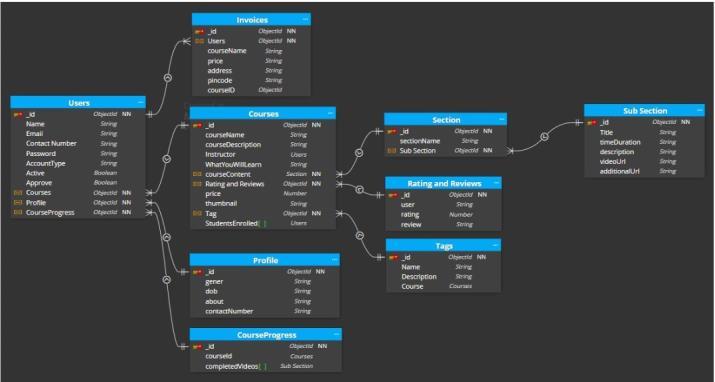
Fig - 1: Classdiagram
A. Core Functionalities (MERN Stack):
User authentication and registration for students andinstructors
Coursecreationandmanagementbyinstructors
Courseenrollmentandcontentaccessforstudents
Onlineassessments,includingessaysubmissions
International Research Journal of Engineering and Technology (IRJET) e-ISSN: 2395-0056
Volume: 10 Issue: 03 | Mar 2023 www.irjet.net p-ISSN: 2395-0072
Progress tracking and reporting for students and
instructors
B. Integration of Automated Essay Scoring (AES):
Theplatformutilizesapre-trainedLSTMnetwork toscorestudentessays.
The model is trained on a relevant engineering essay dataset, such as "The Hewlett Foundation: Automated Essay Scoring Dataset" by ASAP (https://www.kaggle.com/c/asap-aes).
InstructorscanchoosetoutilizetheAESscore alongsidetheirownhumanevaluation.
Theplatformcanflagessayswithsignificant discrepanciesbetweentheAESscoreandthe instructor'sscoreforreview.
C. Results: Step1:


Enter your text for auto-grading Step 3 :

4. SYSTEM ARCHITECTURE
Theproposede-learningplatformwithAESadoptsaclientserverarchitecture,consistingofthefollowingcomponents: Web App (Client-side):
DevelopedusingReactJS,thiscomponentprovidesauserfriendlygraphicalinterfaceforstudentsandinstructorsto interact with the platform. Students can access course materials, submit essays, and view their grades with the platform.
© 2023, IRJET | Impact Factor value: 8.226 | ISO 9001:2008 Certified Journal | Page 34
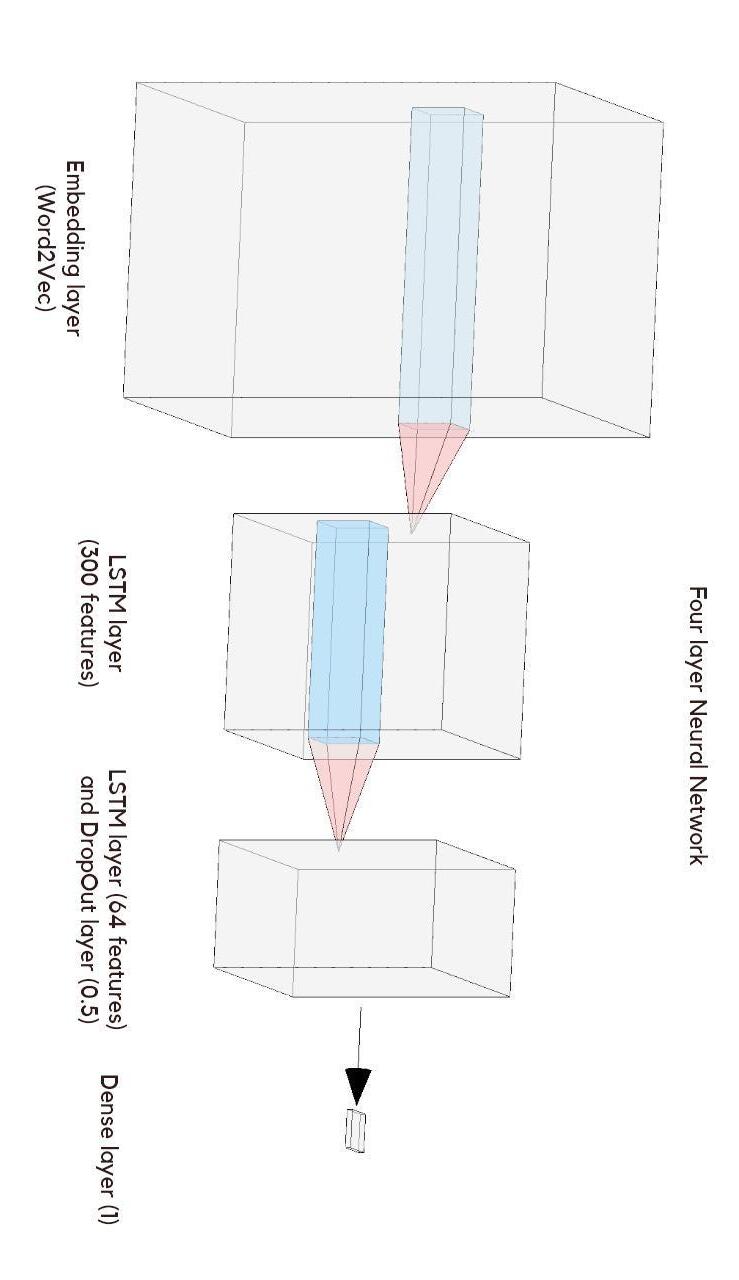
Fig – 2: FourLayeredNeuralNetwork
Fig – 3: Interfaceforautomatedgrading
Step2:
Fig 4:
Fig 5: Result of auto grading
International Research Journal of Engineering and Technology (IRJET) e-ISSN: 2395-0056
Volume: 10 Issue: 03 | Mar 2023 www.irjet.net p-ISSN: 2395-0072
Instructors can create and manage courses, view student submissions,andassigngrades.
API (Server-side):
BuiltusingNode.jsandExpress.js,thiscomponentactsasan intermediarybetweenthewebappandthebackendservices.
It handles user authentication, authorization, and communication with the database and machine learning models.
The API receives essay submissions from the web app, preprocesses the essays using techniques like stop word removal and text normalization, and sends them to the machinelearningmodelforscoring.
It also retrieves grades and feedback from the model and sendsthembacktothewebappfordisplay.
Database (Backend):
MongoDB,aNoSQLdatabase,isusedtostorevarioustypesof data,including:
1. Useraccountsandroles(studentsandinstructors)
2. Coursecontent(lectures,assignments,etc.)
3. Studentessaysandgrades
4. Machinelearningmodelparameters
Machine Learning Model:
A pre-trained Long Short-Term Memory (LSTM) networkisemployedtoperformautomatedessay scoring.
Thismodelistrainedonarelevantengineeringessay dataset, such as "The Hewlett Foundation: Automated Essay Scoring Dataset" by ASAP (https://www.kaggle.com/c/asap-aes).
TheLSTMnetworkanalyzestheessaysandgenerates scoresthatreflectthequalityofthewriting.
External Storage (Optional):
Thesystemmayintegratewithanexternalstorageservice forstoringlargefiles,suchasmultimediacoursecontent.
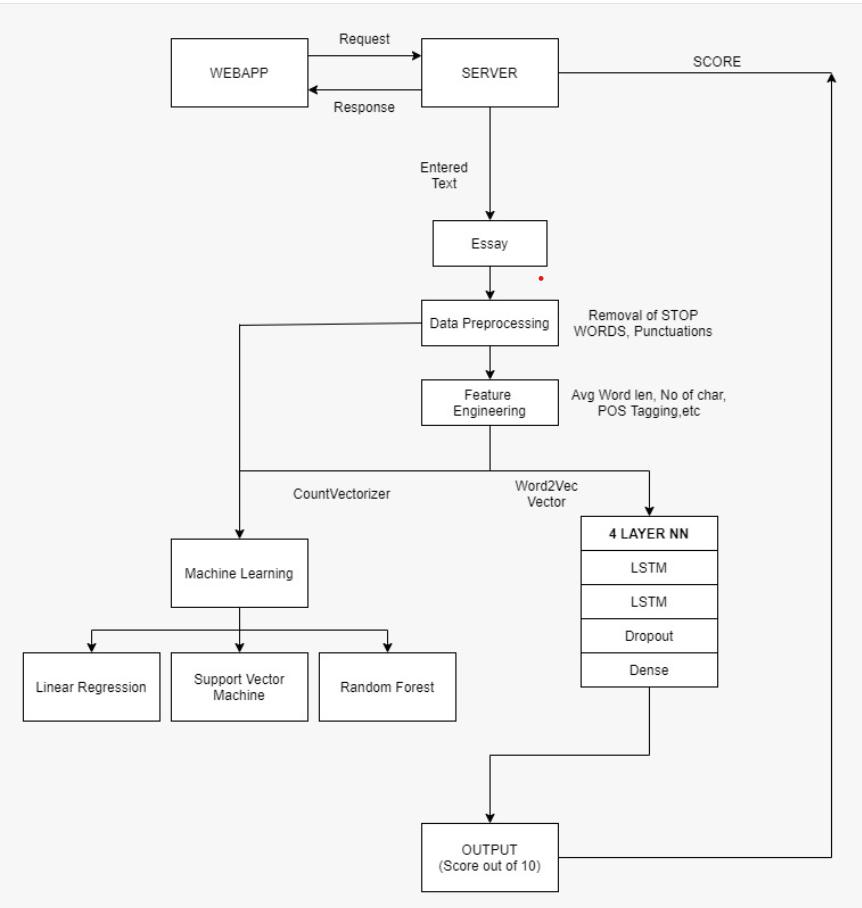
Fig-6:Flowdiagram
International Research Journal of Engineering and Technology (IRJET) e-ISSN: 2395-0056
Volume: 10 Issue: 03 | Mar 2023 www.irjet.net p-ISSN: 2395-0072
5. METHODOLOGY
A. Data Preprocessing
Standardpreprocessingstepsareapplied,including nullvalueimputationandfeatureselection.
Techniquesareimplementedtoaddressskewnessin thedataandimprovemodelperformance.
Essaycleaningisperformedtoremoveunnecessary symbols,stopwords,andpunctuation.
Additionalfeaturesareconsidered,suchassentence count,wordcount,andaveragewordlength.
Techniques for part-of-speech tagging and misspellingdetectionareexploredforfurtherfeature extraction.
B. Machine Learning Model Development
Initial exploration involves applying machine learning algorithms like linear regression, Support VectorRegression(SVR),andRandomForesttothe pre-processeddata.
Featureengineeringisperformedbyincorporating additionalfeaturesidentifiedduringpreprocessing.
A deep learning approach is implemented using a recurrent neural network (RNN) with an LSTM architecture.
TheLSTMnetworkistrainedwithwordembeddings generatedbyaWord2Vecmodel.
The model is optimized using appropriate loss functionsandoptimizers.
C. Web Application Development
A web application is developed using the Flask frameworktodeploythetrainedmodel.
The application provides a user interface for instructors and students to interact with the platform.
Instructors can create and manage courses, while students can enroll in courses, submit essays, and receivefeedback.
The AES functionality is integrated into the essay submissionprocess,providinginstructorswiththe optiontoutilizethegeneratedscore.
6. EVALUATION
The platform's usability and effectiveness will be evaluated through user testing with students and instructors.
TheaccuracyoftheAESmodelwillbeassessedusing standardmetricsonaheld-outtestset.
7. CONCLUSION
The development of a comprehensive e-learning platform with AES for engineering education offers a significant advancement in educational technology. This platform empowers students with a flexible and engaging learning environment while providing instructors with tools to
streamlineassessmentandprovidetimelyfeedback.Future enhancementsmayinclude:
Integration of adaptive learning algorithms for personalizedlearningpaths.
Gamificationelementstoenhancestudentmotivation
8. REFERENCES
Alsawadi, A. Y., Al-Janabi, N. M., & Al-Saedi, S. H. (2019). The effectiveness of a web-based learning environment for teaching undergraduate engineering courses. InternationalJournalofEmergingTechnologiesin Learning (IJET), 14(11),172-183.
Chen,W.,He,W.,&Wang,H.(2020).Aframework for adaptive learning platform based on automatedessayscoring. ComputerApplications in Engineering Education, 28(2),433-445.
Liu,Y.,&Zhao,Y.(2020).Theeffectsofautomated essayscoringwithimmediatefeedbackonEFL writingdevelopment. System, 102,102457.
Sun, Y., Sun, P., & Zhang, D. (2020). A blended learningapproachforanengineeringmechanics course: Effects on student engagement and performance. Journal of Applied Engineering Education, 8(1),1-12.
Wang, Y., Chen, L., & Liu, X. (2021). Design and developmentofanonlinelearningplatformfor EFLwritingbasedonautomatedessayscoring. InternationalJournalofEmergingTechnologiesin Learning (IJET), 16(13),197-210.
Yoon, W. C., & Powers, D. E. (2018). Automated essay scoring of open-ended, problem-solving prompts in engineering courses. Journal of Engineering Education, 107(2),229-244.
Zervan, C., Liu, O., Rios, R., & Rios, J. (2019). Automated essay scoring of engineering ethics essays. 2019 IEEE Frontiers in Education Conference (FIE) (pp.1-9).IEEE.
BIOGRAPHY

Prof. Pramila M. Chawan, is working as an Associate Professor in the Computer Engineering Department of VJTI,Mumbai. She has done her B.E.(Computer Engineering) and M.E.(Computer Engineering) from VJTI College of Engineering, Mumbai University. She has 28 years of teaching
International Research Journal of Engineering and Technology (IRJET) e-ISSN: 2395-0056
Volume: 10 Issue: 03 | Mar 2023 www.irjet.net p-ISSN: 2395-0072
experienceandhasguided80+M.Tech.projectsand100+ B.Tech projects. She has published 134 papers in the International Journals, 20 paper in the National/International Conferences/ Symposiums. She hasworkedasanorganizingcommitteememberfor21 InternationalConferencesand5AICTE/MHRDsponsored workshops/STTPs/FDPs. She has participated in 14 National/InternationalConferences.Shehasworkedas an NBA Coordinator of the Computer Engineering Department of VJTI for 5 years. She had written a proposalunderTEQIP-IinJune2004for‘CreatingCentral Computing Facility at VJTI ’. Rs. Eight Crores were sanctioned by the World Bank under TEQIP-I on this proposal.CentralComputingFacilitywassetupatVJTI through this fund which has played a key role in improvingtheteaching-learningprocessatVJTI.