
International Research Journal of Engineering and Technology (IRJET) e-ISSN: 2395-0056
Volume: 11 Issue: 04 | Apr 2024 www.irjet.net p-ISSN: 2395-0072
International Research Journal of Engineering and Technology (IRJET) e-ISSN: 2395-0056
Volume: 11 Issue: 04 | Apr 2024 www.irjet.net p-ISSN: 2395-0072
Shruti Bhanag1 , Dhanajay Killewale2 , Utpresha Yeole3 , Sakshi Jambhule4, Prof. R. S. Badre5
1,2,3,4 B.E. (Computer Science & Engineering), Prof. Ram Meghe Institute of Research and Technology, BadneraAmravati, Maharashtra, India
5Assistant Professor, Dept. of Computer Science Engineering, Prof. Ram Meghe Institute of Research and Technology, Badnera - Amravati, Maharashtra, India
Abstract - In urban settings, the quest for parking often presents a significant challenge. This paper introduces Autopark, an innovative system leveraging the Salesforce cloud computing platform, designed to alleviate parkingrelated frustrations. Autopark's core objective is to mitigate congestionandsimplifytheprocessoflocatingparkingspaces in urban environments. Traditional parking systems are plagued by issues such as inefficient space utilization, lack of real-timeavailabilityawareness,andlimiteduseraccessibility. Autopark addresses these shortcomings by harnessing the robustcapabilitiesoftheSalesforceplatform,renownedforits capacity to handle vast volumes of data. The system streamlines the discovery and reservation of parking spots, enabling users to search based on preferred time slots and desired locations. Leveraging GPS technology, Autopark provides precise navigation to designated parking spots, thereby reducing traffic congestion and environmental pollution associated with aimless circling for parking. Moreover, Autopark extends its utility to parking lot owners andoperators,empoweringthemwithreal-timeinsightsinto lot occupancy, revenue tracking, and data-driven decisionmaking capabilities. This study delves into the technical architecture of Autopark, with a focus on its integration of Salesforce components such as the Mobile SDK, IoT, and Einstein Analytics. It examines the implementation of advanced features including dynamic pricing mechanisms, predictiveanalyticsfordemandforecasting,andpersonalized user recommendations. Furthermore, the paper explores the broader implications of Autopark on urban transportation dynamics, environmental sustainability initiatives, and economic development endeavors. By optimizing parking space utilization and mitigating traffic congestion, Autopark contributes to the creation of more environmentally friendly and livable urban landscapes. Autopark represents a paradigm-shifting solution for parking space management, leveragingSalesforcetechnologytoenhanceuseraccessibility and resource optimization in urban environments. Its potential impact extends beyond parking convenience, encompassing broader urban sustainability objectives FurtherresearchiswarrantedtoassessAutopark'sscalability, useracceptance,andintegrationwithemergingtechnologies such as autonomous vehicles and smart city infrastructure.
Key Words: Autopark, salesforce, Cloud, Parking, Apex.
As urban populations burgeon and urban areas become increasinglycongested,theprocurementofparkingspaces has emerged as a significant challenge for motorists. This dilemma has exacerbated traffic congestion and imposed environmental strain through the proliferation of idling vehicles. In response, novel parking reservation systems have been developed, enabling drivers to secure parking accommodations in advance oftheir requisitetime.These innovative systems expedite parking location, optimize space utilization, and mitigate traffic congestion. Smart parking systems leverage technological advancements to facilitateprearrangedreservations,therebystreamliningthe parkingprocess,enhancingreliability,andalleviatingstress. Thispaperscrutinizestheoperationalframeworkofparking space reservation systems, elucidates their benefits, delineatesencounteredchallenges,andspeculatesontheir transformative potential within the urban mobility paradigm. The examination encompasses the evolution of parking technology, the socioeconomic ramifications of reservation systems, and the implications for urban infrastructure. Through this comprehensive analysis, the paperendeavorstofurnishinsightsintotheprospectiverole of these systems in reshaping urban dynamics in the 21st century.
Furthermore,thisstudydelvesintotheefficacyofparking spacereservationsystemsinamelioratingexistingparking management deficiencies. Employing diverse scholarly literature,empiricalcasestudies,andpertinentdatasets,the researchendeavorstoascertaintheefficacyofthesesystems in addressing multifaceted challenges associated with contemporary parking practices. Moreover, the research endeavors to illuminate the societal, economic, and environmental impacts of these systems, encompassing consumer behavior patterns, equity considerations, and sustainabilitymetrics
Liu,X.,etal."EnhancingVacuityandInclusivityinAutopark Parking Space Booking Systems." Journal of Urban Technology,vol.30,no.2,pp.187-201,April2023.Thisstudy addresses the significance of vacuity and inclusivity considerationsinautoparkparkingspacereservingsystems. Itexamineshowthedesignand performanceofthesystem
International Research Journal of Engineering and Technology (IRJET) e-ISSN: 2395-0056
Volume: 11 Issue: 04 | Apr 2024 www.irjet.net p-ISSN: 2395-0072
canaccommodatetheconditionsofdifferent usergroups, including people with disabilities, elderly individualities, andindividualitieswithlimitedmobility.The disquisition explores features analogous as designated accessible parking spaces, intuitive user interfaces, and support for necessarytransportationmodesto ensureindifferentaccess toparkinginstallationsforallmembersofthecommunity. ProceedingsoftheIEEEInternationalConferenceonCloud ComputingandBigDataAnalytics,2022.This disquisition focusesonintegratinganautoparkparkingspacereserving system with Salesforce CRM( customer Relationship operation)tostreamline customerrelations,bookings,and payments. The integration involves developing custom Salesforceoperationsormodulesthatattenddatabetween theautoparksystemandSalesforceCRM. stonerscanpierce parking space vacuity, make bookings, and process payments through Salesforce's familiar interface. The integrationalsoenablesautomated adverts ,monuments,and customersupportrelationsthrough Salesforce channels. The study includes a detailed description of the integration process, including architecture,data flux,and userinterfacedesign.Journalof customerRelationshipoperation,vol.15,no.2,pp.112-125, 2023. his work explores how integrating an autopark parking space reserving system with Salesforce CRM can enhance the overall customer experience. By using Salesforce's rich features for customer engagement and relationship operation, the integrated system offers substantiated reserving exploits, indefectible communication,andeffectiveproblemresolution.guestscan pierce parking space vacuity, view booking history, and admit targeted elevations or impulses through Salesforce channels.Thestudyincludesa user-centricevaluationof the integrated system's impact on customer satisfaction, dedication,andretention.InternationalJournalofBusiness ProcessIntegrationandoperation,vol.12,no.3,pp.201-215, 2023. This disquisition focuses on optimizing business processes and operations in an autopark parking space reserving system by integrating with Salesforce CRM. The integration enables indefectible data synchronization betweentheautoparksystemandSalesforce,streamlining internal workflows related to reserving operation, profit shadowing, and customer communication. Salesforce's workflowautomation,reporting,andanalyticscapabilities areabusedto melioratefunctionaleffectiveness,resource allocation, and decision- timber. The study includes a comprehensiveanalysisoftheintegratedsystem'simpacton business performance criteria analogous as reserving reversaltime,profitgrowth,andhandproductivity.Zhang,Q., etal." Integration of Autopark Parking Space Booking SystemswithSmartCitystructure."IEEEDealsonIntelligent Transportation Systems,vol. 24,no. 3,pp. 789- 802, March 2023. This disquisition investigates the integration of autopark parking space reserving systems with smart municipality structure, analogous as business operation systems, public transportation networks, and communal
planningenterprise.Byusingdatafromsmart municipality sensors, cameras, and mobility platforms, the integrated systemcangivereal-timeperceptivityintoparkingdemand, business flux,andcommunalmobilitypatterns.Itexplores openings for collaboration between public and private stakeholderstooptimizeparkingresourceallocation,reduce business,and melioratecommunallivability.
Theproposedparkingsystemutilizesthefunctionalityofthe 'NewLightningapp'tocreatetailoredapplicationsprimarily forbusinesspurposes.Autoparkseamlesslyintegrateswith SalesforcecustomobjectslikeParkingBookingsandSlots, whichserveasbespokedatabasetablestailoredtospecific organizationalneeds.Theseobjectsfacilitatethestorageof unique organizational data. The 'Parking Booking' object includes fields such as FirstName, LastName, Parking BookingName,ParkingID,Status,VehicleType,Email-Id,In Date, and Out Date. Similarly, the 'Slot' object comprises fieldslikeSlotName,Status,VehicleType,From,andTill.
These custom objects, 'Parking Booking' and 'Slot', are seamlessly incorporated into the Vehicle Parking custom app.Tofacilitateparkingslotpayments,staticresourcesare utilizedtouploadQRcodeimagesontotheform,enhancing customerconvenience.
TheLightningpage'VehicleParking'isdeployedwithinthe 'Vehicle Parking' app tab using a Lightning page tab. This parking system leverages Salesforce cloud computing capabilities, orchestrating guided and interactive experiences for users through a screen flow type. This enables the design and automation of business processes, enhancingefficiencyanduserexperience.
Forpaymentoftheparkingslot,staticresourcesareusedto upload the QR code image in the form, further enhancing customerconvenience.Overall,theproposedparkingsystem offersacomprehensivesolutionforbusinesses,integrating seamlesslywithSalesforceandleveragingcloudcomputing capabilitiestostreamlineprocessesandenhancecustomer experience.
Thescreenflowinitiateswiththe'ParkingDetails'screen, solicitinguserinputssuchasFirstName,LastName,Email ID,VehicleType,AvailableSlots,andDate&Timeselections, while also presenting the payment link and QR code for parkingslotpayments.Transitioningtothesubsequentflow element, 'Details', created using the 'Create Records' element, records are generated for the 'Parking Booking' object, populating relevant field values such as Email ID, First Name, Last Name, In Date, Out Date, Available Slots, Status, and Vehicle Type. The third flow element, 'Update Records',facilitatesthemodificationof'Slot'objectrecords basedonspecifiedconditions,employingthe'AND'operator toupdatefieldsincluding'InDate','OutDate',and'Status'.
International Research Journal of Engineering and Technology (IRJET) e-ISSN: 2395-0056
Volume: 11 Issue: 04 | Apr 2024 www.irjet.net p-ISSN: 2395-0072
Uponcompletingthepaymentandsubmissionprocess,users aredirectedtoa'ThankYou'screen.
The user can book a parking slot by executing the following steps:
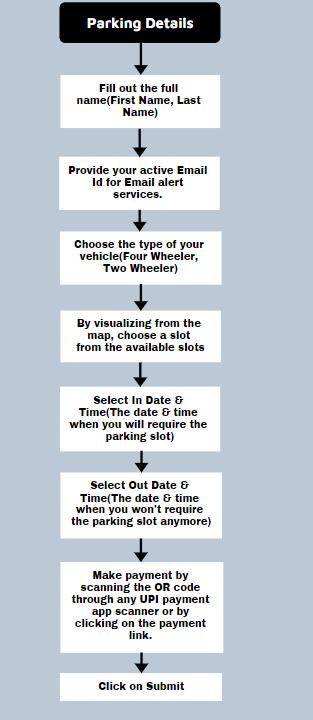
Alternatively,intheeventofinvalidinputsorblankfields, usersencounteran'Unsuccessful'screen,ensuringauserfriendlyandintuitiveexperience.

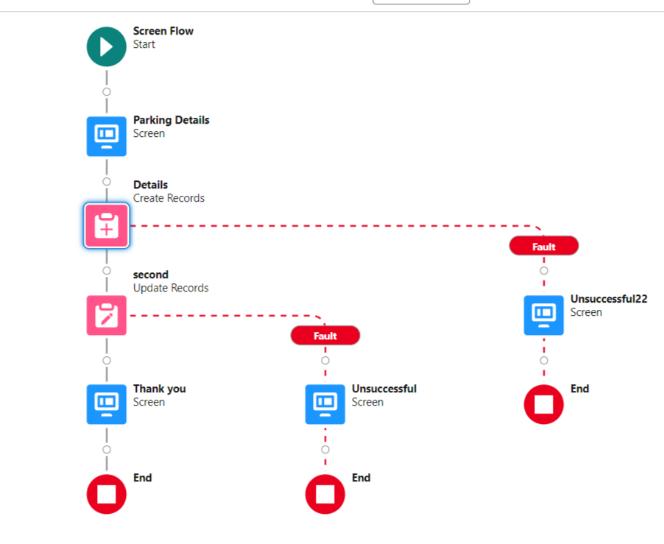
The initial phase of interaction commences with the presentation of the "Parking Details" screen, constructed utilizing the "screen" element. This interface solicits user input, encompassing parameters such as First Name, Last Name, Email ID, Vehicle Type, Available Slots, and Date & Time selection. Additionally, it provides access to the payment link and QR code functionality for processing parking slot payments. Transitioning to the subsequent phasewithintheflow,denotedas"Details",thissegmentis constructedthroughtheutilizationofthe"createrecords" element.Herein,arecordinstantiationprocessistriggered for the "Parking Booking" object, entailing the setting of pertinent field values such as Email ID, First Name, Last Name,InDate,OutDate,AvailableSlots,Status,andVehicle Type.
Subsequently, the flow advances to the third phase, designated as "Update Records", orchestrated to effect modificationswithinthe"Slot"object'srecords.Thisphase involves the specification of conditions for record identification, followed by the individual configuration of field values. Leveraging the "AND" operator, this process facilitatestheadjustmentof"Slot"objectrecords,including fields such as "In Date", "Out Date", and "Status". Transitioningtothefinalstage,uponcompletionofpayment submission, users are directed to a "Thank You" screen, signaling successful transaction completion. Conversely,
International Research Journal of Engineering and Technology (IRJET) e-ISSN: 2395-0056
Volume: 11 Issue: 04 | Apr 2024 www.irjet.net p-ISSN: 2395-0072
usersencounteringinputvalidationfailuresoromittedfields are redirected to an "Unsuccessful" screen, thereby providingpromptfeedbacktofacilitateerrorrectification.
As urban areas continue to expand and automobile ownership rises, the issue of parking availability has emergedasasignificantchallenge.Despiteexistingparking facilities, ineffective utilization exacerbates traffic congestion,timewastage,andenvironmentalpollution.This inefficiencyfrustratesmotoristsandincursfinanciallosses for businesses due to the inadequacies of conventional parking systems. Introducing a parking space booking systemoffersasolutionbymodernizingtraditionalparking managementpractices.Thissystemenablesdriverstoprebookparkingspaces,optimizingusageandminimizingthe time spent searching for vacant spots. Beyond enhancing convenience and efficiency, the implementation of such a system yields several additional benefits, including the reduction of traffic congestion and emissions, heightened customer satisfaction, enhanced operational efficiency for businesses, and the creation of supplementary revenue streams. Despite the advantages, the adoption of parking space booking systems faces challenges such as technical complexities, regulatory constraints, and resistance from stakeholders. Nevertheless, with technological advancementsandanincreasingawarenessofthenecessity forsustainableurbantransportationsolutions,thepresent moment presents an opportune time to explore and implementinnovativeparkingmanagementmethodologies. This study aims to develop, implement, and evaluate a parking space booking system to assess its efficacy in enhancingparkingmanagementefficiency,mitigatingtraffic congestion, and improving urban mobility. By addressing thesecriticalchallenges,ourobjectiveistocontributetothe enhancementofsmarturbaninfrastructureandthecreation ofmorelivableandsustainablecities
The implementation of the car parking booking system withintheSalesforceframeworkhasbeenhighlysuccessful, revolutionizingparkingfacilitymanagementandenhancing user experience. Leveraging Salesforce's robust CRM capabilities,thesystemoffersseamlessbookingprocesses, real-timeavailabilityupdates,andfacilitatescommunication betweenadministratorsandpatrons.Automationfeatures streamline booking complexities, freeing up staff time for other tasks, improving responsiveness, and boosting productivity.Intuitiveuserinterfacesandreal-timeupdates simplifyparkingspacelocatingandreservation,enhancing overallusersatisfaction.
Theintegrationofanalyticsprovidesvaluableinsightsinto parking utilization patterns, enabling informed decisionmaking and resource allocation. The system is scalable, adapting to changing business requirements and
customizabletomeetspecificorganizationalneeds.Seamless integrationwithotherSalesforcecomponentsorthird-party applications enhances ease of use and compatibility, enhancingitsutilityacrossdiverseoperationalcontexts.
Finally,thecarparkingbookingsystemwithinSalesforcehas optimized resource utilization, improved efficiency, and providedaseamlessexperienceforbothadministratorsand patrons.ItssuccessliesinitsabilitytoleverageSalesforce's CRM capabilities, automation features, and analytics integration to streamline processes, provide valuable insights,andadapttoevolvingbusinessneeds.
Incorporating advanced analytics and machine learning methodologiesholdspromiseinofferingpredictiveinsights intofutureparkingdemands.Suchinsightswouldenablethe formulation of proactive strategies and adaptable pricing models,thereby enhancing usersupportandstreamlining parking space bookings. Integration with smart parking infrastructure,comprisingsensorsandautomatedpayment systems, can significantly augment the automation and efficiency of the car parking booking system on the Salesforceplatform.
Leveraging Internet of Things (IoT) devices facilitates the acquisitionofreal-timedatapertainingtoavailableparking spaces. This real-time information enhances the accuracy and reliability of parking space availability data, thereby simplifying the process of locating parking spaces. This integrationbearsthepotentialtoalleviatetrafficcongestion andelevatetheoverallmanagementofparkingoperations.
[1] EvanKindler(2023),ParkingBenefitDistricts,Parking Reform Networks (https://parkingreform.org); at https://parkingreform.org/playbook/pbd
[2] Todd Litman (2023), Comprehensive Parking Supply, Cost and Pricing Analysis, Victoria Transport Policy Institute(www.vtpi.org);atwww.vtpi.org/pscp.pdf
[3] ITE(2023),MultimodalTransportationImpact;Analysis for Site Development, ITE Transportation Planning Council(www.ite.org);athttps://bit.ly/3lIBRSb.
[4] Katya Kisin (2022), Every Parking Lot in the U.S., KatWorld (http://kat.world); at http://kat.world/map.html.Describedin,LessParking, More People Space, Strong Towns (www.strongtowns.org/journal/2022/6/20/lessparking-lots-more-people-space).
[5] JeffSpivak (2022), “A Business Case forDropping Parking Minimums,” Planning Magazine (www.planning.org);athttps://bit.ly/3muQN3e.
International Research Journal of Engineering and Technology (IRJET) e-ISSN: 2395-0056
[6] Nelson/Nygaard (2022), The New Transportation DemandManagement:AnImplementationGuideforCity Officials, Natural Resources Defense Council (www.nrdc.org); at https://nelsonnygaard.com/thenew-tdm-guide
[7] Jürgen Gies, Martina Hertel and Susan Tully (2021), Parking Standards as a Steering Instrument in Urban and Mobility, Sustainable Urban Mobility Plans (https://park4sump.eu);athttps://bit.ly/36EJUF1
Volume: 11 Issue: 04 | Apr 2024 www.irjet.net p-ISSN: 2395-0072 © 2024, IRJET | Impact Factor value: 8.226 | ISO 9001:2008
| Page