
International Research Journal of Engineering and Technology (IRJET) e-ISSN: 2395-0056
Volume: 11 Issue: 04 | Apr 2024 www.irjet.net p-ISSN: 2395-0072

International Research Journal of Engineering and Technology (IRJET) e-ISSN: 2395-0056
Volume: 11 Issue: 04 | Apr 2024 www.irjet.net p-ISSN: 2395-0072
B. Nagamma1 , G. Chandra prabhath2 , V. Goutham3, K. Charan4
, K. Uday Kiran5
1. Assistant Professor, Mechanical Department, Guru Nanak Institute of Technology
2,3,4,5, UGC Scholars, Mechanical Department, Guru Nanak Institute of Technology
Abstract - This research pioneers using FDM technology to create a complaint centrifugal clutch for automobiles. It tackles the limitations of traditional designs by integrating advanced modeling and leveraging FDM's uniquecapabilities. The study employs sophisticated CAD tools to optimize the clutch's design for peak performance and durability, then strategically utilizes FDM's layer-by-layer method to materialize the prototype. Careful material selection ensures the clutch meets its mechanical and thermal demands. The resulting prototype undergoes rigorous testing to validate its performance under various conditions. This research aims to not only optimize clutch efficiency but also introduce the advantages of FDM to the automotive industry, openingdoors for further exploration and adoption of this transformative technology in the design and productionofcriticalautomotive components.
KeyWords: FusedDepositionModeling(FDM), Computeraided design (CAD), Complaint centrifugal clutch, Prototyping, Optimize, etc.
1.
This research tackles the limitations of traditional centrifugal clutches by employing FDM, a layer-by-layer additivemanufacturingprocess.ItutilizesadvancedCADto optimize clutch design for efficiency and durability, showcasing FDM's potential to reshape automotive componentproduction.Byexploringvariousthermoplastics and rigorously testing the prototype, the study aims to bridgethegapbetweentheoryandpractice,pavingtheway for FDM adoption in developing efficient and lightweight clutches for improved vehicle performance. This timely contributionoffersacutting-edgeperspectiveonintegrating advanced design with FDM, redefining the manufacturing landscapeforcriticalautomotivecomponents.
Additive manufacturing, the 3D printing marvel, upends traditional production. Building layer by layer, it grants unmatched design freedom, rapid prototyping, and costeffectiveness.Gonearetheshacklesofsubtractivemethods; intricateshapesandcustomizationflourish,slashingwaste andtime-to-market. From aerospacetohealthcare,across industries,thisversatiletechnologyredefineshowwecreate, fromconcepttoproduction.Additivemanufacturingstands
asabeaconofinnovation,usheringinaneweraoflimitless possibilities.
Centrifugal clutches, the silent heroes of many machines, seamlessly adjust power transmission based on speed. As the engine revs up, centrifugal force engages the clutch, connectingtheenginetotheworkload.Thisautomaticdance makesthemperfectforapplicationslikechainsawsandgokarts,wheresmoothpowerdeliveryiskey.
Therearedifferenttypesofcentrifugalclutches,eachwith its strengths. The classic shoe type uses pivoting arms to engagethepower,whilethe conetypeemploysagradual, progressive engagement ideal for heavier machinery like lawntractors.
Fromcompacttoolstomightymachines,centrifugalclutches keepthepowerflowing,adaptingtoever-changingdemands. Their versatility and reliability make them indispensable playersintheworldofmechanicalengineering
Compliant centrifugal clutches ditch clunky multi-part designsforasingle,flexibleplate.Thissimplerbuildnotonly slashes costs but also stores energy and transmits higher torque.Fewermovingpartsmeanlesswearandtear,whilea clevergraphicaldesignensuressmoothoperation.Agamechangerforefficient,durablepowertransmission
Digital design transforms into physical reality through a sequenceofsteps.First,ideastakeshapeinCADsoftware, where 2D sketches evolve into 3D models. Next, slicing softwarepreparesthemodelforprinting,generatingprecise instructions. Finally, specialized 3D printers like the 3D Metaform PRO-500 or Adroitec machines meticulously constructthecomponentslayerbylayer,translatingdigital blueprintsintotangibleobjects.
Modelingoftheproducthasinvolvedthestepsingeneralare Createanewfile,selectplaneorientation,createa2Dsketch usingline,circle,Sline,andarcentities,setdimension,finish sketch,extrude,andclickOK.
International Research Journal of Engineering and Technology (IRJET) e-ISSN: 2395-0056
Volume: 11 Issue: 04 | Apr 2024 www.irjet.net p-ISSN: 2395-0072
Thenextprocessconvertingdigital3Dmodelsintolayersfor the printer to follow. It determines the print parameters, suchaslayerheightandinfill,ensuringpreciseandaccurate fabrication.CommonexamplesincludeCura,Simplify3D,and PrusaSlicer
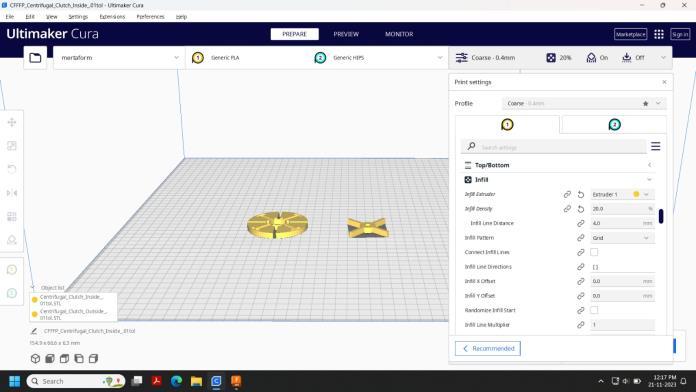
1 Slicing the product in Cura.
ManufacturingusinganFDM3Dprintingmachinenamely MetaformPRO-500.It500isahigh-speed,largeformat3D printer ideal for building low-cost objects and industrial samples. It offers industrial quality and reliability, with a widerangeofthermoplasticmaterials.ItfeaturesWi-Fi,USB datatransfer,poweroffresume,a5-inchtouchdisplay,anda filamentrunoutsensor.
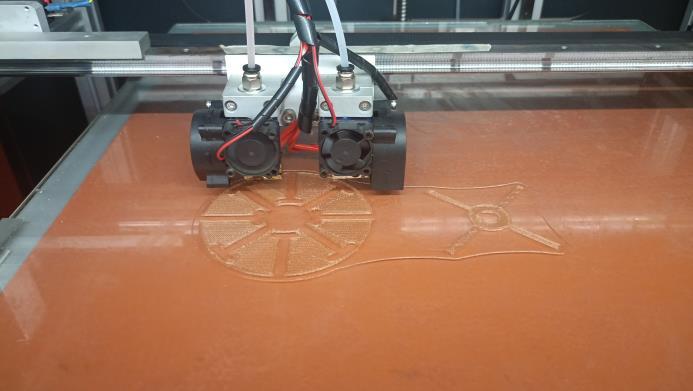
2.1 Result
Our research marries cutting-edge design with FDM's 3D magic, churning out a centrifugal clutch stronger and smoother than ever. FDM's layer-by-layer build banished traditional limitations,yieldinga prototype thatacesboth strength tests and real-world simulations. This isn't just about clutches; it's about FDM reshaping car parts, one precise layer at a time. Buckle up, the future of efficient, resilientvehiclesisinsight.
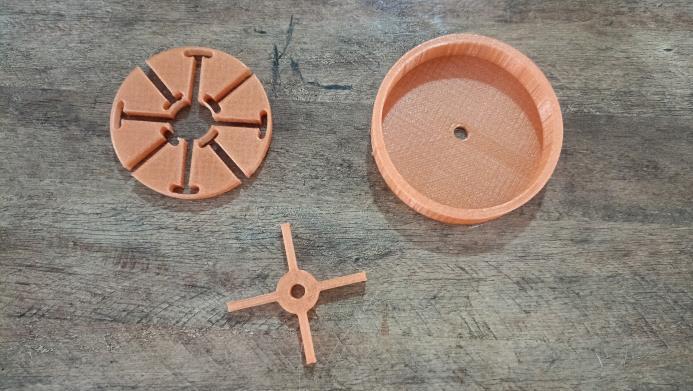
Clutchingontoinnovation,thisresearchmarriesadvanced designwithFDM3Dprintingtoforgeanext-gencentrifugal clutch. FDM's layer-by-layer magic transcends traditional limitations,craftingintricate,durablecomponents.Beyond clutches,thisstudypavesthewayforbroaderFDMadoption in autos, driving toward a future of efficient, resilient vehicles. Our tangible results rewrite the narrative of automotive engineering, shaping a road paved with performanceandsustainability.
[1] Roach,G.M.,Lyon,“ACompliant,FOARatchetandPawl ClutchwithCentrifugalThrowOut,”Proceedingsofthe 1998ASMEDesignEngineeringTechnicalConferences, (1998).2.Sevak,N.M.,C.W.,1974,“OptimalSynthesisof FlexibleLinkMechanismswithLarge
[2] Mettlach,G.A.andMidha,A.,“UsingBurmesterTheoryin theDesignofCompliantMechanisms”,(1996).
[3] MattMoniz."Rapidprototypingintechnologyeducation: rapid prototyping, while costly, can afford students a unique opportunity to bring their ideas to reality.”, (2002).
[4] Suchdev,L.S.andCampbell,J.E.,“Self-AdjustingRotor for a Centrifugal Clutch,” United States Patent No. 4821859,(1989).
[5] SAshley,StevenMechanicalEngineering“Prototyping withadvancedtools”,1994).
[6] Murr,L.E.,Gaytan,S.M.,Medina,F.,Lopez,H.,Martinez, E., MacHado, B. I., ... & Wicker, R. Next-generation biomedical implants using additive manufacturing of complex, cellular and functional mesh arrays. Philosophical Transactions of the Royal Society A: Mathematical, Physical and Engineering Sciences, (2010).
International Research Journal of Engineering and Technology (IRJET) e-ISSN: 2395-0056
Volume: 11 Issue: 04 | Apr 2024 www.irjet.net p-ISSN: 2395-0072
[7] Elgendy,I.(2018)."DesignandAnalysisofaCompliant Centrifugal Clutch." Proceedings of the ASME 2018 International Mechanical Engineering Congress and Exposition”,(2018).
[8] Nathan B., "Compliant Centrifugal Clutches: Design, Analysis,andTesting”,(2003).