
International Research Journal of Engineering and Technology (IRJET) e-ISSN: 2395-0056
Volume: 11 Issue: 04 | Apr 2024 www.irjet.net p-ISSN: 2395-0072

International Research Journal of Engineering and Technology (IRJET) e-ISSN: 2395-0056
Volume: 11 Issue: 04 | Apr 2024 www.irjet.net p-ISSN: 2395-0072
Dnyaneshwari S. Ganorkar 1, Shravani M. Wankhade2 , Mrs. Rachana M. Patil3
1Student of Department of Electronics and Telecommunication Engineering ,Mauli College of Engineering and Technology ,Shegaon-444203(Maharashtra) India
2Student of Department of Electronics and Telecommunication Engineering ,Mauli College of Engineering and Technology ,Shegaon-444203(Maharashtra) India
3Assistant Professor at Department of Electronics and Telecommunication Engineering ,Mauli College of Engineering and Technology ,Shegaon-444203(Maharashtra) India
Abstract - The field of robotics have been witnessed remarkable advancements till now, with the aim of creatingintelligentandversatilemachinesthatcanmimic humancapabilities.Theprimaryobjectiveofthisprojectis to design and construct a hand that achieves natural and fluid movements, enabling it to perform intricate tasks with precision. The design of the animatronic hand will prioritize durability, safety, and power efficiency. These key considerations will ensure that the hand can withstand prolonged usage, operate safely in various environments, and optimize power consumption for extended battery life. The project will culminate in the delivery of a fully functional prototype, accompanied by comprehensive documentation and rigorous testing to showcase its capabilities. Additionally, a user-friendly interface will be developed for both manual control and programming of customized gestures, making the hand adaptableforvariousapplications.
Key words: - Advancements, Animatronic hand, Dexterity, Flexibility, Sensors, Power efficiency, Prototype
The development of animatronic hands represents a groundbreaking advancement in robotics, offering innovative solutions to mitigate risks associated with human involvement in hazardous environments. Industries such as nuclear and chemical sectors face significant challenges in ensuring worker safety while handling potentially harmful substances. Similarly, the medical field seeks innovative technologies to enable remote surgical procedures and enhance patient care. In response to these challenges, the concept of animatronic handsemergesasapromisingsolution.
This research paper aims to explore the design, implementation, and applications of animatronic hands in various industrial and medical settings. By leveraging the capabilitiesofArduinoUnomicrocontrollers,flexsensors, and servo motors, these robotic devices can replicate human hand movements with precision and efficiency. Moreover,theintegrationof wirelesscontrol mechanisms enables remote operation, thereby reducing the need for direct human intervention in hazardous environments.
The significance of this research lies in its potential to revolutionize workplace safety and accessibility across diverse industries. By replacing human hands with animatronic counterparts, tasks that pose risks to human health can be performed with greater efficiency and reducedexposuretodanger.Additionally,theadaptability of animatronic hands makes them invaluable tools for assisting individuals with physical disabilities, fostering greaterindependenceandautonomy.
Inthesubsequentsectionsofthispaper,wewilldelveinto the technical aspects of animatronic hand design, including sensor integration, control mechanisms, and real-world applications. Through empirical analysis and case studies, we aim to demonstrate the efficacy and practicality of animatronic hands in enhancing workplace safety and productivity. Furthermore, we will explore future research directions and potential advancements in this field, highlighting the transformative impact of animatronictechnologyonhuman-machineinteraction.
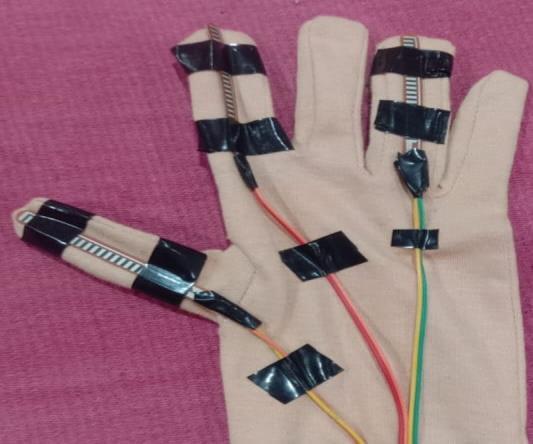
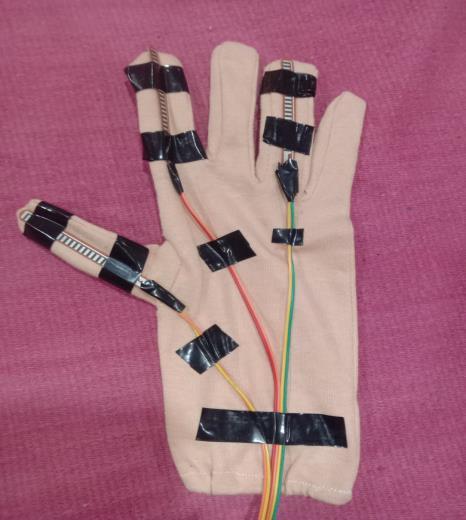
Inthedevelopmentofanimatronichands,flexsensorsplay a crucial role by capturing the intricate movements of the humanhand.Thesesensors,affixedtothehand,detectthe bending and motion of fingers and the hand itself. Operating as transducers, flex sensors quantify both the degree of bend and angular deflection. Typically constructed with a variable resistive circuit, they undergo changes in resistance as they are bent. In this project, the flex sensors utilized measure 2.2 inches in length, providing adequate coverage for a range of hand movements. With two terminals, flex sensors exhibit variable resistance, increasing as the sensor bends. To interface with the Arduino Uno microcontroller, one terminal connects to the power supply, while the other is grounded to the Arduino uno. Implementation on the Arduino, facilitated by a computer interface, allows for real-time monitoring and control. The provision of power to the Arduino ensures continuous operation, enabling seamless integration of flex sensor data into the animatronichandsystem.
International Research Journal of Engineering and Technology (IRJET) e-ISSN: 2395-0056
Volume: 11 Issue: 04 | Apr 2024 www.irjet.net p-ISSN: 2395-0072
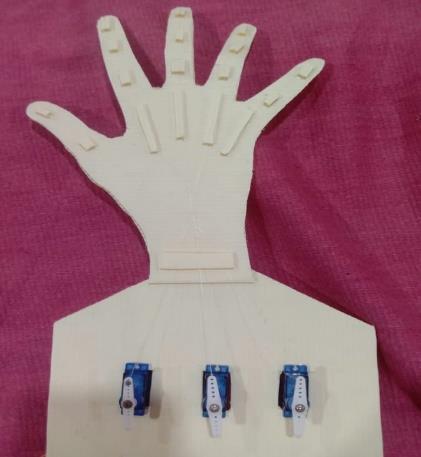
TheReceivermoduleinterfaces directlywiththeArduino, where essential components ensure smooth operation. Withinthismodule,avoltageregulatorwithafixedoutput voltage of 5V provides stable power supply, vital for consistentperformance.A10kohmresistorservestofilter the output of the voltage regulator, enhancing signal integrity.Theconnectionbetweentheservomotorandthe ArduinoUnoisestablished,withtheservomotorfeaturing three pins: Ground, positive terminal supply, and control signal. Once connected, the servo motor becomes an integral part of the animatronic hand system, linking directly to the artificial hand. Programming tasks are executed within the Arduino environment, where commands are generated and relayed to the servo motor. As the servo motor receives these commands, it initiates corresponding movements in the artificial hand, thereby orchestrating precise and responsive actions dictated by the Arduino program. This seamless integration and control mechanismensuretheeffectiveexecutionoftasks by the animatronic hand, enhancing its utility and versatilityinvariousapplications.
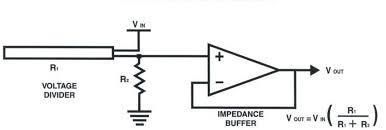
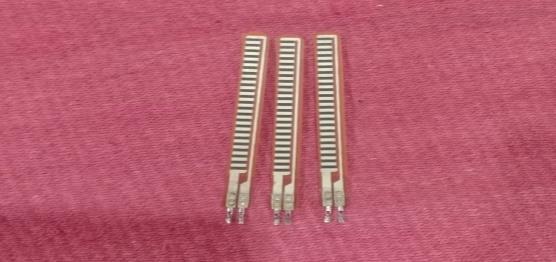
A pivotal component mounted on the human hand, operates as a variable resistance device, undergoing changes in resistance when bent. This resistance alteration isdirectlylinked tothedegreeofbending, with a higher bend angle resulting in increased resistance. Functionally, flex sensors, also known as analog resistors, functionasvariableanalogdividerswithintheirstructure. They contain carbon resistance elements embedded within a flexible substrate, where a higher concentration ofcarbonleadstoreducedresistance.Whenthesubstrate is subjected to bending, the flex sensor generates a resistance output proportional to the bend radius. In essence,theflexsensor'sresistancedynamicallyadjustsin response to the hand's movements, providing valuable inputforcontrollingtheanimatronichandsystem.
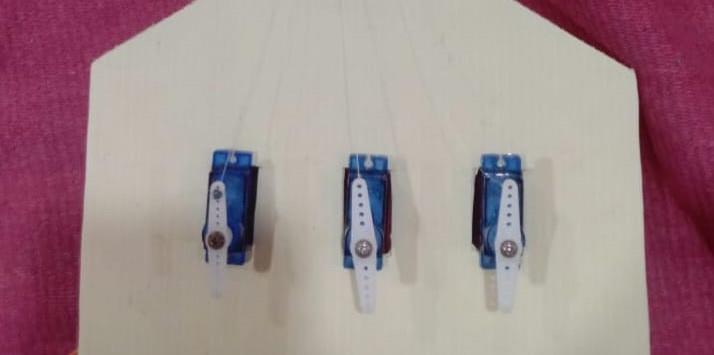
Itis crucialformanipulatingfingermovementswithinthe hand, comprises three output wires: Red, Orange, and Brown. These wires serve distinct functions in facilitating the motor's operation. The Red wire connects to the power supply, providing the necessary voltage for motor activation. Meanwhile, the Brown wire serves as the grounding connection, completing the electrical circuit. TheOrangewire,designatedasthesignalwire,carriesthe pulse-width modulation (PWM) signal from the Arduino. This signal, generated by the Arduino, determines the precise angle of movement for the servo motor. Through programmed instructions, the Arduino dictates the magnitudeofthePWMsignal,therebyregulatingtheangle at which the servo motor rotates. Consequently, the movement of the servo motor is intricately controlled by the Arduino's programming, allowing for precise and
Volume: 11 Issue: 04 | Apr 2024 www.irjet.net p-ISSN: 2395-0072
coordinated finger movements within the animatronic handsystem.
5. The Arduino Uno
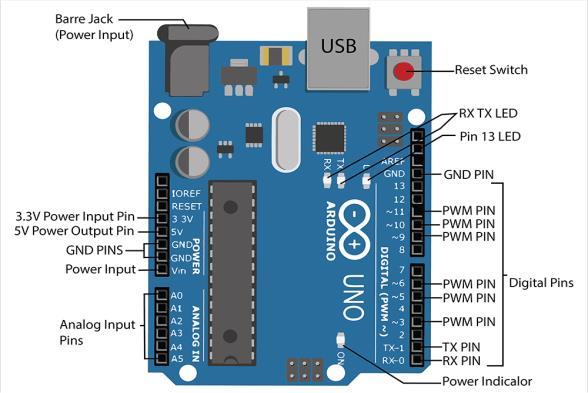
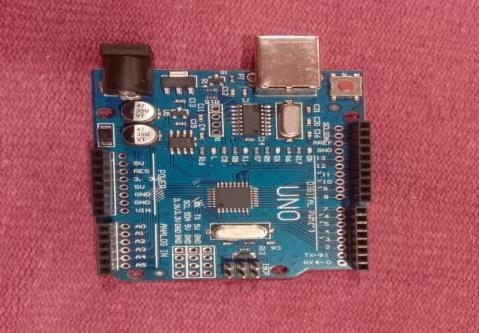
A versatile microcontroller board, serves as the central control unit in numerous electronic projects and prototypes. Featuring an Atmega328P microcontroller, clocked at 16 MHz, it offers a wide array of digital and analog input/output pins for interfacing with sensors, actuators, and other peripheral devices. Equipped with flashmemoryof32KB,ofwhich0.5KBisreservedforthe bootloader, and SRAM of 2 KB, the Arduino Uno provides sufficient memory and processing power for executing complex tasks. Its onboard USB interface facilitates easy programming and communication with external devices, while the integrated voltage regulator ensures stable operation across varying power sources. Additionally, the Arduino Uno is supported by a vast community of enthusiasts and developers, offering extensive documentation, libraries, and online resources. With its user-friendly development environment and robust hardware capabilities, the Arduino Uno continues to be a cornerstone in the realm of embedded systems and DIY electronics,empoweringuserstobringtheircreativeideas tolife.
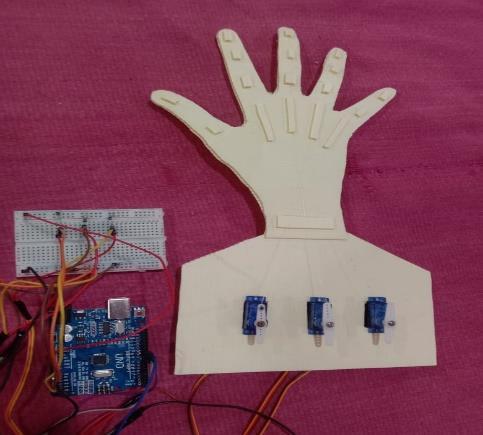
The animatronic hand, a wireless component integrated into a humanoid robot, operates seamlessly in tandem with the human hand through the utilization of flex sensors.Initiallytestedwithasinglefinger,theflexsensor responds to the bending of the human finger, causing a change in resistance. This change is duly detected at the receiver end, where the corresponding artificial hand fingermimicsthemovementangleandmannerismsofthe human finger. Achieving this coordination is made possible through the precise control exerted by servo motors, which handle the moment of each robotic finger. With all five fingers synchronized to mirror the movements of the human hand, the wireless operation enhances flexibility and versatility. Programming, executed through Arduino software on a PC, forms the backbone of this process, encompassing both transmitter and receiver sides. As the flex sensor detects finger movement, Arduino interprets and transmits this data wirelessly,enablingreal-timecommunicationbetweenthe human hand and the artificial hand. At the receiver end, Arduino orchestrates servo motor responses to replicate fingermovementswithutmostaccuracy,underscoringthe critical role of programming in the seamless operation of theanimatronichand.
International Research Journal of Engineering and Technology (IRJET) e-ISSN: 2395-0056
Volume: 11 Issue: 04 | Apr 2024 www.irjet.net p-ISSN: 2395-0072
4. Conclusion
Undoubtedly, robotic advancements have revolutionized everydaytasks,andtheAnimatronichandepitomizesthis efficiency by multitaskingseamlessly.Thistechnology not hazards or risks to human life. Moreover, the potential of the Animatronic hand can be further amplified by overcomingobstaclesandoperatingindiverseconditions, including air and water. Precision in finger movements is crucial for its broader adoption, prompting ongoing researchaimedatrefiningitscapabilities,suchasmobility andload-carryingcapacity.Costreductionmeasures,such as leveraging wireless communication technologies like Bluetooth, hold promise for wider accessibility. Particularly for individuals with physical disabilities, the prospect of a more affordable and efficient Animatronic hand signifies a potential blessing, paving the way for greaterindependenceandempowerment. Onlysavestime but also enhances productivity by enabling simultaneous completion of multiple tasks. Its applicability expands significantly,particularlyinenvironmentsfraughtwith
[1] Sachin Kumar Gupta. “Arduino-Based Wireless Hand GestureControlledRobot”Publishedin:Jan2023IEEE AmericanInstituteofPhysics(AIP)
[2] Virendra Sangtani, Manish Poswal, Ravi Ram Meena, Saurabhmeena, Vikashyadav, Mohit Vishnani. “Animatronic Hand” Published in: Jun 2022 IEEE International Research Journal of Modernization in EngineeringTechnologyandScience(IRJMETS)
[3] Swarnika Shruti,Savita KumariVerma,ShrishtiSingh, Tanya Gupta. “Arduino Based Hand Gesture Controlled Robot” Published in: May 2021 IEEE International Research Journal of Engineering and Technology(IRJET).
[4] Munir Oudah, Ali Al-Naji,JavaanChah.“HandGesture Recognition Based on Computer Vision: A Review of Techniques” Published in: Jul 2020 IEEE MultidisciplinaryDigitalPublishingInstitute(MDPI).
[5] A. Sai Ramya, R. Madhuri, M. Suryanarayan Murty, MithiunBhandari,V.Ramsai.“RoboticARMControlled by Human ARM” Published in: Mar 2018 IEEE International Journal of Scientific Engineering and TechnologyResearch(IJSETR)