
International Research Journal of Engineering and Technology (IRJET) e-ISSN:2395-0056
Volume: 11 Issue: 04 | Apr 2024 www.irjet.net p-ISSN:2395-0072
International Research Journal of Engineering and Technology (IRJET) e-ISSN:2395-0056
Volume: 11 Issue: 04 | Apr 2024 www.irjet.net p-ISSN:2395-0072
Mihir Ghanekar1, Archita Sehgal2, Shrishail Gouragond3, Maitray Wani4, Prof. Pramila M. Chawan5
1,2,3,4B. Tech Student, Dept of Computer Engineering and IT, VJTI College, Mumbai, Maharashtra, India 5Associate Professor, Dept of Computer Engineering and IT, VJTI College, Mumbai, Maharashtra, Indi
Abstract - In today's digital era, face recognition technology plays a crucial role in security, authentication, andidentification,despiteitsloweraccuracycomparedto other biometrics. It presents a promising solution for attendance tracking in educational institutions and workplaces, addressing the inefficiencies of manual processespronetoproxyattendanceissues.Thisresearch aimstodevelopa classattendancesystemleveragingface recognition technology. The proposed system involves database creation, face detection, recognition, and attendanceupdatingusingRetinaFace-10GFandResNet50 models.Throughreal-timemonitoring,attendancerecords are automatically compiled and accessible to faculty, offering a streamlined and automated solution that enhances accuracy and addresses the shortcomings of traditional attendance tracking methods. By integrating advanced technology with the urgent need for efficient attendancemanagement,thisresearchseekstocontribute to the optimization of attendance processes in various organizationalsettings.
Key Words: Machine Learning, Computer Vision, Face detection, Face recognition, Feature matching, Automated attendancesystem.
In today's educational landscape, the process of manually marking attendance remains a tedious and timeconsuming task for faculty members. This traditional approach not only consumes valuable class time but also introduces the possibility of errors such as proxy attendance. In response to these challenges, educational institutions have explored alternative attendance recording techniques, including Radio Frequency Identification (RFID), iris recognition, and fingerprint scanning. However, these methods often suffer from inefficienciesrelatedtoqueuingandintrusiveprocedures.
Face recognition technology emerges as a promising solution to address the shortcomings of traditional attendance tracking methods. Unlike other biometric methods, such as iris or fingerprint recognition, face recognition offers a non-invasive and easily accessible means of identification. Moreover, it is less affected by variationsinfacialexpressionsandcanefficientlyperform bothverificationandidentificationtasks.
This research endeavours to harness the potential of face recognition technology to develop a smart attendance system tailored for educational environments. The proposed system aims to detect student faces from live classroom video streams, thereby streamlining the attendancetrackingprocessandminimizingthelikelihood of errors associated with manual methods. By leveraging advancementsinfacerecognitiontechnologyandmachine learning algorithms, this innovative approach seeks to enhance accuracy, efficiency, and overall classroom management.
With the increasing popularity and accessibility of face recognition technology, this paper proposes a comprehensive solution to address the evolving needs of attendance management in educational institutions. By integrating cutting-edge technology with pedagogical practices,theaimistocreateaseamlessanduser-friendly attendance tracking system that optimizes class time and promotes academic accountability. Through this research, we seek to contribute to the ongoing discourse on leveraging technology to enhance teaching and learning experiencesinthedigitalage.
The evolution of face recognition systems is evident in recent research endeavors, aiming to overcome the limitations of traditional methods that require controlled conditions. Geng underscores the necessity for face recognition under uncontrolled conditions, emphasizing the need for systems capable of operating in real-time without stringent environmental constraints. While such systems offer promise, drawbacks like single-person image input hinder their applicability in scenarios requiring rapid, multi-person detection, such as attendancesystems.
Winarno introduces an anti-cheating presence system using 3WPCA-Dual Vision Face Recognition, showcasing its effectiveness with a 98% recognition rate. Leveraging stereovisioncamerasandthe3WPCAmethod,thissystem enhances cheating detection in facial recognition applications, promising greater integrity in attendance monitoringandothersecurity-sensitivecontexts.
International Research Journal of Engineering and Technology (IRJET) e-ISSN:2395-0056
Volume: 11 Issue: 04 | Apr 2024 www.irjet.net
In response to the shortcomings of traditional attendance methods, recent advancements in picture-based attendance systems have emerged. These systems, as described by various authors, aim to streamline attendance tracking by capturing multiple student faces swiftly. However, ensuring continuous registration remains crucial to achieving high accuracy rates, especiallyindynamicclassroomenvironments.
Furthermore, the integration of mobile presence systems with facial recognitionand NFCsafetyfeaturespresentsa promising solution to the challenges posed by traditional attendance methods. By minimizing human errors and enhancing efficiency, these integrated systems offer a viable alternative for attendance management in educationalsettings.
The studies conducted by Lukas and Polamarasetty delve into the technical aspects of facial recognition, exploring techniques like DWT, DCT, and RFID integration. By combiningthesemethodologieswithadvancedalgorithms and hardware capabilities, researchers aim to develop robust attendance systems capable of operating seamlessly in diverse environments while ensuring accuraterecord-keepingandaccesscontrol.
Inrecentyears,advancementsindeeplearningalgorithms have revolutionized the field of facial recognition. The InsightFace API, RetinaFace, and ResNet-based systems represent notable contributions in this domain. The InsightFace API, developed by Deng et al., offers state-ofthe-art face recognition capabilities with high accuracy and efficiency. Its versatile architecture allows for seamless integration into various applications, including attendancesystems.Similarly,RetinaFace,afacedetection model developed by Deng et al., excels in detecting faces withhighprecision,eveninchallengingconditionssuchas occlusions and variations in pose and illumination. Furthermore, ResNet-based models have demonstrated remarkable performance in face recognition tasks, leveraging deep residual networks to extract discriminative features from facial images. By harnessing thecapabilitiesoftheseadvancedmodels,researchersaim to enhance the accuracy and reliability of attendance systems, enabling seamless integration into educational environmentswhileminimizingadministrativeburdens.
The stated version of Smart Attendance System is based on the Fast Face Recognition model which is based on InsightFace API and its pretrained models powered by RetinaFace-10GFandResNet50modelsforfacialdetection andfacialrecognitionrespectively.
p-ISSN:2395-0072
• RetinaFace-10GF: A powerful face detection model knownforitsaccuracyandefficiency,capableofdetecting faceswithvariousposes,scales,andocclusions.
• ResNet50: A deep convolutional neural network renowned for its superior performance in image classification tasks, consisting of 50 layers and employing residual learning to address the vanishing gradient problem.
The following measures have been used for distance and similarity in the above machine learning search algorithms:
❖ Distance
o Euclideandistance
o Manhattandistance
The above measures are insensitive to outliers and highdimensionaldata.
❖ Similarity
o Cosinesimilarity
Cosine similarity is used to due to its immunity to highdimensionaldata.
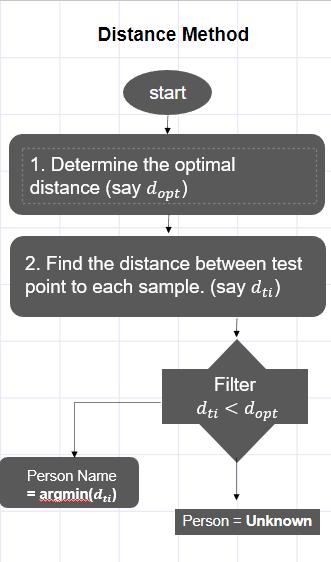
Fig 1:Distancemethodforfacerecognition.
Volume: 11 Issue: 04 | Apr 2024 www.irjet.net p-ISSN:2395-0072
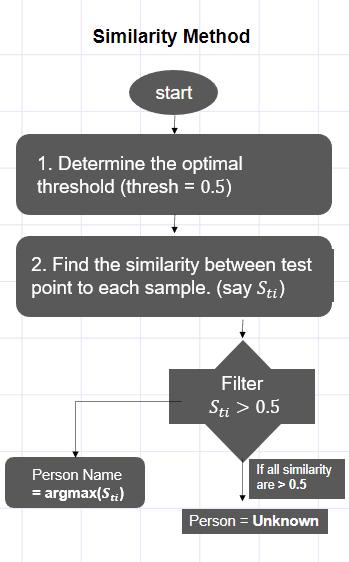
Fig 2:Similaritymethodforfacerecognition.
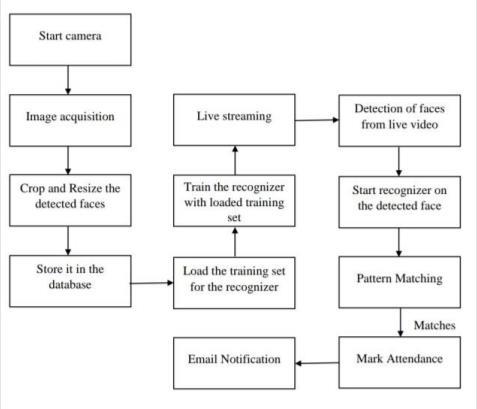
Capturing the dataset forms the foundational step in developing a facial recognition-based attendance system. This involves using a webcam to gather images of students. To ensure robust recognition capabilities, multiple images of each student are acquired, encompassingvariousfacialexpressionsandangles.These imagesundergopreprocessing,whichincludescroppingto isolate the Region of Interest (ROI), resizing to standardized pixel dimensions, and conversion from RGB to grayscale format and conversion to an image vector whichisthenstoredinthe Redisdatabaseinfolderofthe user'sname
The system employs the Fast Face Recognition model in conjunction with OpenCV for face detection. Before use, thepre-trainedclassifierisusedtorecognizehumanfaces effectively. The detection process involves utilizing the InsightFace API which leverages the Euclidean distance and Cosine Similarity search algorithms generating rectangles around detected faces within an image. Finetuning parameters buffalo_l, buffalo_m and buffalo_s optimizes the algorithm's performance for accurate face detection.
Upon successful face detection, the system proceeds to facerecognition.Thisprocessisdividedintoseveralsteps. Initially, the dataset images are pre-processed to assign integer labels corresponding to each student's identity. Subsequently, a face recognizer employing the ResNet-50 technique is utilized. During training, image vectors are computed for each image, facilitating comparison during the recognition phase. Upon recognition, the system identifies the best-matched label associated with the recognized face, determining the corresponding student's identity.
Followingfacerecognition,thesystemupdatesattendance records. Recognized faces are marked as present in theRedisdatabaseandanexcelsheet,whileabsentees are listed. A detailed report of absentees is then accessible to the respective faculty members via the Streamlit WebApp. Additionally, monthly attendance sheets are provided to faculties for comprehensive record-keepingandanalysis.
In addition to the core functionalities, the proposed methodology integrates a clustering method for recommendation systems, enhancing the system's versatility and utility. This entails a multi-step approach involving data collection and annotation, preprocessing, feature extraction, machine learning model development, Redis database integration, search algorithms, real-time monitoring and alerting, customization,userinterfacedesign,securityanddata protection measures, real-world testing and validation,andongoingmaintenanceandoptimization strategies. Each step contributes to the system's robustness, adaptability, and reliability in diverse educationalandcorporateenvironments.
The proposed Attendance System with Face Recognition, incorporating Redis database, OpenCV, machine learning, and search algorithms in Python, presents a transformative solution with numerous advantages across diverse domains. Notable benefits include enhanced accuracy through facialrecognition,automationforincreasedefficiency, heightened security against unauthorized access, and robust data integrity provided by the Redis database. The system's customization, user-friendly interface, and reporting features make it adaptable to the unique needs of educational institutions, corporate
International Research Journal of Engineering and Technology (IRJET) e-ISSN:2395-0056
Volume: 11 Issue: 04 | Apr 2024 www.irjet.net p-ISSN:2395-0072
offices, and various businesses. Its scalability and potential for cost savings underscore its practicality for both small and large entities. The system's versatile use cases span educational institutions, corporate offices, healthcare facilities, government institutions, retail outlets, transportation, hospitality, andbeyond.
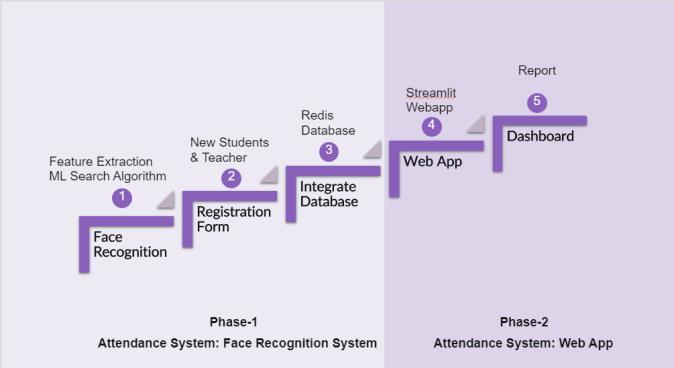
The project's results showcase a user-friendly Graphical User Interface (GUI) that facilitates interaction with the system, offering three main options: student registration, faculty registration, and attendance marking. During student registration, users input necessarydetailsintotheprovidedformandclickthe registerbutton,initiatingthewebcamtoautomatically capture images of faces. The system continues to collect photos until 60 samples are obtained or CTRL+Q is pressed, after which the images undergo preprocessing and are stored in the training images
folder.Facultymembersregisterwiththeirrespective course codes and email addresses, crucial for receivingabsenteelistsviaemail.
Ineachsession,facultyentertheircoursecode,triggering the camera to begin detection. The face recognition window displays recognized students, indicating 'unknown' for unregistered individuals. Pressing CTRL+Q updates attendance in the Excel sheet and emails absentee names to faculty members, ensuring efficientrecord-keepingandcommunication.
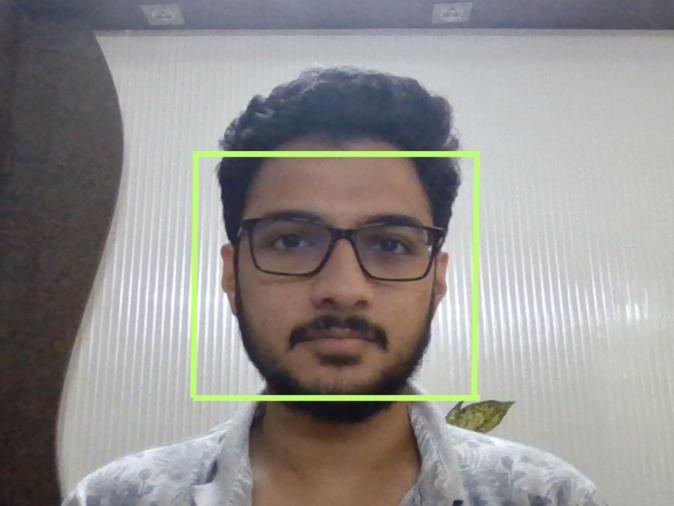
The FastFace Recognition model flexes various benefits overthetraditionalattendancetechniques.Itrequires lesser sample images of a person to train the model comparedto the standard 100to200imagesthatthe traditional systems would need. No model retrain is needed to introduce a new person into the system. The accuracy of the model is not affected by the addition of new people into the attendance system. Moreover, processing is faster and more efficient due to cache-based retrieval enabled by the Redis database.
International Research Journal of Engineering and Technology (IRJET) e-ISSN:2395-0056
Volume: 11 Issue: 04 | Apr 2024 www.irjet.net p-ISSN:2395-0072
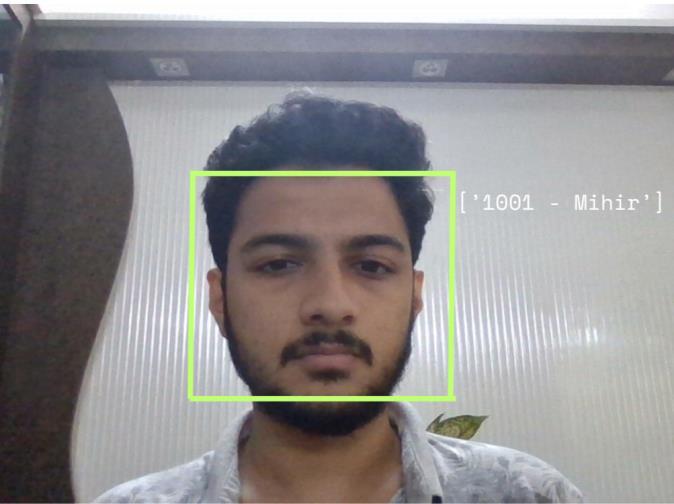
Fig 6: Facerecognized.
Wecansee withwhatlevel ofaccuracywehavemanaged to bring to this model with the following comparative tableofaccuracyfordifferentsearchalgorithms.
Table 1: ComparisonofSearchAlgorithms
Manhattan Distance Sum of absolute differences between corresponding coordinates
Chebyshev Distance Maximum absolute difference between corresponding coordinates
Minkowski Distance Generalizationofboth Manhattan and Chebyshevdistances
Cosine
Similarity
Cosine similarity is a measure of the angle betweenthetwononzero vectors. Often used for highdimensional data like facial features. Closer to 1 means more similarity.
5. CONCLUSION
In conclusion, the employed method utilizing OpenCV, InsightFaceandCosinesimilarityforframeextraction, face recognition and face recognition to demonstrate optimal outcomes. This approach ensures superior accuracy in identifying multiple faces within a single
frame while maintaining minimal response time. The primary objective of this system is to establish a robust class attendance system through the integration of facial recognition techniques. By leveraging facial IDs, the proposed system efficiently captures attendance data. Through webcam detection and facial recognition processes, it accurately identifies individuals and records their attendance. Moving forward, this system holds promise for enhancingattendancemanagementprocesseswithits seamlessintegrationoffacialrecognitiontechnology.
[1] Xin Geng, Zhi-Hua Zhou, & Smith-Miles, K. (2008). Individual Stable Space: An Approach to Face Recognition Under Uncontrolled Conditions. IEEE TransactionsonNeuralNetworks.
[2] Winarno, Wiwien Hadikurniawati, Imam Husni Al Amin,MujiSukur,“Anti-Cheating
[3] Presence System Based on 3WPCA Dual Vision Face Recognition, Faculty of Information Technology UniversitasStikubankSemarangIndonesia.
[4] Prototype model for an Intelligent Attendance System based on facial Identification by Raj Malik, Praveen Kumar, Amit Verma, Seema Rawat, Amity University UttarPradesh.
[5] Convolutional Neural Network Approach for Vision Based Student Recognition System, Nusrat Mubin Ara1,Dept.ofCSE,SUST,Sylhet,Bangladesh.
[6] NFC Based Mobile Attendance System with Facial Authorization on Raspberry Pi and Cloud Server Siti UmmiMasrurohAndrewFiadeImeldaRistantiJulia.
[7] Face recognition-based Attendance System using Machine Learning Algorithms, Radhika C. Damale, Department of Electronics and Telecommunications, Cummins College of engineering for Women, Pune, Maharashtra,India.
[8] Class Attendance system based on Face Recognition" PriyankaWagh.
[9]DesignofClassroomAttendanceSystemBasedonFace Recognition,WenxianZeng.
[10] Automated Attendance System Using Face Recognition, Akshara Jadhav, Akshay Jadhav Tushar Ladhe,KrishnaYeolekar.
[11] An AttendanceMarking Systembased onFace Recognition" written by Khem Puthea, Rudy Hartanto andRisanuriHidayat.
International Research Journal of Engineering and Technology (IRJET) e-ISSN:2395-0056
Volume: 11 Issue: 04 | Apr 2024 www.irjet.net p-ISSN:2395-0072
[12] Class Attendance Management System Using Face Recognition,OmarAbdulRhmanSalimDepartmentof Electrical and Computer Engineering, Faculty of EngineeringInternationalIslamicUniversityMalaysia, KualaLumpur,Malaysiao.salem92@gmail.com
[13]FaceRecognitionBasedAttendanceSystemNandhini R,DuraimuruganN.