
International Research Journal of Engineering and Technology (IRJET) e-ISSN: 2395-0056
Volume: 11 Issue: 04 | Apr 2024 www.irjet.net p-ISSN: 2395-0072
International Research Journal of Engineering and Technology (IRJET) e-ISSN: 2395-0056
Volume: 11 Issue: 04 | Apr 2024 www.irjet.net p-ISSN: 2395-0072
Student, of Civil Engineering, JSPM’s Imperial College Of Engineering & Research, Wagholi Pune, Maharashtra, India
Assistant Professor, Dept. of Civil Engineering, JSPM’s Imperial College Of Engineering & Research, Wagholi Pune, Maharashtra, India
Abstract – This paper STAAD PRO is a sophisticated tool that engineers can use to precisely analyse a building's structural integrity while analysing high-rise structures. With consideration for wind, seismic loads, and other environmental factors, it can offer a thorough analysis of a structure's static and dynamic responses. Comparative evaluation of the seismic performance of a steel-concrete composite buildingframe locatedinearthquake zone IV and a (G+10) storey RCC building. First, a 3D model of the structure is created. This model may then be analysed using the robust finite element analysis programme found in STAADPro.
1.INTRODUCTION
STAAD Pro is a strong tool that engineers can use to analyse high-rise structures and precisely determine a building's structural integrity. It can offer a thorough examination of a structure's static and dynamic reactions, accounting for external factors such as wind and seismic loads. Additionally, it can be applied to design and optimisethestructureforoptimalefficiencyandsafety.
Thefirststepintheanalysisistocreatea3Dmodelofthe structure, which can then be examined using the robust finite element analysis tools available in STAAD Pro. Through this analysis, the loads and forces acting on the structure are identified, and the amounts of stress and strain in various structural components are ascertained. The structure can then be designed with these findings in mindforoptimalsafetyandeffectiveness.
The examination may also be used to look into the structure's serviceability and stability. This entails evaluating the dynamic response of the structure under variousloadingscenariosinadditiontotheeffectsofwind, seismic loads, and other environmental variables. Additionally,STAADProiscapableofanalysingtheeffects offatigueonastructureovertimeaswellasthebuckling, cracking,andfailureofstructuralcomponents.
The analysis's findings can be utilised to optimise the structure's design and ensure that it complies with all
relevant design codes. The study can also be used to produce reports and graphics that help guide decisions duringthedesignandconstructionphases.
Thisresearchworkaimstoinvestigatethecurrentstateof RCC and composite building seismic performance evaluation. An analytical investigation into the structural behaviour of composite and R.C.C. high rise structures is being conducted in this work. Displacements, axial forces, base shear, and natural period are the parameters taken into account. The results, including maximum displacement values, axial forces, base shear, and natural periods,aredeterminedbytheprojectanalysis,whichwas conducted using the structural analysis programme STAAD-PROV8I.[1]
Comparedtomanyemergingnations,Indiausesextremely little steel in the construction industry. Other nations' experiences show that this isn't because steel isn't a costeffective building material[1]. There is a lot of room to grow the amount of steel used in building, particularly given India's present development requirements. The nation has suffered a great loss by not investigating steel as a substitute building material and by not utilising it when it is cost-effective. Furthermore, it is clear that composite sections made of steel encased in concrete are currently a practical, affordable, and quick fix for large civilconstructionslikebridgesandskyscrapers.[2]
A discussion of the planning and building of a high-rise RCC structure opens the literature study. This covers an analysis of the building materials, the structure's design, and the many construction methods that were employed. A overview of the several kinds of analysis that can be done for a high-rise RCC structure is also included in the paper. This covers nonlinear analysis, finite element analysis, and static and dynamic analysis. The purpose of the study is to find any potential flaws or weaknesses in the structure and confirm that it can support the anticipatedloadsandstresses.
International Research Journal of Engineering and Technology (IRJET) e-ISSN: 2395-0056
Volume: 11 Issue: 04 | Apr 2024 www.irjet.net p-ISSN: 2395-0072
3.1 Model Details:
The structure under consideration is a 10-story office buildinginseismiczoneIV,designatedasG+10.Thethreedimensional isometric view is displayed in Figures 2 and 3.InFigure4,thebuildingplanisdisplayed.
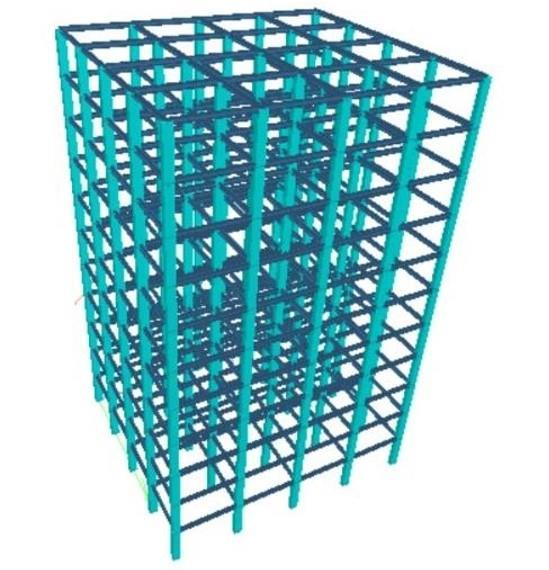
Figure:3DRenderedviewofmodelonSTAAD-Pro
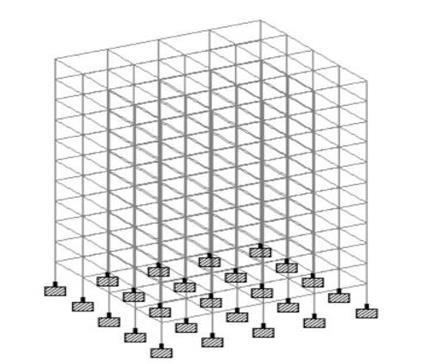
Figure:3-DViewofModelinSTAAD-Pro
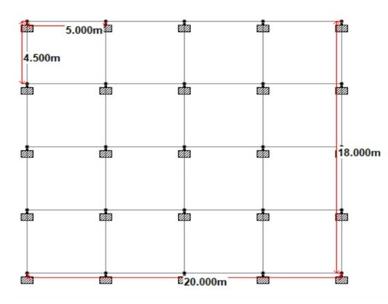
Figure4:3-DViewofModelinSTAAD-Pro
The fundamental design and loading parameters are identical for both RCC and Composite Steel Concrete structures. The slab, beam, and column structural members of an RCC structure are designed in accordance with IS456:2000, whereas the members of a Steel Concrete Composite Structure are developed in accordancewithEurocode4.
Columns are thought to be composed of RCC with structuralsteelsectioninitscoreandreinforcementinthe concrete exterior. Composite beams are constructed with structuralsteelsectionsecuredtothesteeldeckslabwith the assistance of shear studs. The beam column frame is regarded as a moment-resisting frame that carries lateral stresses.
ResponseSpectrumMethod andEquivalentStaticMethod are used to analyse the described 3D building model. STAAD-Pro software is then used to analyse the building models. For the seismic loads in the X-direction, several parameters are investigated, including storey stiffness, storey drift, base shear, weight of the structure, lateral pressures, mode shapes, natural time period, and frequency.Aspecificcountry'sseismiccodesareexclusive tothatlocation.India'sIS1893(PART-1)standardcriteria fordesigningstructuresthatareearthquakeresistant:The primarycodethatoffersanoutlineforfiguringoutseismic designforceis2002.
The parts of a structure that give it stability and support arecalledstructural members.Thesizeofthese partscan vary based on the needs of the design or the application. Beams, columns, trusses, and frames are examples of commonstructuralelements.
The size of the structural members should be carefully taken into account during the design phase in order to guarantee the structural integrity of a project. The weight that a structural part must support, the kind of material employed, and the required rigidity of the structure all
International Research Journal of Engineering and Technology (IRJET) e-ISSN: 2395-0056
Volume: 11 Issue: 04 | Apr 2024 www.irjet.net p-ISSN: 2395-0072
have a role in determining its size. A structural member's sizemayalsoneedtobemodifiedtotakeothermembers' presence and the intended aesthetic of the structure into consideration. After the sizes of the structural members have been established, they should be verified that they complywithallcriteriabycomparingthemtotherelevant engineeringstandardsandbuildingregulations.
Depending on the application, structural components of compositeconstructionsareusuallyconstructedtohavea variety of sizes. Generally speaking, the forces that must be resisted and the stiffness needed for the structure dictate the size of a structural member. The material chosen for the member's construction and manufacturing technique has an impact on its size as well. For instance, larger members might be needed for steel or concrete membersthanforlightweightcompositemembers.
ResponseSpectrumMethod andEquivalentStaticMethod are used to analyse the described 3D building model. The STAAD PRO programme is then used to analyse the building models. For the seismic loads in the X-direction, several parameters are investigated, including storey stiffness, storey drift, base shear, weight of the structure, lateral pressures, mode shapes, natural time period, and frequency.Aspecificcountry'sseismiccodesareexclusive tothatlocation.Theprimarycodethatgivesanoutlinefor determining seismic design force in India is IS 1893 (PART-1): 2002, which is the Indian standard criteria for earthquakeresistantdesignofstructures.
5.1 CONCLUSION:
1. In composite structures, the self-weight of frame is less and therefore substantial reduction in cost ofconstructionoffoundationisobserved.
2. Under seismic considerations because of the inherent ductility characteristics, steel- concrete structure will perform better than a conventional R.C.C.structure.
3. High ductility of steel material leads to better seismic resistance of the composite section. Steel component shows ductile behavior without premature failure and can withstand numerous loadingcyclesbeforefracture.
4. Steel being cost inducing construction material canpose material costonhigherside.Butspeedy construction, reduced dead load & various other factorscancounteractoverallprojectcost.
5. Base Shear for RCC frame is on higher side becausetheweightoftheRCCframeismorethan thecompositeframe.
6. Analysisofthecompositebuildingshowsthatthe axial forces, moments and shear forces of the structure are very less for the same loadings as compared to the RCC building. The reduced momentsandaxialforcesultimatelyresultsinthe reduceddimensionsofthecolumnsandbeamsof composite building. Hence one can conclude that the composite construction is more economical thentheconventionalRCCconstruction
The comparative analysis of RCC (Reinforced Concrete) and composite structures can have several future scopes. Herearesomepotentialareasoffocus:
Performance Evaluation: Future research can delve deeper into the performance evaluation of RCC and composite structures under various loadingconditions.Thisincludesassessingfactors such as strength, stiffness, durability, fire resistance, seismic performance, and long-term behavior. Comparative studies can help identify the strengths and weaknesses of each type of structureandoptimizetheirdesignaccordingly.
Sustainability and Life Cycle Assessment: As sustainability becomes an increasingly important consideration, future studies can explore the environmentalimpactandlifecycleassessmentof RCC and composite structures. This involves evaluating factors such as embodied carbon, energy consumption, recyclability, and overall sustainability. Comparisons can aid in identifying which structural system has a lower environmental footprint and suggest strategies forimprovement.
AdvancedMaterialsandConstructionTechniques: Advancements in materials and construction techniquescansignificantlyimpactthedesignand construction of both RCC and composite structures.Futureresearchcanexploretheuseof innovative materials like high-performance concrete, fiber-reinforced polymers, carbon fiber composites, and hybrid systems. Comparative studies can highlight the benefits and challenges associatedwithincorporatingthesematerialsinto eachstructuraltype.
Structural Optimization and Design Guidelines: Comparative analysis can help in developing optimized design guidelines for RCC and composite structures. By studying their behavior
International Research Journal of Engineering and Technology (IRJET) e-ISSN: 2395-0056
Volume: 11 Issue: 04 | Apr 2024 www.irjet.net p-ISSN: 2395-0072
and performance under different loading scenarios, researchers can establish design methodologies that ensure structural safety, efficiency, and cost- effectiveness. This can includedevelopingcodeprovisions,designcharts, andguidelinestailoredspecificallytoeachtypeof structure.
Retrofitting and Rehabilitation Techniques: Retrofitting and rehabilitation of existing structures is an important aspect of structural engineering. Future studies can explore the comparative effectiveness of retrofitting techniques for both RCC and composite structures. This involves investigating methods such as external post-tensioning, fiber wrapping, and composite jacketing to enhance the loadcarrying capacity and extend the service life of thesestructures.
1. D. R. Panchal, P. M. Marathe, “Comparative Study of R.C.C, Steel and Composite (G+30 Storey) Building”, Institute Of Technology, Nirma University, Ahmedabad- 382481, December, 2011,pp.08-10.
2. Anish N. Shah, Dr. P. S. Pajgade, “Comparison Of RCC and Composite Multistoried Buildings”, InternationalJournalofEngineeringResearchand Applications (IJERA), ISSN: 2248-9622, Vol.3, Issue2,March-April2013,pp.534-539.
3. S. S. Charantimath, Swapnil B.Cholekar, Manjunath M. Birje, “Comparative Study on Structural Parameter of R.C.C and Composite Building”,CivilandEnvironmentalResearch,ISSN 2224-5790 (Paper) ISSN 2225-0514 (Online),Vol.6,No.6,2014
4. A.E. Hassaballa, Probabilistic Seismic Hazard Assessment and Seismic Design Provisions for Sudan,Ph.D.Thesis,SUST,2010.
5. Mario Paz, and William Leigh, Dynamics of Structures (fifth edition, Textbook of Kluwer AcademicPublishers),2004.
6. Uma, S.R., and Jain, S. K., Seismic Design of BeamColumn Joints in RC Moment Resisting FramesReview of Codes, structural Engineering andMechanics,Vol.(23), No.(5),2006, PP. 579 –597.
7. GuidoMAGENESand StefanoPAMPANIN,Seismic Response of Gravity-Load Design Frames with Masonry Infills, 13th World Conference on
Earthquake Engineering, Vancouver, B.C., Canada, August1-6,2004,PaperNo.4004.
8. E. Hassaballa , Fathelrahman M. Adam. 2, M. A. Ismaeil, “Seismic Analysis of a Reinforced Concrete Building by Response Spectrum Method”, IOSR Journal of Engineering (IOSRJEN) e-ISSN: 2250-3021, p-ISSN: 2278-8719 Vol. 3, Issue9(September.2013),||V3||PP01-09
9. Abhishek Sanjay Mahajan , Laxman G. Kalurkar, “Performance Analysis of RCC and Steel concrete composite structure under seismic effect”, IJRET: International Journal of Research in Engineering andTechnology eISSN:2319-1163|pISSN:23217308.
10. Syed Fahad Ali, S. A. Bhalchandra, “Study on Seismic Analysis of RCC and Steel- Concrete Composite Structure and Cost Comparison with Different Support Conditions”, IJSRDInternational Journal for Scientific Research & Development| Vol. 3, Issue 09, 2015 | ISSN (online):2321-0613