
International Research Journal of Engineering and Technology (IRJET) e-ISSN: 2395-0056
Volume: 11 Issue: 04 | Apr 2024 www.irjet.net

International Research Journal of Engineering and Technology (IRJET) e-ISSN: 2395-0056
Volume: 11 Issue: 04 | Apr 2024 www.irjet.net
Dr.Bhibhu prasad1 , Bhadrasi Varun 2 , Kalpana Choudhury 2 , Chandan kumar Satapathy 2 , Rajaram Behera 2
1Asst professor & HOD, ECE department, GIETU, Gunupur, Odisha, India
2UG Scholar, ECE department, GIETU, Gunupur ,Odisha , India
Abstract - Earthquake detection circuits are sophisticated mechanisms designed to detect and respond to seismic vibrations. These circuits, built on the principles of electronic sensing, play a pivotal role in seismic monitoring and early warning systems. By leveraging interconnected electronic components and intricate designs, these circuits swiftly recognize even minor tremors, translating them into actionable alerts. The functionality of these systems is rooted in their ability to sense and interpret seismic activity, providing critical information for disaster preparedness and risk mitigation. Understanding the underlying technology behind these circuits is crucial, as it enhances our capacity to detect and respond effectively to seismic events. Their role in offering early warnings is instrumental in minimizing the potential impact of earthquakes, aiding in prompt responses and ensuring safety measures are in place to mitigate potential risks associated with seismic disturbances.
Key Words: IC555, Battery, BC548 Transistor, Capacitor, LED, LM471, Variable, Resistors, Speakers
1.INTRODUCTION
In the intricate dance of geological forces that shape our planet, earthquakes stand as both awe-inspiring and potentially devastating phenomena. Understanding and accuratelydetectingtheseseismiceventsareparamountfor ensuring the safety and resilience of communities worldwide. The realm of earthquake detection reports represents the forefront of scientific and technological effortstomonitor,analyze,andrespondtoseismicactivities. Earthquake detection circuits play a pivotal role in monitoring seismic activity. They are designed to detect minutevibrationsandtranslatethemintoactionablealerts, offering crucial early warnings. These circuits comprise variouscomponents,eachservingaspecificfunctioninthe detection process. The integration of IC555, BC548 transistors, capacitors, LEDs, LM471, variable resistors, speakers,andbatteriesformsthebackboneofthesecircuits, enabling efficient and accurate detection mechanisms. ThomasHeatonetal.;statedanexplorationintoearthquake detectionandwarningsystemsispresented.Thediscussion encompassesseismometers,accelerometers,andGPS-based systems.Thearticlealsoaddressesthechallengesassociated withimplementingearthquakeearlywarningsystemsand the potential benefits they bring [1]. Mehmed Ali Yildirim and Adem Koc et al.; proposed a real-time seismic
monitoring and early warning system for earthquake disaster mitigation is introduced. The system utilizes a combination of seismometers, accelerometers, and GPSbasedsystemstodetectandmeasureseismicwaves[2].Jörn Lauterjung et al.;providesanoverviewofearthquakeearly warning systems, discussing their history, current status, and future prospects. The article delves into the various types of sensors used in earthquake detection and the challenges associated with implementing early warning systems [3]. R. Sundaresan et al.; stated that earthquakes arise from the gradual movement of the Earth's crust or tectonic plates. While these movements are slow, the resultingcollisionsreleaseasubstantialamountofenergy, generating seismic waves [4]. P.S Prasad et al.; stated althoughearthquakesthemselvesrarelycausedirectharm to living organisms, their aftermath, such as building collapses, fires, and tsunamis, poses significant threats. Predicting the exact timing of earthquakes remains a challenge,despiteadvancementsintechnology.Researchers and engineers worldwide are diligently working on designing earthquake early warning systems to provide crucialtimeforevacuationsbeforeanearthquakestrikes[5]. C.E.Yoonetal.;statedeconomicimplicationsofearthquakes aresubstantial,withtrillionsincosts.[6]M.J.Nandhinietal.; stated the principle of vibration and waves plays a significantroleinearthquakedetectionsystems.Whenthe Earthvibratesduetoseismicwaves,detectors,andwarning systemsaretriggered,providingalertsthroughmechanisms suchasbellsandelectricityflow[7].FischerJetal.;provides researchinvolvingthepreparation,testing,andanalysisof theseeducationaltoolsdemonstratestheirpotentialtomeet criteria for effective student learning. The detectors and warning systems, judged on their appearance and functionality,incorporateeasilyobtainablematerialsanda straightforwardlayout[8].
The IC555, commonly known as a timer IC, is the core componentofthisearthquakedetectioncircuit.Itgenerates a continuous pulsesignal when theLM471 sensor detects ground movement. The BC548 transistor amplifies this signal, which then triggers the LED and the speaker to providebothvisualandaudiblealerts
International Research Journal of Engineering and Technology (IRJET) e-ISSN: 2395-0056
Volume: 11 Issue: 04 | Apr 2024 www.irjet.net p-ISSN: 2395-0072
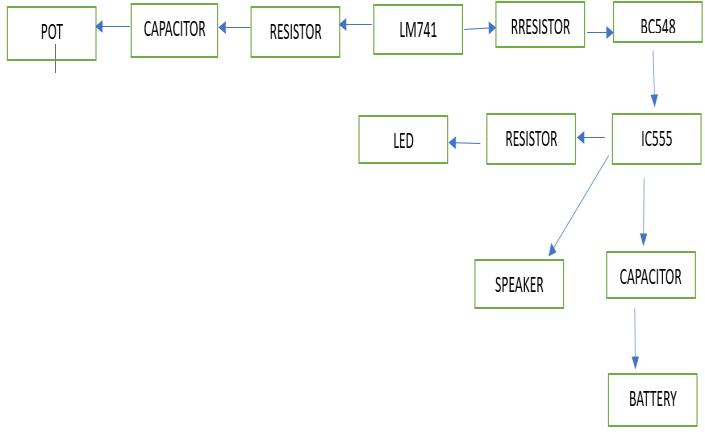
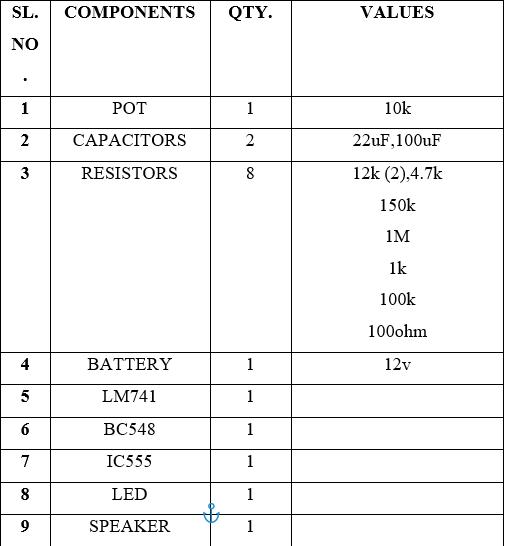
Each component in the circuit plays a specific role, from providingpowertocontrollingthesensitivityoftheseismic activitydetection.Whenanearthquakeoccurs,theLM471 sensor reacts to ground vibrations, setting off a chain reaction of events that results in an immediate alert. The components are easily available, and the circuit can be assembledonaprotoboardoracustomPCB.
Before Analysis
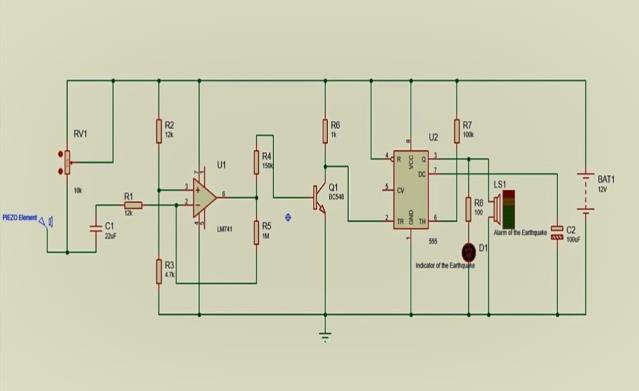
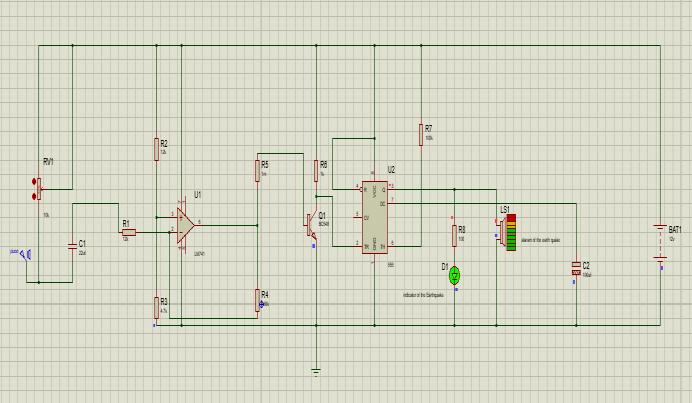
Once the circuit is constructed, it's important to test and calibrate it to ensure accurate earthquake detection. The circuitdemonstratedscalability,adaptingwelltodifferent magnitudesofseismicevents.Thisadaptabilityiscrucialfor its potential deployment in varied geographical regions. Calibrationinvolvesadjustingthevariableresistortosetthe sensitivitylevelthattriggersanalert.Testingcanbedoneby gentlytappingthetableorthesurfaceonwhichthecircuitis placed to simulate seismic activity. When earthquake will erupt around us the sensor (i.e., LM471) present in the hardwarewilldetectthemagnitudeoftheearthquakeand thenIC555willgeneratethealertsignalandtheBC548helps toamplifythealertsignalduetowhichthespeakerproduce an audible alert signal and the LED provides a visual indicationofseismicactivity.
The earthquake detection circuit we've discussed in this report offers a practical and cost-effective solution for detectingseismicactivity.ByutilizingtheIC555timeranda rangeofcomponents,youcancreateafunctionalsystemthat provides both visual and audible alerts in the event of an earthquake. This can be a valuable addition to home or workplace,enhancingpreparednessfornaturaldisasters.
Earthquake detection circuits are invaluable tools in seismically active regions. They offer early warning capabilities,enablerapidresponse,andaidinthecollection ofcriticalseismicdata.Theaccurateandtimelydetectionof earthquakesenhancesdisasterpreparednessandultimately saves lives. As technology advances, these circuits are becomingmoresophisticated,increasingtheirefficiencyand reliability.
1. Filippitzis, Filippos & Kohler, Monica & Heaton, Thomas & Beck, James. (2021). Sparse Bayesian learning for damage identification using nonlinear models:Applicationtoweldfracturesofsteel‐frame buildings.StructuralControlandHealthMonitoring. 29.10.1002/stc.2870.
International Research Journal of Engineering and Technology (IRJET) e-ISSN: 2395-0056
Volume: 11 Issue: 04 | Apr 2024 www.irjet.net p-ISSN: 2395-0072
2. Kubo, Tomohiro & Hisada, Yoshiaki & Murakami, Masahiro & Kosuge, Fusako & Hamano, Kohei. (2011).Applicationofanearthquakeearlywarning system and a real-time strong motion monitoring system in emergency response in a high-rise building.SoilDynamicsandEarthquakeEngineering. 31.231-239.10.1016/j.soildyn.2010.07.009.
3. Mück, Matthias & Taubenböck, Hannes & Post, Joachim&Wegscheider,Stephanie&Strunz,Günter & Sumaryono, Sumaryono & Ismail, F.. (2013). Assessingbuildingvulnerabilitytoearthquakeand tsunamihazardusingremotelysenseddata.Natural Hazards.68.10.1007/s11069-012-0481-1.
4. Sherki, Yogesh & Gaikwad, Nikhil & Chandle, Jayalakshmi&Kulkarni,Anil.(2015).Designofreal timesensorsystemfordetectionandprocessingof seismicwavesforearthquakeearlywarningsystem. 285-289.10.1109/ICPACE.2015.7274959.
5. Manso, Marco & Bezzeghoud, Mourad & Caldeira, Bento. (2016). Design and Implementation of a Network Enabled High-Throughput MEMs-based SeismicSensor.
6. Yoon,C.E.,OReilly,O.,Bergen, K.J., &Beroza,G.C. (2015). Earthquake detection through computationallyefficient similaritysearch.Science Advances, 1(11), e1501057-e1501057.doi: 10.1126/sciadv.1501057.http://advances.sciencema g.org/content/1/11/e1501057
7. Al-Ani, Muzhir. (2015). International Journal of Advanced Research in Computer Science and SoftwareEngineering.10.13140/RG.2.1.1512.6480.
8. Fischer, Joachim & Redlich, Jens-Peter & Zschau, Jochen & Milkereit, Claus & Picozzi, M. & Fleming, Kevin & Brumbulli, Mihal & Lichtblau, Björn & Eveslage,Ingmar. (2012). A wireless meshsensing networkforearlywarning.J.NetworkandComputer Applications. 35. 538-547. 10.1016/j.jnca.2011.07.016.
9. http://ijseas.com/volume2/v2i6/ijseas20160626.pd f
10. Dutta, Pushan. (2017). Earthquake Alarm Detector MicrocontrollerbasedCircuitforissuingWarningfor vibrationinSteelFoundations.InternationalJournal ofMechanical&MechatronicsEngineering.7.35823594.