
International Research Journal of Engineering and Technology (IRJET) e-ISSN: 2395-0056
Volume: 11 Issue: 04 | Apr 2024 www.irjet.net p-ISSN: 2395-0072
International Research Journal of Engineering and Technology (IRJET) e-ISSN: 2395-0056
Volume: 11 Issue: 04 | Apr 2024 www.irjet.net p-ISSN: 2395-0072
Mrunal Dipak Kulkarni1, Kishor Jadhav2
1Design Engineer, Clean Mobility, Pune, India
2Engineering Head, Clean Mobility, Pune, India
Abstract - As the world moves towards clean mobility, there is a demand for low-emission vehicles. Vehicles running on gasoline and diesel cause a lot of pollution, and switching the fuel to hydrogen might bring a major revolution. Hydrogen when used in fuel cells and IC engines is the most viable solution to clean mobility. But the real challenge to this vehicle system is the integrated efficient storage. Hydrogen tanks store hydrogen in all vehicle types under high pressure and supply it to the fuel cells or IC engine. The major concern is regarding safety, so the tanks are built using various layers of materials and the tank goes through a series of tests which build up the resistance in such a way that they can sustain any high speed crash.
Hydrogen when used in fuel cells causes zero emission, so the vehicles running on hydrogen fuel cells are very quiet, highly efficient, reliable, and provide the best fuel economy. Hydrogen in IC engines helps to reduce the emissions drastically while having parts modular with IC and SI engines which provides a great advantage for cost reduction and delivering the required reliability. Also, that this engine can run on lean mixtures.
So switching from conventional gasoline and diesel vehicles to hydrogen powered vehicles would be the most sustainable option for future automotive industry to reach zero emission vehicles.
Key Words: Hydrogen,HydrogenStorageSystem,Hydrogen FuelCells,HydrogenInternalCombustionEngine
1.INTRODUCTION
Integration of hydrogen technology in automobiles is a promising avenue for cleaner energy alternative and environmentalsustainability.Hydrogenisaclean,abundant elementwhichhastakenthemarketattentionintheraceof sustainable transportation solutions. Hydrogen when integrated with fuel cells and internal combustion engine couldmakeoneofthebestemissionfreesolutions.
ThefuelcellsinFCEVsfunctionasanelectrochemicaldevice which converts the chemical energy of the fuel to electric energy.Thepaperwilldelveintothearchitectureofhowfuel cellsareintegratedvehiclesanditspowertrain.Thefuelcell technologyprovidesalotofadvantagesofenergyefficiency, fueleconomy,fastrefueling,extendedrangeascomparedto batterie electric vehicles, etc. Also, this technology faces a fewchallenges,thehurdlesofinfrastructure,cost,andthe
productionofhydrogenareapartofconcernwhichwecould deal with in the near future when this technology would come in mass production.
Hydrogenwhenusedininternalcombustionenginealigns thegoalsofreducingtheemissionsandprovidingareliable and efficient alternative. Hydrogen internal combustion engine run on lean mixtures having an air to fuel ratio of 34:1.
Hydrogenhasahighenergycontent,makingitreliableand potentialfuelforinternalcombustionandservingimproved efficiency and power output. This paper would give a review about the integration of hydrogentechnologyinfuel cellsandinternalcombustion engineswithitsfeatures,opportunitiesandchallenges.
Hydrogen fuel cells are driven by an electrochemical reactioninwhichhydrogenandoxygenproduceelectricity withheatand waterasthe onlyby-product. Fuel cell isa combinationofananode,cathodeandelectrolytemembrane wherehydrogensplitsatanodetohydrogenionsandoxygen isreducedatcathodethatgeneratescurrent.
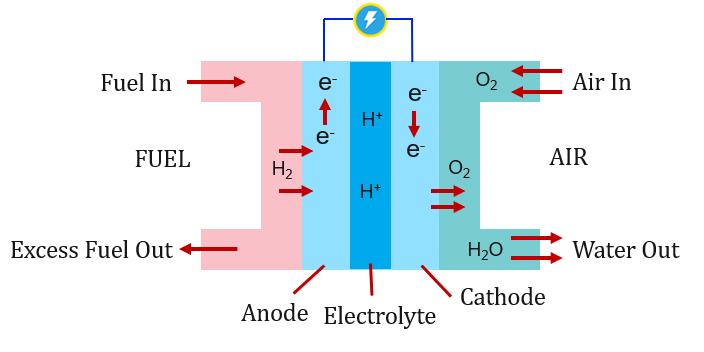
Theelectrochemicalreactionconductedasfollow:
Hydrogensplitsintopositiveionsandnegativeions, H2 →2H++2ePositive ions pass through the electrolyte exchange membranewhereasthenegativeionsfollowadifferentpath throughacircuitgeneratingelectricityandheat. AttheCathode, Thepositiveionscrossthemembraneandtheoxygenfrom theaircombinetoformwater, 2H++2e-+½O2 →H2O
ogy (IRJET) e-ISSN: 2395-0056
Volume: 11 Issue: 04 | Apr 2024 www.irjet.net p-ISSN: 2395-0072
NetRedoxReaction, H2 +½O2 →H2O
Inafuelcellthehydrogenthatremainsunusedgetsrecycled.
3. HYDROGEN STORAGE SYSTEM
The most important component of the Hydrogen Storage Systemisthehydrogentank.Hydrogentankisusedtostore hydrogen at a high pressure of 700bar and 350bar. For automotive applications type III and type IV tanks are preferredfortherelightweightandcapacitytostoreenough hydrogen.
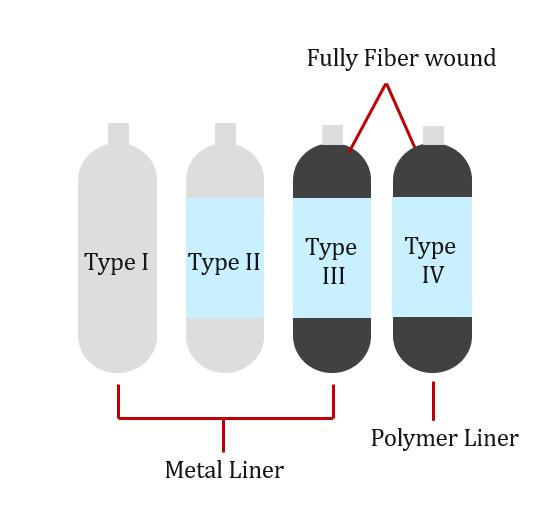
Fig -2:HydrogenTanks
These tanks have a cylindrical section, boundary section, dome section and a boss. There are various layers which buildupthesafetyofthetank:
Thelineristheinnermostlayerwhichsealsinthehydrogen. The liner in the hydrogen storage system ensures permeabilitytohydrogenundergaseousform.Alinermust have good mechanical properties (tensile, compressive, impact strength) as well as good thermo-mechanical behavior.
Thecarbon-fibercompositelayeristheonewhich` ensures pressure resistance. The main motive of using composite materialsinhydrogenstoragesystemistobuildstrength.By mixing two materials (fibers & resins) with different mechanical characteristics will form a material with high performance characteristics. Fibers provide mechanical propertiesandresinsmaintainthereinforcementandhelp togiveafinalshapetotheproduct.
Glass-fiberreinforcedlayerprotectstheCarbonFiberand actsasashockrevealer.Theendsectionofthetankconsists ofDome’sand2BossesoneattheInletandoneattheoutlet. Thismakestheentiretank.
These tanks store hydrogen at a high pressure of 350700bar.
Cars & commercial vehicles powered by the electricity produced by hydrogen fuel cells are known as Hydrogen FuelCellElectricVehicles.
The main constituents of these type of vehicles are the Hydrogen tanks, Fuel cell stack, Battery, Motor, Motor controllerandPowerelectronicssystem. Hydrogenfuelisfilledinthehigh-pressurehydrogentanks fromwhereittravelstothefuelcellgeneratingelectricity. Thiselectricityistransferredtothemotortorunthevehicle and the extra energy is stored in the battery which later providesenergytothemotorswhereverrequired.
Hydrogen Tanks can be accommodated in a vehicle by placingthemontheroof,underfloor,behindthecabinoron thechassis.
Itcanbepossibletoplaceasmallhydrogenreservoironthe frontdeckofthevehicleasthereisnoengineinthiscase,the emptyspacecouldbeutilizedforasmallreservoirincase themaintankgoesempty,andthebatterydoesnotsupport.
There are 3 modes of battery and fuel cell hybridization architecture.
1. Range Extender Fuel Cell: Has a large battery support & small hydrogen system. This is used to increasetheBatteryOnlyVehiclesinsufficientrange andimproveusageflexibility.
2. Dual Power Fuel Cell: Has 50% support by the hydrogensystemand50%supportbythebattery. Generally suitable for vehicles with a balance of urban & highway usage, in context of limited H2 refuelingstations.
3. FullPowerFuelCell:HasamajorFuelCellsupport andaminorbatterysupport.Thisisaconsiderable solution for high range vehicles. Full Power fuel cellsprovidethebestrange andefficiencybutlag withdurabilityandarehighcost.
Considering4drivingvariations.
1]StartingoftheVehicle:BatteryOnly
International Research Journal of Engineering and Technology (IRJET) e-ISSN: 2395-0056
Volume: 11 Issue: 04 | Apr 2024 www.irjet.net p-ISSN: 2395-0072
FuelCell Motor Battery

Themotoroperatesspontaneouslyusingthe batterypowerforasmoothstart.
2]NormalDriving:Powerisprovidedtothemotorfromthe fuelcellsonly.
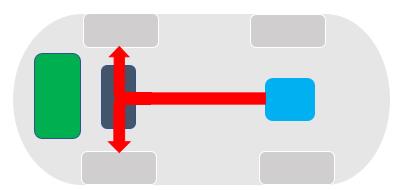
3] Accelerating: Power is provided from the fuel cells & batterytothemotortogiveapowerboost.

4] Braking & Deceleration: During braking & deceleration the Kinetic energy is converted to Potential energy and storedinthebattery.

FCEVarenotasthreateningastheylooktobe. Hydrogentanksservethemajoritysafetyconcernsofthese vehicles.Thesetanksaredesignedinsuchawaythatthey can survive any high-speed crash without cracking or breaking.Themainsourceofprotectionisprovidedbythe carbonfiberandtheGlasswoolinthetank.20-30testsare carried out to check the safety of the tanks and sensitive sensors are installed that detect even a minute amount of hydrogen. Hence, we can say that they are as safe as a conventionalcar.
Quite Operation - as there are no moving parts involveditisaquitesystem.
PollutionFree-Noharmfulpollutantsareemitted fromthesevehicles.
Fastrefueling-Therefuelingtimeisjust3to5mins which is faster than charging battery electric vehicles.
Mileage - These vehicles provide 3 times more mileage than conventional gasoline & diesel vehicles.
Scalability and flexibility – Hydrogen fuel cell technologyisveryscalableandflexible,ashydrogen canbeproducedfromawiderangeofresourcesand isusedoverahugerangeofapplicationsfromsmall scaletohighpowergeneration.
HighCost-Thepriceoffuelcellvehiclesishighas theoverallcostofproduction,Storageanddelivery of hydrogen is high. Its cost would reduce once it comesintomassproduction.
Extraction of Hydrogen - Immense amount of energyisrequiredtoextractitfromwaterorother molecules.
StoringofHydrogen-Hydrogenislightsoitneeds tobeheavilycompressedwhichrequireexpensive tanks.
Fuel Purity - Pure hydrogen is required which shouldbefreefromcontaminants.
FuelingInfrastructure-Thefuelinginfrastructureis notyetdevelopedinmanycountries.
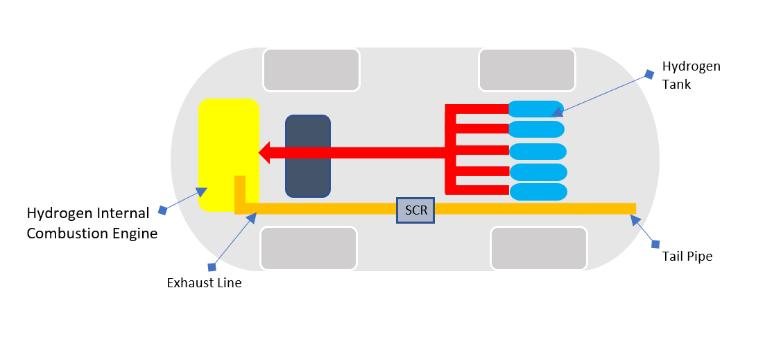
Hydrogen Internal Combustion Engine Vehicles use an internalcombustionenginewithHydrogenasafuel.HICEV aredifferentfromHydrogenfuelcellelectricvehiclesasthey use Hydrogen electrochemically whereas HICEV use it throughcombustion.
International Research Journal of Engineering and Technology (IRJET) e-ISSN: 2395-0056
Volume: 11 Issue: 04 | Apr 2024 www.irjet.net p-ISSN: 2395-0072
HydrogenInternalCombustionEngineoperateonthesame cycle as SI engine or CI engine and almost have the same components.Thismodularityinenginepartsgivesusagood costadvantageandalsodeliverstheneededreliabilityand efficiency.
HICEV operates similar to a 4-stroke gasoline internal combustion engine but provides a better air to fuel ratio whichhelpsthevehiclestooperateonleanmixtures(more airlessfuel).
AsHydrogendoesnotcontainCarbon,therearenocarbonbasedpollutantsformedsuchasCO,HC,CO2 whichhelpsusachievecarbonneutrality.Thecombustionof hydrogen produces oxides of Nitrogen (NOx), due to this theremightbeaneedofSCR(SelectiveCatalyticReduction) inthevehicletocontroltheamountofNOx.HenceHICEVis notazeroemission.
DuetohighcostofFCEV,HICEVcouldbeabetteralternative as it provides better range as compared to conventional vehiclesandbatteryelectricvehicles.
Hydrogen Technology looks to be a very promising technology for future innovative. The integration of hydrogentechnologyinfuel cellsandinternalcombustion engine prove to be a very viable alternative to the nonrenewable fuels and have a significant potential along withitschallengeswhichbringsittothecenterofinnovation anddemand. Theefficiency,zeroemissionandfueleconomy makeitthemostidealoptionfortheautomotivefuture.With increasinginnovationandwidespreadadoptioncanhelpto beat the challenges of infrastructure and cost. Hydrogen InternalCombustionEngineserveslikeabridgebetweenthe fully electric and conventional IC engine vehicles. Which givesagoodadvantageinprice,durabilityandrobustness.
Looking ahead, the integration of hydrogen technology in fuel cells and internal combustion engine presents an evolvingsteptowardsenvironmentfriendlyandsustainable transport solution. Understanding the opportunity and dealing with challenges hydrogen technology will surely makeitswaytothemarketcenter.
[1] Recent development of hydrogen and fuel cell technologies:Areview
Authors:LixinFana, Zhengkai Tua,SiewHwaChanb
Journal:ScienceDirect
[2] Hydrogenandfuelcelltechnology:Progress,challenges, andfuturedirections
Authors: Nancy L. Garland, Dimitrios C. Papageorgopoulos,JosephM.Stanford
Journal:ScienceDirect
[3] Anoverviewofdevelopmentandchallengesinhydrogen poweredvehicles
Author:BraydenButler&SeyedEhsanHosseini
Journal:ScienceDirect
[4] Challengesinthedesigning,planninganddeploymentof hydrogen refueling infrastructure for fuel cell electric Vehicles
Author:DavidL.Greene,JoanM.Ogden,ZhenhongLin
Journal:ScienceDirect
[5] Hydrogen Fuel Cell Vehicle and Its Future CommercializationProspects
Author:HuiWang,QuanmingYu,andMinggaoOuyang
[6] Hydrogen energy systems: A critical review of technologies,applications,trendsandchallenges
Author:MeilingYue,HugoLambert,ElodiePahon,Robin Roche,SamirJemei,DanielHissel
Journal:ScienceDirect
[7] Hydrogenfueledinternalcombustionengines
Author:SebastianVerhelst
Journal:ResearchGate
[8] Recentprogressinhydrogenfueledinternalcombustion engine(H2ICE)-Acomprehensiveoutlook
Author:BaluJalindarShinde,KarunamurthyK.
Journal:ScienceDirect
[9] The role of hydrogen for future internal combustion engines
Author: Angelo Onorati, Raul Payri, BM Vaglieco, AvinashKumarAgarwal
Journal:ScienceDirect