
International Research Journal of Engineering and Technology (IRJET) e-ISSN: 2395-0056
Volume: 11 Issue: 04 | Apr 2024 www.irjet.net p-ISSN: 2395-0072
International Research Journal of Engineering and Technology (IRJET) e-ISSN: 2395-0056
Volume: 11 Issue: 04 | Apr 2024 www.irjet.net p-ISSN: 2395-0072
Ms. Pradnya Telang1 , Anvit Morey2 , Akshar Bandagale3 , Pritesh Pawar4, Ruturaj Bhogle5
1Asst. Professor, Department of Civil Engineering, New Horizon Institute of Technology and Management, Maharashtra, India
2B.E student, Department of Civil Engineering, New Horizon Institute of Technology and Management, Maharashtra, India
3B.E student, Department of Civil Engineering, New Horizon Institute of Technology and Management, Maharashtra, India
4B.E student, Department of Civil Engineering, New Horizon Institute of Technology and Management, Maharashtra, India
5B.E student, Department of Civil Engineering, New Horizon Institute of Technology and Management, Maharashtra, India ***
Abstract - In the face of a rapidly growing global population, our energy demands are skyrocketing exponentially. Projections indicate that within the next nine years, the energy requirements will double, posing a significant challenge. Compounding this issue is the looming threat of global warming, an existential crisis exacerbated by the escalating carbon emissions resulting from human activities. As our planet steadily warms with each passing decade, it becomes imperative to address the rootcauseofthis environmental peril – carbon emissions. Notably, traditional energy generation methods, particularly from nuclear power plants and fossil fuel-driven vehicles, contribute significantly to this predicament. With fossil fuel reserves depleting, an urgent exploration of sustainable alternatives for long-term energy generation is paramount. Wind energy – a renewable and zero-carbon source that holds immense promise. While wind mills have graced our landscapes for over a century, the explorationof verticalaxialwindturbines(VAWT),specifically the Savonius type, remains relatively unchartedterritory.This report delves into the viability of Savonius-type VAWTs and introduces a groundbreaking concept of twisted blades and aimed at enhancing turbine efficiency through experimental approaches.
Key Words: Wind Energy, Wind turbines, VAWT, Savonius, Darrieus.
1.INTRODUCTION
With the advancement of technology, the rate of energy consumptionisrisingdaily.Theamountofenergyconsumed worldwidehasgrown byalmosta thirdsince 2000and is expected to do so for some time to come. In 2018, the worldwide energy demand climbed by 2.9%. If nothing changes,by2040,theglobalenergyconsumptionisexpected toreach740millionterajoules,oranextra30%growth.Itis becomingincreasinglydifficulttogenerateenergywithnonrenewable resources at this rate. In many nations, wind turbines are employed as a more cost-effective and less-
reliant source of intermittent renewable energy to offset risingfossilfuelprices.
Vertical-axis wind turbines have the main rotor shaft arrangedverticallyThisconfigurationhasthebenefitofnot requiring the turbine to face the wind in order for it to function,whichisusefulinlocationswherewinddirectionis very variable, like when the turbine is integrated into a building.Inordertoimproveaccessibilityformaintenance, thegeneratorandgearboxcanalsobepositionedclosetothe groundbyusingadirectdrivefromtherotorassemblytothe ground-based gearbox. The advantages of VAWTs versus horizontal-axis wind turbines are numerous. They can be locatedclosertotheground,wherethewindspeedislower, sotheydon'tneedasmuchwindtogeneratepower.They can be installed in a variety of settings and require less maintenancebecausetheyareclosertotheground.
Savonius Wind Turbine
Vertical Axis Wind Turbine (VAWT) of drag type is the Savonius wind turbine. The typical design consists of a revolvingshaftthatcatchestheincomingwindwithtwoor three scoops. It is utilized when dependability is more crucial than efficiency because of its straightforward and sturdyformandratherpoorefficiency.Approximatelyonly halfofaSavoniuswindturbinecreatespositivetorque;the other half moves against the wind and produces negative torque,whichcontributestotheturbine'slowefficiency.
A vertical axis wind turbine (VAWT) of the lift type is the Darrieus wind turbine. A set of curved airfoil blades with theirtipsfixedtoarevolvingshaftwerepartoftheoriginal concept. On the other hand, other designs known as Hrotor or Giro mill Derrius wind turbines use vertical
Volume: 11 Issue: 04 | Apr 2024 www.irjet.net p-ISSN: 2395-0072
airfoils. Additionally, by distributing the torque uniformly throughout the revolution, the Darrieus wind turbine's bladescanbeformedintoahelixtolessenthetorqueripple impactontheturbine.TheDarrieuswindturbinesarelifttypedevices,meaningtheycanharnesswindenergymore efficiently than drag-type wind turbines like the Savonius windturbine.
1. DesignanddevelopmentofVerticalAxisWindTurbine (2017)
Professors Samir Deshmukh and Sagar Charthal conductedanextensiveinvestigationintothedesignand developmentofVerticalAxisWindTurbines(VAWTs). Their study compares VAWTs with Horizontal Axis Wind Turbines (HAWTs), highlighting the growing popularity of VAWTs for power generation. While HAWTshavebeenutilizedformanyyears,theyrequire higherwindspeedsforoptimalperformancecompared to VAWTs, which can generate electrical energy efficientlyevenatlowerwindspeeds.Theefficiencyof VAWTsexceeds70%,asdemonstratedinthisstudy.The paper elaborates on the intricate design of aerofoil blades, emphasizing their efficiency at various angles. Results indicate that the blades achieve maximum poweroutputata90°angle. Additionally,theauthors incorporate the concept of magnetic levitation at the shaft's base to suspend the turbine, thereby reducing friction.Thisresearchprovidesvaluableinsightsintothe design and fabrication of complex aerofoil blades for VAWTs.VerticalAxisWindTurbinesofferapromising futureforwindpowergeneration,surpassingtheoutput of conventional HAWTs. Consequently, the paper concludesthatVAWTscangeneratemorepowerwith higherefficiency,evenatlowwindvelocities,suggesting thepotentialforthistechnologytoreplacecurrentwind farmtechnologiesentirely.
2. Vertical Axis Wind Turbine for Highway Application (2016)
SaurabhArunKulkarniandProf.M.R.Birajdarpresenta study in this paper focusing on the dimensions of variouspartsofaverticalaxiswindturbine(VAWT),the materials used, and the fabrication process involved. The model was designed to capture wind from all directionsandunderwenttesting,resultinginapower output of 28 watts at a wind speed of 6 m/sec. The papersuggeststhattheefficiencyoftheVAWTcanbe enhancedbyalteringthesizeandshapeoftheblades.It is noted that this model has the potential to generate more energy on faster routes and can be utilized to powerstreetlights.Notably,themodelwasconstructed ataverylowcost,primarilyduetotheuseofplasticfor theblades.
3. PowerGenerationbyUsingHighwayVerticalAxisWind Mill(2017)
N.Venkata SubbaiahandM.L.SDeva Kumarpresenta study in this paper focusing on the number of blades usedinverticalaxiswindturbines(VAWTs),theangleof the blades, and the maximum rotational speed of the blades. They find that a turbine equipped with three Savonius bladescurvedatanangleof104°achievesa maximumspeedof473.5RPM.Themaximumspeedof thegeneratoris500RPM,which,whenfullyoperational, yieldsanoutput of14.5kW. Theauthorssuggestthat implementing this method on all National Highways could result in significant power generation. They emphasize the importance of carefully selecting the blade profile to minimize losses and enhance power generation efficiency. Additionally, they propose hybridizingthemodelbyaddingsolarpanelsontopto furtherincreaseitsefficiency.
4. Design, modeling and economic performance of a verticalaxiswindturbine(2018)
SahishnuR.Shah,RakeshKumar,KaamranRaahemifar, andAlanS.Fungexplorethefeasibilityofimplementing VerticalAxisWindTurbines(VAWTs)inurbansettings, suchasonthegroundorbuildingroofs.Theyhighlight thatdevelopingappropriateVAWTdesignscouldleadto widespread acceptance of these machines on a large scale.Themainaimoftheirresearchwastodesignand modelasmall-scaleVAWTcapableofmeetingthepower needs of low-demand applications.The study investigatestwonovelshapesofSavoniusrotorblades, comparing their rotational performance with conventionalstraightandcurvedblades.
MATLAB simulation is employed to create a mathematical model incorporating wind power coefficient,tipspeedratio,andvariousmechanicaland electrical components. The model is validated using measured results from the developed turbine. Their objectives include analyzing turbine blade shapes, devisingamathematicalalgorithm,andevaluatingthe techno-economicperformanceofthenewcurvedblade design. The model predicts that the proposed turbine can generate an annual energy output of 7838 kWh, resultinginanannualelectricitycostsavingof$846.51 inOntario,basedonanelectricitypriceof$0.108/kWh.
3. Site selected for testing of model
3.1 General
Highways offer significant wind potential for turbine operation due to the high volume of vehicle traffic. This untapped energy source can be harnessed for power generation purposes. The turbines will be strategically placedonhighwaymedianstocapturewindflowfromboth
International Research Journal of Engineering and
Volume: 11 Issue: 04 | Apr 2024 www.irjet.net
directions effectively. Wind speed measurements were conductedusinganAnemometer,adevicedesignedtogauge windspeedanddirection.
All the parameters were gathered from the designated location,specifically "NH 48, Varsova Road, near Metro De Royale Multicuisine Family Restaurant," situated in Thane, Maharashtra.
3.2 Site Parameters
Table -1: DifferentParametersofsite
4
5
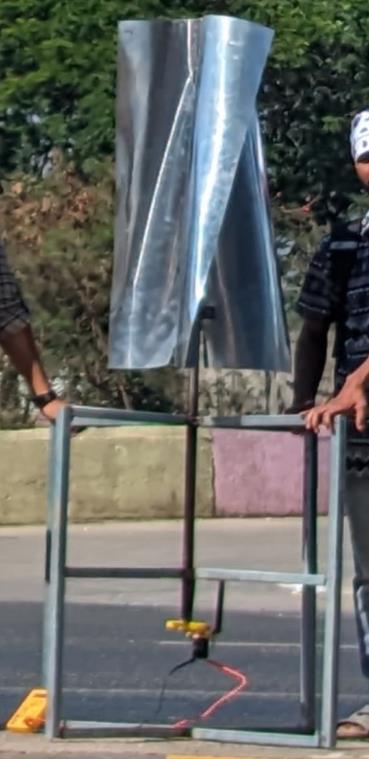
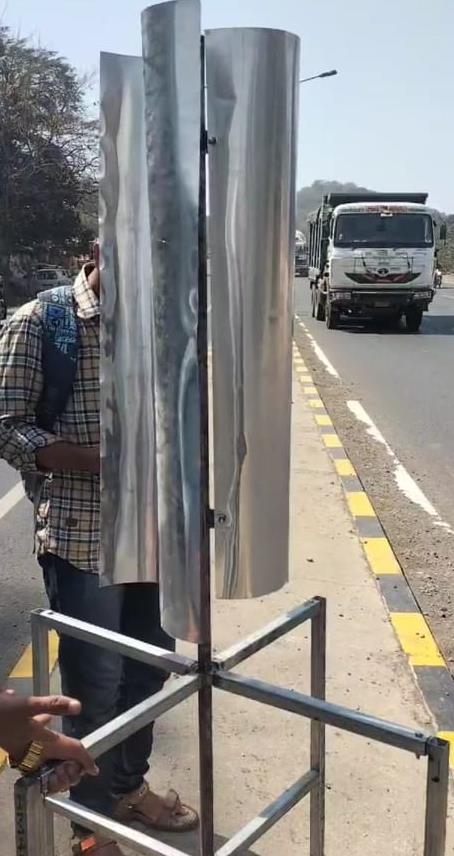
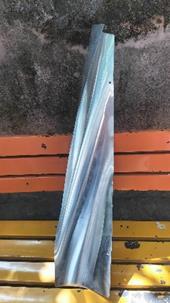
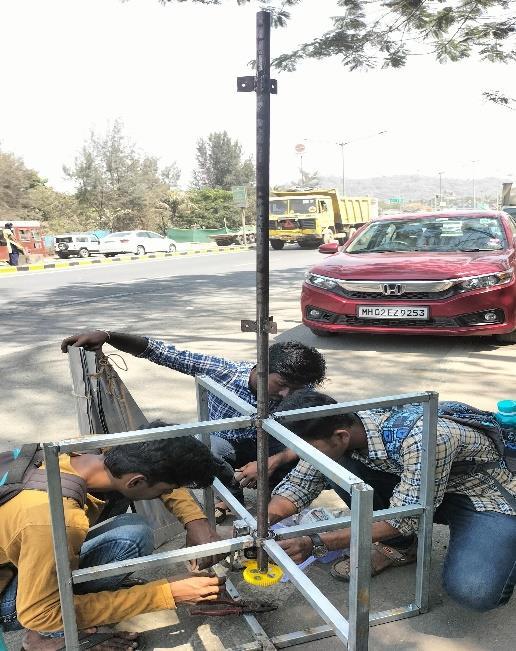
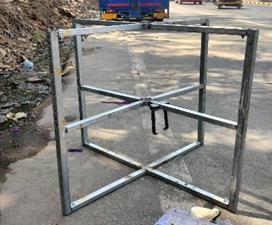
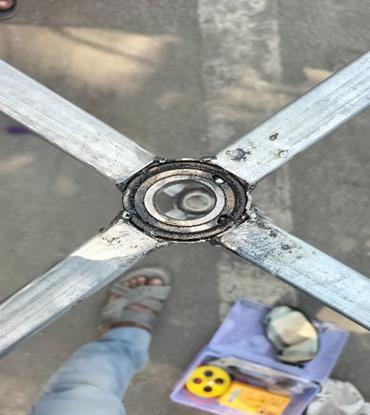
4. Proposed Model
5. Design Of Model
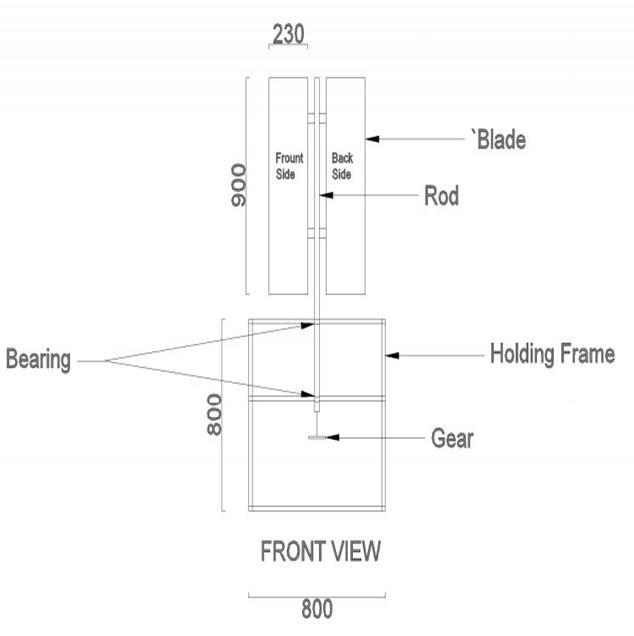
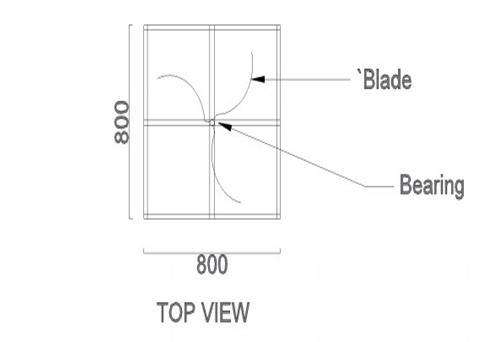
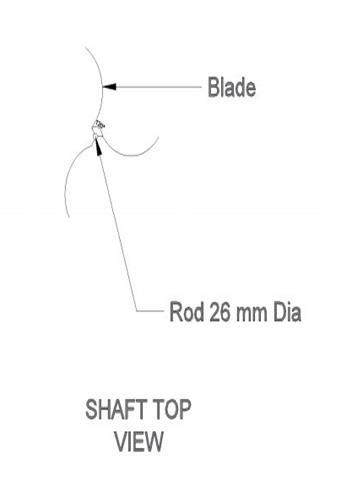
The design of model is based on the study of different researchpapersregardingVerticalAxisWindTurbine.
Table -2: DetailedspecificationsofVerticalAxisWind Turbine
International Research Journal of Engineering and Technology (IRJET) e-ISSN:
Volume: 11 Issue: 04 | Apr 2024 www.irjet.net p-ISSN:
International Research Journal of Engineering and Technology (IRJET) e-ISSN: 2395-0056
Volume: 11 Issue: 04 | Apr 2024 www.irjet.net p-ISSN: 2395-0072
6. Fabrication Process
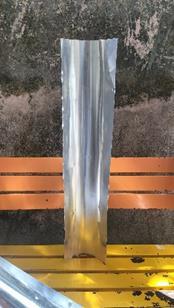
1. Theinitialshapingprocesses
2. BladeBending,Twistingandcutting
3. WeldingProcess
4. Surfacefinishing
7. Theoretical Power Calculation
Thepowerinthewindcanbecalculatedusingtheprinciples of kinetics. Operating on the premise of transforming the wind's kinetic energy into mechanical energy, the wind turbinesubsequentlyconvertsthismechanicalenergyinto
electrical energy. The power produced by the turbine's rotation is determined by multiplying the voltage and current.
Forhighways,theaveragewindspeedperminuteandthe numberofvehiclespassingeachminutewererecordedover a period of 15 minutes. Additionally, the corresponding voltageandcurrentfortheaveragewindspeedwerenoted. By multiplying the voltage, current, and the number of vehicles,thepowergeneratedforthe15-minuteintervalwas calculated.
Power generated per hour = power generated in 15 minutes x 4
The power generated per hour, day, and year can be computedusingthesameformulabymultiplyingitwiththe respectivetimefactors.
Supposewehaveperhourpoweroutputreadingthenthe one-dayreadingcanbegivenas:
Power generated per day = power/hour x 24
Again,foroneyearthereadingscanbegivenas:
Power generated per year = Power generated/day x 365
The tests were conducted for 15 minutes on the selected location.
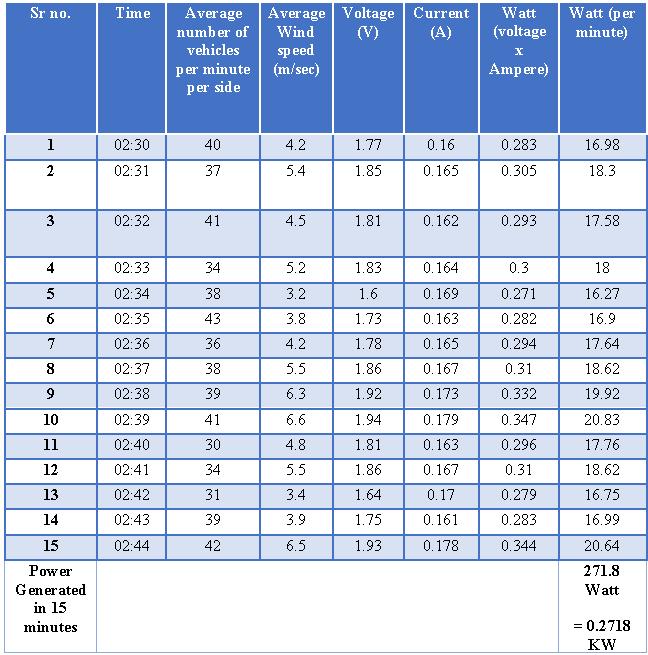
International Research Journal of Engineering and Technology (IRJET) e-ISSN: 2395-0056 Volume: 11 Issue: 04 | Apr 2024 www.irjet.net p-ISSN: 2395-0072
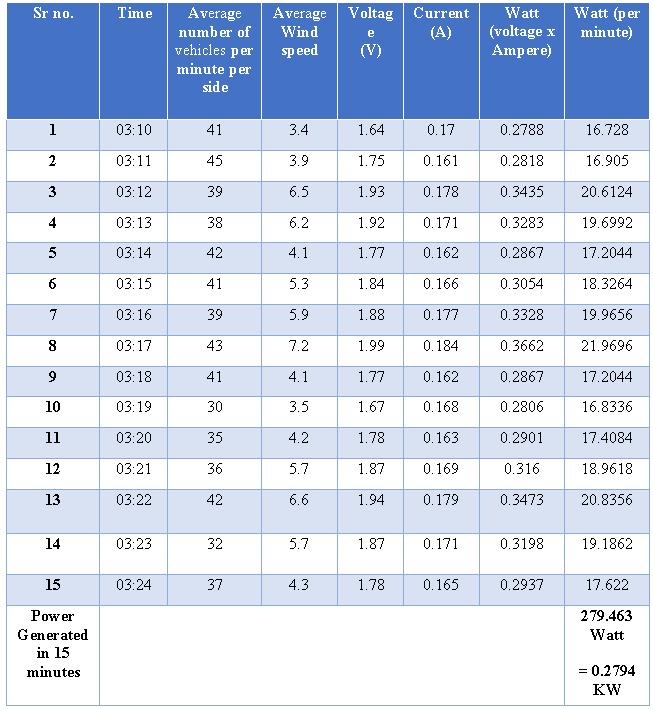
-10:DataCollectedforTwistedBladeVAWT
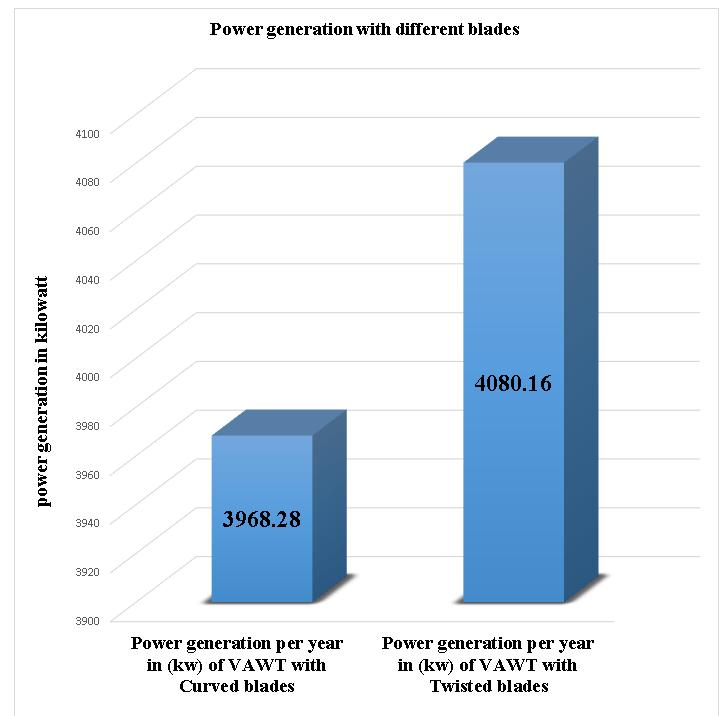
-1:ComparisonofPowerGenerationbetween CurvedbladeVAWTandTwistedbladeVAWT Calculations of power generated
• Curved Blade generates electricity of 1087.2 Watt perhour.
• So,ifthemodelrunsfor10hrs.perdayitgenerates electricityof10872wattperday.
• For 1 year = 10872 x 365 = 3968280 Watts = 3968.28KW/year.
• Twisted Blade generates electricity of 1117.852 Wattperhour.
• So,ifthemodelrunsfor10hrs.perdayitgenerates electricityof11178.52Wattperday.
• For1year=11178.52x365=4080159.8watts= 4080.16KW/year.
• In India, the average rate per unit is Rs 5.3.
• Therefore,
• For curved blade,
• Rateofpowergeneratedperyear=3968.28x5.3= Rs 21031.89
• For twisted blade,
• Rateofpowergeneratedperyear=4080.16x5.3= Rs 21624.89
9. Cost Analysis
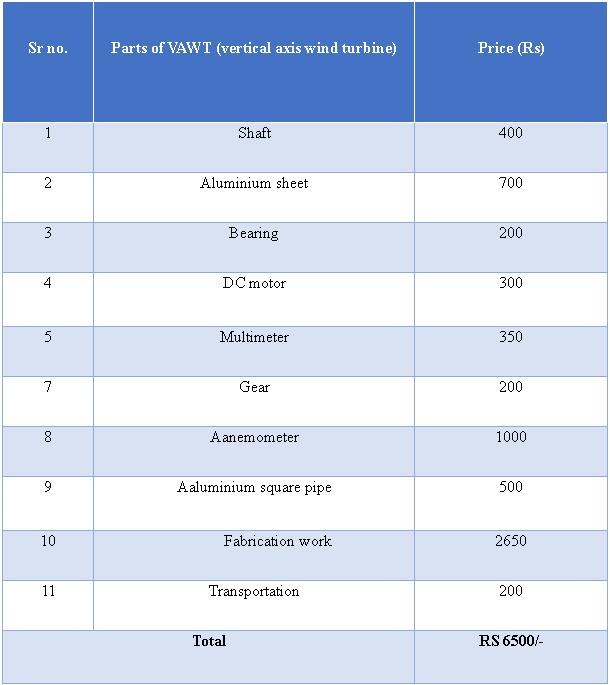
-12:ManufacturingcostofVerticalAxisWindTurbine
International Research Journal of Engineering and Technology (IRJET) e-ISSN: 2395-0056
Volume: 11 Issue: 04 | Apr 2024 www.irjet.net p-ISSN: 2395-0072
The total manufacturing cost of this model is RS 6500/-
The project extensively investigated and analyzed two distinctbladedesigns,curvedandtwisted,forSavonius-type verticalaxiswindturbines.Themodelunderwentrigorous testingon-sitetoevaluateitsefficiency.Resultsrevealedthat the twisted blade VAWT outperforms the curved blade variant, yielding 1117.852 Watt per hour of electricity compared to 1087.2 Watt per hour. The application of twistedbladeVAWTonhighwaysholdssignificantpromise, particularlyinilluminatingstreetlights.
Moreover,theproject'seconomicviabilityisunderscoredby itsabilitytorecoupmanufacturingcostswithinayear.This demonstrates the project's potential for providing a costeffectiverenewableenergysolution.Thefindingsunderscore thesignificanceofverticalaxiswindturbinesasavaluable contributortotherenewableenergylandscape.
In conclusion, this research underscores the potential of vertical axis wind turbines in leveraging various blade designstogeneratecleanandsustainableenergy.
Astablefoundationisessentialforoptimizingtheefficiency of vertical axis wind turbines (VAWT). Additionally, hybridizationofVAWTcanbeaccomplishedbyintegrating solar panels, thereby harnessing energy from multiple renewablesources.Furthermore,incorporatingaraingauge to measure precipitation levels at specific locations can provide valuable data for system optimization and maintenance. To mitigate potential corrosion caused by rainfall,theturbinemodelcanbecoatedwithathinlayerof plastic as a protective measure. These strategies aim to enhancethereliabilityandlongevityofVAWTsystemswhile maximizingtheirenergyoutput.
[1] Deshmukh, S., Charthal, S. (2017). Design and DevelopmentofVerticalAxisWindTurbine.Proceedings of the International Conference on Science & EngineeringforSustainableDevelopment(2017),286294.DOI:10.21013/jte.ICSESD201728
[2] Shah,SahishnuR.;Kumar,Rakesh;Raahemifar,Kaamran; Fung, Alan S. (2018): Design, modeling and economic performance of a vertical axis wind turbine, Elsevier, Amsterdam, Vol. 4, pp. 619-623, https://doi.org/10.1016/j.egyr.2018.09.007
[3] Muhammad Mahmood Aslam Bhutta, Nasir Hayat, Ahmed Uzair Farooq, Zain Ali, Sh. Rehan Jamil, Zahid
Hussain(2011),Verticalaxiswindturbine–Areviewof variousconfigurationsand design techniques,Elsevier doi:10.1016/j.rser.2011.12.004.
[4] Mounia Zemamou, Mohammed Aggour, Abdelghani Toumi(2017),Reviewofsavoniuswindturbinedesign andperformance,Elsevier,Volume:EnergyProcedia141 (2017)383–388,doi:10.1016/j.egypro.2017.11.047.
[5] Abhay Mahajan, Pankaj, Verma,Shekar & Sharma PrashantSaini(2020).ExplorationOfMaterialsusedto design Airfoil of the vertical Axis Wind Turbine. InternationalJournalofResearchinEngineering,Science andManagementVolume-3,Issue-8.
Ms. Pradnya Telang
“Asst Professor, Department of Civil Engineering, New HorizonInstitute of Technology and Management, Maharashtra, India”




Anvit Morey
“B.E student, Department of Civil Engineering, New HorizonInstitute of Technology and Management, Maharashtra, India”
Akshar Bandagale
“B.E student, Department of Civil Engineering, New HorizonInstitute of Technology and Management, Maharashtra, India”
Pritesh Pawar
“B.E student, Department of Civil Engineering, New HorizonInstitute of Technology and Management, Maharashtra, India”
Ruturaj Bhogle
“B.E student, Department of Civil Engineering, New HorizonInstitute of Technology and Management, Maharashtra, India”