
International Research Journal of Engineering and Technology (IRJET) e-ISSN: 2395-0056
Volume: 11 Issue: 04 | Apr 2024 www.irjet.net p-ISSN: 2395-0072
International Research Journal of Engineering and Technology (IRJET) e-ISSN: 2395-0056
Volume: 11 Issue: 04 | Apr 2024 www.irjet.net p-ISSN: 2395-0072
Anshu Aditya1, B.V.S.S.Vardhan2, D.S.Chanakya Varma3 , P.Kailashnadh Gupta4, Dr Venkat
Ramana M5
1234Student, GITAM (Deemed to be University), Visakhapatnam, Andhra Pradesh, India.
5Assistant Professor, GITAM (Deemed to be University), Visakhapatnam, Andhra Pradesh, India.
Abstract ‐ In our current global prone to changes and biased information environment, the most reliable and unbiased news is the means of rational decision-making and the world comprehension, and yet the increasing scale of fake news and partial reporting constitute a core challenge to the mass media credibility. We envisage creating a biased news article detector algorithm that will be powered by BERT, Google's pre-trained and powerful, natural language model. The strategy collects a diverse dataset of newsletters emanating from several sources relating to varied views on a vast group of topics with every composition classified as containing one of several biases like political bias, ideological bias, and sensationalism. The subsequent step boosts the performance of the pre-trained BERT model using this dataset, tweaking its parameters to deal with those thoughtprovoking features in the text data. Evaluating the trained model's performance through typical machine learning metrics like accuracy, precision, recall, and F1-score shows that it is indeed capable to effectively identify echoed-in biases in the text it is trained on, including way subtle hints, and an overall bias of the news. Therefore, this automatic system has the potential to help journalists, policymakers, as well as the general public have the right understanding regarding biased news media. Finally, the work focuses on creating state-ofthe-art machine learning tools that can search and fix biased media content across all news texts by using BERT and advanced text analytics in order to check all the content for bias and promote transparency in media industry.
Key Words: Machine learning, BERT model, News media credibility, Text analytics
1.Introduction
Thedigitalagehasbroughtsuccessstoriesinthesearchfor information. Nowadays, social media networks and online news are seen as sources of information because change from traditional news is happening to many people. This gives everyone access to information and makes it very useful, but the environment that creates the media has become an environmentfor the spread of misinformation –“fake news”. Fake news, misinformation or disinformation presented as official news can take many forms: stories,
packaged images, fake advertisements or fake news. This influence leads to the formation of pillars on social media known for decision making, social discourse, and religion. Global fake news problem: Fake news does not only cover countries and regions. In fact, space has the power to affect everyone,nomatterwhereorwhotheyare.However, special combinations are also available in some regions. undefined Major Internet Users: Because the Internet is limited and a significant portion of the population depends mostly on mobile devices for information, it is difficult for people to distinguish between right and wrong. .Linguistic Diversity: Powerful information storage operations at the heart of the country often fail to meet the needs of India's linguistic diversity. Political Polarization: In general, political schools like to use weapons, consider certain groups as "fake news", andthensuppresstheoppositionwiththe"lightproblem"and "public opinion management" during elections. Social Trust Issues:Asaresultofsomeissueswithmediatrust,peopleare easily influenced by fake news that they believe to be true, oftenduetotheirownstereotypesorbiases.TheLimitsofthe Law: A Project to Add to the Problem Currently, the way to combatfakenewsismostlybasedonasinglecomparisonand rules of thumb. These techniques often identify content or signatures frequently used by fake news organizations. Althoughitisusefulinsomesituations,italsohaslimitations: Althoughitisusefulinsomesituations,italsohaslimitations: LimitedAdaptability:Solvingthisproblemoftenrequiresclear solutions, solutions are not always made with new ones. Adoption of lie communication. As marketers get better at creating and identifying misinformation, content-based programs may not be as good at removing new information. Contextual blindness: Traditional methods often do not understand the integrity of the data. They may miss the differencebetweencriticismandopinion,favorfakenews,and lead to misclassifications. Language Barrier: Available solutions may not be able to speak local languages, slang and customs. They won't have time to track down fake news in a language other than English. Introduction to BERT: An excellent tool for handling the content of words BERT stands forBidirectional EncoderRepresented bytransformers andis a family of pre learning, deep learning that demonstrates a good understanding of its meaning. Ability to use a word in a sentence. Unlike traditional methods, BERT teaches patterns
International Research Journal of Engineering and Technology (IRJET) e-ISSN: 2395-0056
Volume: 11 Issue: 04 | Apr 2024 www.irjet.net p-ISSN: 2395-0072
bidirectionally; This means that the content of a word depends on nearby words, including words to the left and right. This allows BERT to capture context and connections in text, making it a promising model for tasks that require goodlanguageskills,suchasemotionalanalysisandwriting. ThePromiseofBERTinNewsDistribution:Aboutnextsteps and solutions. Understanding more details: BERT models arepowerful designedtohelpdeterminethemeaningofan article, especially whether a word is offensive or not. The meaning of the sentence or the whole meaning, Thoughts, feelings, etc. It allows them to separate real news from made-upstories,withoutanyknowledgeofthepossibilityof being involved in the preparation of the fake campaign. Adaptingtochangingstrategies:BERT's model will growas the strategies used by fake news continue to evolve. The skills they learn from lots of literature help them find used words or phrases that don't make the story seem new. Multi-languagecapability:BERTmodelusessingleLanguage by default. By carefully considering different information about different languages, the same model can be modified to include the spread of fake news into different areas of conversation, ultimately finding a solution. Purpose The purposeofthisprojectistoverifywhethertheBERTmodel issuitable for distinguishingreal content fromfake content on social media. We will create a BERT model that will provide training on information covering the fake news problem in our region. The performance of the model will be evaluated and analyzed in terms of its ability to explain the complexity of the selected words. By using BERT's artificial intelligence technology, we hope to create a more powerfulandflexiblesystemtocombatfakenews.Thiswill lead to the emergence of a multicultural public opinion, whichcanbeconsideredanewcharacteristicofourage.
[1]RahulChauhan,SachinUpadhyayand HimadriVaidya titled“FakeNewsDetectionbasedonmachinelearning algorithm”
Fake news has become a major problem in today's world, spread rapidly through social media. This misinformation can negatively impact public opinion and decision-making. To address this issue, researchers are exploring machine learning techniques for fake news detection. One approach involves analyzing the text of news articles using Natural Language Processing (NLP). This includes techniques like removingunnecessarywordsandconvertingthetextintoa format that machine learning algorithms can understand. Several machine learning algorithms have been studied for fakenewsdetection.SomeexamplesincludeSupportVector Machines (SVMs), Convolutional Neural Networks (CNNs),
andBidirectionalLongShort-TermMemory(Bi-LSTMs).These algorithms can learn patterns from real and fake news data andthenusethosepatternstoidentifynewfakenewsarticles. The paper by Chauhan et al. proposes a system for fake news detection that utilizes a combination of machine learning algorithms. Their system involves collecting datasets of real andfakenewsarticles,preprocessingthetextdata,converting the text into numerical vectors, and then applying machine learning algorithms to classify the news as real or fake. The study mentions using four algorithms in their model: Logistic Regression, Decision Trees, Random Forest, and Gradient Boosting. They achieved high accuracy (around 90-94%) in detecting fake news by combining the results from these algorithms. Logistic Regression provided the best individual accuracy (around 94%). While this approach shows promise, there are some limitations to consider. The paper doesn't specify the datasets used for training and testing the model. Additionally, it doesn't detail how the final outcome is determinedbycombiningtheresultsfromthefouralgorithms. Overall,thispaperhighlightsthepotentialofmachinelearning fortacklingtheproblemoffakenews.Asresearchcontinuesto develop, these techniques can become even more effective in helpingusdistinguishbetweenrealandfakenews.
[2] Poonam Narang, Upasana Sharma titled “A Study on ArtificialIntelligenceTechniquesforFakeNewsDetection”
Fake news is a growing problem on the internet, and its potential to harm society is significant. Researchers are activelydevelopingmethodstodetectfakenews,butthisfield is still in its early stages. This paper examines existing research on fake news detection techniques. The authors conducted a thorough analysis of various datasets used for fake news detection. They also explored the different techniques employed to identify fake news, including manual fact-checking by human experts and automated methods that leverage machine learning and artificial intelligence. These automated methods can analyze vast amounts of data, including text content, social network structures, and other relevant information. The review process involved examining over 200 research papers on fake news detection. From this collection, the authors selected 33 papers that focused on various detection techniques. Many of these techniques involvemachinelearningalgorithmsforclassification,suchas Support Vector Machines (SVMs), Convolutional Neural Networks (CNNs), and Recurrent Neural Networks (RNNs). Feature extraction is another crucial aspect, where researchers identify characteristics like language style, sentiment analysis, and topic modeling to differentiate real fromfakenews.Severalpubliclyavailabledatasetsareusedto train and test the effectiveness of these detection models. Some prominent examples include FakeNewsNet and LIAR.
International Research Journal of Engineering and Technology (IRJET) e-ISSN: 2395-0056
Volume: 11 Issue: 04 | Apr 2024 www.irjet.net p-ISSN: 2395-0072
Theperformanceofthesemodelsismeasuredusingmetrics likeaccuracy,precision,recall,andF1score.Thepaperalso presents a comparative analysis of various state-of-the-art models. This analysis highlights the detection methods, datasets used, and performance achieved by different studies. However, the authors also identify several challengesthatneedtobeaddressedinfutureresearch.One challenge is the difficulty of accurately identifying the underlyingsocialnetworkstructure,whichlimitstheability to predict how information spreads in the real world. Additionally, limited access to free and reliable API web services hinders the generation of trust factors for news sources. The rapid evolution of fake news on social media platforms necessitates faster detection techniques to stay ahead of this ever-changing threat. Extracting factual contentfroma mixofopinionsandgeneral statements also presents a significant challenge. Text normalization techniques might not be able to capture all temporal references,suchasreferencestospecificdatesortimes.
[3]Shubh Aggarwal, Siddhant Thapliyal, Mohammad Wazid, D. P. Singh titled ”Design of a Robust Technique for Fake NewsDetection”
The vast amount of information available online makes it crucial todistinguishfactual accuracyfrommisinformation. Truth detection models, powered by machine learning, are valuable tools for classifying statements as true or false. These models are used in various fields, including journalism, social media analysis, fact-checking, and legal investigations. Truth detection models offer several advantages. They automate the process of verifying information, saving time and resources. Additionally, they can handle the ever-increasing volume of data on the internet. These models also promote consistency by applying objective criteria for evaluating truthfulness, minimizingtheinfluenceofsubjectivejudgments.Moreover, they complement human efforts by helping fact-checkers and investigators identify potentially false information. Researchers have actively explored various approaches for detecting fake news, including those based on content, social context, and existing knowledge. Some studies have focused on developing explainable decision systems for automated fake news detection, while others have addressedchallengesrelatedtoimbalanceddataintraining models. Despite their advantages, truth detection models have limitations. The accuracy of these models can be affected by the quality and availability of training data. Additionally,there'sa need forfurther researchtoimprove how these models explain their reasoning behind classifications (interpretability). Furthermore, as tactics for spreading misinformation evolve, new techniques are
needed to stay ahead of these ever-changing challenges. This survey provides a comprehensive overview of truth detection models, highlighting their applications, limitations, and potential areas for future research. It serves as a foundation for understanding the current state of the art and paves the wayforfurtherexplorationinthiscriticalfield
[4]YadongGu,MijitAblimit,AskarHamdullatitled“FakeNews DetectionbasedonCross–ModelCo-Attention”
Rumors spread quickly online, and with the constant development of social media, the format of these rumors has evolved.Theyarenolongerjusttext-basedbutoftencombine text and images to create a more convincing facade. This makes it crucial to have effective detection methods. Traditionally, rumor detection relied on analyzing textual features and employed machine learning algorithms for classification. However, with the rise of deep learning, neural networks have become the go-to approach for feature extraction and classification in rumor detection tasks. These models can capture various aspects of textual data, including temporalinformation,structure,andlinguisticcues.Recurrent neural networks (RNNs) are particularly useful for learning hidden representations from sequential text data like tweets, while convolutional neural networks (CNNs) can identify key features scattered within the text. Despite the advancements in text-based rumor detection, there's a limitation: relying solely on text might not be sufficient for accurate judgment. Fake news often leverages the combined power of text and images on social media platforms. This has led to the rise of multimodalrumordetection,whichrecognizestheimportance of combining textual and visual information for better detection accuracy. Multimodal rumor detection explores different techniques for fusing these two modalities. Early fusion combines features from text and image before feeding themintothemodel,whilelatefusioncombinesfeaturesafter processing them separately. Attention mechanisms are also being explored to focus on the most relevant aspects within textandimagefeatures.However,therearestill challengesto overcome. Existing models might not fully capture the intricate relationship between text and image content. More researchisneededonmethodsthatcaneffectivelyexploitthe interaction between these modalities. Additionally, extracting textual information embedded within images itself could be a valuable avenue for future exploration in multimodal rumor detection. This survey provides a comprehensive overview of the evolution of rumor detection models, highlighting the limitations of unimodal approaches and the potential of multimodalmethodsformoreaccuratedetectionoffakenews.
International Research Journal of Engineering and Technology (IRJET) e-ISSN: 2395-0056
Volume: 11 Issue: 04 | Apr 2024 www.irjet.net p-ISSN: 2395-0072
The proliferation of fake news online poses a significant threat to public discourse and informed decision-making. This survey explores the potential of combining Bidirectional Encoder Representations from Transformers (BERT) for improved detection. Detecting the veracity of online information is complex due to factors like fabricated content, emotional manipulation, and rapid dissemination. Existing approaches include machine learning algorithms like naive Bayes classifier, logistic regression, and support vector machines, alongside natural language processing techniques. BERT, a powerful language model, excels at understandingtextnuances,makingitsuitableforanalyzing news articles and identifying potential falsehoods. Studies have shown positive results in using BERT for tasks like sentiment analysis and text classification which requires understanding of the language. Limitations and Challenges include bias in training data and models, necessitating fairness to avoid inaccurate results. The evolving nature of fake news tactics requires continuous adaptation of detectionmethods.ResearchoncombiningBERTwithother AI models holds promise for further improvement, along with developing explainable AI approaches to understand model conclusions and address biases. Addressing bias in both data and models is essential for fair and responsible development and deployment of fake news detection systems. Combining BERT shows potential for improved fake news detection. However, addressing limitations like bias and the evolving nature of fake news tactics is crucial for responsible development and deployment of such technologies. Exploring additional AI models and explainable AI approaches can further contribute to advancingthisfield.
3.1.1
These are one of the most common, especially used during proportions. Logits are estimates that are then normalized using the softmax distribution. In a classification problem, themodelassociatestheinputwiththeprobabilityforeach class. The logit term represents the probability of the prior model before applying the softmax function designed to convert the raw score into probability. "Logit" is derived from the logistic function, a regression model commonly used in binary problems. For most register logic, it usually contains a score vector where each score is specific to a class.Theserawscoresarethenconvertedintoresultswith thehelpofthesoftmaxfunctiontoensureaconsistentresult duringtheapplication.
A sigmoid function is a bounded, differentiable, real function thatisdefinedforallrealinputvaluesandhasanon-negative derivativeateachpoint.IthasacharacteristicS-shapedcurve or sigmoid curve. This function takes any real-valued number and “squashes” it into a value between 0 and 1. This is particularly useful when we want to interpret the output of ourmodelasaprobability.Thesigmoidfunctionismonotonic and has a first derivative, which is bell-shaped. It has exactly oneinflexionpoint.
BERT (short for Bidirectional Encoder Representation called Transformers) is an ML (machinelearning) model for natural language processing. Developed by Google AI researchers in 2018,BERTisamulti-purposesolutionthatsolvesmor e than 11 of the most commonly used tasks, such as responsibility-related sentiment analysis and recognition. Traditionally computers have been great at collecting, storing andreadingdata,buttheyhavefacedlanguageunderstanding problems. Improve natural language processing (NLP) skills Smart computers use natural language processing (NLP) technology to read and understand spoken and written language. This integrated method converts the knowledge of words, numbers, and procedures used by computers into the syntax of the human language. In general, an NLP task is solved only with a model designed for a specific purpose. But BERT successfully solves more than 11 NLP tasks, changing the NLP state, surpassing their performance and becoming versatile and adaptable to many languages. The model is designed for deep, bidirectional representation of content. Therefore, computer scientists can add an output layer to BERTtocreateglobalmodelsforvariousNLPtasks.
The Indian Fake News Detection (IFND) Dataset: A Resource forPoliticalNewsClassificationThisprojectutilizestheIndian FakeNewsDetection(IFND)dataset,acollectionofreal-world news articles pertaining specifically to India. The dataset leveragescontentscrapedfromreputableIndianfact-checking websites. It comprises two distinct categories: real news and fakenewsarticles.
The IFND dataset offers a valuable resource for training and evaluatingmachinelearningmodelsfocusedonpoliticalnews classification within the Indian context. The articles cover a variety of topics, with a concentration on political news, reflecting the prevalent nature of such content in the Indian newslandscape.
International Research Journal of Engineering and Technology (IRJET) e-ISSN: 2395-0056
Volume: 11 Issue: 04 | Apr 2024 www.irjet.net p-ISSN: 2395-0072
S.No Attribute Description
1. ID Uniqueidentifier foreachnews
2. Statement Titleofthenews article
3. Image ImageUrl
4. Category Topicofnews
5 Date Dateofnews
6. Label 1indicateTrue newsand0 indicatefake news
Table 1: DatasetattributesandDescription
5.Tools And Libraries
5.1 Seaborn
Seaborn, based on matplotlib and used as a powerful data visualizationpackage,isalibrarywhichisdevelopedforthe same purpose. It provides a tall-level interface through which one may be intact as well as provide Impressive statisticalgraphics.
5.2 Scikit-learn
Within the Python data science community, Scikit-learn is the most widely utilized machine learning library. It has a reputation foritsuser-friendlyinterface,compatibility with otherwell-knownscientificPythonlibrarieslikeNumPyand Matplotlib, and a broad range of tools for data analysis positions. For many machine learning enthusiasts and data scientists, scikit-learn is their preferred solution because of thesefeatures.
5.2 Pandas
Pandas is a free library for data management and analysis using the Python language. It provides two data elements: List (one-dimensional inline array) and DataFrame (twodimensional inline data structure consisting of rows and columns).
5.3 NumPy
NumPy (Numerical Python) is an important module for computing in Python. It has built-in support for large multidimensional arrays and matrices, as well as a number of advanced mathematical functions for manipulating arrays.
5.4 Transformers
TransformerslibraryisadeeplearningNLPlibrarydeveloped byHuggingFaceusingthebestofnaturallanguageprocessing (NLP). Text classification, language generation, name recognition, responsiveness, etc. It is a repository of prelearningmodelsandtoolssuitableformostNLPtasks,suchas Some key features and functions of the Transformers library are: Some key features and functions of the Transformers library are: Training opportunities in many languages, including BERT, GPT-2, RoBERTa, XLNet and others, to name justafew.Thisprocessoflearningbigdatacanbemodifiedto workorrecord,dependingonitslimitations.
Matplotlibisausefultoolforvisualizingdata(includingcharts and graphs) in Python. It provides a low-level API that allows thecreationofmanydifferentstatic,graphicalandinteractive functionsinPython.
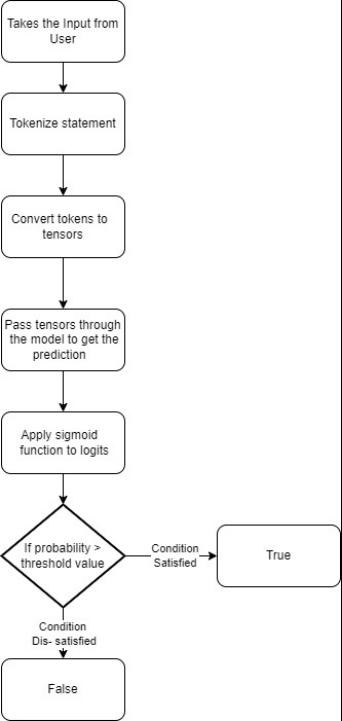
Figure 1:ModelFlowchart
International Research Journal of Engineering and Technology (IRJET) e-ISSN: 2395-0056
Volume: 11 Issue: 04 | Apr 2024 www.irjet.net p-ISSN: 2395-0072
When the program starts the user will give an input statementandthestatementispassedontothemodel.The modelwilltokenizethestatementintowordsorsub-words. These tokens are then converted into Tensors, which are multi-dimensional vectors. These Tensors are then passed into the model, which must predict the probability. To do this, the model converts the Tensors into Logits, commonly usedinmachinelearning,particularlyinclassificationtasks. The logits will then be given to the Sigmoid function which will give the output as probabilistic value. After setting a Threshold Value the model will compare it with the probabilityandreturntheoutput.
Upon successful training, we tested our model with some common statements which are not present in the dataset, and we got some positive results. Model Performance on Unseen Data To assess the model's generalization capabilities, we tested it on statements not present in the trainingdataset. Weincludedexampleslike:
Statement 1: MS Dhoni was the captain of Indian cricket team

Figure 2: Resultforstatement1
Statement2:WhatsAppnewsisreliable

Figure 3: Resultforstatement2
Thesestatementshighlightthemodel'sabilitytogobeyond simplekeywordmatchingandleverageitsunderstandingof contextandlanguagerelationshipsforclassification.
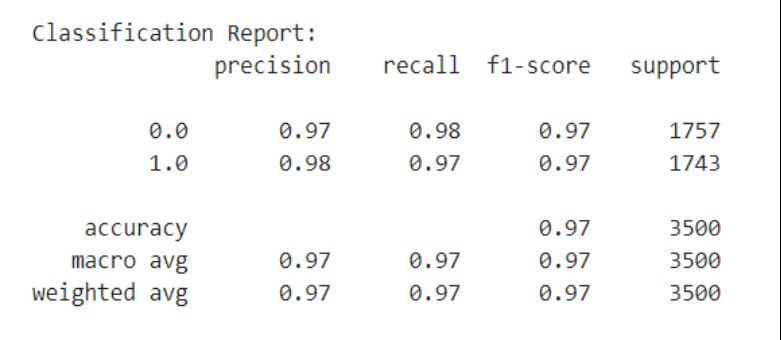
To comprehensively evaluate the model's performance, we measuredkeymetrics:
Accuracy:Thismetricreflectstheoverallpercentageofcorrect predictionsmadebythemodel.

Precision: This metric measures the proportion of positive predictions that were actually correct (true positives / (true positives+falsepositives)).Itindicateshowgoodthemodelis at avoiding false positives (predicting real news when it's fake).

F1 Score: This metric combines precision and recall (the proportion of actual positive cases the model identified correctly) intoa singlemeasure,providinga balancedview of themodel'sperformance.

International Research Journal of Engineering and Technology (IRJET) e-ISSN: 2395-0056
Volume: 11 Issue: 04 | Apr 2024 www.irjet.net p-ISSN: 2395-0072
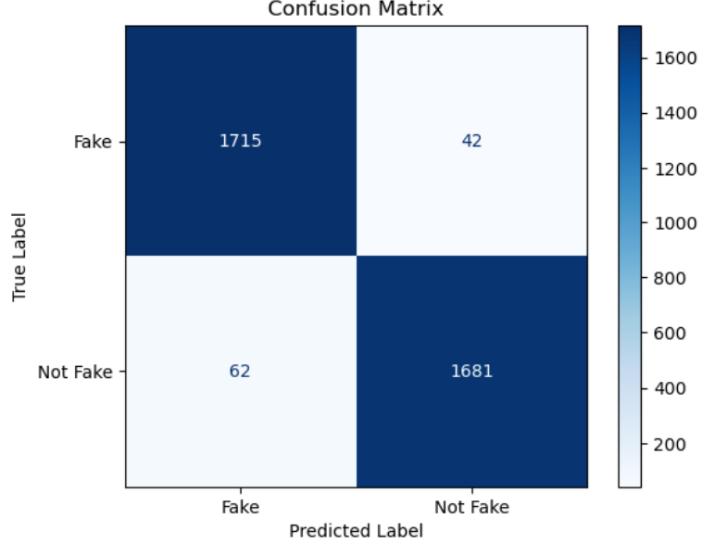
The confusion matrix shows the performance of our model classifying news articles as real or fake. The text labels on the axes indicate the Fake or Not Fake(True) labels. The values in the table represent the number of news articles thatfallintoeachcategory.
Breakdownofthevaluesinthematrix:
True Positives (TP): 1715 - The model correctly classified 1715realnewsarticlesasreal.
False Negatives (FN): 62 - The model incorrectly classified 62realnewsarticlesasfake.
FalsePositives(FP):42-Themodelincorrectlyclassified42 fakenewsarticlesasreal.
True Negatives (TN): 1681 - The model correctly classified 1681fakenewsarticlesasfake.
8. Limitations
Dataset Scope: Our model is currently trained on a dataset focused on Indian news and headlines. This limits its knowledge base to news content specific to that region. To broaden its applicability, future work could involve incorporatingdatafromvariousregionsandlanguages.
Computational Resources:Fine-tuningBERTon evenlarger datasets requires significant computational resources, including powerful GPUs and faster memory. Exploring techniquesforefficientmodeltrainingandoptimizationwill becrucialforfutureimprovements.
9. Conclusion
A Fake News Detection system was implemented using BERT to show how state-of-the-art natural language processing models can be used so that the task can be performed more efficiently. The project began with preprocessing our classified dataset; attention, however, was given to addressing any biases in terms of class distributionandalsocheckingon data integrity. The neural network is designed for binary classification, using the
powerful BERT(Bidirectional Encoder Representations from Transformers) model in order to differentiate between fake and genuine statements. This enhanced the performance of the model due to its ability of capturing contextual informationandsemanticnuances.
During training, there were several hyperparameters being tuned carefully for instance by applying dropout as a method of regularization and optimizing the model through Adam optimizer. It’s critical during the training loop process that theseparametersshouldbeiterativelyadjustedsothatBinary Cross-Entropy loss is minimized, this way making sure that input’s true meaning is learnt by the model. Evaluation stage provided metrics such as precision, recall, F1-score through a comprehensiveclassificationreportthatshowedhowwellthe model could generalize on unseen data. Consequently, quality results clearly indicate that BERT-based approach is highly effectiveinidentifyingfakenewsutterances
10.Future
Integration with APIs and Bias DetectionTo enhance the model'slongevityandadaptability
APIIntegration:WecanintegratethemodelwithnewsAPIsto continuously expose it to fresh data and news streams. This approachhelpsthemodel stayrelevantandadaptto evolving trendsinnewscontent.
Bias Detection: By training the model to identify potential biases within news articles retrieved from APIs, we can provide a more nuanced analysis of the information. This can empower users to make informed judgments about the credibilityofnewssources.
11.Reference
[1] RahulChauhan,SachinUpadhyayand HimadriVaidya titled “Fake News Detection based on machine learning algorithm”
[2] Poonam Narang, Upasana Sharma titled “A Study on ArtificialIntelligenceTechniquesforFakeNewsDetection”
[3] Shubh Aggarwal, Siddhant Thapliyal, Mohammad Wazid, D. P. Singh titled ”Design of a Robust Technique for FakeNewsDetection”
[4] YadongGu,MijitAblimit,AskarHamdullatitled“Fake NewsDetectionbasedonCross–ModelCo-Attention”