
Volume: 11 Issue: 04 | Apr 2024 www.irjet.net p-ISSN:2395-0072
Volume: 11 Issue: 04 | Apr 2024 www.irjet.net p-ISSN:2395-0072
1Assistant Professor, Department of commerce with international business, Dr.N.G P Arts & Science College, Coimbatore.
2Student, M. Com (IB), Department of commerce with international business, Dr.N.G.P Arts & Science College, Coimbatore.
1.1.
Indiastandsoutasoneoftheworld'sswiftestgrowingeconomies,capturingglobal attentionwithitsdynamism.Itranks as the seventh largest nation by geographical expanse. Presently, India holds the third spot among Asian economies, trailing only Japan and China. Despite its vast agricultural potential, India's agricultural exports on the global stage have remainedrelativelymodest,owingpartlytogovernmentaltradepolicies.
In recent times, there have been noteworthy shifts in the trade balances of various agricultural commodities. However, despite strides in economic growth, over 60 percent of India's populace continues to reside in rural areas, where agricultureservesastheprimarylivelihood.
The Indian government is vigorously incentivizing and facilitating agricultural exports, particularly of fruits, flowers, and vegetables, through initiatives outlined in the schemes of Commodity Boards and Export Promotion Councils. These initiativesarepoisedtobolstertheentireagriculturalexportsector.
Under the auspices of the Department of Commerce, the Agricultural and Processed Food Products Export Development Authority(APEDA)isspearheadingnumerousschemestoprovidefinancialsupporttoeligibleexporters.Theseencompass schemes dedicated to market expansion, infrastructure enhancement, quality improvement, research and development, andtransportationassistance.
Economic development stands as a paramount objective for societies globally, with economic growth serving as a vital enabler. Within the spectrum of contributors to economic growth, exports emerge as a cornerstone. However, concerns surroundingtradepersist,especiallyamongnationsreliantonexportingprimaryandindustrialgoods,wherethetermsof tradeoftendisadvantagepoorernations.
Pandit Jawaharlal Nehru's famous assertion, "export or perish," underscores the critical significance of exports in the contextofadevelopingeconomy.Anationwithambitiousdevelopmentplansoftenrequiressubstantialimportsofcapital goods, technology, raw materials, and other essentials to effectively execute these plans. Since imports are funded by exports,anation'sabilitytoimporthingesdirectlyonitsexportperformance.Exportationisthereforeindispensablefora nation, fostering a robust and resilient economy by maintaining favourable trade balances. In an increasingly globalized marketplace, the role of exports becomes even more pivotal. Virtually all nations recognize the imperative of developing their export capabilities, as exports provide access to foreign markets, enabling opportunities for economies of scale, growth,andtheacquisitionofforeignexchange.
Agriculture has been the significant driving force of Indian economy. It gave around one-third of the Gross Domestic Product (GDP) and utilized 5 roughly two thirds of the population. The share of agriculture in the GDP has however declinedincontrastwiththegrowthofindustrialandservicessectors.However,agriculturestillgivesthegreaterpartof wagegoodrequiredbythe non-agriculturalsectorandinadditionvariousrawmaterialsforindustry.Thedirectshareof agriculturalandunifiedsectorsintotalexportsisaround18percentwhencomparedwiththeindirectshareofagricultural products in total exports such as cotton textiles, and jute goods is considered the percentage is substantially higher. Agriculturepossessesapositionofpride,beingthelargestIndustryinthecountry.Itgivestheutilizationandservicegoods butmanyexportsadditionallyrelyonuponit. International Research Journal of Engineering and Technology (IRJET) e-ISSN:
International Research Journal of Engineering and Technology (IRJET) e-ISSN:2395-0056
Volume: 11 Issue: 04 | Apr 2024 www.irjet.net p-ISSN:2395-0072
Toexaminethesocio-economicstatusofAgriexportentrepreneursingeneralandparticulartostudyarea
ToexploretheproblemsandchallengesfacedbyAgriexportersinCoimbatoreandPollachiregion
To study the effectiveness of APEDA (Agricultural and Processed Food Products Export Development authority) exportincentivestopromoteExportofAgriculturalProcessedFoodProducts.
Research is comprehensive strategy for carrying out an official inquiry. The science is concerned with methods and principlesforinvestigation andstudy. Aresearch technique isa method forgatheringtherequireddata from a varietyof primaryandsecondarysources.
Research design -DescriptiveResearch
Area of the study –Coimbatore
Sampling technique -SimpleRandomSamplingmethod.
Data collection -Primaryandsecondarydata
Sample size -125
Statistical tools used for the study-SimplePercentageanalysis,chi-square,andFactoranalysis
A. Abdul Kadhar (2019) conducted research on challenges and opportunities’ of agri export entrepreneurs that Agriculturalproductiondevelopedcolossallywiththeopeningof newwesternlands.TheAgriculturalandProcessedFood ProductsExportDevelopmentAuthority(APEDA)cameintoexistencein1986underanActoftheParliamenttopromote Indianagriculturalcommoditiesandprocessedfoodsexports.
Sri Durga Prasad (2018) researched a study on analysis of soya bean exporters in agriculture industry mentioned that India is the third largest producer of coconut and leads 90 cocoanut producing countries of the world. The extreme fluctuations and variations in weather conditions create instability in food production and affect livelihood of millions of farmersspreadalloverthecountry.
Lal and Lavanya (1984) analysed the growth rates of major crops in Agra district in Uttar Pradesh. The study was conducted for the period from 1959-60 to 1973-74 and the crops selected were Maize, Bajra, Wheat, Barley and Potato. The results revealed the highest growth in maize production. There was a significant growth of production in all the foodgrain crops except barley which showed a decline in production. Dass et al., (1985) analysed the trends in coffee exportinrelationtogeneral exportsfromIndiafortheperiod1956-57to1982-83.Theannualcompoundgrowthrateof export in general had fallen during the period 1972-73 to 1982-83 in spite of buoyant world demand and high domestic production.Theshareofcoffeeexportsintotal exports, invalueterms,hadincreasedintheperiods1956-57to 1971-72 and 1972-73 to 1982-83. However, unit value, quantity and export value recorded chronic instability during the same period.
Raveendran and Aiyaswamy (1982) analysed the export growth and export prices of turmeric in India. They observed cyclic pattern of variation in prices with a length of three to seven years. The export prices were studied in relationtothedomesticpricesandfoundthattherewasaveryhighcorrelationbetweenexportpriceanddomesticprice ofturmeric.Undoubtedlyitwasconfirmedthevulnerabilityofthelattertotheinternationalpricefluctuations.
The Economic Unit of the Indian Institute of Public Opinion (1999) had suggested that indigenous as well as imported raw materials should be made available to the small sector at reasonable prices. Organisations such as The State Trading Corporation and The State Export Corporation should take the entire responsibility for providing raw materials and for the marketing of the products of the small sectors. It was necessary to incorporate special export promotioncellsinorganisationscreatedforthedevelopmentofthesmall-scalesector.Specialattentionshouldbepaidto project the products of the small-scale sector in trade fairs and exhibitions overseas. It would be desirable to organise specialisedexhibitionsdevotedexclusivelyforprojectingIndia'ssmall-scalesectorproductsinstrategicoverseasmarkets. It was necessary to encourage the SSI units to participate in the overseas exhibitions free of cost. The expenses of their personnelattheseexhibitionsshouldbeheavilysubsidisedbytheGovernment.
International Research Journal of Engineering and Technology (IRJET)
Volume: 11 Issue: 04 | Apr 2024 www.irjet.net p-ISSN:2395-0072
Ananthi (2000) analysed the growth of area, production, productivity, and export of Indian non-basmati rice. The growth rates were calculated by sub-dividing the study period into 1949-50 to 1969-70 as first period and 1970-71 and 1997-98 as second period. The area, production and productivity showed positive trend for the export during the study period1980-81to1998-99forbasmatiandnon-basmatirice.Thegrowthratewasalsopositiveandsignificant
Angles (2001) assessed the growth performance of turmeric in important south Indian states overtheperiodfrom India 1979-80 to 1998-99 by using the exponential An Economic Analysis of India’s Basmati Rice Exports 14growth functions of the form Yt = abt. They reported that the growth rates in area, production, and productivity of turmeric in Andhra Pradesh, Tamil Nadu and Karnataka were registered positive and a significant growth. While growth rate of area was negative (-0.02%) in Kerala but in production and productivity of turmeric were recorded positive and a significant growth. The growth rates in area (2.07 %), production (6.57 %) and productivity (3.78 %) of turmeric in India were registered positive and a significant growth. A negative growth rate of area was found (-0.02 %) in Kerala due to productionofturmericinsmallpatches,wheretheplantationscropsuchasrubber,coconutetc.dominatedandtheywere more profitable than turmeric. The other main problem was the labour requirement, wherein around 50 per cent of the costofcultivationwasspentonlabourinturmericproduction.Butthelabouravailabilitywasscarceandlabourwagewas very high. Hence, the farmers opted for plantation crops where there was no need of more labour throughout the year. Consequently,theareaunderturmericwasreducingyearafteryear.
Table 1.6.1
INTERPRETATION
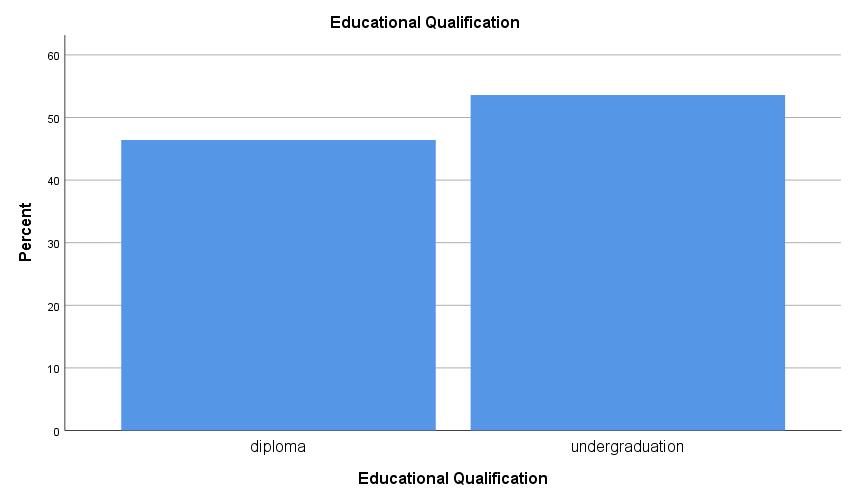
From the above table 53.6% of the respondents are completed post-graduation,46.4% of the respondents are under graduation.Mostoftherespondentsare(53.6%)arepost-graduation.
Volume: 11 Issue: 04 | Apr 2024 www.irjet.net
Table 1.6.2
INTERPRETATION:
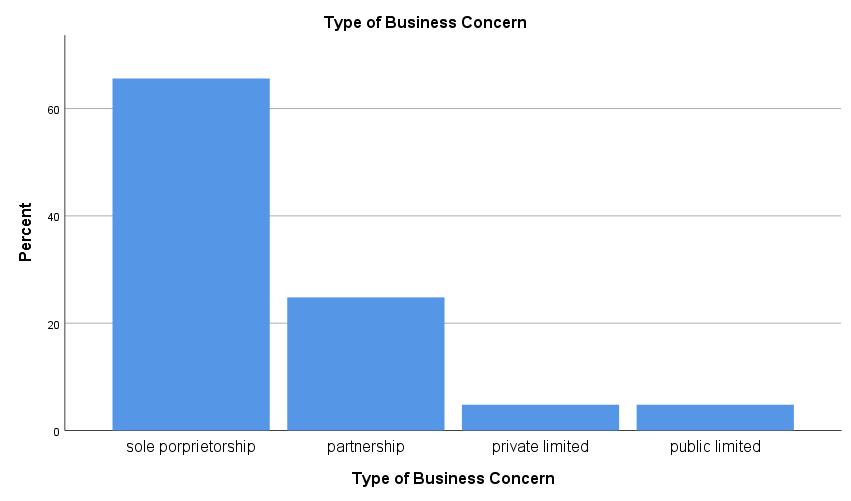
From the above table (65.6%) of the respondents having sole proprietorship type of business concern, (24.8%) of the respondents having partnership type of business concern, and (4.8%) of the respondents having both private and public limitedcompany.Hencemaximumnumberofrespondents(65.6%)havingsoleproprietorshiptypeofbusinessconcern.
CHI-SQUARE
HYPOTHESIS:
Ho: Thereisnoassociationbetweenyearsofexperienceandeducationalqualification
H1: Thereisanassociationbetweenyearsofexperienceandeducationalqualification
Table 1.6.3
International Research Journal of Engineering and Technology (IRJET) e-ISSN:2395-0056
Volume: 11 Issue: 04 | Apr 2024 www.irjet.net p-ISSN:2395-0072
INTERPRETATION:
From the above table it was understood that the significant value 0.000 is less than the p value, so we reject null hypothesis.Hence.thereisanassociationbetweenyearsofexperienceandeducationalqualification
ANOVA HYPOTHESIS:
Ho: ThereisnoassociationbetweenAPEDAassistanceandservicesofgovernmentagencies H1: Thereisanassociationbetween.APEDAassistanceandservicesofgovernmentagencies.
Table 1.6.4 Association Between APEDA assistance and services of government agencies
ANOVA
doyoutakeassistanceofAPEDA
INTERPRETATION:
Fromtheabovetableitwasunderstoodthatsignificantvalue0.73ismorethanthepvalue.So,weacceptnullhypothesis. Hence,thereisnoassociationbetweenAPEDAassistanceandservicesofgovernmentagencies.
Maximum53.6%oftherespondentsarecompletingpost-graduation
Maximum65.6%oftherespondentshavingsoleproprietorshiptypeofbusinessconcern
Identified value is less than p value, it is rejected null hypothesis.so there is no association between years of experienceandeducationalqualification
Identifiedvalueismorethanpvalue,itisacceptednullhypothesis. hencethereisanassociation betweenAPEDA assistanceandservicesofgovernmentagencies
Based on this study the following suggestions are put forward for consideration of Support provided by the APEDA is a function of the APEDA‟s five export promotional schemes for Market Development, Infrastructure Development, Quality Development,Research&DevelopmentandTransportAssistance.ItisbasictoadvancesolidmarkettechniquesbyAPEDA initsplansforshowcaseimprovementtomakeIndianAgriculturalProcessedFoodProductsmoreaggressiveandupgrade its proficiency. For this reason, by and by APEDA is broadening monetary help under market improvement plans to enrolled exporters of new organic products, vegetables, blossoms, and eggs up to 25 percent of the aggregate cost of bundlingmaterial 270subjecttoa roof ofRs.5lakh.Brandadvancementforthose brandsofIndian source, promotionin universal print/electronic media,site improvementand soforth.,APEDAis broadeningup to 25percent of theaggregate costsubjecttoaroofofRs.50lakhinayearonrepaymentpremise.Thereismusthelp100percentmonetaryhelptoAgri export business visionaries under Market Development Scheme of APEDA to meet front-end special consumption to quickenexportdevelopmentofAgriculturalProcessedFoodProductswithdevelopedcountriesmarketsinview.
The APEDAhelped Agri export entrepreneurs by methodfor different schemes booster were conceivably expanded their export capacities as far as esteem. The APEDA as of now has an obligation to advance export of Indian Agricultural processed food products, however the present limited time part by its schemes to create export intensity of Agri export entrepreneursinworldwidemarketmoderatelywrong. Anoteworthytroubleconfrontedbyagriexportentrepreneursin
International Research Journal of Engineering and Technology (IRJET) e-ISSN:2395-0056
Volume: 11 Issue: 04 | Apr 2024 www.irjet.net p-ISSN:2395-0072
the universal market is the abnormal state of sponsorships given by created 274 nations for their agricultural processed food products. The present help plan of APEDA has imparity and absence of sufficient financial help and sponsorships. ThereareimperativesandissuesinfinancialhelpunderschemesbolsterbyAPEDA.
1. Caswell,J.,&Henson,S.J.(1997).InteractionofPrivateandPublicFoodQualityControlSystemsinGlobalMarkets
2. Diaz-Bonilla,E.,&Reca,L.(1999).TradeandArgoindustrializationindevelopingcountries
3. Finger,J.M.,&Schuler,P.(1999).ImplementationofUruguayRoundcommitments:Thedevelopmentchallenge.
4. ilmour,B.,&Oxley,J.(1998).Tradefacilitationmeasuresinprocessedfoodtrade.EconomicandPolicyAnalysis...
5. GonzaloRios,K.(1999).Technicalassistanceneedsofdevelopingcountriesandmechanismstoprovidetechnical...
6. Hathaway,D.E.,&Ingo,M.D.(1996).AgriculturalliberalizationandtheUruguayRound.InW.Martin,&L.A....
7. Henson,S.J.,Loader,R.J.,Swizbank,A.,Bredahl,M.,&Lux,N.(2000).Impactofsanitaryandphytosanitary...
8. S.J.Henson et al. Impactof sanitaryandphytosanitary standardson developingcountriesandthe role of the SPS Agreement
9. Johnson,R.W.M.(1997).TechnicalmeasuresformeatandotherproductsinPacificBasincountries