
International Research Journal of Engineering and Technology (IRJET) e-ISSN: 2395-0056
Volume: 11 Issue: 04 | Apr 2024 www.irjet.net
International Research Journal of Engineering and Technology (IRJET) e-ISSN: 2395-0056
Volume: 11 Issue: 04 | Apr 2024 www.irjet.net
p-ISSN: 2395-0072
Jayanti Dang1, Sujal panda2 , Rudra prasad Shadangi2 , Satasree Barik2 , Alok Parida2
1Aistant Professor ,ECE department, Gunupur, Odisha, INDIA
2UG Scholar, ECE department, GIETU, GUNUPUR ,Odisha, India
Abstract - The Automatic Night Lamp using a Light DependentResistor(LDR)isanintelligentlighting system designed for energy-efficient and automated illumination. ThisprojectemploysanLDRasasensortodetectchangesin ambientlightlevels.Whenthesurroundingstransitioninto darkness, the LDR's resistance increases, activating a transistorthatallowscurrentflowtopowertheLEDcircuit. Thisseamlessprocessensuresthatthenightlampturnson automaticallyinlow-lightconditions,eliminatingtheneed formanualoperation.Theproject'sversatilityisenhanced bytheinclusionofapotentiometer,enablinguserstofinetune sensitivity according to their specific lighting preferences.TheimplementationofthisDIYsolutioniscosteffective and user-friendly, making it accessible to a wide rangeofenthusiasts.Bycombiningelectronicsand sensor technology, the Automatic Night Lamp with LDR not only addsalayerofconveniencetodailylifebutalsocontributes to energy conservation. This intelligent lighting system presentsasustainableandpracticalapproachtoaddressthe need for adaptive lighting in diverse environments, showcasingthepotential ofsimpleyet effectiveelectronic solutionsforeverydaychallenges.
Key Words: LDR, Lamp, Resistor, Alternator, Pot, Transistor(BC547), LM358N, Relay, Diode(1N4148)
Inourfast-pacedandenergy-consciousworld,theneedfor efficientandenergy-savingsolutionsisparamount.Onesuch solutionisthedevelopmentofan"AutomaticNightLamp" using a Light Dependent Resistor (LDR). This project showcasesasimpleyeteffectivemethodtoilluminatespaces duringthenightorinlow-lightconditionswithouttheneed formanualintervention[1].AnLDR,alsoknownasaphotoresistor, is a sensor resistance based on the intensity of incident light. As darkness falls and ambient light levels decrease,theresistanceoftheLDRincreases.Thisproperty makesLDRsaperfectcandidatefordesigninganautomatic nightlamp. Theprimaryobjectiveofthisprojectistocreate a lighting system that senses the environmental light conditionsandactivatesitselfwhenitdetectsareductionin light, such as during the evening or in dimly lit rooms. Conversely, the lamp should deactivate when sufficient daylightorartificiallightingisavailabletosaveenergy[2]. ThefundamentalcomponentsofthissystemincludeanLDR, amicro-controller(suchasanArduinoorRaspberryPi),a
relayortransistor,andanLEDorlightsource.WhentheLDR detectslowlight,ittriggersthemicro-controllertoturnon theLEDorlightsource.Thisautomationensuresthatspaces are adequately lit when necessary and turned off when sufficient natural or artificial light is present. The fundamentalcomponentsofthissystemincludeanLDR,a micro-controller (such as an Arduino or Raspberry Pi), a relayortransistor,andanLEDorlightsource.WhentheLDR detectslowlight,ittriggersthemicrocontrollertoturnon theLEDorlightsource.Thisautomationensuresthatspaces are adequately lit when necessary and turned off when sufficient natural or artificial light is present [3]. The Automatic Night Lamp using an LDR not only promotes energyefficiencybutalsoenhancesconvenienceandsafety. It finds applications in various settings, from home environmentswhereitcanserveasabedsidenightlamp,to outdoor areas like gardens and pathways. Moreover, the project serves as an educational opportunity for students and electronics enthusiasts to understand the practical implementationofsensormicro-controllers,andautomation [4].Inthefollowingsections,wewilldelveintothedetailed components,circuitdiagram,andprogrammingaspectsof this project. By the end of this endeavor, you will have a working understanding of how to construct your own AutomaticNightLampusinganLDR,contributingtoamore sustainableanduser-friendlyword.
TheinvestigationbyAndrasKovacsandRolandBatai(2016) aimedtocreateasubgridforpubliclightingthatgenerated :positive energy balance using solar power. The study focusedonthecentralcontroller,whichfacilitatedsmartcity services through its web-based interface while ensuring adaptability of the system. Of particular interest was optimizing energy management via buying and selling electricity from/to the grid based on variable time-of-use tariffs[5].
Y M Jagadeesh et al.(2016) discussed how street lights contribute significantly to overall electric consumption in modern societies dueto nocturnal operation times. The paperproposedasensor-basedsolutionthatenablesrealtimepatternadjustmentstoreflectvaryingtrafficconditions and naturalistic scenarios such as full moon phases. This approach reduces CO2 emissions with an embedded lowcostIRsensorsystemconsistingofPIRcontrollers,astorage device,andaninexpensivemicrocontroller[6].
International Research Journal of Engineering and Technology (IRJET) e-ISSN: 2395-0056
Volume: 11 Issue: 04 | Apr 2024 www.irjet.net
AnifJamaluddin&AnafiNur(2016)furtherexploredlithium iron phosphate battery performance undercharging/discharging circumstances for stand-alone photovoltaicsystems.Monitoredover12hoursatdischarge condition, the average current ranged from -1.2A –1A. On chargingmodeinvolving8-hoursutilizeda current range of .10– 195 Amps between11 am-2 pm. A deficit in energy usage approximately equaling 10% per operational cycle was detected following evaluations established using Lab VIEWInterfaceforArduino(LIFA)[7].
Nallapaneni Manoj Kumar& Anup Kumar Singhb’s study presentedalternativesolutionsreplacingfossilfuelusewith renewable energies like solar energy. In relation to case studies conducted at Fugarcity, Nigeria a comparative analysis reviewed four potential methods including diesel generators,gridelectricity,on-sitesolarphotovoltaicsand off-site photovoltaics, to determine their respective economicfeasibilitywhilereducingcarbonemissionoutput. Analysisfoundonsitesolarphotographbestsuitedamong alternativesevaluatedintermsofactualization,finances,and sustainability[8].
K.Thatsanavipasa&N.Ponganunchokea(2011),offeranew wireless-controlledtrafficlightsolutionforeffectiveremote manipulationofroadjunctionsbytrafficpoliceofficers.This system offers two control approaches; Manual and Automatic.Inmanualmode,theofficerpressesadesignated button on the correspondence controller unit in keeping with directional green light alerts. The automatic-mode operatesviapresetpatternsthatincorporatespecifieddelay timesandcyclesequencingcontrolledvia a wirelesshand heldremote. Thissystem will enable police to manipulate street junction conditions instantly, relying on their individual discretion in real-time action ability driven by dynamicflowsoftrafficpatterns[9].
:
ThedevelopmentofanAutomaticNightLampusingaLight Dependent Resistor (LDR) is a meticulous process that combineshardwaredesignandsoftwaresimulationtocreate anenergy-efficientandreliablelightingsolution.
Key hardware components include the LDR, a microcontroller (such as Arduino or Raspberry Pi), a relay or transistor,andanLEDorlightsource.TheLDR,actingasthe light sensor, is responsible for detecting variations in ambientlightlevels.Themicro-controllerinterpretsthedata from the LDR, deciding when to activate or deactivate the LED.Properplacementandwiringofthesecomponentsis critical to ensure precise light sensing and controlled illumination.
Simulation:
Utilizingsimulationsoftware,suchasTinkercadorProteus, enablesthecreationofavirtualrepresentationofthecircuit. This virtual environment facilitates rigorous testing and validationofthedesignbeforeactualassembly.Parameters likelightintensityandresponsetimecanbeadjustedinthe simulationtooptimizeperformance.Simulationsserveasan invaluabletoolforidentifyingandresolvingpotentialissues, finetuningthesystemforoptimalefficiencyandaccuracy
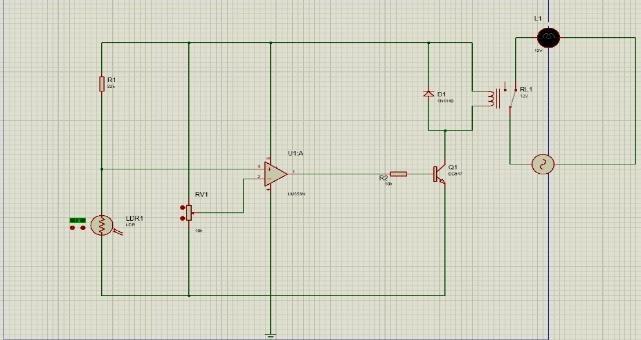
Fig-1:simulationdiagramdonebyusingtheproteus software
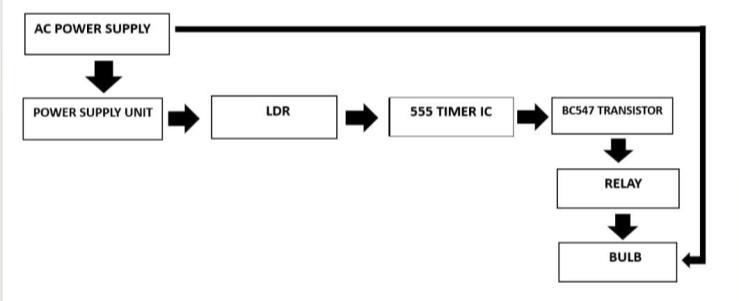
Fig-2:BlockDiagramOfAUTOMATICNIGHTLAMPUSING LDR
Table -1: STIMULATION PARAMETER:
International Research Journal of Engineering and Technology (IRJET) e-ISSN: 2395-0056
Volume: 11 Issue: 04 | Apr 2024 www.irjet.net p-ISSN: 2395-0072
TheAutomaticNightLampdesignedwithaLightDependent Resistor(LDR)hasbeensubjectedto rigorous testingand analysis to evaluate its performance in various light conditions. The analysis encompasses several crucial aspects:
1.Energy Efficiency: TheAutomaticNightLampsuccessfully conservesenergybyactivatingthelightsourceonlywhen ambientlightlevelsdropbelowapredeterminedthreshold. Thisensuresthatenergyisutilizedjudiciously,resultingin potentialcostsavings.
2.Sensitivity and Response Time: Thelampdemonstrated a commendable level of sensitivity to changes in light intensity. It promptly responds to diminishing light conditionsanddeactivateswhensufficientlightisdetected, minimizingenergywastage.
3.Accuracy of Activation: Theaccuracyofactivation,orthe point at which the lamp turns on, aligns with the set thresholdvalue,ensuringthatitfunctionsasintended.This precision enhances its practicality and usefulness in realworldscenarios.
4.Versatility: The Automatic Night Lamp's versatility is a noteworthy feature. It can be easily adapted for use in various settings, from household applications to outdoor spaces,cateringtodiverselightingneeds.
[1]. AndrasKovacs,RolandBatai,BalazsCsanadCsaji,Peter Dudas,BorbalaHay,GianfrancoPedona,TiborRevesz,Ozsef Vancza, “Intelligent control for energy-positive street lighting Energy114 (2016)40-51. Published on 2016 by ElsevierLtd.
[2].YM Jagadeesh, S Akilesh “Intelligence street lights” SMARTGRIDTechnologies,August6-8,2015
[3]. AnifJamaluddina,AnafiNurAinia,EgyAdhitamaa, AgusPurwantob. “Assessment of LiFePO4 Battery Performance in Stand Alone Photovoltaic Street Light System”EngineeringPhysicsInternationalConference,EPIC 2016
[4]. Nallapaneni Manoj Kumara, Anup Kumar Singhb, andK.VinayKumarReddyc,“FossilFueltoSolarPower:A Sustainable Technical Design for Street Lighting in Fugar City,Nigeria”6thInternationalConferenceonAdvancesin Computing&Communications,ICACC2016,6-8September 2016,Cochin,India
[5]. K.Thatsanavipasa,N.Ponganunchokea,S.Mitathab andC.Vongchumyenb,“WirelessTrafficLightController”2nd International Science, Social-Science, Engineering and Energy Conference 2010: Engineering Science and Management.2011PublishedbyElsevierLtd
[6].“Streetlightthatglowsonmotiondetectiontechnique” by[http://www.edgefxkits.com]
[7].RajKamal–MicrocontrollersArchitecture,Programming, InterfacingandSystemDesign.
[8].Shashank SinghShiva Pujan Jaiswal ,“Enhancementof ATCofmicrogridbyoptimalplacementofTCSC”,Materials today:proceedingshttps:
[9]. Shiva Pujan Jaiswal, Vivek Shrivastava, Dheeraj Kumar Palwalia, “Opportunities and challenges of PV technologyinpowersystem”,Materialstoday:proceedings DOI:10.1016/j.matpr.2020.01.269,2020
Fig-3:Outputsimulationdiagram
CONCLUSION:
In conclusion, the development and implementation of an AutomaticNightLamprepresentasignificantstepforward inaddressingtheneedforconvenientandenergy-efficient lightingsolutions,particularlyduringnighttimehours.This project successfully designed and built a system that combines modern technology and user-friendliness to provideambientlightingwhenrequired.
[10]. Shiva Pujan Jaiswal, Vikas Singh Bhadoria, Amit Agrawal,HemantAhuja“InternetofThings(IoT)forSmart Agriculture and Farming in Developing Nations” International Journal of Scientific & Technology Research 8(12):1049-1058,2019.
[11]. Shiva Pujan Jaiswal, Vivek Shrivastava, Shashank Singh “Economic Viability Solar PV Power Plant in Distributionsystem”IOPConf.Series:MaterialsScienceand Engineering Vol. 594 (2019) 012010, DOI:10.1088/1757899X/594/1/012010.