
International Research Journal of Engineering and Technology (IRJET) e-ISSN: 2395-0056
Volume: 11 Issue: 04 | Apr 2024 www.irjet.net p-ISSN: 2395-0072
International Research Journal of Engineering and Technology (IRJET) e-ISSN: 2395-0056
Volume: 11 Issue: 04 | Apr 2024 www.irjet.net p-ISSN: 2395-0072
Abhilash P M1 , Hajara Beevi V2 , Sunaina P3 , Suwaina D4 ,Ms. Chithra K G
1234 UG Student, Dept. of Civil Engineering, Jawaharlal College of Engineering and Technology, Lakkidi, Kerala, India
5Assistant Professor, Dept. of Civil Engineering, Jawaharlal College of Engineering and Technology, Lakkidi, Kerala. India ***
Abstract - The sustainability of raw materials used in construction consume large quantities of materials of great importance. The major raw material in brick industry is clay. Ceramic tile waste and steel slag waste can be used as clay replacement at dosages of 5%, 10%,15%,20% and25% by weight of clay brick. These brick specimens with ceramic tile waste and steel slag waste were compared with that of the conventional bricks. This project report presents a comparative analysis of in corporating ceramic tilewasteand steel slag waste as partial replacements for conventional clay in brick manufacturing. The study evaluates the mechanical, Physical, and environmental properties of the resulting bricks compared to traditional clay bricks. The projectaimstoassess the feasibility and sustainability of utilizing these industrial wastes in brick production, considering factors such as costeffectiveness, strength, durability, and environmental impact. The experimentalinvestigationinvolvesvaryingproportionsof ceramic tile waste and steel slag waste mixed with clay, followed by comprehensive testing including compressive strength, water absorption, density, and impact. Results indicate the potential of these waste materials to enhance certain properties of claybrickswhilereducingenvironmental burden and promoting resource efficiency.
The findings contribute to advancing sustainable practicesin construction materialsandprovideinsightsfortheadoptionof alternative materials in the brick manufacturing industry. Bricks with ceramic tile waste are lighter with better insulation characteristics and increased porosity and using steel slag waste as a replacement in brick productioncanoffer several benefits. Steel slag is a byproduct of steel production and is often used in construction due to its properties. Additionally, incorporating steel slag waste into bricks can contribute to sustainable construction practices by reducing the need for virgin materials and diverting waste from landfills. However, the exact properties of the bricks will depend on factors such as the percentage of steel slagusedthe manufacturing process, and any additives or treatments applied. Research and testing are typically conducted to ensure that the resulting bricks meet quality standards and performance requirements.)
Key Words: Steelslag,Ceramictile,Traditionalclaybrick
Clay consumption had been increasing by manufacturingofbricks.Forconservingtheresourcesandto reducethewastedumpingthemanufacturingofbrickcanbe utilisedbythewastematerial.CeramictilewasteandSteel slag is utilized in brick manufacturing which can save the resources such as clay. Ceramic tiles aremade using clay Theceramictilewasteisdurable,hardandhighlyresistant tobiological,chemicalandphysicaldegradationforces.The propertiesofthesematerialsmakethemagoodandsuitable choicetobeusedinbrick.Wasteceramic(WC)isproduced majorly by ceramic industry. WC has different types like ceramictile,waste ceramicpowder(WCP),sanitaryware, and ceramic electrical insulator waste. Ceramic tiles are manufactured by firing natural materials such as clay, quartz, feldspar, sand, etc. Ceramics can be crushed and recycledintoarangeofusefulproducts,andcanbeusedin manufacturing of brick. The advantages of using waste ceramic dust as a clay replacement include reducing environmentalimpactandconservingnaturalresources
Steelslag,aby-productofsteelmaking,isproducedduring theseparationofthemoltensteelfromimpuritiesinsteelmakingfurnaces.Theslagoccursasamoltenliquidmeltand isa complexsolutionof silicatesandoxides thatsolidifies uponcooling.Virtuallyall steel is now made inintegrated steelplantsusingaversionofthebasicoxygenprocessorin specialty steel plants (mini-mills) using an electric arc furnace process. The open hearth furnace process is no longer used. In the basic oxygen process, hot liquid blast furnacemetal,scrap,andfluxes,whichconsistoflime(CaO) anddolomiticlime(CaO.MgOor"dolime"),arechargedtoa converter(furnace). Alance islowered intotheconverter andhigh-pressureoxygenisinjected.Theoxygencombines with and removes the impurities in the charge. These impurities consist of carbon asgaseous carbonmonoxide, andsilicon,manganese,phosphorusandsomeironasliquid oxides, which combine with lime and dolime to form the steelslag.
Collectionofrawmaterialssuchasceramictilewaste,clay, steelslag
Preliminarytestingofmaterial
International Research Journal of Engineering and Technology (IRJET)
Volume: 11 Issue: 04 | Apr 2024 www.irjet.net
Manufacturingprocessofbrick
Test on physical properties, mechanical properties, durabilityproperties
Plottinggraphs
Comparingtheresults
2. PRELIMINARY TESTING OF MATERIAL
Physicalandchemicalcharacteristicsclaysoilandteawaste such as chemical composition of clay soil, plastic limit, shrinkagelimit,drysieveanalysis,hydrometeranalysisand specificgravitywerestudied.
2.1 PLASTIC LIMIT OF CLAY
Plasticlimitisthemoisturecontentthatdefineswherethe soilchangesfromasemisolidtoaplasticstate.Itmayalso definedasthatwatercontentatwhichsoilstartscrumpling whenrolledintothreadsof3mmdiameter.
Table1;Plasticlimitofclay
2.2LIQUID LIMIT OF CLAY
The liquid limit is the water content, expressed as percentageoftheweightofovendriedsoilatwhichthesoil hasasmallshearstrength.Liquidlimitisdeterminedusing Casagrande’sliquidlimitdeviceandgroovingtool.
Table2Liquidlimitvalues
Woodenbrick mouldsize200mmx100mmx100mmwas used for casting bricks. In this step, clay is cleaned of impurities such as stones, pebbles, plant roots etc. after removingimpuritiesitisexposedtoweatherforfewdays.
Thisiscalledweathering.Afterthecompletionofweathering processthelumpsofclayareconvertedusingamechanical soil crusher or sieved. Similarly, the ceramic tile waste is cleanedofimpuritiesand crushedintopowderandsieved .steelslagwhichiscollectedfromSteelIndustrialsLimited Kerala had crushed to powder and sieved . dried raw materialsareusedformanufacturingofbrick.Afterdrying therawmaterials,clayismixedwithtilewasteforasetof brickandmixingclaywithsteelslagforanotherset.Small quantity of M sand slurry is also added to void cracking while burning. It is added at a percentage of 25. Required amountofwaterisaddedtothemixture.Themixtureisthen pressed or mixed so that the mixture obtain the plastic natureandnowitissuitableformoulding.
Mixingratioofrawmaterialsisobtainedbyreferringmany papersgivenbyvariousresearcherStudiesshowedthatclay canbereplacedwithwastematerialsby5%,10%,15%,20% and25% byweightofclay.Therefore,theclayisreplaced with0%,5%, 10%, 15%, 20%and 25% of tile wasteand steelslag.
Moulding is the process where the prepared mixture is placedinastandardmouldwhichformsitintotheshapeofa brick.Inmouldingprocess,preparedmixtureismouldsinto brick shape. Rectangular is preferred. Wooden mould of standardsize20x10x10cmareused.Requiredamountof clay,teawasteandMsandslurryaretaken.Mouldisplaced onthegroundandfilledwithbrickmixtureandcompressed it by pressing to fill the corners of the mould. Extra clay mixtureistakenoffbylevellingthesurfaceofthemould.The mouldisthenliftedupandrawbrickiskeptontheground. Duringmoulding,insidesurfaceofthemouldisoiled.Two setsofbricksarecastdonewithtilewasteandanotherwith steelslag.
Aftermoulding processthebrickcontainsmoistureinit.So, dryingistobedoneotherwisetheymaybecrackedwhile burning.Thedryingofdoneisdonebynaturalprocesscalled sundry.Thebricksarelaidinstacks.Bricksaredriedfora period of 7 days. The sun dried bricks are burned at 200 degreeCelsiusformorethan2days.Nextiscooling.Cooling is an important stage in brick manufacturing because the rateofcoolinghasdirecteffectoncolour.Firedbricksare cooledtoroomtemperatureforlessthan10hrs.
Waterabsorptiontestnbricksisconductedtodeterminethe durability property of bricks such as degree of burning qualityandbehaviourofbricksinweathering.
Volume: 11 Issue: 04 | Apr 2024 www.irjet.net
Table3Waterabsorptionofofsundrytilewastebrick
SI
4
5
6
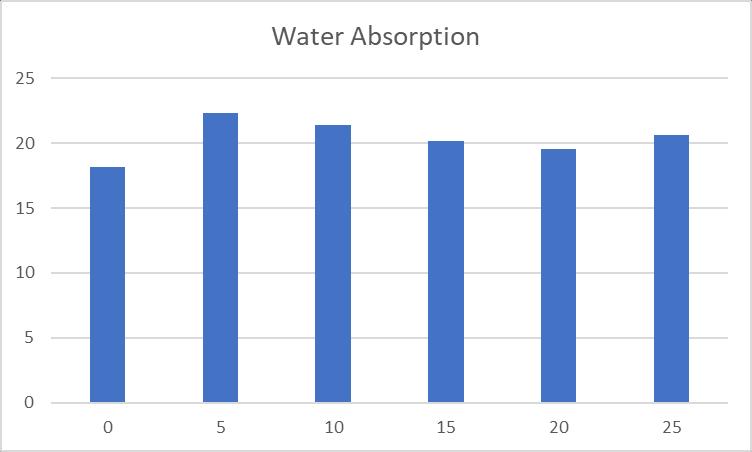
Table4Waterabsorptionofofovendrytilewastebrick
SI
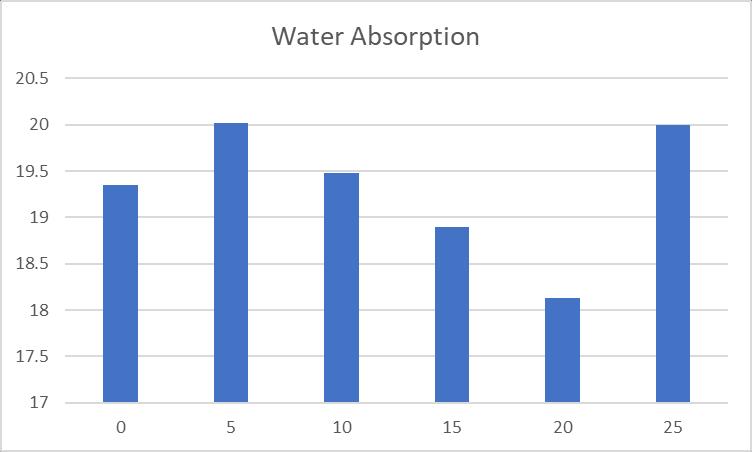
Fig2Waterabsorptiongraphovendriedtilewastebricks
Theabovegraphshowsthatwaterabsorptionishighfor sundriedbrickthanovendriedbrick.Incaseofovendried brickwaterabsorptionishighat5%and25%.
Table5Waterabsorptionofofsundrysteelslagbrick
Volume: 11 Issue: 04 | Apr 2024 www.irjet.net
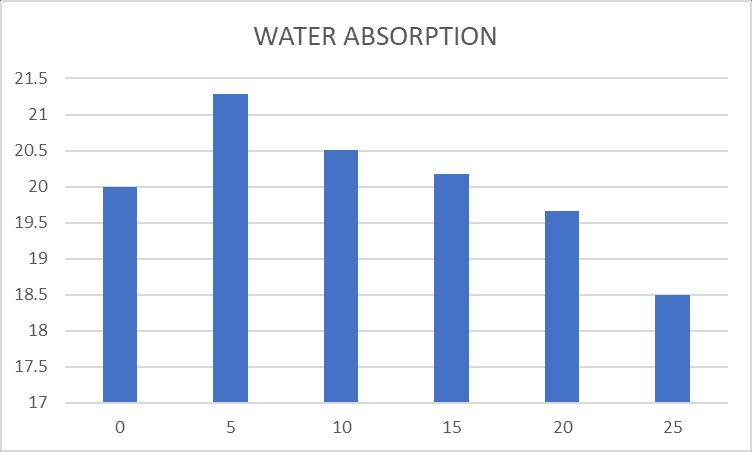
3Waterabsorptiongraphsundriedsteelslagbrick
Table6Waterabsorptionofovendrysteelslagbrick
SI
1
2
3
4
5
6
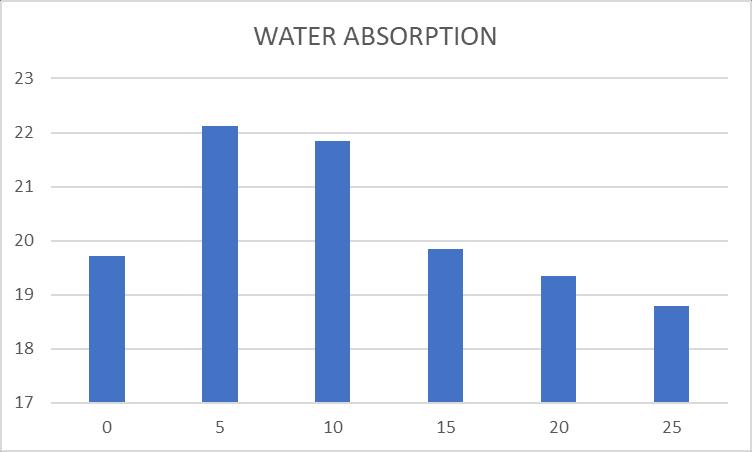
Table7Bulkdensity
Densityindicatestheweightofbrickwork.Densityofbrick dependsonclaycomposition.Densityofaconventionalclay brickisaround2000kg/m3.Thetestshowsthatdensityof brickincreaseswithadditional5%
In conclusion As one of the main functions of the soil is reflectedinitsbulkdensity,thesoilmustalsosupportplants structurally,transferwaterandothersolutes,andprovide aeration.
Table8compressivestrengthofsundriedbricksample withtilewaste
International Research Journal of Engineering and Technology (IRJET) e-ISSN: 2395-0056
Volume: 11 Issue: 04 | Apr 2024 www.irjet.net p-ISSN: 2395-0072
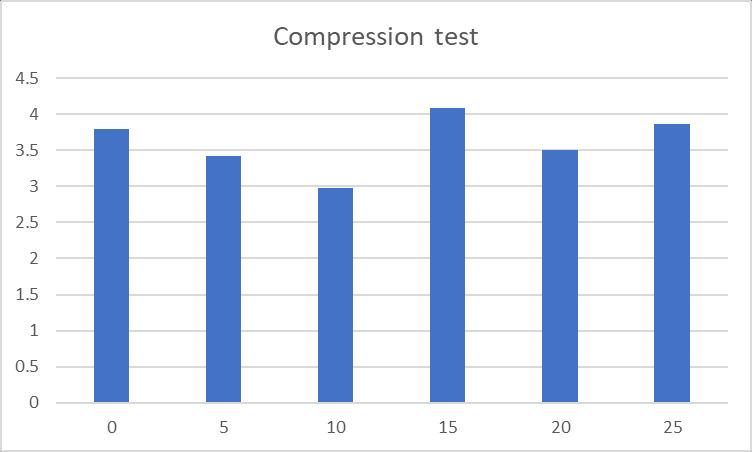
Table9compressivestrengthofovendriedbricksample withtilewaste Si
1
10compressive
4
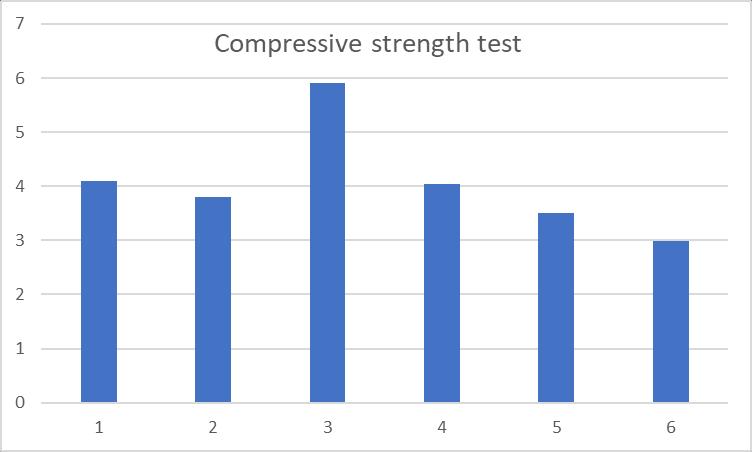
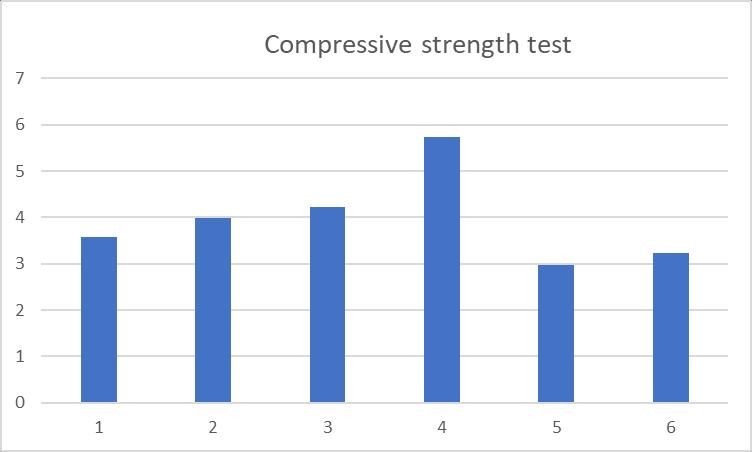
Thecompressivetestresultsforbricksampleswithsteel slagandovendriedbricksamplesaretabulatedandthe graphisplotted
Table11compressivestrengthofovendriedbricksample withsteelslag
International Research Journal of Engineering and Technology (IRJET) e-ISSN: 2395-0056
Volume: 11 Issue: 04 | Apr 2024 www.irjet.net p-ISSN: 2395-0072
Basedontheobservations,thestandardvalueofovendried bricks and sun-dried bricks were compared to the values obtainedincaseofbrickswith5%,10%,15%,20%and25% ceramic tile waste and steel slag waste . The values are comparedinthetablegivenbelow:
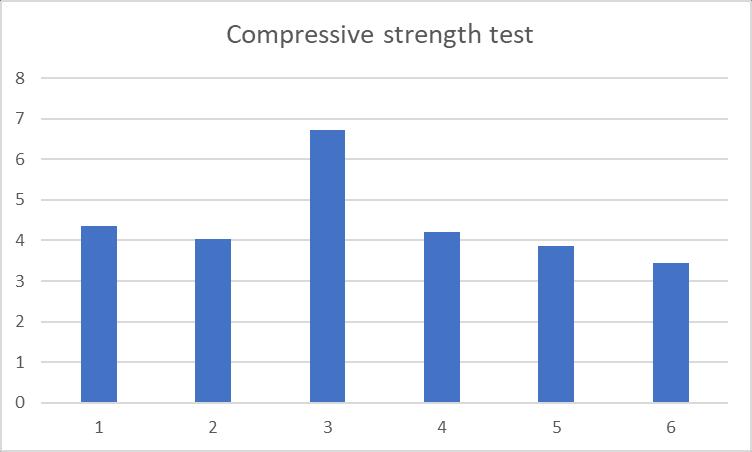
Basedontheobservations,thestandardvalueofovendried bricks and sun-dried bricks were compared to the values obtainedincaseofbrickswith5%,10%,15%,20%and25% ceramic tile waste and steel slag waste . The values are comparedinthetablegiven
3. CONCLUSIONS
Clay bricks, as one of the most frequently used building materials,areaveryinterestingresearchmaterialbecauseof their durability, fire resistance, strength, aesthetic characteristics,insulatingandmanyotherproperties. Visual inspectionshowsthatthebrickhasconstantshapeandsize. The hardness of the bricks was normal. There is no efflorescence in bricks with 0%, 5% ,10% and 15% in ceramictilewasteand0%,5%,and10%insteelslagwaste. Slight efflorescence was observed in brick with 20%and 25%ceramic tile waste and 15% ,20%,and 25% steel slag waste.
Theimpacttestshowedthatthebrickissufficientlyhardin bothwastematerials.Thesoundnessofthebrickswasalso good. It produced a clear ringing sound. The compressive strengthofbrickswith15%ceramictilewastewashigher thanthatofconventional claybrick bothinsun-driedand ovendriedconditionandin10%steelslagwaste washigher than that of convectional clay brick both in sundried and ovendried.Thewaterabsorptionofthebrickincreasewith increaseinteawasteadditionupto15%.
UtilizationofCeramicTileWasteinBrick:
Therefore, the optimum value was found to be 15%. The resultshowsthatcompressivestrengthandefflorescenceof thebrickcanbeimprovedbyaddingteawasteasadditives. Thus, due to these beneficial properties, an economic and environmentalfriendlybrickswereprepared.
UtilizationofsteelSlagwasteinBrick:
Therefore, the optimum value was found to be 10%. The resultshowsthatcompressivestrengthandefflorescenceof thebrickcanbeimprovedbyaddingteawasteasadditives. Thus, due to these beneficial properties, an economic and environmentalfriendlybrickswereprepared.
Basedontheobservations,thestandardvalueofovendried bricks and sun dried bricks were compared to the values obtainedincaseofbrickswith5%,10%,15%,20%,25%tile wasteandsteelslag.
Thevaluesarecomparedinthetablegivenbelow.
Brickwith ceramictilewastearegivenbelow
Brickwithsteelslagisgivenbelow
International Research Journal of Engineering and Technology (IRJET) e-ISSN: 2395-0056
Volume: 11 Issue: 04 | Apr 2024 www.irjet.net p-ISSN: 2395-0072
3
4
5
6
[1] Chiara Zanelli, Sonia Conte, Chiara Molinari, Roberto Soldati, Michele Dondi a technological outlook on Waste recycling in ceramic tiles , ConservationandRecycling168, 105289,2021
[2] J Baalamurugan, V Ganesh Kumar, R Padmapriya, VK BupeshRaja. Recent applications of steel slag in construction industry .Environment,DevelopmentandSustainability26 (2),2865-2896,2024
[3]JihadRahou,HalimaRezqi,MeriamElOuahabi,Nathalie Fagel Characterization of Moroccan steel slag waste: the potential green resourceforceramicproduction. Construction andBuildingMaterials314,125663,2022
[4] Mandefrot Dubale, Gaurav Goel, Ajay Kalamdhad, LaishramBoeingSingh. An investigation of demolished floor and wall ceramic tile waste utilization in fired brick production. Environmental Technology & Innovation 25, 102228,2022
[5]MuhammadHassanRiaz,AnwarKhitab,SajjadAhmad, Waqas Anwar, Muhammad Tausif Arshad. Use of ceramic waste powder for manufacturing durable and eco-friendly bricks. AsianJournalofCivilEngineering21,243-252,2020
[6] Osman Gencel, Muhammad Junaid Munir, Syed Minhaj Saleem Kazmi, Mucahit Sutcu, Ertugrul Erdogmus, Pedro MunozVelasco,DoloresElicheQuesada. Recycling industrial slags in production of fired clay bricks for sustainable manufacturing. Ceramics International 47 (21), 3042530438,2021
[7] Ying Ji, Enyao Li, Gang Zhu, Ruiqi Wang, Qianqian Sha Influence of Solid Waste Material Content on the Propertiesof Steel Slag-Waste Clay Brick Ceramic Bricks.Coatings14(4), 434,2024