
International Research Journal of Engineering and Technology (IRJET) e-ISSN:2395-0056
Volume: 11 Issue: 04 | Apr 2024 www.irjet.net p-ISSN:2395-0072
International Research Journal of Engineering and Technology (IRJET) e-ISSN:2395-0056
Volume: 11 Issue: 04 | Apr 2024 www.irjet.net p-ISSN:2395-0072
Atharv Bhopale1, Omkar Bhorade2, Girish Chaudhari3, Ganesh Tekale4, Aniket Koli5 , Prof. Priyanka Barde6
1Atharv Bhopale SPPU (Jayawantrao sawant college of Engineering)
2Omkar Bhorade SPPU (Jayawantrao sawant college of Engineering)
3Girish Chaudhari SPPU (Jayawantrao sawant college of Engineering)
4Ganesh Tekale SPPU (Jayawantrao sawant college of Engineering)
5Aniket Koli SPPU (Jayawantrao sawant college of Engineering)
6Professor Priyanka Barde Dept. of Mechanical Engineering, JSCOE, Maharashtra, India ***
Abstract -
This study offers a thorough examination of Regenerative Braking systems, with a special emphasis on Power Monitoring. It begins by examining the fundamental principles of regenerative braking, a revolutionary technology that allows for the recovery and reuse of kinetic energythatistypicallywastedduringthe brakingprocessin conventional vehicles. The paper then delves into the intricacies of power monitoring, a critical aspect that ensures the systems' ideal functionality and effectiveness. Additionally,byhighlightingthebroaderimplicationsofthis technology in promoting sustainable mobility and reducing thecarindustry'simpactontheenvironment.Itunderscores thepotentialofregenerativebrakingsystemsinclearingthe path for the creation of more environmentally friendly, efficient, and cost-effective transportation systems in the future. Through this research, it is hoped to contribute significantly to the existing body of knowledge in this field and inspire further innovations in energy-efficient automotive technologies. The results of this investigation have the potential to influence policy-making in the transportation sector and guide the development of future sustainablemobilitysolutions.
Keywords: Regenerative Braking, Kinetic Energy, ElectricalEnergy,etc.
Regenerative braking is a cutting-edge energy recovery system that decelerates a vehicle or object by transforming its kinetic energy into a form that can be utilized immediately or stored for future use. [1] This stands in sharp contrast to conventional braking systems, which,becauseoffrictionin thebrakes,wasteawayextra kinetic energyasheat. which,asa resultof brakefriction, turn extra kinetic energy into undesired and wasted heat Besides enhancing the vehicle’s overall efficiency, [2] regenerativebrakingcansignificantlyprolongthelifespan of the braking system, as its components do not wear out as rapidly. Brakes are devices that aid in slowing down a
moving object; [3] they employ friction to transform kinetic energy into heat. This mechanism is utilized by traditional braking systems. When the brake pads come into contact with the vehicle’s wheels, a substantial amount of heat energy is generated. This heat is then dissipated into the air, accounting for approximately 30% ofthevehicle’sgeneratedpower.
Instead of wasting the kinetic energy of a vehicle with brake pads, regenerative braking recovers it. This can result in an increase of 10 to 25% in a vehicle’s range in urban settings where brakes are frequently used. [5] The least energy consumption is achieved when the loss during energy recovery is minimized, which implies that mechanicalbrakesshouldnotbeemployed.
This study's main objective is to identify all practical regenerative braking methods for the recreational threewheelrear-wheeldrivehybridcarshowninFigure1.
[6] A unique regenerative braking command, separate fromthestandardbrakecommand,isemployedtoapplya regenerative torque to the electric motor, which is then transmitted to the rear wheel (Tregen). During deceleration,someoftherear-wheelweightistransferred tothefrontwheels,reducingtherearwheel’sadherence.
If Tregen is set too high, [4] the rear wheel locks, making the vehicle unstable and reducing the regenerative performance.Thisindicatesthatthechoiceofstrategyisa significant concern for rear-wheel regenerative braking. The primary regenerative braking strategies outlined in the literature aim to maximize the power extracted, the power incoming to the battery, or the electrical efficiency Theimpactofmechanicallossonenergyregenerationand the road friction coefficient were not taken into account whendevelopingthesesolutions.
Electric motor (RBS): This technique entails turning an electric motor into a generator. The regenerative brake
International Research Journal of Engineering and Technology (IRJET) e-ISSN:2395-0056
Volume: 11 Issue: 04 | Apr 2024 www.irjet.net p-ISSN:2395-0072
system's operation is dependent on the operation of an motor electric. An electric motor has to have current flowingthroughitinordertooperate.But,themotoracts like a generator and produces electricity when an outside force is supplied to activate it (during braking). The batteryissubsequentlyrechargedusingthiselectricity.
Flywheel (KERS): A flywheel, which is coupled to the driveshaftviaagearboxandtransmission,spinswhenthe vehicle's kinetic energy is captured by the Flywheel Kinetic Energy Recovery System. The car will then gain power as a result of the flywheel's spinning ability to impart torque to the driving shaft. These kinds of technologies find application in Formula One cars due to theirgreatefficiencyandinstantaneousenergysupply.
Hydraulic (RBS): The car is slowed by the Hydraulic Regenerative Braking System, which compresses a fluid while producing electricity. A common choice for the working fluid is nitrogen gas. Because compressed fluid doesn't lose energy over time, hydraulic regenerative braking systems can store energy for the longest. But using an engine to compress gas is a laborious procedure that drastically reduces the hydraulic RegenerativeBrakingsystem'spower.
RBS, or electromagnetic flywheel: The electro flywheel regenerative brake is a hybrid model that combines the electromagnetic system and fundamental power generation techniques; the energy is stored in a flywheel asopposedtobatteries.Theflywheelcanbethoughtofas a mechanical battery that stores and releases electrical energy.Themoreeconomicalwaytostoreelectricityisvia an electric flywheel regenerative braking system since flywheel batteries have a longer lifespan than lithium-ion batteries.
“Regenerative Braking System: A Comprehensive Review” byTanveer(2018).A test rigisdeveloped to evaluatethe regenerative braking capability of a Brushless DC Motor. Thestudyemphasizestheimportanceofenergyefficiency and conservation, concluding that regenerative braking systems perform optimally at higher speeds and cannot solely serve as the vehicle’s braking system. The paper suggests that the adoption of this technology in future automobiles could contribute to a more energy-efficient world.
Tushar L. Patil, Rohit S. Yadav, Abhishek D. are, Mahesh Saggam, Ankul Pratap (2018) ‘Performance Improvement ofRegenerativebrakingsystem’(2018).
discusses various techniques to enhance the efficiency of the regenerative braking system. The paper suggests reducing the weight of the vehicle, using super capacitors
to improve the energy conversion rate in regenerative braking systems, and compacting the automobile to increasesystemefficiency.
D. Mohan Kumar, Jagadeesh Vikram, and Dr. P. "'Fabrication of Regenerative Braking System', Naveen Chandra(2018)"Thereisadiscussionandimplementation oftheRegenerativeBrakingSystemfabricationprocess.In light of the study's criteria, the report proposes future improvements for regenerative braking systems and highlightstheirsignificanceincarmobility.
“Khushboo Rahim and Mohd. Tanveer, ‘Regenerative Braking System: Review Paper ‘The authors discuss the advantages of regenerative braking systems over conventional braking systems. Regenerative braking systems can operate at high temperature ranges and are highlyefficientcomparedtoconventionalbrakes.Theyare more effective at higher momentum. A car may get more useoutofitsbrakingsystemthemoreoftenitstops.Large andheavyvehiclesthatmoveathighspeedsbuildupalot ofkineticenergy,sotheyconserveenergymoreefficiently. Thepaperconcludesthatthereisabroadscopeforfurther advancements and energy conservation in regenerative brakingsystems.
Regenerativebrakingaloneisnotadequatetosafelyhalta vehicle or decelerate it as necessary; it must operate alongsidetraditionalfriction-basedbrakingsystems.
Speed Limitations: The efficacy of regenerative brakingdecreasesatlowervelocitiesandisunableto bringavehicletoacompletestopswiftly.
Stationary Vehicle Constraints: Regenerative brakes cannotsecureastationaryvehicle;amechanicallock is needed, for instance, to prevent vehicles from rolling downhill.
Drive Motor Restrictions: Regenerative braking typically only affects powered wheels; not all road vehicles with this feature have driven motors on everywheel(likeinatwo-wheeldrivecar).
For safety, the capacity to break all wheels is mandatory.
Effectiveness Limitations: The regenerative braking effect is finite and often inadequate, especially in urgentsituations.
Friction Brake Backup: The friction brake is an essential contingency in case the regenerative brake fails.
The vehicle’s propulsion system predominantly manages the braking process. When the driver presses the brake pedal (in hybrid or electric vehicles), the brakes engage the motor in reverse, slowing the wheels. In reverse, the
International Research Journal of Engineering and Technology (IRJET) e-ISSN:2395-0056
Volume: 11 Issue: 04 | Apr 2024 www.irjet.net p-ISSN:2395-0072
motoractsasagenerator,channelingelectricitybackinto the batteries. Most hybrid and electric vehicles on the market utilize this method to increase the battery pack’s lifespan. Employing a regenerative mechanism is highly advantageous as it diminishes pollution and enhances enginelongevity.
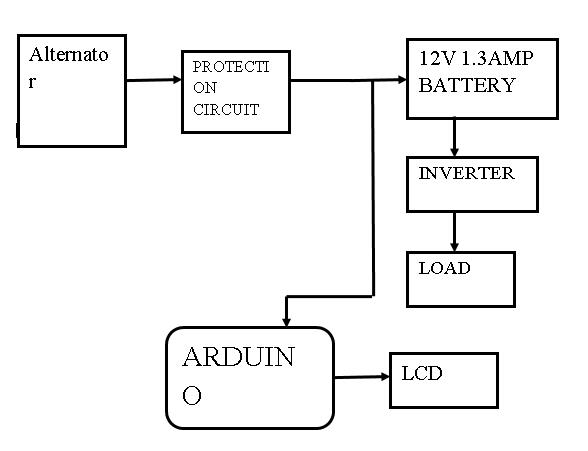
Figure1:BlockDiagram
Here, we use Regenerative charged battery systems provide continuous power delivery regardless of weather conditions.Wecanharvestasignificantquantityofpower from regenerative radiations by using technology appropriate for the geographical location. Furthermore, regeneration energy is thought to be the most promising alternativesourceofenergy
DESIGN AND CALCULATIONS
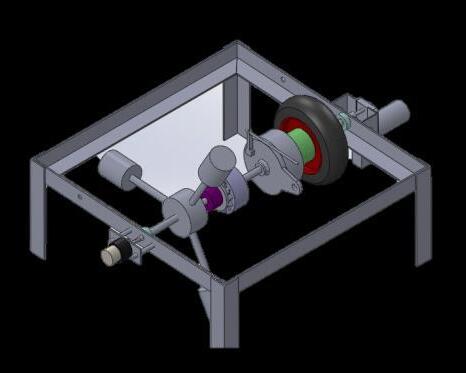
Figure2:ProposedModel
Design of shaft:

Bendingmoment=force*perpendiculardistance Bendingmoment=5*9.81*400 Bendingmoment=19620Nmm
Fordiameter15mm, I= I= I=2483.78
Therefore, =
σb=7.899*7.5=59.24Nmm 59<105Nmm therefore,designissafe.
Power: Outputmotoris300rpm.
Power= Power= power=7.35
Power= T=
=0.23Nm T=2.34kg-cm
Design of Frame:
2024, IRJET | Impact Factor value: 8.226 | ISO 9001:2008
International Research Journal of Engineering and Technology (IRJET) e-ISSN:2395-0056
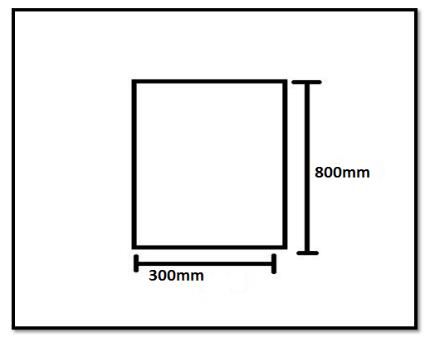
Bending moment (M) =force *perpendicular distance
=30*800*9.81
Bendingmoment(M)=235440Nmm I=
Thereforeabovevalueuseinequationno(1).
Therefore,σb=90.40Nmm
90.40<105
Hencedesignissafe.
This project is designed with the ARDUINO controller. In this project, we utilized a hybrid system that integrated regenerationandwindenergy.Itisaproductivemethodof producing electricity. Hence This project develops a hybrid powergenerationsystemcapableofdrivinga load using regenerative panels and windmills as energy sources. To meet the increasing need for electricity, a clean hybrid power station based on regenerative wind can be deployed. In addition, this approach decreases reliance on a single supplier while increasing reliability. This technology has already contributed to the developmentofvehiclessuchastheTeslaRoadster,which runs solely on batteries. Sure, these automobiles may use fossilfuelsduringtherechargingstagethatis,ifthepower source is a fossil fuel such as coal but once on the road, theycanoperate withoutusingany fossil fuels, whichis a significant step forward. When you consider the energy losses experienced by battery-electric hybrid systems, it seemsreasonabletoexpectthatefficientflywheelhybrids willsoonbecomethestandard.However,itisnotquiteso black and white, and more investigation suggests that a combination of battery-electric and flywheel energy storageismostlikelytheoptimal.
Volume: 11 Issue: 04 | Apr 2024 www.irjet.net p-ISSN:2395-0072 © 2024, IRJET | Impact Factor value: 8.226 | ISO 9001:2008 Certified Journal | Page2581 = (1)
Even though regenerative braking is more effective than conventional braking, electricandhybridvehiclesarestill in the development or design review stages, so regenerative braking is still uncommon and unpopular. Batteriesareusedtostoreenergyforavarietyofelectrical appliances, including lights, air conditioning, mobile phones,andotherdevices.
Regenerative braking makes a car more efficient, but it alsomakesitheavier,whichisabigissue.Itcanbesolved by researching material sciences and employing lighter materials for regenerative circuit components. The adoption of more effective methods may result in significantcostsavingsfortheautoindustry,whichwould inevitablybenefitthenationaleconomy.
Lossesincurredthroughoutthegeneratingprocessshould be decreased to increase its efficiency, and the upkeep neededforthismethodshouldbeconsideredforuseinthe future.Thisregenerativebrakingtechnologyisgoingtobe revolutionary since electrical and hybrid vehicles are the wayofthefuturefortheautomobileindustry.
[1] "Design, Fabrication and Testing of Regenerative Braking Test Rig for BLDC Motor," Avinash Srivastava, Shaikh Farhan, Sayed Nashit, Sufiyan Adhikari,AmrutaGambhire,andothers,2016.
[2] Performance Improvement of Regenerative Braking System, International, Tushar L. Patil, Rohit S. Yadav, Abhishek D. Mandhare, Mahesh Saggam,AnkulPratap.
[3] The international journal of advanced research and innovative ideas in education published an article titled "Design and Fabrication of Regenerative Braking System," written by A. Eswaran, S. Ajith, V. Karthikeyan, P. Kavin, and S. Loganandh(2018).
[4] Ketan Warake, Dr. S. R. Bhahulikar, Dr. N. V. Satpute, ‘Design & Development of Regenerative Braking System at Rear Axle’, International Journal of Advanced Mechanical Engineering.Volume8,Number2(2018).
[5] In the International Journal of Creative Research Thoughts, Volume 6, Issue 1 (2018), Siddharth K. Sheladia, Karan K. Patel, Vraj D. Savalia, and Rutvik G. Savaliya present "A Review on Regenerative Braking Methodology in Electric Vehicle."
International Research Journal of Engineering and Technology (IRJET) e-ISSN:2395-0056
Volume: 11 Issue: 04 | Apr 2024 www.irjet.net p-ISSN:2395-0072
[6] "Design, Fabrication and Testing of Regenerative Braking Test Rig for BLDC Motor," Avinash Srivastava, Shaikh Farhan, Sayed Nashit, Sufiyan Adhikari, Amruta Gambhire, along with others, 2016.
We extend our heartfelt gratitude to all those who We extendourheartfeltgratitudetoallthosewhocontributed to the successful completion of our research paper titled ‘Regenerative Braking System with Power Monitor.’ First and foremost, we express our appreciation to Prof. Priyanka Barde, our research supervisor, for their invaluable guidance, unwavering support, and expertise throughouttheresearchprocess.Theirinsightfulfeedback andencouragementsignificantlyshapedthedirectionand qualityofourstudy.
We also acknowledge Dr. Pradeep A. Patil, Head of the Mechanical Engineering Department at JSCOE, for his valuable advice and counsel during the writing phase. His insights enriched our work and ensured its depth and relevance.
Furthermore, we extend our profound gratitude to Dr. R. D. Kanphade, Principal of JSPM’s Jayawantrao Sawant College of Engineering, Hadapsar, Pune. His constant encouragement and unwavering support, along with providingnecessarylabandlibraryspace,werepivotal to ourprogress.
Lastly, we sincerely thank Dr. Mahesh Gaikwad, Project Coordinator, for his technical assistance and efforts in preparing this study. His contributions were invaluable, andwetrulyappreciatehisdedication.