
International Research Journal of Engineering and Technology (IRJET) e-ISSN:2395-0056
Volume: 11 Issue: 04 | Apr 2024 www.irjet.net p-ISSN:2395-0072
International Research Journal of Engineering and Technology (IRJET) e-ISSN:2395-0056
Volume: 11 Issue: 04 | Apr 2024 www.irjet.net p-ISSN:2395-0072
Arun KS1* , Juan Shaji Austin2* , Kiran Paulson3* , Kevin Paulson4* , Suzen Saju Kallungal5*
1,2,3,4BTech.Students,Department of Computer Science and Engineering, Mar Athanasius College of Engineering, Kothamangalam, Kerala
5Assistant Professor,Department of Computer Science and Engineering, Mar Athanasius College of Engineering, Kothamangalam, Kerala ***
Abstract - This paper introduces a pioneering approach to deepfake detection leveraging the power of mobile platforms through Flutter. We combine state-of-the-art ResNeXt and LSTM models for robust deepfake identification and en-capsulate them within a user-friendly mobile interface. By harnessing the versatility of Flutter’s InAppWebView, our so- lution seamlessly integrates with mobile devices, empowering users with real-time deepfake detection capabilities on their smartphones. Through rigorousevaluation,wedemonstratetheefficacy and usability of our approach, marking a significant advancement in the fieldofmobile-baseddeepfakedetection.
Index Terms-Flutter,Dart,Inappwebview,LSTM,ResNext
In recent years, the proliferation of deepfake technology has raised significant concerns regarding the manipulation of digital content and its potential consequences on various aspects of society, including politics,media,andpersonalprivacy.Deepfakes,whichrefer to synthetic media generated using advanced machine learningtechniques,havebecomeincreasinglysophisticated, making it challenging to distin- guish between real and manipulated content. As a result, the need for effective deepfake detection mechanisms has become paramount to combat misinformation and protect individuals and organizations from the harmful effects of manipulated media.
Traditional approaches to deepfake detection have primarily relied on complex algorithms and computational resources, often restricting their deployment to highperformance com- puting systems. However, with the widespread adoption of mobile devices, there arises an opportunity to democratize deepfake detection by bringing ittothe fingertipsofeverydayusers.Mobileplatformsoffer unparalleledaccessibilityandconvenience,allowingusersto verifytheauthenticityofmediacontent,irrespectiveoftheir locationortechnicalexpertise.
In this context, this paper presents a groundbreaking approach to deepfake detection tailored specifically for mobileplatforms.Ourmethodologycombinescutting-edgedeep learning architectures, namely ResNeXt and LSTM, to effectively identify and classify deepfake content. Leveraging the versatility and efficiency of the Flutter framework, we encapsulate our deep learning models within a user-friendly mobileapplication,providinguserswithaseamlessandintuitiveexperiencefordeepfakedetection.
The integration of Flutter’s InAppWebView further enhances the functionality of our mobile application, enabling userstoanalyzeonlinemediacontentdirectlywithintheapp interface. By harnessing the power of mobile devices, our solution empowers users to verify the authenticity of media content,therebymitigatingthespreadofmisinformationand preservingtheintegrityofdigitalcommunicationchannels.
Throughout this paper, we provide a comprehensive overview of our deepfake detection methodology, detailing the architecture, implementation, and evaluation of our mobile application. We present experimental results demonstrating the effectiveness and efficiency of our approach, as well as discuss the potential implications and future directions of mobile- based deepfake detection technology.Ultimately,ourresearchaimstocontributetothe ongoing efforts in combating digital manipulation and fostering trust in the authenticity of media content in the mobileera.
A. Flutter
Flutterisanopen-sourceUIsoftwaredevelopmentkitcreatedbyGoogle,primarilyusedforbuildingnativelycompiled applicationsformobile,web,anddesktopfromasinglecodebase. It offers a fast development cycle, expressive UI components, and native performance across multiple platforms. Flutter utilizes the Dart programming language, developed by Google, known for its efficiency and simplicity. Dart isa statically typed language with features like hot reload,
International Research Journal of Engineering and Technology (IRJET) e-ISSN:2395-0056
Volume: 11 Issue: 04 | Apr 2024 www.irjet.net p-ISSN:2395-0072
enabling developers to instantly see changes in their code reflected in the app during development. Together, Flutter andDartprovideapowerfulcombinationforcreatingcrossplatform applications with high performance and a smooth userexperience.
ResNeXt, short for ”Residual Next,” is a deep neural network architecture developed by Facebook AI Research (FAIR) researchers. It builds upon the ResNet architecture’s success in computer vision by introducing a novel parameter called ”cardinality.” This parameter controls the network’s width andenhancesparameterefficiency.Unlike traditional methods that increase model capacity by adjusting depth or width, ResNeXt boosts performance by adjusting cardinality, result- ing in superior performance whilemaintainingcomputationalefficiency.Itseffectiveness in image classification tasks has made ResNeXt a widely adopted architecture in both research and practical applications, cementing its position as a pivotal framework indeeplearningforcomputervision.
LSTM, or Long Short-Term Memory networks, emerged as a solution to the challenge of gradient disappearance in recurrentneuralnetworks(RNNs).DevelopedbyHochreiter and Schmidhuber, LSTMs aim to effectively capture longterm dependencies in sequential data. Unlike conventional RNNs, LSTMs featurea memory cell with three gates: input, forget, and output gates. These gates regulate the flow of information, enabling LSTMs to selectively retain or discard dataateachstep.ThiscapabilityallowsLSTMstoefficiently capture distant relationships within the data. Widely employed in natural language processing, speech recognition,andtimeseries prediction,LSTMshavebecome afundamentalelementindeeplearningmodelsdesignedfor sequentialdataanalysis.
Python stands out as a multifaceted high-level programming language celebrated for its user-friendly nature, clear syntax, and diverse utility. Crafted by Guido van Rossum, Pythonprioritizeshuman-readablecodeandfacilitatesmultipleprogrammingapproaches,includingprocedural,objectoriented,andfunctional paradigms.Itsrichstandardlibrary encompassesa vastarrayofmodulesandpackagescatering tovariousdomains,suchaswebdevelopment,dataanalysis, artificial intelligence, scientific computing, automation, and beyond. Python’s popularity thrives on its accessibility, robustcommunityengagement,andextensiveadoptionacross aspectrumofindustries.
[1]This paper discusses the evolution of AI technologies and the emergence of deepfake manipulation, primarily focusing on summarizing existing research on deepfake detectionmethodologies.Thispaperdiscussthepotentialrisksand challengesassociatedwiththeproliferationofdeepfaketechnology, highlighting the importance of developing effective detection methods to mitigate the spread of misinformation andsafeguarddigitalauthenticity.
[2]Deepfake videos replace a person’s features with those of another, often used for misinformation. While Generative Adversarial Networks (GANs) create deepfakes, they’re not commonly used for detection. This study explores using GAN discriminators for detection, training them alongsideMesoNet.Variousdiscriminatorarchitectures aretestedondifferentdatasets,andensemblemethods are proposed to boost performance. Results indicate GAN discriminators, even with ensemble methods, strugglewithvideosfromunknownsources.
[3]This paper addresses the growing concern over the proliferation of deepfake media, particularly due to their potential misuse in activities like terrorism and blackmail. It highlights the advancements in deep generative networks, which have enabled the creation of realistic face swaps with minimal traces of manipulation. To tackle this issue, the paper proposes a method based on frequency domain analysis to detect subtle unnatural features in deepfake imagesthatareimperceptibletothenakedeye.
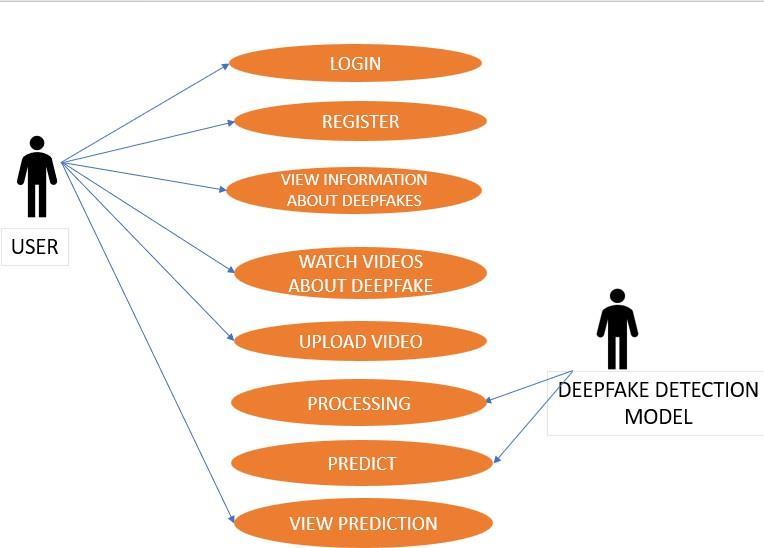
The proposed model is a cutting-edge mobile application for deepfake detection, uniquely developed using the versatile Flutter framework. Tailored for seamless user experience, this application harnesses the power of LSTM (Long Short- Term Memory) and ResNeXt architectures to discerndeepfakemanipulationinuploadedvideos.Userscan easily navigate the intuitive interface, upload videos, and initiate the deepfake analysis process, all within the familiar environment of their mobile devices. Additionally, users can access information related to deepfake technologies and detection methodolo- gies, as well as watch educational videostoenhancetheirunderstandingofthesubject.Initially developed as web ap- plication, the model has been seamlessly integrated into a mobile application using Flutter’sinAppWebViewfeature.Throughthecombinationof advanced detection algorithms and user-friendly features, this mobile application offers a robust defense against the proliferation of deepfake contentinthedigitalrealm.
International Research Journal of Engineering and Technology (IRJET) e-ISSN:2395-0056
Volume: 11 Issue: 04 | Apr 2024 www.irjet.net
p-ISSN:2395-0072
V. METHODOLOGY
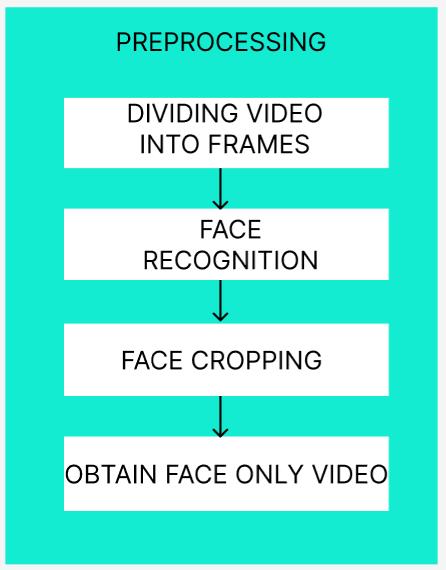
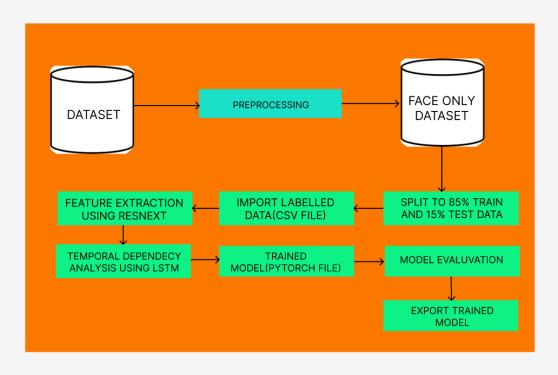
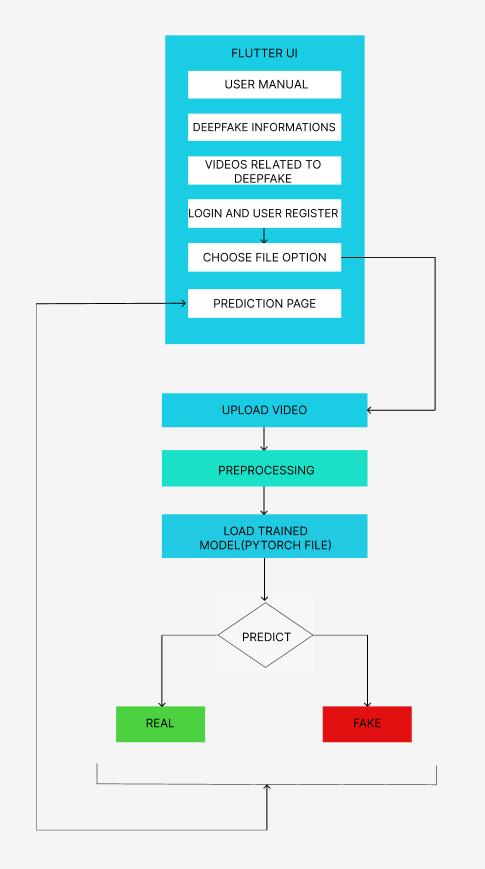
1) Data preprocessing: After gathering datasets like CelebDF Version 1, CelebDF version 2, and DFDC, the initial step involved breaking down each video into individual frames using OpenCV. Following this, a Python face recognition module was employed to detect faces within these frames. Once faces were detected, they were isolated fromtheframesthroughaprocesscalledfacecropping.
This methodology ensures that only the relevant facial regions are retained for further analysis, simplifying subsequentprocessingsteps.Withthisapproach,thedataset is primed for subsequent stages like feature extraction and modeltraining,settingasolidfoundationforrobustdeepfake detectionsys-tems.
International Research Journal of Engineering and Technology (IRJET) e-ISSN:2395-0056
Volume: 11 Issue: 04 | Apr 2024 www.irjet.net
2) Data splitting for training and testing: The dataset was meticulously partitioned into two subsets: a training set comprising 85% of the data and a test set comprising the remaining 15%. This division ensures that the bulk of the datais allocated for training the model, allowing it to learn from a diverse array of examples. Meanwhile, the test set servesasanindependent benchmarktoevaluatethe model’s perfor- mance, providing an unbiased assessment of its effectivenessindetectingdeepfakes.
3) ResNext:EnhancingFeatureExtraction: ResNextstands out for its ability to capture rich and diverse feature representationswithinimages.Whenappliedtofeatureextraction in deepfake detection, ResNext analyzes facial images at variouslevelsofgranularity,discerningintricatedetailsthat distinguishbetweengenuinefacialexpressionsandmanipulatedones.Byleveragingitsdeeparchitectureandadvanced convolutionallayers,ResNextenhancesthemodel’sabilityto detectsubtleanomaliesindicativeofdeepfakemanipulation, thereby strengthening the overall accuracy and robustness of the deepfake detection system. The ResNeXt model, specifi-callytheResNeXt5032x4darchitecturecode,actsas afeatureextractorforimages.
4) ModelingtemporaldependenciesusingLSTM: TheLSTM layer takes as input a sequence of feature vectors extracted from video frames. Each feature vector represents the outputoftheResNeXtmodelforasingleframe.
Duringtheforwardpass,theLSTMprocesseseachfeature vector in the input sequence one by one, updating its internal state and generating an output hidden state for eachtimestep.
The output hidden state at each time step captures the LSTM’sunderstandingoftheinputsequenceuptothatpoint. TheLSTMlayermayhavemultiplelayers,andeachlayermay havemultiplehiddenunits.ThisallowstheLSTMtocapture complexpatternsanddependenciesintheinputsequence.
The final output of the LSTM layer is typically the hidden stateatthelasttimestep,whichsummarizestheentireinput sequence. This final hidden state is often used for making predictions or further processing downstream in the neural network.
Developed and integrated a comprehensive deepfake detec-tionsystemthatincludesbothawebapplicationanda mobile application. The web application, created using HTML, CSS, and Django, allows users to register, log in, and uploadvideosforanalysis.
C. Flutter
p-ISSN:2395-0072
1) Registration:Createuseraccountssecurely.
2) Login:Authenticatingusers securely.
3) Video upload: Users can select and upload a video file.
4) Preprocessing thevideo
5) Loading trained model: Next, the trained model is loadedintomemory,readytoanalyzetheuploaded videodataforanysignsofdeepfakemanipulation.
6) Finalresult:Getsthefinalresultwhetherthevideo ismanipulatedornot.
International Research Journal of Engineering and Technology (IRJET) e-ISSN:2395-0056
Volume: 11 Issue: 04 | Apr 2024 www.irjet.net p-ISSN:2395-0072
a) Image Descriptions::
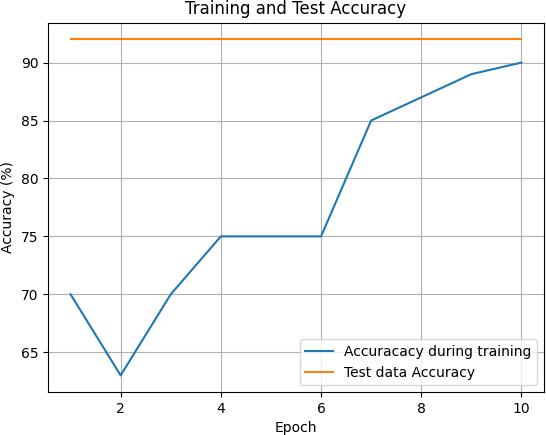
1) Model Training and Testing (Figure 5): This visual representationpresents the outcomeof model training and testing. The horizontal axis denotes the training epochsoriterations,whiletheverticalaxissignifiesthe performance metric, such as accuracy or loss. The graph illustrates the evolution of the model’s performance over time, offering insights into its learningdynamics.
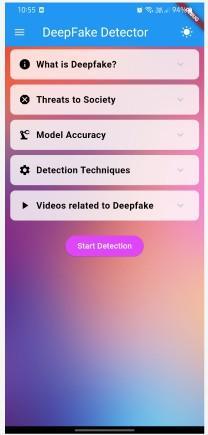
2) Mobile App UI (1) (Figure 6): This image showcases the user interface of the mobile application, emphasizing its user-friendly design. It provides users with intuitive controls and options for interacting with the deepfake de- tection system. The interface design focuses on simplicity and ease of use, ensuring a smoothexperienceforusersregardlessoftheirlevelof expertise.
International Research Journal of Engineering and Technology (IRJET) e-ISSN:2395-0056
Volume: 11 Issue: 04 | Apr 2024 www.irjet.net p-ISSN:2395-0072
1) Enhanced Scalability:
As computational resources advance, especially with powerful GPUs and better cloud infrastructure, the Deepfake Detection App can handle larger file sizes efficiently. This benefits users dealing with high-resolution or longer videos,expandingitsutility.
2) Improved Frame Extraction and Analysis: Advancements in GPU technology can enable more efficient frame extraction and analysis, surpassing current limitations. This enhances detection accuracy, especially forvideoswithsubtlemanipulation.
3) Multi-Faced Video Support:
Expanding the model’s capabilities to detect and analyze videos with multiple faces broadens its applicability, particularlyinscenarioslikeinterviewsorgroupsettings.
4) Enhanced Model Training with Larger Datasets: Training the model on larger and diverse datasets improves accuracy and generalizability. Incorporating extensive datasets helps distinguish between genuine and fake videos, enhancing reliability in combating deepfake content.
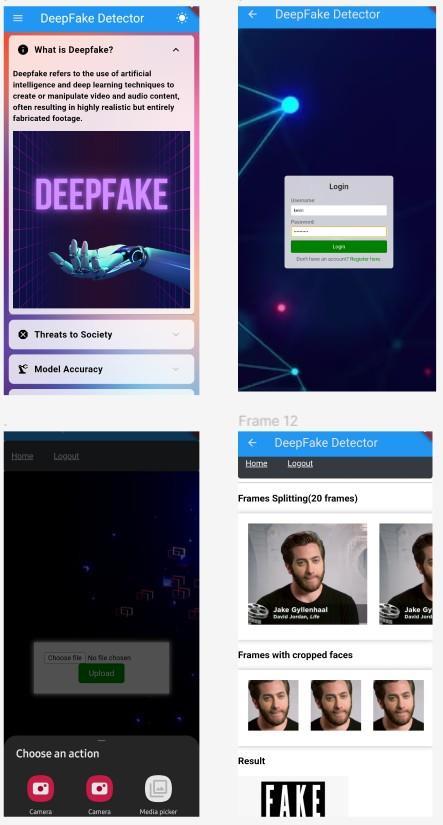
3) Mobile App UI (2) (Figure 7): This depiction presents additional perspectives of the mobile application interface, highlighting supplementary features and functionalities. Users can seamlessly navigate through various sections of the app to access relevant information and controls,enhancingtheiroverallexperience.
In conclusion, the development of a mobile application dedicatedtoadvancingdeepfakedetectioncapabilitiesrepresentsasignificantmilestoneintheongoingbattleagainst manipulated media in digital environments. Through this project, we’ve successfully crafted a robust architecture that integrates cutting-edge deep learning algorithms with detectionfunctionalities, facialrecognitiontechniques,and an intuitive user interface. Our project showcases the efficacy of deep learning technology, particularly in its ability to identify and mitigate the spread of deepfake content with precision and ef- ficiency. By harnessing the power of sophisticated algorithms, we’ve laid the groundwork for a tool that empowers users to combat the threats posed by manipulated media, thereby safeguarding trust and authenticity in online media environ- ments. Furthermore, our work underscores the importance of continual innovation and adaptation in this
rapidlyevolving field.Movingforward,avenuesforfurther exploration include enhancing offline capabilities, optimizing algorithms for mo- bile performance, and addressing potential limitations such as reliance on consistent internet connectivity. As we look to the future, it’s clear that advancements in deepfake detection hold immense promise for bolstering the security and integrity of digital content. By leveraging the insights gleaned from this project and remaining committed to ongoing research and development, we can continue to advance the field of deepfake detection and contribute to the creation of a more secure and trustworthy online ecosystem.
[1] Rana, M. S., Nobi, M. N., Murali, B., & Sung, A. H. (2022). Deepfake Detection: A Systematic Literature Review. IEEE Access,10,pp.31578–31593.
[2] Aduwala, S. A., Arigala, M., Desai, S., Quan, H. J., & Eirinaki, M. (2021). Deepfake Detection using GAN Discriminators. In 2021 IEEE Seventh International Conference on Big Data Computing Service and Applications(BigDataService) (pp.69-77).Oxford,United Kingdom. doi: 10.1109/BigDataService52369.2021.00014.
[3] H.Agarwal,A.Singh,andR.D,”DeepfakeDetectionUsing SVM,” 2021 Second International Conference on Electronics and Sustainable Communication Systems (ICESC), Coimbatore, India, 2021, pp. 1245- 1249, doi: 10.1109/ICESC51422.2021.9532627.
[4] Khan, S. A., & Dang-Nguyen, D.-T. (2024). Dee Ac pfake Detection: An- alyzing Model Generalization ross
[5] Ramadhani, K. N., Munir, R., & Utama, N. P. (2024). Improving Video Vision Transformer for Deepfake Video Detection Using Facial Landmark, Depthwise Separable Convolution, and Self Attention. IEEE Access, 12,pp.8932–8939.
[6] Patel, Y. et al. (2023). Deepfake Generation and Detection: Case Study and Challenges. IEEE Access, 11, 143296–143323.
[7] Malik, A., Kuribayashi, M., Abdullahi, S. M., & Khan, A. N. (2022). DeepFake Detection for Human Face Images and Videos:ASurvey. IEEE Access,10,pp.18757–18775. Architectures,Datasets,andPre- TrainingParadigms. IEEE Access,12,pp.1880–1908.
International Research Journal of Engineering and Technology (IRJET) e-ISSN:2395-0056
Volume: 11 Issue: 04 | Apr 2024 www.irjet.net p-ISSN:2395-0072
[8] Mitra,A.,Mohanty,S.,Corcoran,P.,&Kougianos,E.(2021). A Machine Learning Based Approach for Deepfake Detection in Social Media Through Key Video Frame Extraction. SNComputerScience,2.
[9] Pan,D.,Sun,L.,Wang,R.,Zhang,X.,&Sinnott,R.O.(2020). Deepfake Detection through Deep Learning. In 2020 IEEE/ACM International Conference on Big Data Computing,ApplicationsandTechnologies (BDCAT)
[10] Gu¨era, D., & Delp, E. J. (2018). Deepfake Video Detection Using Recurrent Neural Networks. In 2018 15th IEEE International Conference on Advanced Video and Signal BasedSurveillance(AVSS)
[11] Theerthagiri, P., & Nagaladinne, G. B. (2023). Deepfake Face Detection Using Deep InceptionNet Learning Algorithm. In 2023 IEEE International Students’ Conference on Electrical, Electronics andComputerScience (SCEECS) (pp. 1-6). Bhopal, India. doi: 10.1109/SCEECS57921.2023.10063128.
[12] Lyu, S. (2020). Deepfake Detection: Current Challenges and Next Steps. In 2020 IEEE International Conference on Multime- dia & Expo Workshops (ICMEW) (pp. 1-6). London, UK. doi: 10.1109/ICMEW46912.2020.9105991.