
International Research Journal of Engineering and Technology (IRJET) e-ISSN:2395-0056
Volume: 11Issue:04|Apr2024 www.irjet.net p-ISSN:2395-0072
International Research Journal of Engineering and Technology (IRJET) e-ISSN:2395-0056
Volume: 11Issue:04|Apr2024 www.irjet.net p-ISSN:2395-0072
1,2,3,4 UG Students, Department of Civil Engineering, Jawaharlal College of Engineering and Technology, Ottapalam, Kerala, India
5 Assistant Professor, Department of Civil Engineering, Jawaharlal College of Engineering and Technology, Ottapalam, Kerala, India ***
Abstract - This paper proposes anall-inclusiveInternetof Things (IoT) solution that integrates a range of sensors and Arduino-based hardware for leak detection and water quality monitoring. The system uses pH and turbidity sensors to check water quality in real time, guaranteeing ongoing monitoring of important parameters. Water flow rates are measured with a flow sensor, and temperature fluctuations are detected with a temperature sensor (DS18B20). Using the NodeMCU platform and an Arduino microcontroller, the data gathered from various sensors is processed and sent to a central hub. Proactive reactions to variations in water quality are made possible by the IoT infrastructure, which makes remote monitoring and analysis easier. The system also includes a leak detection mechanism that allows for the early detectionand control of possible leaks. The proposed solution intends to improve water quality management by offering a low-cost, real-time monitoring system capable of detecting and preventing leaks, thereby contributing to the sustainable and efficient use of water resources.
Key Words: IoT, pH and turbidity sensors , temperature sensor, flow sensor, NodeMCU, Arduino UNO Microcontroller,
As the world's population grows and environmental concerns grow, so does the demand for sustainable and clean water resources. This study suggests an inventive waytohandletwocrucialissues:leakdetectionandwater quality monitoring - by utilizing the Internet of Things (IoT)technology.Thisisinresponsetotheurgentdemand for efficient management of water resources. Maintaining the sustainability of the ecosystem and public health dependheavilyontheavailabilityofpure,uncontaminated water. In order to minimize infrastructure damage and prevent water loss, leaks in water distribution systems must be promptly detected and fixed. Within this framework, our work focuses on creating a complete Internet of Things system using a variety of sensors and Arduinotechnologies.Inordertoenablereal-timeanalysis of water quality, turbidity and pH sensors are used,
providing information on acidity and suspended particle levels.
The incorporation of a flow sensor facilitates precise volumemeasurements,henceaugmentingcomprehension of water consumption trends. The temperature sensor (DS18B20) also keeps track of temperature fluctuations, which is an important aspect of water quality evaluation. When these sensors are combined with Arduino microcontrollers, a strong, data-driven ecosystem for evaluating water quality is produced. The IoT Node MCU microcontroller, which allows for smooth data transfer and communication between the sensors and a central hub,isthebrainsbehindthesystem.
Recognizing the importance of leak detection in water distribution systems, our solution also includes a mechanism to locate leaks and take immediate action to stop water loss and minimize damage to infrastructure. This research aims to lead to the development of more advanced, scalable, and technologically affordable water management strategies. In the end, the suggested system willbecrucialinguaranteeingthattherewillbecleanand readilyavailablewaterresourcesforboththecurrentand futuregenerations.Itseekstoimprovetheeffectivenessof waterdistributionnetworks,encouragesustainablewater usage,andprotectwaterquality.
Limited Accuracy: Conventionaltemperaturesensing systems may lack the precision required for modern applications, leading to inaccuracies in temperature measurements.
Lack of Real-time Data: Many existing systems provide periodic or delayed temperature readings, limiting their suitability for dynamic environments wherereal-timedataisessential.
High Power Consumption: Traditional temperature sensors may consume significant power, restricting theiruseinbattery-operateddevicesandcontributing tohigheroperationalcosts.
International Research Journal of Engineering and Technology (IRJET) e-ISSN:2395-0056
Volume: 11Issue:04|Apr2024 www.irjet.net p-ISSN:2395-0072
Limited Connectivity: Conventional sensors often lack wireless connectivity, hindering seamless data transferandremotemonitoringcapabilities.
Obsolete Communication Protocols: Older temperature sensing systems may rely on outdated communication protocols, limiting interoperability withmoderndevicesandsystems.
High Accuracy with Advanced Sensors: The proposedsystemintegratesadvancedsensorslikethe DS18B20, ensuring high accuracy and reliable digital temperaturemeasurements.
Real-time Monitoring Capabilities: Leveraging the latesttechnologies,theproposedsystemenablesrealtime data monitoring, enhancing responsiveness to dynamicenvironmentalchanges.
Energy Efficiency: Designedwithenergyefficiencyin mind, the proposed system is suitable for batteryoperated devices, contributing to longer operational lifetimesandreducedpowercosts.
Wireless Connectivity: The inclusion of wireless connectivity options such as Wi-Fi or Bluetooth facilitatesseamlessdatatransferandsupportsremote monitoringapplications.
Integration with IoT Platforms: The proposed system is designed to integrate with IoT platforms, allowing for efficient data exchange, analysis, and interoperability with other smart devices and systems.
Future-Ready Communication Protocols: The system incorporates modern communication protocols, ensuring compatibility with contemporary devices and systems, thus future-proofing its connectivity.
Comprehensive Applications: With improved accuracy,real-timecapabilities, energy efficiency,and advanced connectivity, the proposed system is versatile and well-suited for applications in research, industry,andthebroaderIoTlandscape.
2.1 A Low-Cost IoT System for Monitoring Air Quality inIndoorWorkingPlaces IEEE2022
This paper describes the creation of an indoor air quality monitoring system based on the internet of things (IoT). Thesystem'sgoalistokeepaneyeontheofficeairquality. It is to ensure workplace health and safety, which is particularly important in light of the COVID-19 epidemic. Monitoring may be done from anywhere, at any time, by puttingtheIoTconceptintopractice.Threemainpartsare usedintheconstructionofamonitoringsystemprototype: an IoT cloud platform (ThingSpeak), a microcontroller (NodeMCU ESP-12), and an air quality sensor (BME680).
The outcome of the experimental test demonstrates that the system could track the following parameters: air pressure, temperature, humidity, and IAQ (indoor air quality)index,aswellastheamountofcarbondioxideand volatile organic compounds (VOCs). These data are available anywhere at any time via a web application that displaystheminrealtimeforusersofPCsorcellphones.
2.2 Development of an IoT-based Real-Time Air Quality MonitoringDevice IEEE2021
Theairqualityhasbeendecliningalarminglyoverthepast few decades, resulting in the deaths of around seven million people annually worldwide. In light of the aforementioned alarming statistics, people everywhere should have access to information on the state of their environment so that sensible actions can be taken before it'stoolate.Thishasledtothedevelopmentofaprototype airqualitymonitoringsysteminthis work.TheNodeMCU ESP32, the MQ-135 gas sensor, and the DHT-11 temperature and humidity sensor module make up the suggested air quality monitoring equipment. Our suggestedsystemhasanadvantageoveritscompetitorsin terms of cost, small size, and economical power consumption. The NodeMCU, which serves as the setup's base station, receives the data that the sensors capture. With its built-in microcontroller and on-chip WiFi transceiver,theNodeMCUnotonlymonitorsdatabutalso transmits it to a distant server, opening up a vastamount of possibilities for extremely fine-grained and precise physical world communication. The gas sensor provides an overall air quality parameter along with the concentration of harmful gases such as smoke, CO2, benzene,andNOx.Analarmmessageisalsoshownonthe server if the concentration of dangerous gasses is higher than a predetermined threshold. The integrated system may be a major factor in smart cities' ability to defend actionstakeninthefuturetoreducepollutionlevels.
2.3 Water Quality Monitoring System Based on IoT 2022
This paper discusses an effective implementation approach that comprises a variety of sensor devices and other modules and their functionality. In this kind of implementation,theATMEGA328withWi-Fimodulewas employed.Theembeddeddevice'sintegratedADCandWiFimodule allowfor internet connection. Sensorsare built into the Arduino UNO board for monitoring purposes. An ADC is used to transform the sensor readings into a digital value, which is then used to evaluate the relatedenvironmental parameter. afterdatahas been gathered from numerous sensor devices placed in a particular area of interest. The detected data will be immediately sent to the web server after a successful connectionhasbeenmadewiththeserver.
International Research Journal of Engineering and Technology (IRJET) e-ISSN:2395-0056
Volume: 11Issue:04|Apr2024 www.irjet.net p-ISSN:2395-0072
The useful implementation strategy that includes a range of sensor devices and other modules and their functionalities is covered in this paper. In this kind of implementation,theATMEGA328withWi-Fimodulewas employed.Theembeddeddevice'sintegratedADCandWiFimodule allowfor internet connection. Sensorsare built into the Arduino UNO board for monitoring purposes. An ADCisusedtotransformthesensorreadingsintoadigital value, which is then used to evaluate the related environmental parameter. once data has been gathered frommultiplesensordevicesplacedinaparticularareaof interest. One of the main objectives for urban and rural areas is the development of complete Internet of things (IoT)-based solutions for water quality monitoring and management that support pertinent users and researchers.
Inorder tomanagewaterleaksthatoccurinit,thisstudy providesasmartwaterpipelinemonitoringsystem.Water usage is rising in direct proportion to rising water waste. In order to solve this, the Internet of Things (IoT) is used in the design and proposal of a smart monitoring system. Inthissystem,aturbiditysensorisusedtomeasurewater contaminationandawaterflowsensorisusedtomonitor water flow in the pipeline. One of the most popular microcontrollers for Internet of Things applications, the NodeMCU microcontroller, is employed in this system. This microcontroller's interrupt pins are its primary function. The turbidity and water flow sensors transfer their measured information to the cloud server. Because the ThingSpeak cloud server is open source and free to use, it has been utilized for the system's cloud data storage. The data is shown on the ThingSpeak cloud website using the values that the water flow sensor measured. So, it will be extremely simple to monitor the waterflowinthepipeline.
hazardous to drink. The four water quality parameters pH, temperature, turbidity, and TDS may all be monitored and data can be gathered by the researchers' system.TheycanthensavethisdatainCSVfileformaton anSDcardandonaThingSpeakchannel.WithanArduino Uno microcontroller, the planned drinking water quality monitoringgadgetwasimplemented.
Hardware Requirement: Arduino UNO (Microcontroller) , Lcd, Flow Sensor, Temperature Sensor,pHSensor,FlowSensor,IoT.
SoftwareRequirement: ArdunioIDE,Blynk.
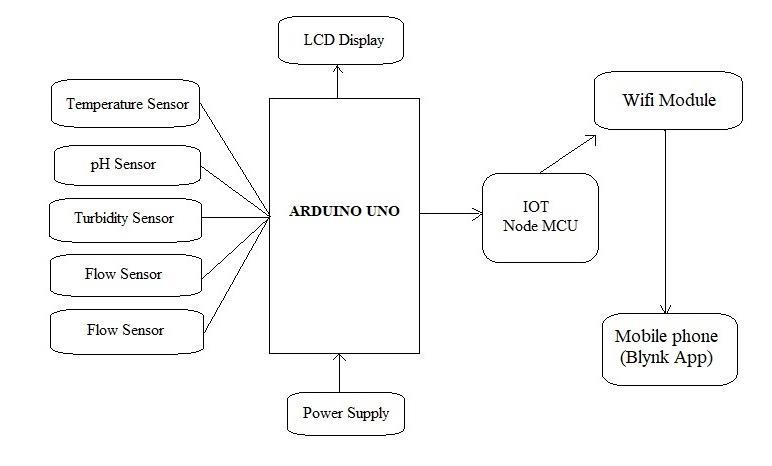
Fig-1:BlockDiagram
Temperature, Turbidity, And Tds
In order to detect unintentional or intentional water contamination, this study describes an Arduino-based monitoring system that examines four physicochemical water parameters: pH, temperature, turbidity, and Total DissolvedSolids(TDS).Thesystemconsists oftwo nodes: the sink node and the sensor node. The sensor node manages LCD data presentation, pre-processing, and data collection.Thesinknodeperformsdatareceivingfromthe sensor node, data display on an LCD, and alert systems utilizing a buzzer when it is decided that the water is
The system's block diagram is displayed in Figure 1. An Arduino UNO microcontroller board, input, and output make up the system. The Arduino board, which is also connected to the output devices, its serial monitor, and a Blink App inventor-based mobile application that is connected to a Wifi module, are used to display the viewer's digitally altered data. Analog data is sent from sensors to the ArduinoUNO microcontroller. Throughthe wifi module, the Arduino transfers the data to the mobile applicationinareadabledigitalformat.Italsoshowsiton the Arduino's serial monitor. Figure 1 above depicts the entire block diagram for the current project, which comprises the 16x2 LCD display, IOT or wifi module, power supply, PH, temperature, and turbidity sensors, as wellasthecontrollerunit.
Here, analog signals from the temperature, pH, turbidity, and flow sensors are sensed from the water supply and senttothemicrocontroller.Theseanalogimpulsesarefed into the ArduinoUNO, whichtransforms them intodigital
International Research Journal of Engineering and Technology (IRJET) e-ISSN:2395-0056
Volume: 11Issue:04|Apr2024 www.irjet.net p-ISSN:2395-0072
signals that are shown in real time on the Arduino IDE monitor. The Wifi module, which transmits the data to a mobile application called blynk app that displays the leakagemetricsandreal-timevariationsinwaterquality.
4. EXPERIMENTAL RESULTS
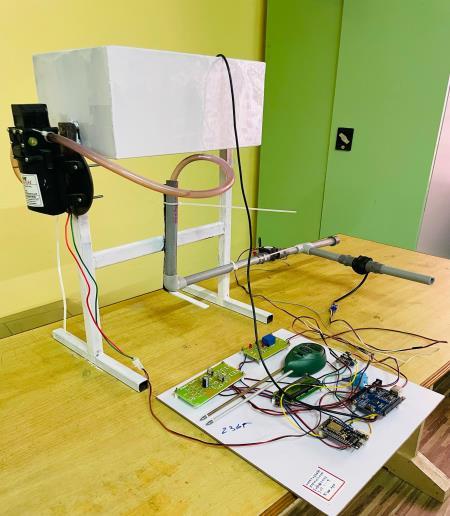
1. Incorporating all of the sensors pH, temperature, turbidity and flow into the pipe line network and samplingthewater.
2. This prototype indicates how each component is connected.
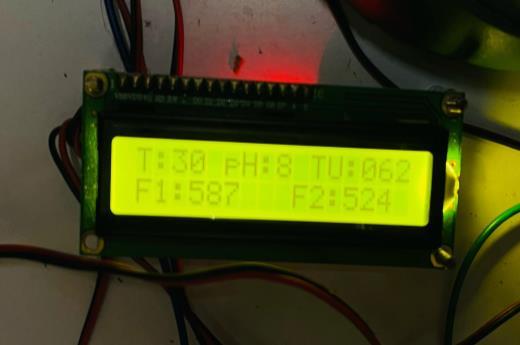
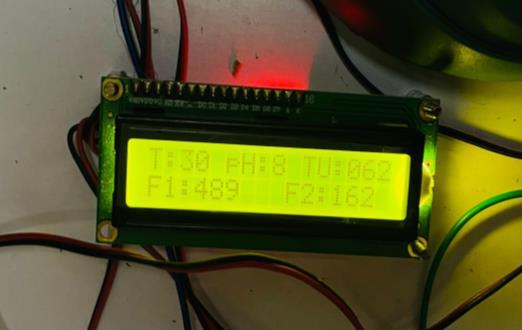
3. Turn the power source on and the LCD screen will showtheparametervalues.
4. Threshold value for each parameter is set in the sourcecode.Waterisconsideredcontaminatedifany oftheparametervaluesarehigherthanthethreshold value.
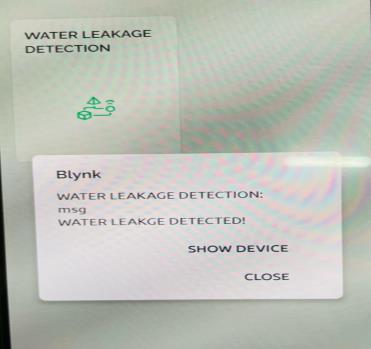
5. Flow sensors would independently measure flow rate,andtheirreadingscouldbecomparedtoensure consistency. If there's a discrepancy between the readings,itcouldindicatea potentialleakinpipeline network
6. Theuserwillthenreceivethe alertmessageinblynk app when leakage is detected with the assistance of Wifimodule
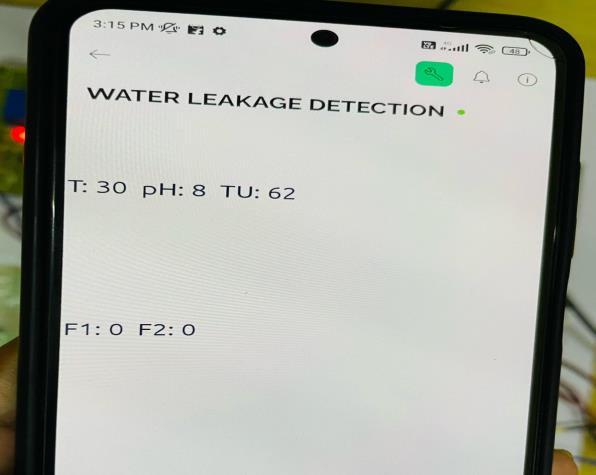
:ParametersvalueshowninBlynkApp
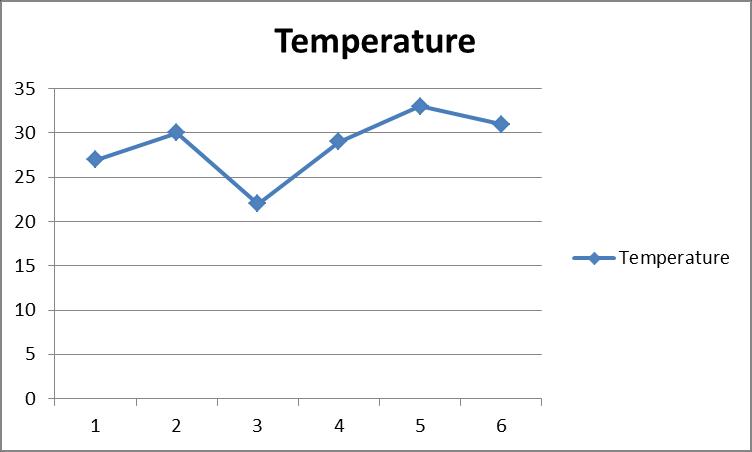
-4: Temperaturevariationsofdifferentwatersamples
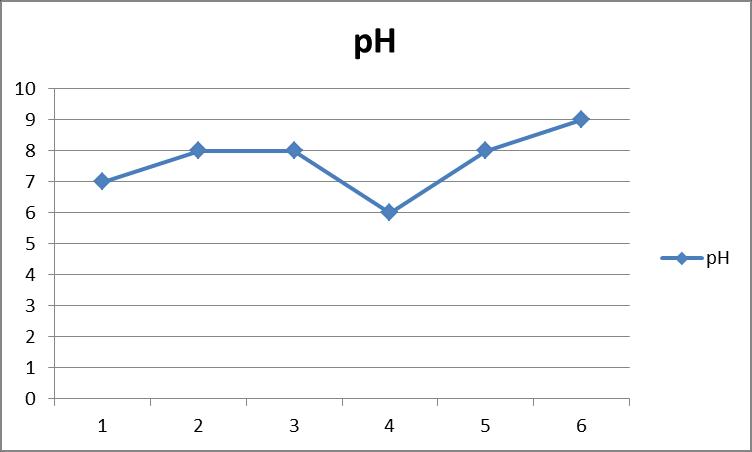
-5: pHvaluesofdifferentwatersamples
International Research Journal of Engineering and Technology (IRJET) e-ISSN:2395-0056
Volume: 11Issue:04|Apr2024 www.irjet.net p-ISSN:2395-0072
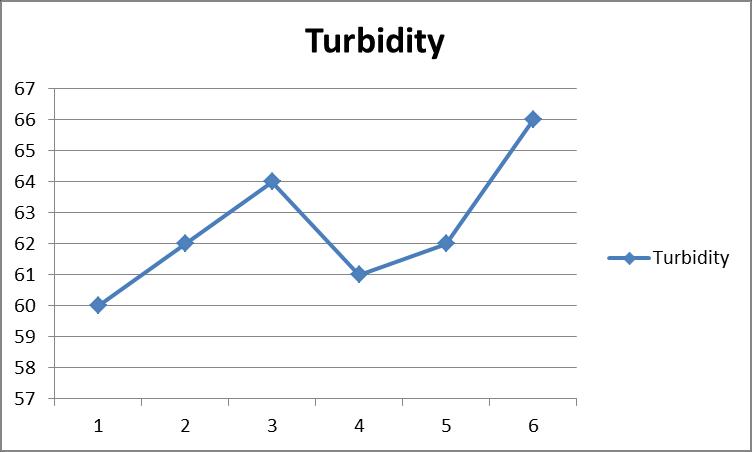
4.2Leakage Detection
Utilizing the already-existing GSM network and a water detection sensor with a special advantage, turbidity, PH, temperature, and water leakage are all monitored. The system is inexpensive, self-sufficient, and capable of autonomously monitoring the quality of the water obligation. Therefore, it is likely to be faster, easier, and less expensive to test the water quality. There is good flexibility in the system. This device can only be used to monitoradditionalwaterqualitymetricsbyswappingout the appropriate sensors and updating the necessary software. The process is easy to follow. It is possible to expand the system to monitor hydrologic conditions, air pollution, industrial and agricultural output, and other aspects.Itsapplicationandextensionvalueareextensive. Maintaining embedded devices in the surroundings for observation allows the environment to protect itself (smart environment). In order to put this into practice, sensor devices must be placed throughout the environment to gather and analyze data. Sensor devices allowus to bring the environment to life by allowing it to communicate with other items over a network, thereby bringing it closer to reality. The end user will then have accesstothegathereddataandanalysisfindingsviaWi-Fi.
[1] Allen T Chafa, Gibson p Chirinda, Stephen Matope,”Design of a real-time water quality monitoring and control system using internet of things (IOT)”,November 2022
[2] Ankit Anilkumar Maroli, Vaibha S. Narwane, Rakesh D. Raut, Balkrishna E.Narkhede,”Framework for the implementation of an internet of things (IOT)‑ based water distribution and management system”, October2020
[3] Dr D Mahesh Kumar, T Jagadeep,”Water pipeline leakage detection and monitoring system using smart sensorwithIOT”,2022
[4] Ermiyas Birihanu Belachew, Mebiratu Beyene, Birtukan Adamu,”Intelligent water quality monitoring usingwsnandmachinelearningapproaches”,May2023
[5] Juma S. Tina, Beatrice B. Kateule, and Godfrey W. Luwemba,”Water leakage detection system using arduino”,Jan2022