
International Research Journal of Engineering and Technology (IRJET) e-ISSN: 2395-0056
Volume: 11 Issue: 04 | Apr 2024 www.irjet.net p-ISSN: 2395-0072
International Research Journal of Engineering and Technology (IRJET) e-ISSN: 2395-0056
Volume: 11 Issue: 04 | Apr 2024 www.irjet.net p-ISSN: 2395-0072
Saloni Raorane1 , Kirti Singh2 , Sakshi Tawte3 , Vidhi Shiste4 , Jyoti Bansode5 , Ashvini Ahirrao6 ,
1Shah and Anchor Kutchhi Engineering College, Maharashtra, India
2Shah and Anchor Kutchhi Engineering College, Maharashtra, India
3Shah and Anchor Kutchhi Engineering College, Maharashtra, India
4Shah and Anchor Kutchhi Engineering College, Maharashtra, India
5Assistant Professor, Dept. of Information Technology, Shah and Anchor Kutchhi Engineering College, Maharashtra, India
6Assistant Professor, Dept. of Information Technology, Shah and Anchor Kutchhi Engineering College, Maharashtra, India
Abstract - Agriculture farming is an important sector for each country's growth. Many technologies like MLandDLare being implemented for farmers for the growth of crops. This research paper presents a novel approach to address this challenge by integrating crop recommendation with plant disease detection. Leveraging machine learning and image processing techniques, our system aims to provide farmers with intelligentdecisionsupportforcropselectionanddisease management. The methodology involves the collection of extensive datasets comprising crop information, soil conditions, climate data, and images of plant diseases. Deep learning models like RESNET models are employed for accurate disease detection from these images, while decision support algorithms analyze multiple factors to recommend suitable crops based on local conditions and disease prevalence. The results of our study demonstrate promising accuracy in disease detection and effectiveness in crop recommendation,thusofferingapracticalsolutiontoenhance agricultural productivity and sustainability. This research contributes to the advancement of precision agriculture and underscoresthepotentialoftechnology-drivenapproachesto address critical challenges in food security and agricultural sustainability.
Key Words: Deep Learning, Random Forest, Logistic Regression, Feature Extraction, Accuracy.
1.INTRODUCTION
Agricultureisthefoundationofglobalfoodsecurity,butit facessignificantdifficultiessuchaschangingenvironmental conditions and the ongoing danger of plant diseases. In recentyears,theuseoftechnologyintoagriculturalmethods has shown considerable promise for tackling these difficulties. One such novel strategy is the combination of croprecommendationsystemsandplantdiseasedetection methods. Using machine learning, image processing, and dataanalytics,thisstudyaimstocreateaholisticsystemthat providesfarmerswithintelligentdecisionsupporttoolsfor cropselectionanddiseasecontrol.Traditionally,agricultural practices rely on subjective assessments and historical
knowledge,whichmaynotalwaysbeaccurateortakemore time to detect the emerging threats like plant diseases. In CropRecommendation,variousfactorssuchastemperature, soil nutrient levels (nitrogen, phosphorus, potassium), humidity, and pH are considered to assist farmers in selecting suitable crops for specific land plots. Utilizing advancedrecommendationtools,farmerscananticipatethe most appropriate crops to cultivate based on these environmental parameters. In Plant Disease Detection, farmers can upload images of their plants to identify potential diseases and monitor their plant health. This methodenablesfarmerstopromptlydiagnoseplantdiseases and track the types of diseases affecting their crops. Furthermore,thescalabilityandadaptabilityoftheproposed systemholdthepotentialtodrivesustainableagricultural practicesandenhancefoodsecurityonaglobalscale.
In,"Crop Recommender System Using Machine Learning Approach",itincludes76-90%accuracyinassessingweather impacts on crops in Madhya Pradesh. Another system comparedsupervisedandunsupervisedlearningmethodsto predict yields and recommend fertilizers based on soil quality.Decisiontreeclassifiersandrandomforestmodels havealsobeenexplored,alongsideclusteringtechniquesfor improved accuracy. The current paper builds on these previoussystemstoadvancecropyieldpredictionfurther[1].
In "Improving Crop Productivity Through A Crop Recommendation System Using Ensembling Technique" (Kulkarnietal.,2018),anensemblemodel isdevelopedto recommendoptimalcropsbasedonsoildata.Bycombining multiplemodels,suchasRandomForestandNaiveBayes,the system achieves 99.91% accuracy in classifying crops for KharifversusRabigrowingseasons.Thisapproachaimsto boostagriculturalproductivitybyofferingtailoredguidance tofarmersregardingsuitablecropsfortheirsoilconditions. Further advancements in predictive farming systems hold promiseforbenefitingfarmersandthewidereconomy[2].In "Prediction of Crop Yield and Fertilizer Recommendation Using Machine Learning Algorithms" (Bondre &
International Research Journal of Engineering and Technology (IRJET) e-ISSN: 2395-0056
Volume: 11 Issue: 04 | Apr 2024 www.irjet.net p-ISSN: 2395-0072
Mahagaonkar,2019),SoilnutrientdataisutilizedbyRandom Forest and Support Vector Machine (SVM) algorithms to categorizesoilsandestimateyieldsforcropslikerice,wheat, andsoybeans.TheSVMmodelachieves99.47%accuracyfor yieldforecasting,surpassingRandomForest.Moreover,the system offers location-based weather data and suggests optimal fertilizers for selected crops [3].In Using Deep Learning for Image-Based Plant Disease Detection, it demonstrates the use of deep convolution networks to accurately identify plant diseases from images. It uses PlantVillagedatasetofover54,000labeledimagescontaining 14cropspeciesand26diseasemodelsthatweretrainedto classifycrop-diseasepairs.Thebestmodelachieved99.35% accuracyonthetestdata,However,theperformancedropped onreal-worldimagestakenundervariableconditions[4]. In "Plant Disease and Classification by Deep Learning," deep learning methods are employed to accurately identify leaf diseases. The dataset comprises a substantial collection of imagesdepictingvariousdiseases.Toenhanceaccuracy,the study utilizes techniques such as data augmentation, visualization, and transfer learning. Furthermore, the significance of hyper-spectral imaging for plant disease detectionisdiscussed[5].Inthepapertitled"KrishaRakshan -AMachineLearningBasedNewRecommendationSystem for Farmers," a novel machine learning-based recommendation system named KrishaRakshan is introduced,aimed at enhancing farmers' productivity. The system employs the XGBoost algorithm to predict suitable crops based on soil nutrients and rainfall, while utilizing RandomForestforfertilizerrecommendation.Additionally, MobileNetisutilizedfordetectingplantdiseasesfromleaf images. Moreover, the system contributes to soil fertility improvement. Notably, the model achieves high accuracy rates of 99% for crop prediction, 95.7% for fertilizer recommendation, and 92% for disease detection. By providing personalized recommendations, the system aids farmers in enhancing yields sustainably, steering clear of excessivefertilizerusethatcanleadtosoildegradation.The proposed system surpasses existing methods and offers a user-friendlytoolforfarmerstoenhanceproductivity[6].In the research on "Deep Learning-based Plant Leaf Disease Detection,"CNN,VGG16,andVGG19modelsareexaminedfor theirefficacyinidentifyingplantleafdiseases.Thedataset comprises 9,000 images representing 8 types of diseases. CNN emerges as the top performer, achieving an accuracy and recall rate of 97%. Its architecture enables effective learning of relevant features from the images. Among the architectures evaluated, VGG16 demonstrates the highest precisionandscore.Thestudyunderscoresthecapabilityof deeplearningtechniquestoautomatediseaseidentification from leaf images accurately, offering a potential means to enhancecrophealthandyields[7].Inthepaper,Cropand FertilizerRecommendationtoImproveCropYieldusingDeep Learning, the system's development stages include data collection, pre-processing, model generation, and user interface development. These phases necessitate considerable investments in infrastructure and data
collecting, as well as skill in deep learning model development and training. The system's successful implementation,whichresultedinhigheryields,increased nutrient utilization rates, and lower fertilizer costs for suggestedcrops,demonstratesitseffectivenessinincreasing agriculturalproductivity,mitigatingenvironmentaldamage, andimprovingagriculturaleconomicsustainability[8].
ThecroprecommendationdatasetiscollectedfromKaggle which consists of 7 data fields or attributes which are Nratio of Nitrogen content in soil, P - ratio of Phosphorus content in soil, K - ratio of Potassium content in soil, temperature in degree Celsius, relative humidity in %, ph valueofthesoil,rainfallinmm.Eachattributeismeasured usingsuitableinstrumentsormethodologiestoensuredata accuracy and consistency throughout the dataset. By combininginformationonsoilnutrients,climate,andrainfall, the dataset provides a robust foundation for developing predictivemodelsthatcanassistfarmersinmakingstrategic decisionsaboutcropselectionandagriculturalpractices.The dataset'sfocusontheIndianagriculturalcontextenhancesits applicability to regional farming scenarios, contributing to thebroaderlandscapeofprecisionagricultureresearchand application. An extensive dataset of crop images was amassed, featuring both healthy specimens and those afflictedbyvariousdiseases.Theaimwastocreatealarge and varied collection, covering various types of crops and issues.TheimageswereprocuredfromKaggle,arenowned platformfordatasetsandmachinelearningresources.Post data acquisition, rigorous efforts were undertaken to preprocesstheimages,ensuringuniformityintermsofsize, color, and brightness for enhanced model comprehension. Additionally,weaddedlabelstoinformthemodelaboutthe croptypeandthepresenceofdiseasesineachpicture.This approach enables our model to learn effectively from the dataset,contributingtoabetterunderstandingofcrophealth anddiseasesinourresearch.
Following the preparation of our dataset, the subsequent phaseinvolvesthejudiciousselectionofanappropriatedeep learningmodelfortrainingwiththecurateddataset.Inthe contextofimageclassificationtasksrelevanttoourdisease prediction and crop recommendation project, several distinguisheddeeplearningmodels,suchasConvolutional NeuralNetworks(CNNs),ResNet,andVGGNet,areavailable, each renowned for its unique strengths. In our specific pursuit of disease prediction, we have opted for the utilizationofResNet.Thisarchitecturalselectionisinformed by ResNet's established efficacy in capturing intricate features within images, particularly advantageous for discerningnuancedpatternsassociatedwithcropdiseases.
International Research Journal of Engineering and Technology (IRJET) e-ISSN: 2395-0056
Volume: 11 Issue: 04 | Apr 2024 www.irjet.net p-ISSN: 2395-0072
Likewise,forthecroprecommendationfacetofourproject, weemployedatailoredmodelspecificallycraftedtoaddress the intricacies of crop-specific recommendations. The trainingprocessissystematic,involvingtheprovisionofpreprocessedimagesalongwiththeircorrespondinglabelsto theselectedmodel.Throughthisiterativetrainingprocess, themodelundergoesalearningphase,whereinitacquires theabilitytodiscriminatebetweenvariouscropspeciesand detect the presence of diseases within each image. This trainingphaseispivotal,asitempowersthemodelwiththe requisite insights to make precise predictions and recommendations. By implementing ResNet for disease prediction and employing a specialized model for crop recommendation, our research endeavors to leverage the distinctive strengths of these architectures to achieve optimal performance in the dual tasks of identifying crop diseases and recommending suitable crops. This strategic approachalignswiththeoverarchingobjectiveofadvancing agricultural practices through the integration of sophisticateddeeplearningmethodologies.
InResNet,featureextractionhappensthroughaprocessakin topatternrecognition.Imagineyou'relookingatacomplex image,likeascenewithvariousobjects.Atthestartofthe ResNet,therearelayersthatserveasfilters.Thesefiltersact like different lenses, each looking for specific patterns or features within the image, such as edges, textures, or shapes.Astheimagepassesthroughtheselayers,thefilters detect increasingly complex patterns. Early layers might detect simple features like lines or colors, while deeper layersdetectmoreabstractfeatureslikeshapesortextures ofobjects.ThemagicofResNetliesinitsabilitytolearnand adapt.Itdoesn'tjustpassivelyanalyzetheimage;itactively adjusts its filters based on what it learns. This learning process is facilitated by what are called "residual connections."Theseconnectionsallowthenetworktoskip overcertainlayersif needed,makingthelearningprocess moreefficientandenablingthenetworktodelvedeeperinto understanding the image. Additionally, there are pooling layers interspersed throughout the network. These layers serve to condense the information gathered from the previouslayers,makingitmoremanageablewhileretaining the most essential featuresBy the time the image has traversed through all thelayersoftheResNet,ithas been broken down into a set of highly abstract features that capture the essence of what the image contains. These features can then be used for various tasks like image classification,objectdetection,orimagegeneration.Overall, featureextractioninResNetisacomplexyetelegantprocess that mimics how our brains interpret visual information, breakingdownimagesintomeaningfulcomponentsthatcan beusedtounderstandandinterprettheworldaroundus.
Weassessedtheperformanceofsixchosenmodelsonthe testingset,examiningmetricslikemodelaccuracyforCrop Recommendation.Wealsoutilizedvisualizationtools,such asbargraphstogaininsightsintomodelperformanceand identify potential areas for improvement. So as Table I. showsthealgorithmRandomForesthavingahighaccuracy of 0.99 was used to create the model for crop recommendation.
Table-1: Thistableshowstheevaluatedresultsof performancefactorsofthealgorithm(s).
Name Accuracy
NaïveBayes 0.990909090909091
SVM 0.10681818181818181
DecisionTree 0.9
XGBoost 0.990909090909091
RandomForest 0.990909090909091
LogisticRegression 0.9522727272727273
For Plant Disease Detection, we utilized the ResNet algorithm as we had an image dataset to model. ResNet, short for Residual Network, is a type of artificial neural network architecture designed primarily for image recognitiontasks,knownforitsdeepstructurewiththeuse ofresidualblocks.Wetrainedthemodelfor20epochs,and theaccuracyobtainedafterusingthisalgorithmwas0.9479. Additionally, we employed visualization tools such as bar graphs and line graphs to gain insights into the model's performance.
Intherealm,thefocusisonpresentingcomplexagricultural data in a visually intuitive and comprehensible manner. Utilizing various techniques such as charts, graphs, and maps,therelationshipsbetweendifferentfactorsinfluencing crop growth and yield can be effectively conveyed. Visual representationsofsoilnutrientlevels,weatherpatterns,and crophealthindicatorsallowstakeholderstoidentifytrends, patterns, and correlations that may not be immediately apparent from raw data alone. Furthermore, interactive visualizationtoolsenableuserstoexploreandanalyzethe data dynamically, fostering deeper insights and informed decision-making in agricultural practices. Through thoughtfulandinformativedatavisualization,thesystems can empower farmers and agricultural professionals to optimizecropselection,improveproductivity,andenhance sustainabilityinfarmingpractices.
International Research Journal of Engineering and Technology (IRJET) e-ISSN: 2395-0056
Volume: 11 Issue: 04 | Apr 2024 www.irjet.net p-ISSN: 2395-0072
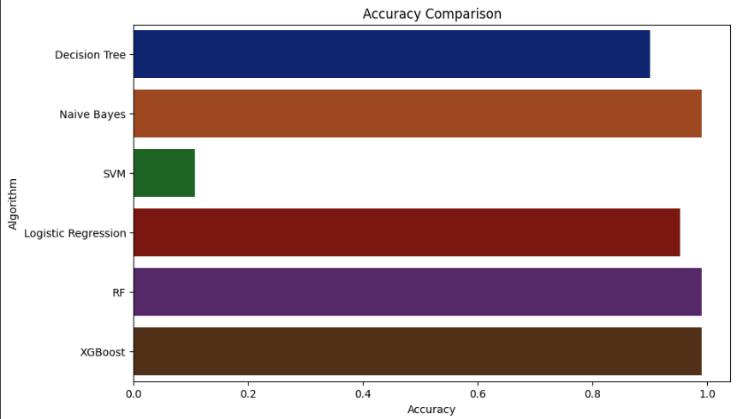
-1:AccuracyforCropRecommendationmodels
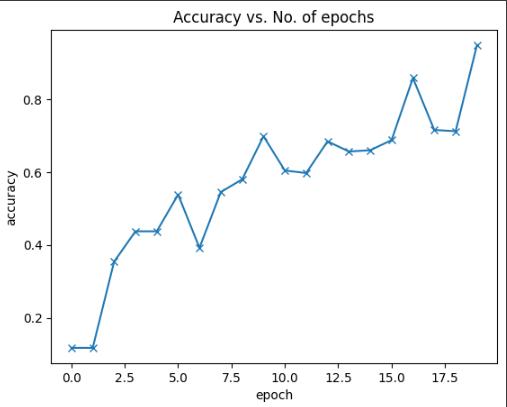
Chart -2:Linechartforaccuracygainedatdifferent epochsforPlantDiseaseDetectionmodel
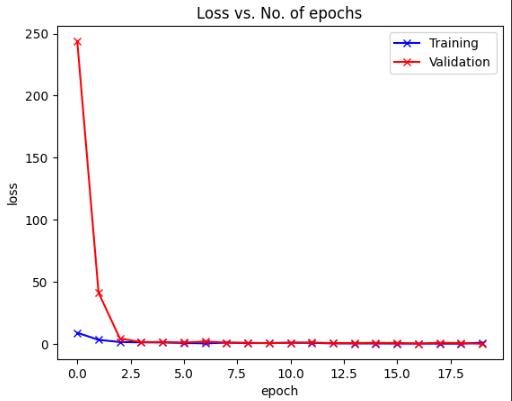
Chart -3:LosscausedatdifferentepochsforPlantDisease Detectionmodel
Thisstudyshowcasestheeffectivenessofmachinelearning (ML) algorithms in crop recommendation and disease detectioninagriculture.NaiveBayes,XGBoost,andRandom Forest models offer high accuracies, providing valuable insightsforfarmers.TheintegrationofaspecializedRESNET modelfordiseasedetectionunderscorestheimportanceof
tailored approaches. However, the lower accuracy of the SupportVectorMachine(SVM)modelsuggeststheneedfor further investigation. Overall, this research highlights the transformativepotentialofMLinagriculture,emphasizing collaboration between agricultural experts and data scientistsforoptimalresults
This study looks at the efficacy of machine learning algorithmsforcroprecommendationanddiseasedetectionin agriculture. ML algorithms like Naive Bayes, XGBoost, RandomForest,LogisticRegression,andDecisionTreewere tested.Additionally,fordiseasediagnosis,aRESNETmodel wasused.Theaccuracyrateswereasfollows:NaiveBayes, XGBoost, and Random Forest achieved the greatest 99% accuracy,followedbyLogisticRegressionat95%.Decision Tree had an accuracy of 90%, while SVM had the lowest accuracyat10%.
[1]S.M.Pande,P.K.Ramesh,A.Anmol,B.R.Aishwarya,K. RohillaandK.Shaurya,"CropRecommenderSystemUsing Machine Learning Approach," 2021 5th International Conference on Computing Methodologies and Communication(ICCMC),Erode,India,2021,pp.1066-1071, doi:10.1109/ICCMC51019.2021.9418351.
[2] N. H. Kulkarni, G. N. Srinivasan, B. M. Sagar and N. K. Cauvery, "Improving Crop Productivity Through A Crop Recommendation System Using Ensembling Technique," 2018 3rd International Conference on Computational Systems and Information Technology for Sustainable Solutions(CSITSS),Bengaluru,India,2018,pp.114-119,doi: 10.1109/CSITSS.2018.8768790.
[3] Bondre, Devdatta & Mahagaonkar, Santosh. (2019). Predictionofcropyieldandfertilizerrecommendationusing Machine Learning algorithms. International Journal of EngineeringAppliedSciencesandTechnology.04.371-376. 10.33564/IJEAST.2019.v04i05.055.
[4]Author=MohantySharadaP.,HughesDavidP.,Salathé MarcelTITLE=UsingDeepLearningforImage-BasedPlant Disease Detection JOURNAL=Frontiers in Plant Science VOLUME=7YEAR=2016DOI=10.3389/fpls.2016.01419 ISSN=1664-462X
[5]L.Li,S.ZhangandB.Wang,"PlantDiseaseDetectionand ClassificationbyDeepLearning AReview,"inIEEEAccess, vol. 9, pp. 56683-56698, 2021, doi: 10.1109/ACCESS.2021.3069646.
[6]D.N.V.S.L.S.Indira,M.Sobhana,A.H.L.SwaroopandV. PhaniKumar,"KRISHIRAKSHAN-AMachineLearningbased New Recommendation System to the Farmer," 2022 6th
International Research Journal of Engineering and Technology (IRJET) e-ISSN: 2395-0056
Volume: 11 Issue: 04 | Apr 2024 www.irjet.net p-ISSN: 2395-0072
International Conference on Intelligent Computing and Control Systems (ICICCS), Madurai, India, 2022, pp. 17981804,doi:10.1109/ICICCS53718.2022.9788221.
[7]K.ShivaprasadandA.Wadhawan,"DeepLearning-based Plant Leaf Disease Detection," 2023 7th International ConferenceonIntelligentComputingand Control Systems (ICICCS), Madurai, India, 2023, pp. 360-365, doi: 10.1109/ICICCS56967.2023.10142857.
[8] R. Thendral and M. Vinothini, "Crop And Fertilizer Recommendation to Improve Crop Yield using Deep Learning," 2023 Second International Conference on Electronics and Renewable Systems (ICEARS), Tuticorin, India, 2023, pp. 1123-1130, doi: 10.1109/ICEARS56392.2023.10085054.
© 2024, IRJET | Impact Factor value: 8.226 | ISO 9001:2008
| Page