
International Research Journal of Engineering and Technology (IRJET) e-ISSN: 2395-0056
Volume: 11 Issue: 04 | Apr 2024 www.irjet.net p-ISSN: 2395-0072
International Research Journal of Engineering and Technology (IRJET) e-ISSN: 2395-0056
Volume: 11 Issue: 04 | Apr 2024 www.irjet.net p-ISSN: 2395-0072
Prof. M. P. Shinde 1 , Shreyash Dhurupe 2 , Viraj Karanjavane 3 , Sanna Shaikh4 , Abhishek Suryawanshi5
1Professor, Department of Computer Engineering, SKNCOE, Savitribai Phule Pune University, Pune 411041, India 2,3,4,5Undergraduate Students, Department of Computer Engineering, SKNCOE, Savitribai Phule Pune University, Pune 411041, India
Abstract – This paper introduces a novel Android application that aims to greatly enhance the safety and autonomy of visually impaired people when they navigate their surroundings. The application uses cutting-edge object detection algorithms in conjunction with technologies for recognizing traffic signs to give users auditory feedback in real-time. Users can enjoy a safer and more informed navigation experience Our aim is to incorporate advanced image captioning capabilities along with improved audio output features, with the goal of offering a more comprehensive and contextualized auditory depiction of the user's environment. This proposed update aims to change how blind people engage with their surroundings by providing a more complex and all-encompassing perception oftheirimmediatevisualcontext.
Key Words: Object Detection, Convolutional Neural Networks (CNN), Long Short-Term Memory (LSTM), ImageCaptioning,YOLOV3,COCODataset
1.INTRODUCTION
Advances in artificial intelligence (AI) and machine learning have created new opportunities in the rapidly developing field of assistive technologies to improve the quality of life for those who are visually impaired. The development of apps that convert visual dataintoauditoryinformationhasbeenmadepossible by these technological advancements, giving visually impaired people more autonomy and security when navigatingandunderstandingtheirenvironment. Tomeet the specific needs of this community, this paper presents an innovative Android application that focuses on realtime object detection and traffic sign recognition from uploaded images. This application's dual-functional strategyisatitscoreandaimstoimproveuserexperience by offering customized help according to need and context. This system's first feature uses state-of-the-art object detection technology to recognize and announce in real-time the presence of objects in the user's immediate surroundings.Thisfeatureisessentialforbothindoorand outdoor navigation as it aids users in avoiding obstacles andnavigatingareaswithgreaterassuranceandsafety.
A crucial part of urban navigation for visually impaired peopleiscomprehendingandinteractingwithtrafficsigns, which is covered in detail in the second aspect. Users can upload images from their gallery for analysis using this feature, unlike real-time object detection. After that, the application finds any traffic signs in these pictures and plays audio descriptions of them. This ability is especially helpful for understanding complicated crossroads, creating route plans, and improving mobility in general when outdoors. The creation of this application marks a substantial advancement in the integration of artificial intelligence, computer vision, and auditory feedback to make the world more approachable and comprehensible for people with visual impairments. With an emphasis on immediatesupportandin-depth examinationofuploaded photos,theapplicationprovidesaflexibletoolthattackles a variety of issues that its users encounter daily. This introduction lays the groundwork for an in-depth examination of the development of the application, covering everythingfrom thetechnical implementation to the user-centered design and conceptual foundations. It seeks to demonstrate the possibilities for these cuttingedge applications to improve visually impaired people's mobility and safety while also giving them more independence and opportunities to interact with their surroundings.
As we continue to explore the frontiers of assistive technologies, the incorporation of image captioning has great potential to improve visually impaired people's perception. Although the real-time object detection and trafficsignrecognitionfeaturesofourAndroidapplication are its primary focus, the exciting prospect of image captioning technology integration in the future will allow us to further enhance its functionality. Thanks to developments in natural language processing and computer vision, image captioning algorithms can now provide comprehensive textual descriptions of visual scenes. These algorithms provide users with a deeper understanding of their surroundings by generating captions that convey important details and relationships withinthescenebasedontheiranalysisofthecontentand context of images. The incorporation of image captioning is a compelling future direction for our application.
International Research Journal of Engineering and Technology (IRJET) e-ISSN: 2395-0056
Volume: 11 Issue: 04 | Apr 2024 www.irjet.net p-ISSN: 2395-0072
Throughtheabilityforuserstotakeoruploadphotosand get insightful textual comments, we can provide a more complete and sophisticated view of their surroundings. For visually impaired users, this feature may improve navigation, spatial awareness, and general interaction withthevisualenvironment.
Areal-timeobjectdetectionalgorithmcalledYOLOv3(You Only Look Once, Version 3) can recognize particular objects in pictures, videos, or live feeds. The YOLO machinelearningalgorithmlocatesobjectsinanimageby using features that a deep convolutional neural network haslearned.YOLOversions1-3weredevelopedbyJoseph RedmonandAliFarhadi;thethirditerationofthemachine learning algorithm is the most accurate of the initial ML algorithm. In 2016, Joseph Redmon and Ali Farhadi developed the initial iteration of the YOLO algorithms. Two years later, in 2018, the two released Version 3. An enhancedformofYOLOandYOLOv2iscalledYOLOv3.The Keras or OpenCV deep learning libraries are used to implementYOLO.
OLO is a real-time object detection system that uses a Convolutional Neural Network (CNN), a type of deep neural network. CNNs are classifier-based systems that identify patterns in input images by processing them as structured arrays of data. YOLO has the advantage of maintaining accuracy while operating at a much faster speed than other networks. It makes it possible for the objectdetectionmodeltoexaminetheentireimageduring testing. This indicates that the predictions are influenced by the image's global context. Regions are "scored" by YOLO and other convolutional neural network algorithms according to how similar they are to predefined classes. Positive detections of the class that the high-scoring regions most closely resemble are reported. For instance, YOLOcanbeusedinfootageofself-drivingcarstoidentify various
TheCOCO(CommonObjectsinContext)datasetisalargescale object detection, segmentation, and captioning dataset. It is designed to encourage research on a wide variety of object categories and is commonly used for benchmarking computer vision models. It is an essential dataset for researchers and developers working on object detection,segmentation,andposeestimationtasks.
Out of the 330K images in COCO, 200K have annotations for tasks like object detection, segmentation,andcaptioning.
Eighty object categories make up the dataset; these include more specialized categories like handbags, sports equipment, and umbrellas as wellasmorecommononeslikecars,bicycles,and animals.
Eachimagehasacaption,segmentationmask,and object bounding boxes included in the annotations.
COCO is a useful tool for comparing model performance because it offers standardized evaluation metrics such as mean Average Precision (mAP) for object detection and mean AverageRecall(mAR)forsegmentationtasks.
Our suggested mobile application system consists of two separate modules: one for traffic sign recognition from uploaded images and the other for real-time object detection using Google's ML Kit. Users can effortlessly switchbetweenfunctionalitiesbasedon theirpreferences andimmediateneedsthankstothismodulararchitecture. Using real-time object detection on live camera feeds, the object detection module makes use of Google's ML Kit, a robust collection of machine learning tools and APIs. This module enhances the user's visual experience and opens up a plethora of interactive applications by rapidly and accurately identifying different objects in their environment by utilizing pre-trained models and ondevice processing capabilities The traffic sign identificationmodule,ontheotherhand, providesa more methodical and concentrated approach to environmental perception. Users have the option to upload pictures of trafficsignsfromtheirgallery.Thesignsarethendetected and categorized by sophisticated computer vision algorithms. This feature is especially helpful for route planning,identifyinghazards,andadheringtotrafficlaws.
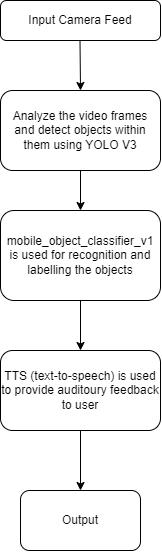
In the proposed system, the workflow begins with capturing a live feed from the device's camera. This live feed serves as the input for the object detection process. Once the camera feed is obtained, the YOLO V3 algorithm is utilized to analyze the video frames and detect objects withinthem.
YOLO is a state-of-the-art object detection algorithm known for its speed and accuracy. It divides the input image into a grid and predicts bounding boxes and class probabilities for objects present in each grid cell. This approach allows YOLO to detect multiple objects in real-
International Research Journal of Engineering and Technology (IRJET) e-ISSN: 2395-0056
Volume: 11 Issue: 04 | Apr 2024 www.irjet.net p-ISSN: 2395-0072
time with a single forward pass through the neural network. After YOLO has detected objects within the camera feed, the detected objects are passed on to Google's ML Kit for further analysis and labeling. ML Kit provides pre-trained machine learning models for enabling the recognition and labeling of various objects withinthecamerafeed.OncetheobjectsarelabeledbyML Kit,thesystemutilizesText-to-Speech(TTS)technologyto provideauditoryfeedbacktotheuser.Thelabelsassigned by ML Kit are converted into speech by the TTS engine. This auditory feedback allows users to perceive and understand the objects detected in the camera feed without relying on visual cues. Overall, this workflow seamlessly integrates live object detection using YOLO, object labeling with ML Kit, and auditory feedback with TTStechnologytoprovideuserswithreal-timeawareness oftheirsurroundingsthroughtheirdevice'scamerafeed. Fig -1:Real-TimeObjectDetectionModule
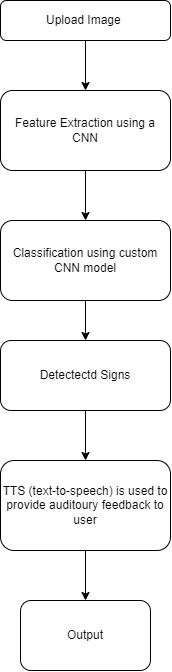
Usersinitiatetheprocessbyselectinganimagecontaining atrafficsignfromtheirdevice'sfilesorgallery.Thisimage serves as the input for the traffic sign detection module. Our system employs a custom Convolutional Neural Network (CNN) model specifically trained for traffic sign detection. The CNN architecture is designed to extract intricate features from images and perform classification tasks accurately. The custom CNN model is trained on a meticulously curated dataset comprising images of traffic signsbelongingtofiveclasses:"fifty,""left,""right,""stop," and "thirty." This dataset includes diverse examples of each class to ensure the model's ability to generalize and accuratelyclassifytrafficsignsinvariousconditions.Upon uploading an image, the custom CNN model performs feature extraction by analyzing the image's pixel values. The convolutional layers of the CNN identify and extract relevant patterns and features indicative of traffic signs. Subsequently, these features are passed through the classification layers of the CNN, where the model assigns probabilitiestoeachclassbasedonlearnedfeatures.After feature extraction and classification, the system determinesthedetectedtrafficsignbyanalyzingtheclass probabilities assigned by the CNN model. The class with the highest probability is selected as the predicted traffic sign. Once the traffic sign is identified, the system generates output in audio form using Text-to-Speech (TTS) technology. The detected traffic sign's label (e.g., "fifty," "left," "right," "stop," or "thirty") is converted into synthesized speech by the TTS engine. The synthesized speech, containing the label of the detected traffic sign, is delivered to the user as auditory feedback. This auditory feedback mechanism ensures that users receive essential information about the detected traffic sign audibly, enabling them to stay informed and make informed decisionswhilenavigatingtheirenvironment.
International Research Journal of Engineering and Technology (IRJET) e-ISSN: 2395-0056
Volume: 11 Issue: 04 | Apr 2024 www.irjet.net p-ISSN: 2395-0072
3.3 Mobile Application
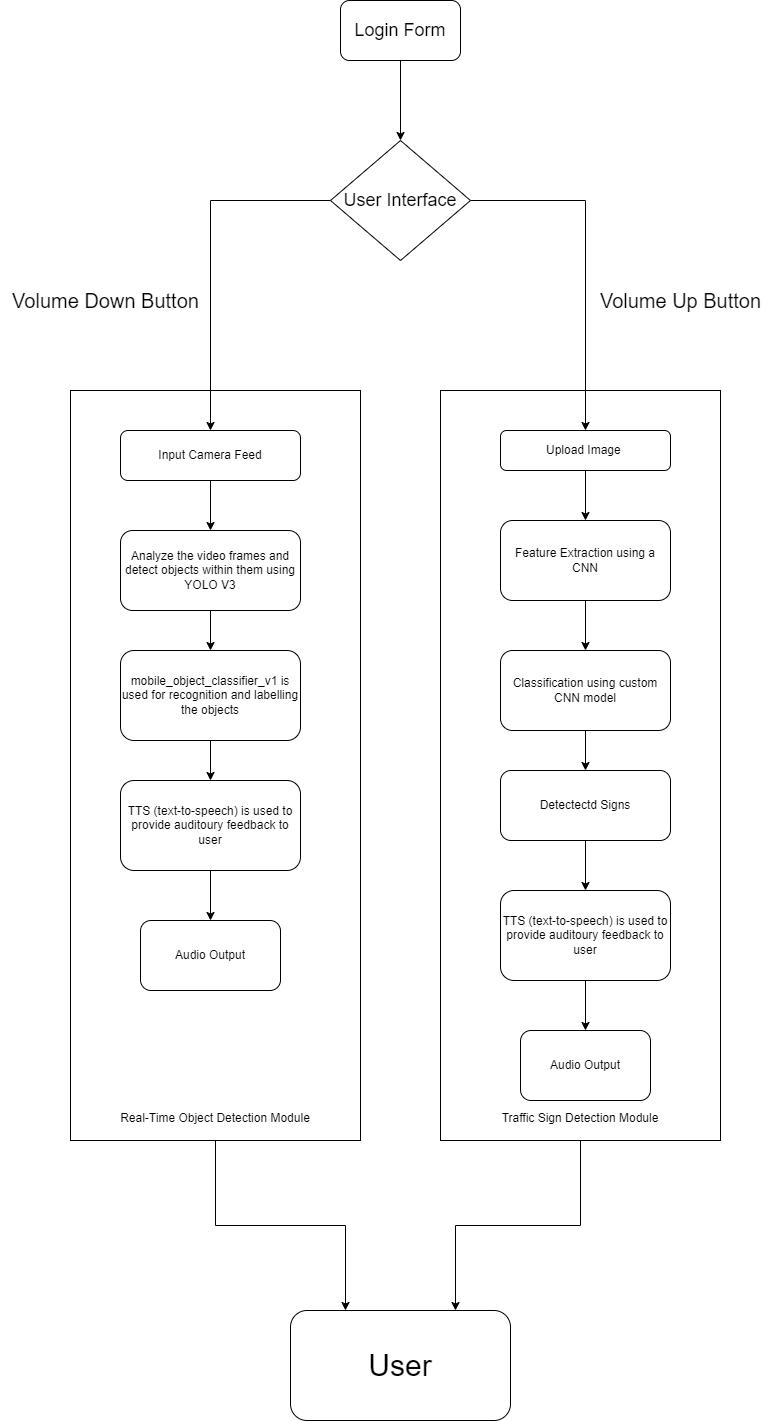
Uponlaunchingtheapplication,visuallyimpaired usersarepresentedwitha user-friendlyinterface thatallowsforintuitiveinteraction.
Thevolumeupbuttononthedeviceisdesignated for initiating traffic sign detection. Users can simplypressthevolumeupbuttontoactivatethe trafficsigndetectionfunctionality.
Once activated, the application prompts users to upload an image containing a traffic sign from theirdevice'sgallery.
A custom Convolutional Neural Network (CNN) model, trained specifically for traffic sign
detection, is employed to analyze the uploaded image.
The CNN model performs feature extraction and classification, accurately identifying and classifyingthedetectedtrafficsign.
The detected traffic sign is then announced audibly using Text-to-Speech (TTS) technology, providing users with real-time auditory feedback aboutthetrafficsign'smeaningandsignificance.
Conversely, the volume down button on the deviceisdesignatedforinitiatingobjectdetection. Users can press the volume down button to activatetheobjectdetectionfunctionality.
Once activated, the application utilizes the device'scameratocapturealivefeedoftheuser's surroundings.
An advanced object detection algorithm, such as YOLO (You Only Look Once), is employed to analyzethecamerafeedinreal-time.
Detected objects within the camera feed are identified and classified using pre-trained machinelearningmodels.
Thelabelsofdetectedobjectsarethenannounced audibly using TTS technology, providing users with real-time auditory feedback about the objectspresentintheirsurroundings.
The application seamlessly integrates both traffic signdetectionandobjectdetectionfunctionalities into a single user interface, allowing visually impaired users to switch between functionalities withease.
Users can utilize the volume controls on their devicetotogglebetweentrafficsigndetectionand object detection functionalities, enabling convenientandintuitiveinteraction.
The real-time auditory feedback provided by the application enhances user awareness and safety, enablingvisuallyimpairedindividualstonavigate their surroundings confidently and independently.
International Research Journal of Engineering and Technology (IRJET) e-ISSN: 2395-0056
Volume: 11 Issue: 04 | Apr 2024 www.irjet.net p-ISSN: 2395-0072
4. FUTURE WORK
Regarding image captioning in the context of our application, there are a lot of opportunities for future growth and enhancement. Even though our current system is good at identifying and labeling objects in photos, adding image captioning functionality opens up exciting new possibilities for improving accessibility and user experience. Improving the generated captions' relevance and accuracy is a major area of future work. Although our app labels detected objects with descriptive
information successfully, adding the ability to caption images will allow us to create more detailed and contextually relevant descriptions of entire scenes. In order to produce captions that fully convey the context and meaning of images, future research endeavors might concentrate on improving natural language processing modelsandtrainingmethodologies.
Moreover, our app's image captioning feature could be extended to include more intricate visual content. In the future, the app might have sophisticated image understanding features that go beyond object identification to explain abstract ideas, decipher complicated scenes, and offer more detailed contextual data. This could greatly improve the app's usefulness for users who are blind or visually impaired, giving them a deeper comprehension of their environment. Furthermore, the requirement to customize and modify image captioning outputs to suit specific user requirements and preferences is increasing. Subsequent advancements could investigate methods for integrating user input and interactions to customize captioning results, guaranteeing that descriptions correspond with individualuserneedsandpreferences.
Furthermore, ethical and societal ramifications must be taken into account as we develop our image captioning skills. Subsequent investigations could concentrate on formulating structures to guarantee impartiality, openness, and diversity in captioning algorithms, along with tackling issues associated with confidentiality, prejudice,andculturalawareness.Tosumup,theaddition ofpicturecaptioningfunctionalityoffersathrillingchance toimprove our app'sfeaturesand usability forusers who are blind or visually impaired. By investigating ways to enhance relevance, accuracy, personalization, and ethical considerations, we can keep innovating and enable users to feel more confident and independent when navigating theirenvironment.
Tosumup,thisresearchpaperhasdiscussedthecreation and possibilities of a mobile application intended to help people with vision impairments navigate their environment. The program is a major advancement in blind assistance technology because it combines auditory feedback features, an intuitive user interface, and realtimedetectionofobjectsandtrafficsigns. Wehaveproven through extensive development and testing that the application is feasible and effective in improving visually impaired users' safety, independence, and accessibility. The application's utility is further enhanced by the integrationofimagecaptioningcapabilities,whichprovide more in-depth descriptions of scenes and improve user experience.
International Research Journal of Engineering and Technology (IRJET) e-ISSN: 2395-0056
Volume: 11 Issue: 04 | Apr 2024 www.irjet.net p-ISSN: 2395-0072
The application will continue to be improved and optimized going forward in response to user input and technical developments. Subsequent iterations could investigate ways to enhance functionality, boost accuracy, and tackle ethical issues to guarantee technology that is inclusiveandresponsible.Allthingsconsidered,thisstudy advances the field of blind assistance technology and emphasizes how critical it is to use technology to develop inclusive and easily accessible solutions for people who are visually impaired. We can move toward a more inclusive society where everyone has the chance to independently and confidently navigate their surroundings by carrying on with our innovation and collaborationinthisarea.
[1] Vaishnavi,K.&Reddy,G.&Reddy,T.&Iyengar,N. & Shaik, Subhani. (2023). Real-time Object Detection Using Deep Learning. Journal of Advances in Mathematics and Computer Science. 38.24-32.10.9734/jamcs/2023/v38i81787.
[2] DeepthiJain,B,ShwethaMThakurandKaggereV. Suresh. “Visual Assistance for Blind Using Image Processing.” 2018 International Conference on Communication and Signal Processing (ICCSP) (2018):0499-0503.
[3] Deng, Jun, Xi Xuan, Weifeng Wang, Zhao Li, Hanwen Yao and Zhiqiang Wang. “A Review of Research on Object Detection Based on Deep Learning.” Journal Of Physics: Conference Series 1684(2020):N.Pag.
[4] Thilanka,S.A.&Jinadasa,G.C.H.&Bandara,Prasad &Weerakoon,W.M.M..(2023).Vision-BasedRealTime Object Detection and Voice Alert for Blind AssistanceSystem
[5] Mark, Aishwarya, Sakshi Adokar, Vageshwari Pandit, Rutuja Hambarde and Prof. Swapnil Patil. “Review on Image Caption Generation.” International J ournal of Advanced Research in Science, Communication and Technology (2022): n.pag.
[6] Singh, Yadwinder & Kaur, Lakhwinder. (2017). Obstacle Detection Techniques in Outdoor Environment: Process, Study and Analysis. International Journal of Image, Graphics and Signal Processing. 9. 35-53. 10.5815/ijigsp.2017.05.05.