
International Research Journal of Engineering and Technology (IRJET) e-ISSN:2395-0056 Volume: 11 Issue: 04 | Apr 2024 www.irjet.net p-ISSN:2395-0072
International Research Journal of Engineering and Technology (IRJET) e-ISSN:2395-0056 Volume: 11 Issue: 04 | Apr 2024 www.irjet.net p-ISSN:2395-0072
Soumya
Halalli1 , Veena Patil2 , Mahalaxmi Navi3 , Savita Kumbar4,Anandraddi N5
1Student, Dept. of Ece engineering, Sgbit, Karnataka, India
2Student, Dept. of Ece engineering, Sgbit, Karnataka, India
3Student, Dept. of Ece engineering, Sgbit, Karnataka, India
4Student, Dept. of Ece engineering, Sgbit, Karnataka, India
5Professor, Dept.ofEce engineering, Sgbit, Karnataka, India
Abstract - The “Intelligent Colour Sorting Machine For Enhanced Efficiency” is an integrated solution designed to represents a pioneering advancement in industrial automation, aimed at optimizing color-based sorting processes. Leveraging the power of Internet of Things (IoT) technology, this system revolutionizes traditional sorting methodologies by integrating intelligent sensors, real-time data processing, and remote accessibility. At its core, the machine employs a conveyor belt mechanism to transport objects for sorting, while an array of color sensors precisely identifies the color attributes of each item. A microcontroller unit orchestrates the sorting process, swiftly categorizing objects based on their color characteristics. The IoT connectivity empowers operators with remote monitoring capabilities, allowing them to oversee operations, adjust sorting parameters, and receive timely notifications regardless of their physical location. This seamless integration of IoT not only enhances operational efficiency but also promotes scalability and adaptability to diverse production environments. Furthermore, the system's data analytics capabilities enable insights-driven decision-making, fostering continuous improvement and optimization. Overall, the IoT-based Color Sorting Machine embodies the convergence of cutting-edge technology and industrial innovation, poised to redefine the standards of automated sorting solutions across various industries.
Key words- IoT, NodeMcu, Color sensor, Arduino Nano, hardware, software.
Automationreferstotheuseoftechnologytostreamline the production and delivery of goods and services with minimal human involvement. It improves efficiency and speed across various sectors like manufacturing, transportation, utilities, defense, and information technology. As technology advances rapidly, there's an increasing demand for high-quality products and services, leading to a need for enhanced productivity. Industrial automation plays a crucial role in meeting these demands through process engineering systems
andautomatedmanufacturing solutions. One such system automates thesortingofcolor-codedboxesonaconveyor belt using a color sensor for precise detection, reducing theneedformanuallaborwhileensuringaccuracy.
Additionally, the system tracks the number of objects passing through the process. Connectivity between the conveyorsystem and theoperating station is facilitated by a Node MCU with a built-in WIFI module. The Internet of Things (IoT) represents a modern communication model where everyday objects, microcontrollers, electronic devices, and smart systems communicate seamlessly, becoming integral parts of the web. IoT aims to make the internet more immersive and ubiquitous, enabling easy access and interaction with a wide range of devices, from home appliances to surveillance cameras and vehicles. It fosters the development of various applications utilizing thevastamountofdatageneratedbythesedevicestooffer new services to individuals, businesses, and public institutions. In the near future, IoT is expected to have widespread applications in households and businesses, improving quality of life by enabling physical objects to communicate, share data, and make decisions. This transformation from conventional to smart objects is driven by IoT's underlying technologies such as global computing, embedded devices, and communication protocols.Forexample,smarthomeswillallowresidentsto automate tasks like opening garage doors upon arrival or preparing coffee. To realize this potential, emerging technologies and service applications need to evolve in sync with market demands and consumer needs, with a focus on device accessibility and communication compatibilitystandards.
Moreover,oursystemexemplifiestheseamlessintegration ofautomationwiththeInternetofThings(IoT),heraldinga future where interconnected devices communicate effortlessly to enhance productivity and user experience. By harnessing the power of IoT, our solution facilitates seamless connectivity between the conveyor system and operatingstations,enablingremotemonitoringandcontrol forenhancedefficiencyandresponsiveness.Aswenavigate the ever-expanding horizons of automation and IoT, it becomes increasingly evident that the future belongs to thosewhoembraceinnovationandadaptability.Bystaying at the forefront of te,chnological advancements and
continually refining our solutions to meet the evolving International Research
Volume: 11 Issue: 04 | Apr 2024 www.irjet.net
needsofindustries,wearepoisedtousherinaneweraof efficiency, reliability, and connectivity. By leveraging advanced color sensing technology and real-time object tracking capabilities, our solution not only minimizes errors but also maximizes throughput, ultimately saving valuablemanpowerandresources.
It'scrucialtogetanunderstandingofsomeoftheservices andkeywordsbeforewediveintotheproject'sexecution.
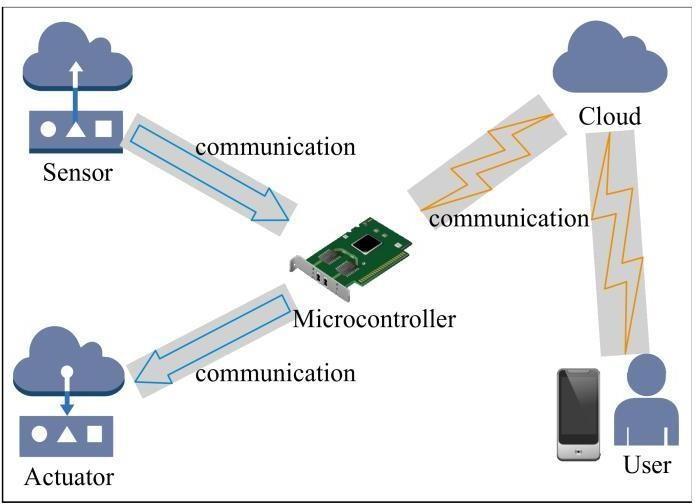
A microcontroller (MCU) is a little chip with a straightforwardoperationthatisusedinseveralproducts, such as sensors, home appliances, health monitors, cars, and industrial automation. Several of these gadgets might gainfromdeviceaccesstothecloud.Forinstance,inorder torecorduse,smartenergymeterswillneedtoconnectto the cloud, and building security systems will need to interact locally in order to release doors when a badge is scanned . The computation and memory resources of the MCU are constrained to enable the completion of straightforward functional activities. IoT applications are mademoredifficultbythefactthatmicrocontrollersoften run operating systems without built-in capability to connect to the cloud or local networks. Free on Amazon. ThisissueisresolvedbyRTOS,whichoffersboththecore operating system and software libraries (to operate the edge device). This makes it simple to connect securely to the cloud (or other edge devices) so that data can be gatheredfromthemforIoTapplicationstotakeaction.
An IoT-based color sorting system employing a conveyor has diverse applications across industries like food processing, recycling, and manufacturing. Its main aim is automating object sorting by color, enhancing efficiency and accuracy.This system vastly improves sorting speed compared to manual methods, boosting throughput and
productivity. It efficiently handles large volumes ofobjects, streamliningoperations.ThroughIoT integration,itenables real-time monitoring and control, collecting and analyzing data on sorting processes for quality control, optimization, andperformancetracking.
Prior to commencing the project, a brief examination was conducted on existing systems in this field. The work of prominent researchers was thoroughly reviewed, with key insights documented in the literature review. For instance, onestudyexploredautomatedobjectsortingusingArduino nano, proposing various sorting mechanisms. The system comprises a conveyor belt transporting objects such as bottles or boxes past sensors, with sorting logic determined by NODEMCU. Color sensors, an inductive sensor, and a load cell detect object colors. Based on color detection, the system activates a DC motor with a circular container divided into compartments, sorting objects accordingly. Another system employs Arduino to code color recognition, segregating desired objects into bins using servo motors. This proposed high-speed color sorting machine utilizes robust mechanical structure, advanced sensing technology, sophisticated image processing algorithms, and user-friendly interface components to accurately sort objects based on color properties.
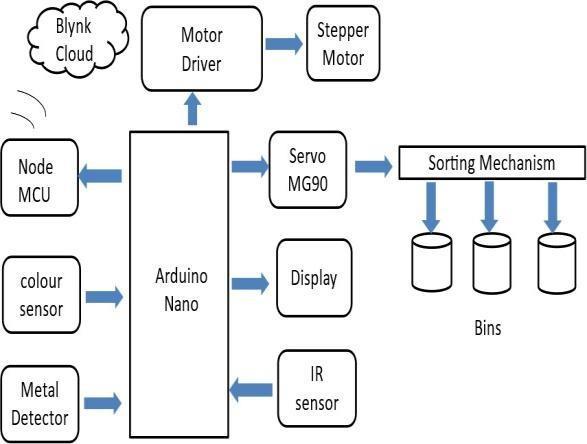
Fig:BlockDiagramOfTheProposedMethod
TheFlowchart ofthisproposed which depicts the process of an intelligent color sorting machine that uses IoT (InternetofThings)toenhanceefficiency.
In enhancing efficiency, this intelligent color sorting machineleveragesIoTtechnology. Theprocessstarts with acoloredballplacedonasensorthatdetectsitscolor.This informationis then relayed to a controller, which analyzes it and sends instructions to a servo motor. . The servo motor, based on the controller's signal, positions a sliding platform over the appropriate chute. Finally, the ball rolls downthedesignatedchute andlandsinthebinmatching itscolor.
Volume: 11 Issue: 04 | Apr 2024 www.irjet.net p-ISSN:2395-0072
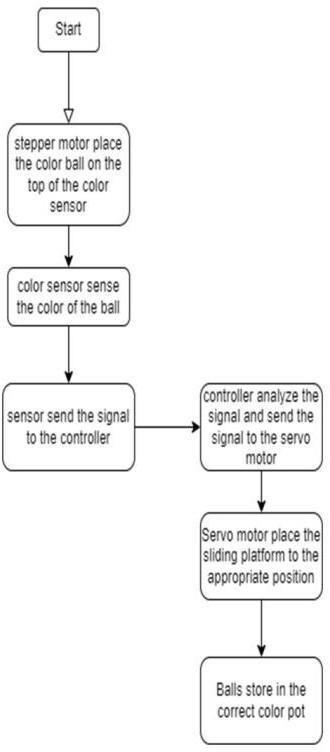
Fig:Flowchartofthe proposedSystem
This automated system, driven by IoT, streamlines the sorting process and eliminates the need for manual color identificationandsorting
Hardware Description:
The following Hardware Components are used in this project
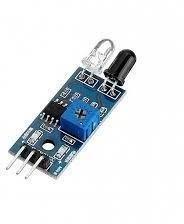
IR Sensor
AnIRsensorservesadualpurpose:measuringanobject's heat and detecting motion. In the infrared spectrum, all objects emit thermal radiation, which is invisible to the naked eye but detectable by IR sensors. These sensors typically consist of an IR LED emitter and an IR photodiodedetector.
The photodiode is sensitive to IR light of the same wavelength emitted by the IR LED. When IR light reaches thephotodiode,itcauseschangesinresistanceandoutput voltage proportional to the intensity of the received IR light.
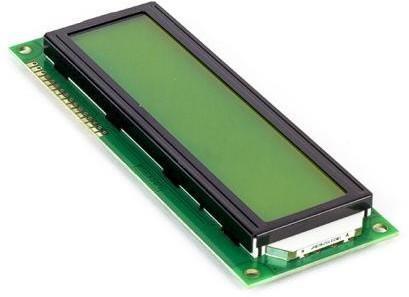
The liquid crystal display (LCD) offers several advantages over LEDs, including lower power consumption, typically measured in microwatts compared to milliwatts for LEDs. ThislowpowerrequirementmakesitcompatiblewithMOS integrated logic circuits. LCDs are also known for their affordability, good contrast, and ability to operate within a limited temperature range of 0 to 60°C. However, they do have drawbacks such as the need for an external light source, limited reliability and operating life, poor visibility in low ambient light, slow speed, and the requirement for ACdrive.Atypicalliquidcrystalcellconsistsofathinlayer (approximately 10 µm) of liquid crystal sandwiched between two glass sheets with transparent electrodes. These electrodes can be configured to create either a transmissive type cell, with both glass sheets being transparent, or areflective type cell, where one glass sheet istransparentandtheotherhasareflectivecoating.Unlike LEDs, LCDs do not produce their own illumination and relyentirelyonexternallightsourcesforvisibility.
Motor
A servo motor is a rotary actuator that enables precise control of angular position by integrating a motor with a position feedback sensor. To complete the system, a servo driveisessential.Thisdriveutilizesthefeedbacksensorto accurately manage the rotary position of the motor. The position sensor provides a feedback signal indicating the currentloadposition.
Typically, this sensor is a potentiometer that generates a voltageproportionaltothemotorshaft'sabsoluteanglevia a gear mechanism. It is compact and lightweight yet offers high output power.This servo can rotate approximately 180 degrees (90 degrees in each direction) and operates similarlytostandardmodelsbutinasmallerformfactor.
A servo motor is a type of motor that uses feedback to control its position accurately. It consists of a DC motor, a gear train, a position sensor, and a control circuit. When you send a signal (like a PWM signal) to a servo motor, it rotatestothedesiredpositionbasedontheinput.
International Research Journal of Engineering and Technology (IRJET) e-ISSN:2395-0056
Volume: 11 Issue: 04 | Apr 2024 www.irjet.net

Fig:ImageOfServoMotor
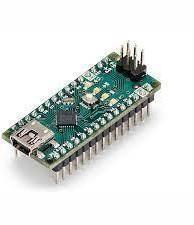
The Arduino Nano is a compact microcontroller board designed for prototyping and DIY electronics projects. It featurestheATmega328Pmicrocontrollerchiprunningat 16 MHz, providing 32KB of Flash memory, 2KB of SRAM, and1KBofEEPROM.Despiteitssmallsize(18x 45mm), it offers various connectivity options, including a USB interface for programming and serial communication through a Mini-B USB connector. With14digital I/Opins, 8 analog input pins, and 6 PWM output pins, users can interface with sensors, actuators, and other electronic components. The Nano can be powered via USB or an external power supply (7-12V DC), with built-in voltage regulationforstableoperation.
The TCS3200 color sensor is a versatile and popular device used for color detection and measurement in various applications. This sensor is capable of detecting a wide range of colors by utilizing an array of photodiodes and a light-to- frequency converter. It operates by illuminating an object with white light and then measuring the reflected light through its photodiodes, whicharesensitivetored,green,blue,andclearlight.The TCS3200canprovidedigitaloutputscorrespondingtothe intensity of each color component detected, enabling precise color sensing and analysis. This sensor is commonly used in robotics, industrial automation, printing,andotherfieldswhereaccuratecolordetectionis essential. Its compact size, ease of integration, and reliabilitymakeitapreferredchoiceforprojectsrequiring color sensing capabilities. Configuration and interfacing 0 incidentlightdistribution.
© 2024, IRJET | Impact Factor value: 8.226 |
with microcontrollers are straightforward, making it accessible for hobbyists and professionals alike in the realmofelectronicsandsensortechnology.
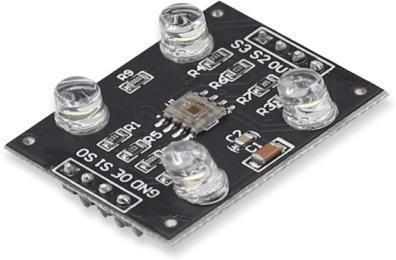
Fig:ImageofTCS3200ColourSensor
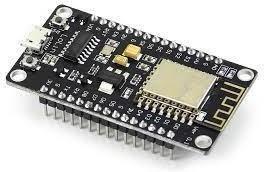
The term "NodeMCU" originates from "node" and "MCU" (micro-controllerunit).It primarilyrefersto the firmware, rather than the associated development kits, and both the firmware and prototyping board designs are open source. NodeMCU utilizes the Lua scripting language. Its main purpose is to facilitate IoT projects needing wireless connectivity, including smart home devices, remote sensors,dataloggers,andotherinternet-enableddevices.
The Arduino IDE is the software used to program microcontrollers. Arduino, an open-source company and community, creates kits for building digital devices and interactive objects. These kits can sense and control the physicalworld.Arduinoboardsareavailablepreassembled oraskits,withhardwaredesigninformationaccessiblefor DIY assembly. These microcontroller boards, primarily manufacturedbySmartProjectsinItaly,utilize8-bitAtmel AVR microcontrollers or 32-bit Atmel ARM processors. They offer digital and analog I/O pins for interfacing with extension boards and circuits. The Arduino IDE, based on the Processing project, supports C and C++ programming languages. Programs are loaded onto the microcontroller boardsviaserialcommunicationsinterfaces,includingUSB onsomemodels.TheArduinoIDEfacilitatescompilingand uploadingprogramstoArduinoboards.
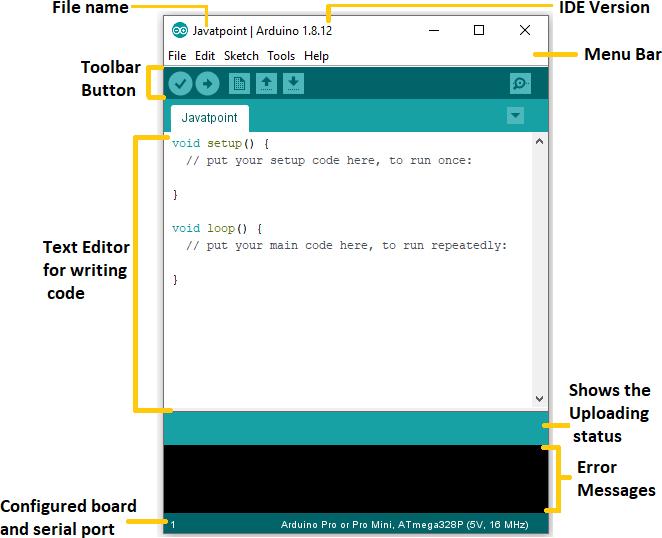
Fig:ImageofEditorWindowofArduino
Blynk provides a comprehensive ecosystem of software toolsandservicesdesignedtosimplifythedevelopmentof IoT applications. It consists of a mobile app, a cloud platform, and a library ofsupported hardware. The Blynk mobile app, available for both iOS and Android devices, serves as the user interface for controlling and monitoring IoT projects. Users can create custom dashboards with widgets such as buttons, sliders, graphs, and displays to interact with their devices. Blynk's cloud platformactsasabridgebetweenthemobileappandIoT devices, facilitating real-time communication and data exchange.Itprovidessecureconnectivityovertheinternet and allows users to remotely control and monitor their projects from anywhere in the world. Blynk supports a wide range of hardware platforms, including popular microcontrollerssuchasArduino,RaspberryPi,ESP8266, ESP32,andothers.Itoffersalibraryofcodeexamplesand libraries that developers can use to integrate Blynk functionalityintotheir projectsseamlessly.Blynk'smobile app features a drag-and-drop interface that allows users to create custom user interfaces for their IoT projects withoutwritingasinglelineofcode.Widgetscanbeeasily added, configured, and arranged on the dashboard to createintuitiveandvisuallyappealing interfaces.
Blynk's cloud platform enables cloud-based development and deployment of IoT applications, eliminating the need foruserstosetupandmanagetheirownservers.Projects canbeeasilysharedwithcollaboratorsormadepublicfor others to use and modify. Blynk prioritizes security and privacy, implementing encryption and authentication mechanisms to protect user data and ensure secure communication between devices and the cloud platform. Blnyk's sorting machines are designed for scalability, capable of handling different types and sizes of items
while maintaining high sorting rates. Blnyk's solutions revolutionize the sorting process, enhancingproductivity andproductqualityforbusinesses worldwide.
The intelligence color sorting machine project encompasses research, design, development, and implementation phases. It involves collaboration betweenengineers,datascientists,andindustryexpertsto create a robust sorting system. Key components include the selection of high-quality sensors, the development of precise algorithms for color recognition, and the integration of user-friendly interfaces for operators. Throughout the project, rigorous testing and optimization are conducted to ensurethemachine'sreliability,accuracy,andefficiencyin various operating conditions. The end result is a cutting-edge solution that revolutionizes the sorting process in industries, improving product quality, reducinglaborcosts,andminimizingwaste.
Scalability is prioritized, accommodating different items and sizes while optimizing speed and throughput. Integration with existing production lines, user training, and sustainability considerations are central. Partnerships with industry stakeholders provide valuable feedback, guiding customization to meet specific market needs. Future enhancements may include defect detection, size sorting, or advanced imagingcapabilitiesforenhancedqualitycontrol.
An IoT-based color sorting machine utilizes various components to automate the sorting process according to objectcolor.Acolorsensor,liketheTCS3200,identifiesthe object's color. This data is then relayed to a microcontroller, such as the Arduino Nano, which makes a decisionbasedonthecolor.Asignalisthensenttoamotor driver, controlling a stepper or servo motor to divert the object into the designated bin. The system can be further enhancedwithanIoTplatformlikeBlynkCloudforremote monitoring and control via smartphone app. This technology offers increased efficiency, accuracy, and productqualitywhilereducing laborcosts.
International Research Journal of Engineering and Technology (IRJET) e-ISSN:2395-0056
Volume: 11 Issue: 04 | Apr 2024 www.irjet.net p-ISSN:2395-0072
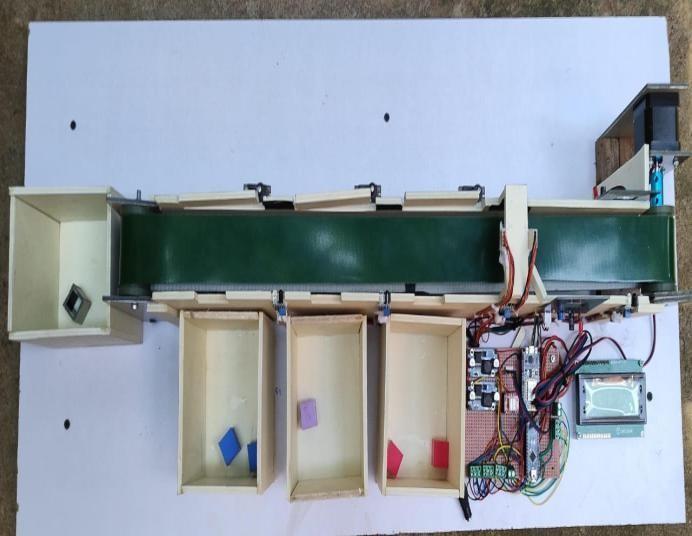
Fig:Imageofcoloursortingmachine
We'vedevelopedaprototypeutilizingamicrocontrollerto automatically sort color discs into respective color pots. Thissetupaimstominimizehumaneffortanderrors.The circuit includes an ESP32,TCS3200 color sensor, stepper motor with driver, and servo motor. Upon power-up, the stepper motor positions the color disc above the TSC230 sensor. After sensing the color, , the servo motor moves the disc to the corresponding color pot using a sliding platform.Allmotorsarecontrolledbythemicrocontroller. The prototype, built according to the circuit diagram. yieldedexpected results,effectivelysortingthediscswith theassistanceofthecoloursensorandmotors.
[1] Design And Development Colour Sorting Robot Lim Jie Shen*, Irda Hassan –This gave us the knowledge of howarobotisusedforthesortingprocessandnomanual helporlaborwasneeded.
[2] Sortingofobjectsbasedoncolourweightandtypeon a conveyor line using PLC,S.V Rantu ,A.P.Shinde, N.R.Darda, A.V. Vaghule,C,B.Meshram,S.S .Sarawade-their gave us the knowledge of how different sensors are responsible and helpful for the sorting based on weight,colourandmetal.
[3] ”Study on colour Analyzer based on the multiplexing of TCS3200 Colour sensor and Microcontroller”,Li qiaoyi,IJHIT Vol7,NO.5(2020).
[4] ”Design and operation of synchronized robotic arm”, goldykatal,saahilgupta,shitijkakkar,Internationaljouranal ofresearchinengineeringandtechnology,volume2,issue 8,aug-2020.
[5] Automated Object Sorting Using Raspberry Pi N.Aarthi1P.Sahithi2P.V.Sitaramaih,M.InduVardhani,N.Ranj ith Kumar, D. SuneelVarma –This published work gave different ideas in which this sorting mechanism can be takenintoconsideration.
[6].”Detection & Distinction of Colors using Color Sorting Robotic Arm in a Pick & Place Mechanism “, Uzma Amin,Ghulam Ahmad, Nudrat Liaqat,Manzar Ahmed4,Sumbal Zahoor,International Journal pf Science andresearch(ILSR)Volume3Issue6,June2019.
[7]”Design And Development of Colour Sorting Robot”, Lim Jie Shen ,Journal of Engineering Science and TechnologyJanuary,2019.
[8] “Colour And Shape Based Object Sorting”, Abhishek Kondhare, Garima Singh, Neha Hiralkar , M.S.Vanjale, International Journal Of Scientific Research And EducationVolume2,Issue3,2018.
[9]. Shravani, G. Indira, V Appalaraju, “Ardunio Based color Sorting Machine using TCS3200 Colour sensor”,Internationa Journal of Innovative Tecnology and Exploring Engineering (IJITEE), ISSN: 2278-3075, Volume-8, Issue-6S4, April 2019.Sorting of object is an essentialmechanical process in which difficult work is quite required to perform machine to superior to human begins.
[10].Aung,Thike,Zin,Moe San, Dr. Zaw Min Oo “Design andDevelopmentofanAutomaticColourSortingMachine Belt Conveyour”, International Journal of Science and Engineering Applications Volume 9-Issue 07 ,176-179, 2020,ISSN:23