
International Research Journal of Engineering and Technology (IRJET) e-ISSN: 2395-0056
Volume: 11 Issue: 04 | Apr 2024 www.irjet.net p-ISSN: 2395-0072
International Research Journal of Engineering and Technology (IRJET) e-ISSN: 2395-0056
Volume: 11 Issue: 04 | Apr 2024 www.irjet.net p-ISSN: 2395-0072
Saurav1 , Dr. D.K. Bhalla2
1B.Tech. Mechanical Engineering (Evening) Scholar, School of Mechanical Engineering, Lingaya’s Vidyapeeth, Faridabad, Haryana, India
2Professor and LEET Coordinator B.Tech., M.Tech., PhD, FIE in Lingaya’s Vidyapeeth, Faridabad, Haryana, India
Abstract- Highrigidityandahighstrengthtoweightratio arebenefitsofpolymericmaterialsreinforcedwithsynthetic fiberslikeglass,carbon,andaramidovertraditionalbuilding materials like steel, concrete, and wood. Despite these benefits,syntheticfiber-reinforcedpolymercompositesare becoming lessandlesscommonduetotheirhighstarting prices,inefficientstructuralforms,and mostimportantly disastrousenvironmentaleffects.Ontheotherhand,oneof thekeyreasonstoinvestigatethepossibilityofemploying naturalfibersasreinforcementforpolymersisthegrowing interestinusingthemasreinforcementinplasticstoreplace traditionalsyntheticfibersinseveralstructuralapplications. Dueofthis,scientistshaveconcentratedonstudyingnatural fibercomposites,alsoknownasbio-composites,whichare made of natural or synthetic resins and reinforced with naturalfibers.Becauserenewablerawmaterialsarehealthy anddonotharmtheenvironment,researchersfromallover the globe have been pursuing the production of highperformance engineered materials from renewable resources.
Key words: Composite materials, Polymer composite material,tensiletest,impacttestetc.
Acompositeismixtureoftwomaterialsinwhichoneofthe materials, known as the reinforforcing phase, is in the structureoffibers,sheets,orparticles,andisembeddedin the other materials known as the matrix phase. The reinforcing fabric and the matrix material can be meta l, ceramic, or polymer. Composites usually have a fiber or particle segment that is stiffer andmore suitable than the continuous matrix segment andserveas theprimaryload carryingmembers.Thematrixactsasaloadswitchmedium betweenfibers..Thematrixisgreaterductilethanthefibers and thus acts as a source of composite toughness. The matrix additionally serves to guard the fibers from environmentaldamagebefore,forthedurationofandafter composite processing. When designed properly, the new mixed material reveals higher strengthh than would each character material. Composites areused now not only for their structural properties, however additionally for electrical, thermal, tribological, and environmental applications.
Composite materials are commonly classified at following twodistinctlevels
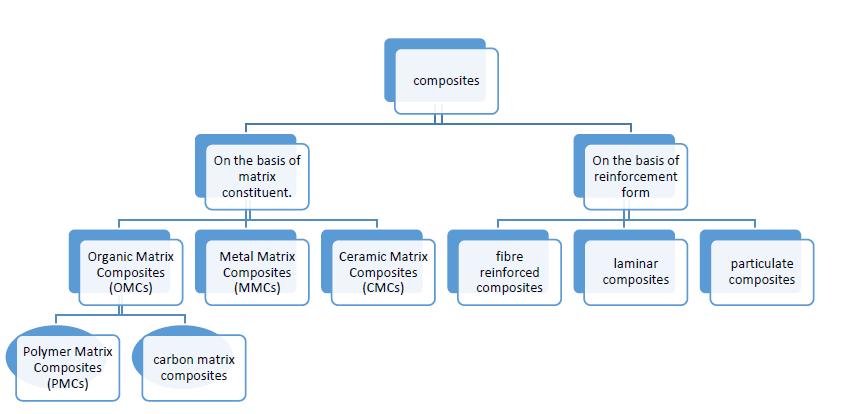
Fig.1.1-Classificationofcompositematerials
1.2.
Themainobjectiveistostudyandevaluatethemechanical and physical properties of polycarbonate granules as a reinforcementmaterialintheepoxyresinmatrix.Aseriesof composite material will be developed by varying the weight% of polycarbonate granules that is 2%, 3%, 4% & 5%.Andtestingwill beperformedinordertoanalyzethe mechanical properties of the developed material. The varioustestsincludetensiletest,impacttest&bendingtest,
Todevelopaseriesofpolymercompositematerial byvaryingpercentageofpolycarbonategranules.
To evaluate the physical mechanical characterization for the developed composite materials.
Based on the strength of the composites suitable application will be predicted for automobile applications
International Research Journal of Engineering and Technology (IRJET) e-ISSN: 2395-0056
Volume: 11 Issue: 04 | Apr 2024 www.irjet.net p-ISSN: 2395-0072
a. Polycarbonate:
Polycarbonates(PC)areacrewofthermoplasticpolymers containingcarbonateagenciesintheirchemicalstructures. Polycarbonatesusedinengineeringarestrong,challenging materials,andsomegradesareopticallytransparent.They arewithoutdifficultyworked,molded,andthermoformed. Becauseoftheseproperties,polycarbonatesdiscovermany applications.
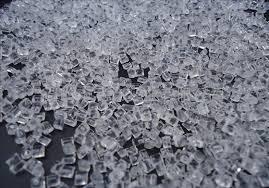
Properties of Polycarbonate:-
Physical properties-
Density-1.2-1.22g/cc
Refractiveindex-1.584-1.586
Mechanical properties :
Young’smodulus- 2.0-2.4Gpa
Tensilestrength- 55-75Mpa
Thermal properties :
Meltingtemperature- 155degrees
Thermalconductivities- 0.19-0.22W/(m-K)
b. Epoxy:
Epoxymaybeatermusedtodenoteeachthefundamental parts and therefore the cured finish products of epoxy resins, further as a conversational name for the epoxide functional group. Epoxy resins, additionally called poly epoxidesareaunitacategoryofreactivepre-polymersand polymersthatcontainepoxideteams.Epoxyresinsarethe foremost ordinarily used resins. they're low relative molecularmassorganicliquidscontainingepoxidegroups. Epoxide has 3 members in its ring: one atomic number 8 and2carbonatoms.Thereactionofepichlorohydrinwith phenolsoraromaticaminesmakesmostepoxiesandfillers are supplemental to provide epoxies with a large vary of propertiesofconsistence,impact,degradation,etc.theroom temperaturepropertiesofatypicalepoxy.thoughepoxyis
costlier than different polymer matrices, it's the foremost common PMC matrix. over two- thirds of the compound matrices utilized in region applications are epoxy based mostly.
Properties of epoxy:
Betteradhesiveproperties
Superiormechanicalhomes(strengthandstiffness)
Improvedresistancetofatigueandmicro-cracking
Highlywaterresistant
Increasedresistancetoosmosis
Nounstableproducts&exothermicresponse
Duetopolarityofaliphatichydroxylcrewandether grouppromoteselectromagneticbonding
Highstrength
c. Epoxy hardener(Araldite HY 951):
Hardener is used as solvent .in this project EH-9510 hardenerisused.HardenersareSubstancesthatareadded to polymers for aiding in curing ofcomposites.Hardeners areusedtoenhancethephysicalpropertiesofepoxyresins suchasadhesion,impactstrengthandtoaltertheviscosity of the polymer matrix. It also improves the life, lower exothermicandreduceshrinkage.
Applications of epoxy hardeners –
Solventfree,highcoatings.
Pipeline&tankcoatings.
Adhesives
Surfacetolerantprimersformetallicsubstrate.
Marine&industrialcoatings.
d. Filler:
Fillersaretheparticlesaddedtomaterialsto:
Lower the consumption of expensive binder material.
Betterthepropertiesofthemixturematerial.
Fillerhastwotypes:
Natural filler: Sugarcane – Rice husk, wheat husk, coconutcoir.
Synthetic filler: Glass,carbon
Advantages of natural filler over synthetic filler:
Availabilityofrenewablenaturalresources
Satisfactoryhighspecificstrengthandlightweight
Lowcostandbio-degradability
Eco-friendly
e. Sugar cane waste:
Sugar will used filler material. Sugarcane trash (or cane trash)isawonderfulbiomassresourceinsugar-producing
International Research Journal of Engineering and Technology (IRJET) e-ISSN: 2395-0056
Volume: 11 Issue: 04 | Apr 2024 www.irjet.net p-ISSN: 2395-0072
countriesworldwide.thenumberofcanetrashmanufacture depends on the plantselection, age ofthe crop at harvest andsoilandweather.Canewastebin doubtless bereborn into heat and electricity. This trash contains twenty eight.6%-organic carbon, 0.35 to 0.42% N, 0.04 to 0.15% phosphorus, 0.50 to 0.42% atomic number 19. The sugarcane trash incorporation within the soil influences physical,chemicalandbiologicalpropertiesofthesoil
2.2. CALCULATIONS
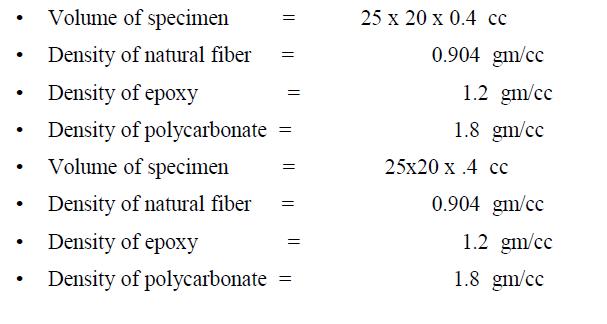
2.2.1. Table of calculation:
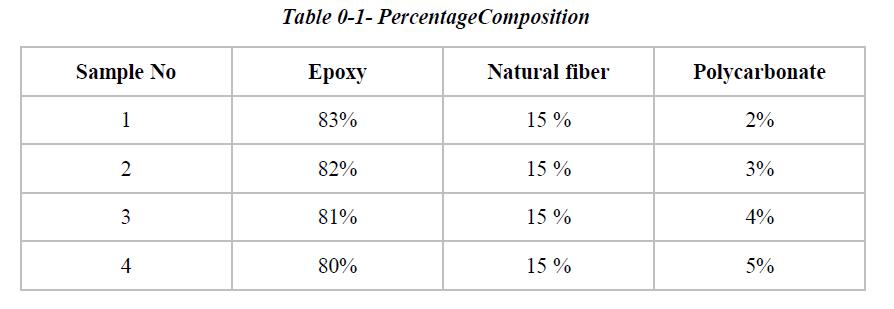
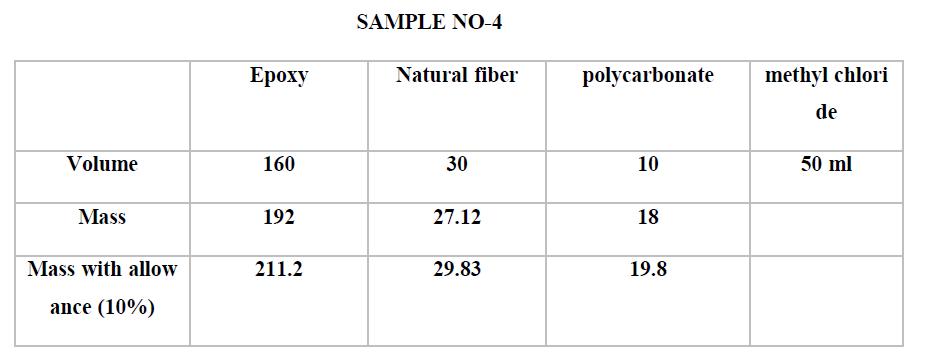
Thefollowingtablerepresentsthepercentagecomposition of material taken for the p reparation of the different samples
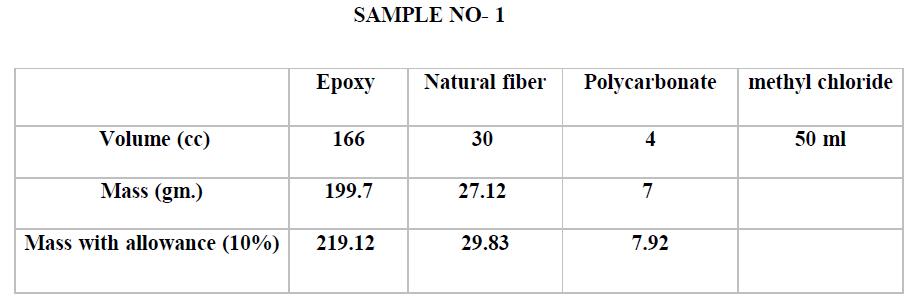
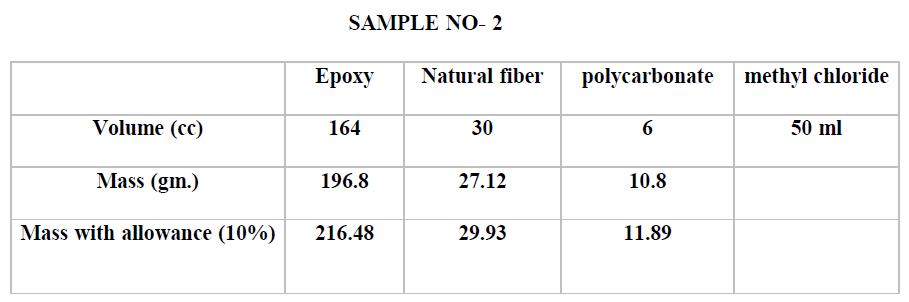
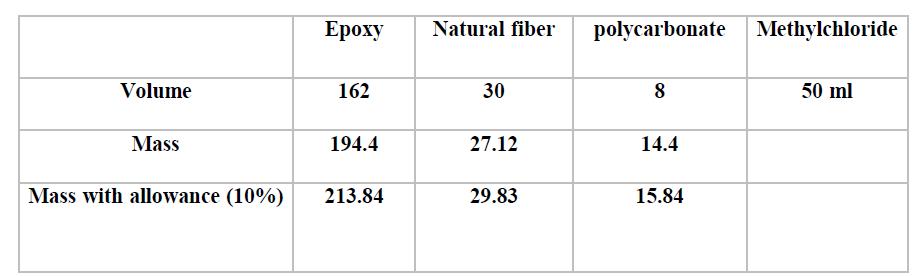
Thefollowingfourtablerepresentsthemassofthedifferent materialtakenforthepreparationofthedifferentspecimen (calculated according to their density and percentage composition)
Table2-MassCalculationForDifferentSamples
SAMPLE 3
3. FABRICATION OF COMPOSITE
Compressionmouldingprocess
Handlay-upmethod
3.1. Compression moulding process
Compressionmoldingisamethodofmouldinginwhichthe mouldingmaterial,usuallypreheated,isfirstpositionedin anopen,heatedmoldcavity.Themoldisclosedwithatop pressure or plug member, pressure is applied to pressure thematerial intocontact withall mouldareas,whileheat and stress are maintained until the molding material has cured.
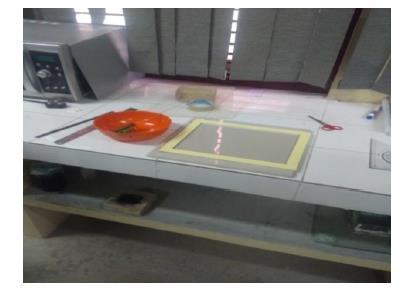
3.2. Mold Preparation
Wehavepreparedamoldofi25x20x0.4cc
WetookasmoothtileandplacedOHPsheetonthat tile and draw a margin ofi25x20on the sheet and used 2mm thick double sided tape to provide thicknessofi4mm
Volume: 11 Issue: 04 | Apr 2024 www.irjet.net p-ISSN: 2395-0072
Sheet Preparation:
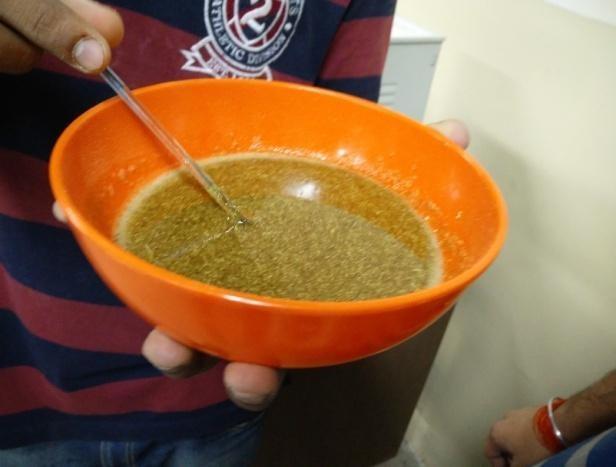
Wetook50mlofmethyl chlorideandaddedmass ofpolycarbonateaccordingtoourcalculations
Then kept it for 30 minutes so that pc granules coulddissolveinmethylchloride.
Then we took epoxy natural fiber and previously dissolvedpcgranulesinabeakerandmixedthem withthehelpofblender.
We put this mixture in mold that we had already preparedwithappropriatedimensionns.
Withthehelpofroller,wespreadthemixtureinto the mold properly and took care of bubble formation.
3.4. Curing Time:
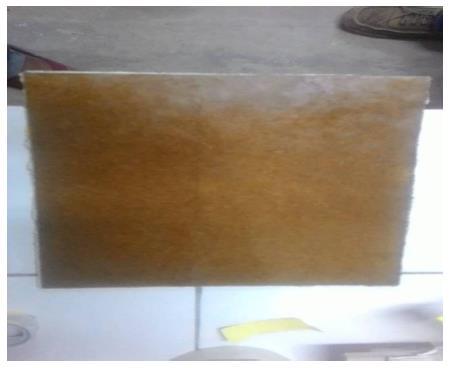
After preparing the mold we put it under room temperatureupto48hourswithsomeweightover weightit.
After 48 hours it becomes flexiblesheet and then we put it under furnace about 3 hours under temperature65degreeCelsius.
3.5. CUTTING OF SAMPLE IN DESIRED DIMENSION:
ARacksawbladewasusedtocuteachlaminateintosmaller pieces,forvariousexperiments
Tensiletestsampledetails:
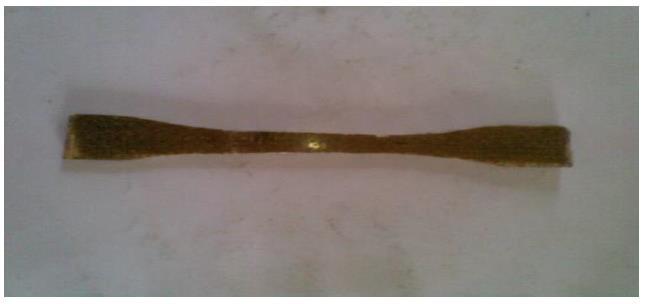
Samplewascutintodogboneshape(17x2x2)cm
3.6. Tensile test :
Thetensilestrengthofamaterialisthatthemostquantity oftensilestressthatitwilltakebeforefailure.Theusually usedspecimenfortensilecheckisthatthedog-bonekind. throughoutthecheckauniaxialloadisappliedthrougheach the ends of the specimen. The dimension of specimen is (17x2x2)cm. Typical purposes of interest once testing a materialinclude:finaldurability(UTS)orpeakstress;offset yieldstrength(OYS)thatrepresentsadegreesimplyonthe farsidetheonsetofpermanentdeformation;andtherefore the rrupture (R) orfracture point whereverthespecimen separatesintopieces.Thetensilecheckisperformedwithin the universal testing machine (UTM) Instron 1195 and results are analyzed to calculate the tensile strength of composites
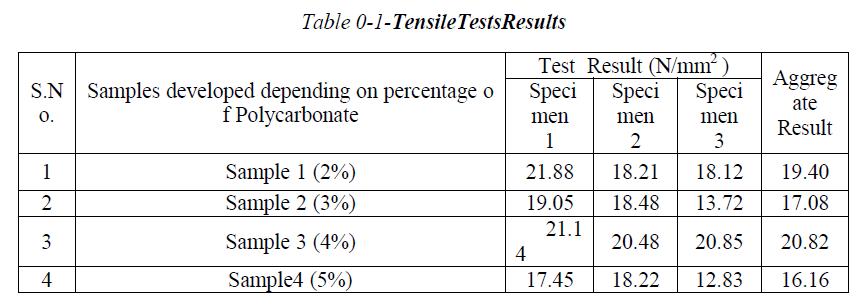
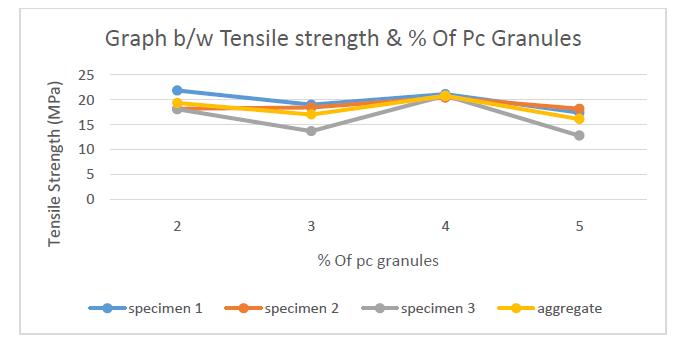
4.1. TENSILE TEST RESULTS
ASTM D638 is one of the most common plastic strength specification and cover the tensile properties of
International Research Journal of Engineering and Technology (IRJET) e-ISSN: 2395-0056
unreinforcedandreinforcedplasticthistestapproachuses wellknown“dumbbell”Or“dgbone”shape.Awidespread checkingoutm/cisneededtoperformthistest.
Bend test (also flex or flexural testing) is commonly performed to measure the flexural strength .this test is performed on universal testing m/c with a 3 point or 4 pointbendfixture.
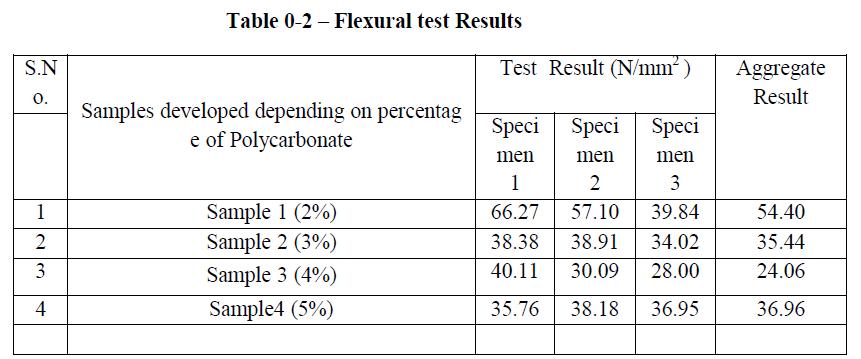
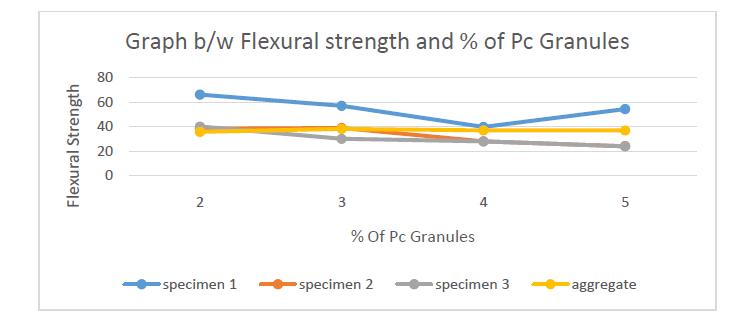
Figure4.2-Graphbetweenflexuralstrengthand%ofpc granules
IzodImpactis singlepoint testthatmeasureasubstances resistancetohaveaneffectonfromaswingingpendulum. Izod influence is defined as the kinetic energy needed to initiatefractureandcontinuethefracturetillthespecimen is broken. Izod specimen are notched to pre vent deformationofthespecimenuponimpact.Thischeckcanbe usedasaquickandeasyqualitymanagetesttodetermineif amaterial meets specificimpact residences ortoevaluate materialsforordinarytoughness
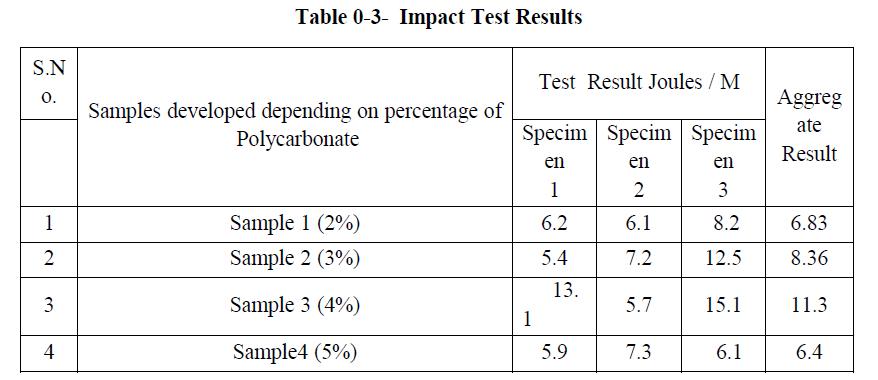
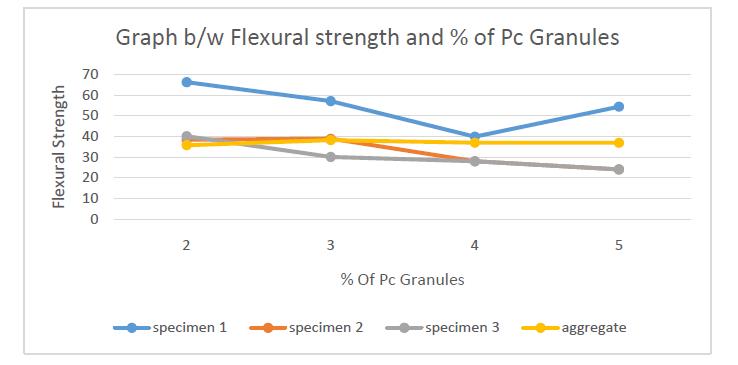
Figure-4.3Graphbetween impactstrength&“percentage ofpcgranules”
A series of polymer composites material has been successfullydevelopedbyvarying%ofpolycarbonate.
Mechanical tests such as tensile, elongation, flexural and impact test were successfullycarried as per the ASTMstandard.
Physicalcharacterizationsuchasdensityandparticle sizetestwerecarriedoutsuccessfully.
Developed composite having 4% polycarbonate is showinggoodresultsintensiletestt.
Developed composite having 2% filler by weight is showinggoodresultsinflexuralstrength.
It is observed that when percentage polycarbonate increases, tensile strength ofthe specimen increases upto4%andthenitshowsdecline.
Volume: 11 Issue: 04 | Apr 2024 www.irjet.net p-ISSN: 2395-0072 © 2024, IRJET | Impact Factor value: 8.226 | ISO 9001:2008 Certified Journal | Page2693
International Research Journal of Engineering and Technology (IRJET) e-ISSN: 2395-0056
Volume: 11 Issue: 04 | Apr 2024 www.irjet.net p-ISSN: 2395-0072
Theimpactstrengthcomesouttobemaximumat4% filler content and then it startsdecreasing when the percentageofpolycarbonatecontentincreases
6. FUTURE SCOPE:
As we all know waste management is one of the biggest challenges of the future. As population is increasing rapidly we have to be ready for an alternativeresourcewhichcanfulfillthe demandof people. Sugarcane trash is an agricultural waste materialwhichcanbeutilizedinthedevelopmentof material.Thiswillminimizethedepositionof waste materialwhichisproducedbyindustriesandhelpin wastemanagement.
Since the strength ofdeveloped composite material obtained is low, it can be increased by silage treatment offiller material orbyusinghybrid filler. We can add thermoplastic like polycarbonate for increasingthetoughnessofthematerial,theflexural strength increases by adding the pc and now the flexibility of the sheet has increased and it is no longerbrittleandnowcanbearmoreload.
[1] EricaR.H.et.al,“Strategicmaterialsselectioninthe automobile body: Economic o pportunities for polymer composite design.” Composites Science andTechnology,68,(2008)1989–2002.
[2] Dr.MahammedHaneefietal,HybridpolymerMatrix Composites foribiomedical applic ations, International Journal ofiModern Engineering Research 2013,Vol.3(2), 3,970-979
[3] M.R. Mansor et.al,Hybrid natural and glass fibers reinforcedpolymercompositesmaterialselection usingAnalyticalHierarchyProcessforautomotive brake lever design. Materials a nd Design 51 (2013)484–492
[4] Gururaja M N, A N Hari Rao , A review on recent applications and future prospectus ofi hybrid composites, International journal ofisoft computingandengineering2012,Vol.1(6), 352355
[5] P S ShivakumariGouda et al. Experimental and numerical investigations on fracture beha viour ofihigh silica glass/satin textile fibre reinforced hybrid polymer composites, Advanced Materials letters2013,4(11),827-835
[6] AmarPatnaiket.al,Astudyonapossiblecorrelation betweenthermalconductivityandwearresistance
ofiparticulatefilledpolymercomposites.Material andDesign31(2010)837-849
[7] MohanD.Rao,“Recentapplicationsofivisco-elastic damping forinoise control in automobiles and commercial airplanes”, Journal ofiSoun d and Vibration,2003,page(s):457–474.
[8] Amar Patnaik et.al , Solid particle erosion wearicharacteristicsoffiberandparticulatefilled polymer composites: A review, Wear 268(2010) 249-263.
[9] A.A.Perez-Fonsecaetal.Effectofihybridizationon the physical and mechanical properties ofihigh den sity polyethylene-(pine/agave) composites, MaterialandDesign64(2014),35-43
[10] Begum K. and Islam M.A, Natural Fiberias a substitute to Synthetic Fiber in Polymer C omposites: A Review, Research Journal ofiEngineering Sciences Vol. 2(3), 46-53, April (2013)
[11] Jinchun Zhu et.al, Recent Development ofiFlax FibresandTheirReinforcedCompositesBasedon Different Polymeric Matrices. Materials 2013, 6, 5171-5198
[12] M Ramesh et al. Mechanical property evaluation ofisisal-jute-glass fiber reinforced polyster composites,Composites:PartB48(2013)1-9
[13] EmanuelM.Fernandeset.al,Hybridcork–polymer composites containing sisal fibre: Morphology, effect ofithe fibre treatment on the mechanical properties and tensile failure prediction. CompositeStructures105(2013)153–162
[14] M. Jawaid et.al , Effect ofijute fibre loading on tensileanddynamic mechanicalpropertiesofioil palm epoxy composites, Composites: Part B 45 (2013)619–624
[15] ASSinghaand VinayKumarThakur,Mechanical properties ofinatural fibre reinforced polymericomposites, Bull.Mater. Sci.,Vol.31(5),2008,791-799