
International Research Journal of Engineering and Technology (IRJET) e-ISSN: 2395-0056
Volume: 11 Issue: 04 | Apr 2024 www.irjet.net p-ISSN: 2395-0072
COMPARATIVE SEISMIC ANALYSIS OF K8 KIWIETT RETICULATED DOME STRUCTURE, K8-Ribbed HYBRID AND DOME STRUCTURE WITH OPENING
Kruti Jani, Dipak Jivani
P.G Student, Dept. of Civil Engineering, Darshan University, Gujarat, India Professor, Dept. of Civil Engineering, Darshan University, Gujarat, India
Abstract - Reticulated dome structures are the preferred choice for large spanned structures. Theanalysisanddesignof these dome structures differ significantly from low-rise dome structures due to lateral forces caused by wind and earthquakes. The dome structure system features rigid connections between members and fixed hinge bearings. This study focuses on the seismic behavior of dome structure patterns, specifically Kiewitt-8, Kiewitt-Ribbed Hybrid(K8), and Dome with opening, to identifystructuralefficiency.These domes resist both gravity and lateral loads through axial action of the members. The span length of 60m with various h/s ration 0.20, 0.25,0.30, 0.35 are considered for the study and design purposes. Earthquake parameters are based on IS 1893-2016. The analysis of dome structure systems will be carried out using the Sap2000 analysis and design software. This research examines a set of structures using reticulated Kiewitt dome structures with three different patterns for varying rise-to-span ratios. The seismic behavior of these different reticulated Kiewitt dome models is compared based on vertical rare earthquake loads in terms of Response, time period, base reaction, P-deltaeffect,plastichingepatterns,and failure mechanisms of the dome structure.
Key Words: Reticulated dome, Kiewitt dome structure, rise to span ratio, p-delta analysis, plastic hinge.
1.INTRODUCTION
Spatial structures have been widely utilized in the constructionofvariouslargespanstructuresoverthelast few decades, including aircraft hangars, exhibition halls, stadia,airportterminals,gymnasia,bridgesystems,railway platform shelters, shopping malls, and atriums. These structures are known for their aesthetic appeal and engineering efficiency, enabling them to cover extensive spans.Theinstallationofareticulateddome'smainstructure canbecompletedrapidlyinjustafewhours,asopposedto themonthsoryearsrequiredforheavierstructures.Thereis no evidence to suggest that well-designed domes have experiencedanyissuesordamagefromwindortyphoons.A reticulateddomeisatypeofspatialstructurethatresembles a section of a sphere, constructed from a grid of triangles thatformasphericalsurface.Themoretrianglesused,the closerthedomeresemblesaperfectsphere.Thepatternofa Kiewitt dome consists of subdivided triangles along the circumferentialdirection,allmeetingatacommonvertexat
thedome'scrown.Here’sthepatterninvolvesK8Kiewitt,K8 Kiewitt-RibbedHybridandK8Kiewitdomewithopening.
The nonlinear dynamic response history analyses were conductedonareticulateddomeatvariousseismicrecord magnitudestocalculatecollapseloads.MingZhang(2019) compareddifferenttypesofreticulateddomesintermsof materialefficiencybyanalyzingweight,stress,andbuckling constraints.ParvathyK.T(2020)determinedthemaximum lateralforceunderseismicloadingthroughanalysis,whileF. Fan (2018) conducted finite element analysis to study plasticity spread and node displacement under seismic loading.FengFan(2014)conductedparametricanalyseson asingle-layerreticulateddomeunderseismicload,showing anincreaseinlimitloadwithdecreasingrise-spanratio,roof mass, and initial defects. FAN Feng (2008) discussed the Hamiltonvariationprincipleandcentraldifferencemethod forsolvingnon-lineardynamicproblems.Differentfailure modeswereidentifiedforasingle-layerKiewitreticulated dome under impact loads based on vertical displacement, stress,andplasticdeformation.
1.1 BUILDING CONFIGURATION
The structural patterns of the reticulated dome modal Kiewitt are K8 Kiewitt, K8 Kiewitt-Ribbed Hybrid and K8 Kiewitdomewithopening.beingconsideredforanalysis.A totalof16modelsarebeinganalyzedanddesignedwithrise tospanratiosof0.20,0.25,0.30,0.35,andspansof60m.The first step involves analyzing and designing all structures, followed by comparing the results for different dome patternsandh/sratio.Thetypicalplanandelevationcanbe seen in figure given. Dead load, live load, and earthquake loadcasesaretakenintoaccountfortheanalysisanddesign. Themodelling,analysis,anddesignofallreticulateddome models are being conducted using SAP2000 software. For linearstaticanalysisanddesign,beamelementsandbraces aremodeledusingtrusselements.Thesupportconditions are assumed to be hinged supports, and all structural membersaredesignedaccordingtoIS800:2007.
International Research Journal of Engineering and Technology (IRJET) e-ISSN: 2395-0056
Volume: 11 Issue: 04 | Apr 2024 www.irjet.net p-ISSN: 2395-0072

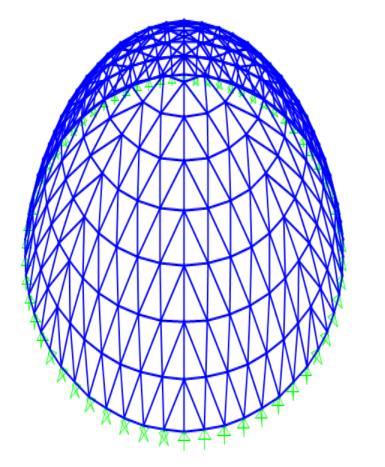
Figure 1 1. Reticulateddome'sstandardfloorplanand elevationareasabove
Table 1 - DomeParameters
DomeSpan 60m
RisetoSpanratio
0.20,0.25,0.30,0.35
Dome’sPattern K8 Kiewitt, K8 KiewittRibbed Hybrid, Dome withopening
Young’smodulus 210GPa
MaterialGrade Fe345
SectionProperties Hollow steel tubes i)0.095x3.500E-03 ii)0.102x3.000E-03
Table 2 – LoadingConditions
Deadload 0.5kN/m2
LiveLoad 1.5kN
ZoneFactor(Z) 0.24
ImportanceFactor(I) 1
Response reduction factor(R) 5
SoilType II–Medium
Table 3 – DomeModels
Deadload&Liveload 0.5kN/m2&1.5kN/m2
ZoneFactor(Z) 0.24
ImportanceFactor(I) 1
Responsereductionfactor(R) 5
SoilType II–Medium
1.2 MODAL ANALYSIS
Theseismicanalysisofareticulateddomestructurebegins withthefirstmodalanalysis,whichisconductedintheform oftheFundamentalNaturalTime-Period.Thetimetakenfor each complete cycle of oscillation is known as the FundamentalNaturalPeriodofthesystem.Thistimeperiod is an inherent characteristic of the system, allowing it to vibratefreelywithoutanyexternalforce,andisdependent onthemassandstiffnessofthestructure.Thenaturaltime period is inversely proportional to the frequency of the structure,indicatingthatastructurewithahighernatural time period is less rigid compared to one with a lower naturaltimeperiod.Therelationshipbetweenfrequencyand timeperiodisexpressedbythefollowingequation.
T=2π/ω
Theseismicbehaviorofthereticulatedvariousmentioned patterns of K8 dome structure is influenced by the rise to span ratio increase, which results in a corresponding increaseinthetimeperiod.Conversely,astherisetospan ratio decreases, the time period decreases in value. The stiffnessofthedomestructureisaffectedbythetimeperiod reductioninthereticulatedK8Kiewit-RibbedHybriddome. When comparing the modal time period of a rise to span ratioof0.2to0.25,thereisadecreaseof10.83%.Similarly, comparing a ratio of 0.25 to 0.30 results in a decrease of 3.91%, and comparing a ratio of 0.20 to 0.40 shows a decreaseof29.42%inthedome'smodaltimeperiod.

Chart 1 Timeperiodcomparisonfordifferentpatternof above-mentionedreticulateddomestructure.
InanalyzingthereticulatedK8domestructureswithvarious differentpatternreticulateddomestructurewhichvarying riseandrisetospanratios,itwasobservedthatasthedome rise increases, the time period value also decreases. Conversely,areductionintherisetospanratioleadstoan increase in the time period value. The stiffness of the K8 domestructuresisdirectlycorrelatedtothetimeperiod.For instance,whencomparingthemodaltimeperiodofa10m rise dome to an 20m span dome, there was a 21.36% increaseinthetimeperiodvalue.Similarly,comparingthe
International Research Journal of Engineering and Technology (IRJET) e-ISSN: 2395-0056
Volume: 11 Issue: 04 | Apr 2024 www.irjet.net p-ISSN: 2395-0072
modal timeperiodofa 0.20 h/sdometoa 0.35h/sdome resultedina29.13%increaseinthetimeperiodvalue.
2. P-DELTA ANALYSIS OF RETICULATED DOME STRUCTURE
P-Deltaanalysisisananalyticalmethodusedtoassessthe impact of deformation on structures when subjected to lateral loads such as wind or earthquakes. This technique takesintoaccountthesecond-ordereffectsthatarisefrom thedeformation,consideringbothaxialandtransverseloads appliedtobeamorwallelements.P-Deltaanalysisbecomes necessarywhenastructureexperiencessignificantvertical andlateralforcessimultaneously,resultinginbothfirstand second-orderlateraldisplacement.Thisanalysisaddresses thenonlineargeometriceffectcausedbytheinteractionof large direct stress with transverse bending and shear behavior.
Table 4 - DomemodelforVariouspatterndomeforPdeltaeffect
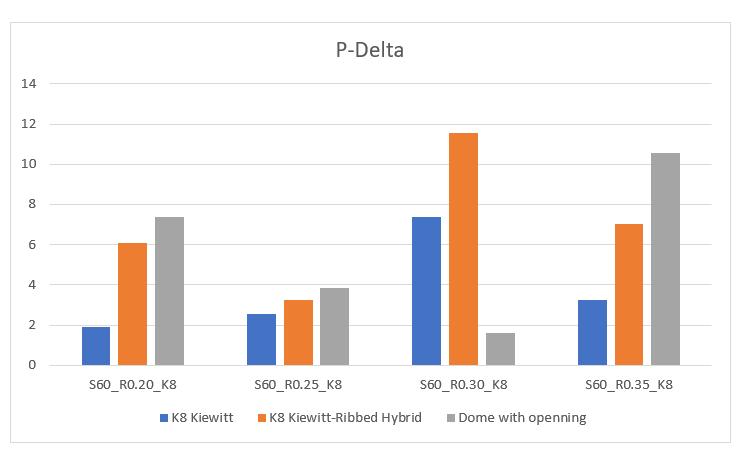
Chart 2 P-DeltaComparisonGraph
IndianStandard(IS)codesofferrecommendationsfor structuralanalysisanddesign.WhenitcomestoP-Delta effects,IScodesusuallysuggestloadcombinationsthat includedeadload(DL)andliveload(LL).Somecommon combinationsare:
1.2 DL + 0.5 LL: Considered conservative for overall swayeffects.
1.0DL+0.7LL:Providesaccurateresultsforcapturing P-Deltaeffectcausedbysway.
1.0DL+0.5LL:Consideredconservativeintheabsence oflateralload.
Scalefactor: DL-1.4 LL-0.7
D_S60_R0.30_K8 K8 Kiewitt-Ribbed Hybrid dome has higher P-delta value than H_S60_R0.30_K8andO_S60_R0.30_K8.
D_S60_R0.30_K8K8Kiewitt domehashigherPdelta value than H_S60_R0.30_K8 and O_S60_R0.30_K8.
D_S60_R0.35_K8 K8 Dome with opening has higherP-deltavaluethanH_S60_R0.20_K8and O_S60_R0.25_K8.
Differencesaround0.50-0.52%betweenthese variouspatternvaluesofP-Deltaanalysis.
2.2 Plastic Hinge
The K8 modal of the reticulated dome structure is characterizedbyaD_S60_R0.20_K8domestructure,withthe plastichingedeformationoccurringatthecentermarkedby the“•”.Althoughtheforty-eightmembersnearthesupport experienceplasticdeformationatthetop,theyareallinthe B-IO stage. There is no requirement for repair, and the structurecanbeusedwithoutinterruption.
International Research Journal of Engineering and Technology (IRJET) e-ISSN: 2395-0056
Volume: 11 Issue: 04 | Apr 2024 www.irjet.net p-ISSN: 2395-0072


2.1 D_S60_R0.20_K8andD_S60_R0.25
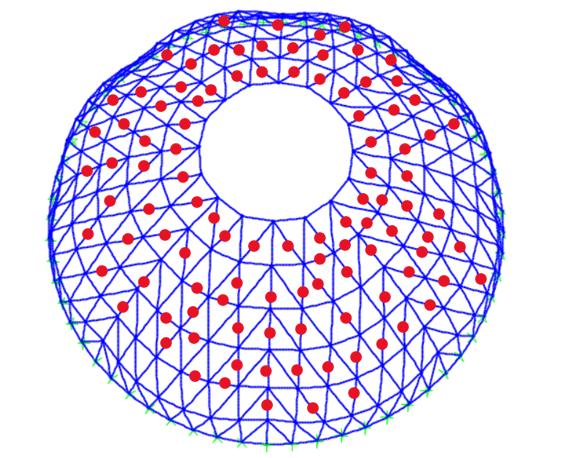
2.2 O_S60_R0.20_K8
TheK8domestructureisamodelofthereticulateddome structurewith8members,featuringa plastichingeat the center of plastic deformation. The top of the plastic deformation stage near the support consists of sixty-four members.
2.3 COMPARISON OF DIFFERENT PATTERNS RETICULATED DOME STRUCTURE
Table 5 – Displacement&Baseshearatultimatepoints
Displacement & Base Shear at ultimate point
Model
H_S60_0.20_K8
H_S60_0.25_K8 307814.38 850.631
H_S60_0.30_K8 253020.63 560.75
H_S60_0.35_K8 139004.38 188.977
O_S60_0.20_K8 369804.31 298.977
O_S60_0.25_K8 607814.38 740.631
O_S60_0.30_K8 353020.63 390.75
O_S60_0.35_K8 239004.38 169.977

Chart 3- ComparisonofultimateBaseShearforvarious configurationsofreticulateddomestructures.
International Research Journal of Engineering and Technology (IRJET) e-ISSN: 2395-0056
Volume: 11 Issue: 04 | Apr 2024 www.irjet.net p-ISSN: 2395-0072

4 – ComparisonofultimateDisplacementfor variousconfigurationsofreticulateddomestructures.
3. CONCLUSIONS
The reticulated dome models demonstrate thatamongvariousgeometricfactorstaken intoaccount,onlythe"rise-to-spanratio" andthe"relativestiffnessofthesupports" haveasignificantimpact.
Thereticulateddomeofthedisplacementof less than 1/400 of rise of the structure is safe(IS1893part4).
InaccordancewithIS1893(part4),atall structure with a plan dimension greater than its height must be engineered to accommodate a vertical displacement of 1/400 of its height. Various designs of reticulateddomemodels withrisetospan ratios of 0.20 and 0.30 only meet the necessarycodalcriteria.
The seismic behavior of the reticulated various mentioned patterns of K8 dome structureis influencedby therise tospan ratio increase, which results in a correspondingincreaseinthetimeperiod. Conversely, as the rise to span ratio decreases, the time period decreases in value.
The stiffness of the dome structure is affectedbythetimeperiodreductioninthe reticulatedK8Kiewit-RibbedHybriddome.
Whencomparingthemodaltimeperiodof arisetospanratioof0.2to0.25,thereisa decreaseof10.83%.Similarly,comparinga ratioof0.25to0.30resultsinadecreaseof 3.91%, and comparing a ratio of 0.20 to 0.40 shows a decrease of 29.42% in the dome'smodaltimeperiod.
Anincreaseintherisetospanratioresults inanincreaseinbothEQandgravityload. The EQ and gravity load values for the reticulatedK8domeare66.784KN
Differences around 0.50-0.52% between these various pattern values of P-Delta analysis.
The rise in various reticulated dome structures increases the stiffness of the dome.
The rise to span ratio of the reticulated domestructureincreasesasthetimeperiod anddisplacementincrease.
The response modification factor and ductility factor have an impact on the reticulateddomestructure.
ACKNOWLEDGEMENT
I express my sincere thanks to Prof. Dipak Jivani for their utmostguidanceandmotivationonbothresearchaswellas onmycareer.
REFERENCES
1. Anu J S, Preethi M. “Parametric Analysis of Single layer Ribbed dome with Diagonal membres”. InternationalResearchJournalofEngineeringand Technology (IRJET) , Volume: 04 Issue: 08 | Aug2017
2. DewenKong,LinglingWang,LiaoWu,YuxiaZhang. “Influence of Column Supports on Seismic Performance of K8 Single-Layer Spherical Reticulated Domes with Friction Pendulum Bearings”.InternationalJournalofSteelStructures, 2018.
3. Jie Zhong , Xudong Zhi , Feng Fan. “Sensitivity of Seismic Response and Fragility to Parameter Uncertainty of Single-Layer Reticulated Domes”. InternationalJournalofSteelStructures,2018
4. MingZhang,Yao-PengLiu,Zhi-XiangYuandGerry Parke.“STUDYOFSEISMICRESISTANCEOFKIEWIT8DOMECONSIDERINGKEYSTRUCTURALDESIGN PARAMETERS”.AdvancedSteelConstruction – Vol. 15No.4(2019)386-397.
5. . Dr. Usha S and Parvathy K.T. “Structural PerformanceofSingleAxialExpandedDomeunder SeismicLoading”InternationalResearchJournalof EngineeringandTechnology(IRJET)Vol.9Issue06, June-2020
6. DewenKong,LinglingWang,LiaoWu,YuxiaZhang. “Influence of Column Supports on Seismic Performance of K8 Single-Layer Spherical Reticulated Domes with Friction Pendulum Bearings”.InternationalJournalofSteelStructures, 2018.
International Research Journal of Engineering and Technology (IRJET) e-ISSN: 2395-0056
Volume: 11 Issue: 04 | Apr 2024 www.irjet.net p-ISSN: 2395-0072
7. Fengyuan Yang, Xudong Zhi , Feng Fan. “Effect of complex damping on seismic responses of a reticulateddomeandshakingtabletestvalidation”. Thin-WalledStructures134(2019)407–418
8. FAN Feng , WANG Duozhi , ZHI Xudong , SHEN Shizhao.“FailureModesforSingle-LayerReticulated Domes Under Impact Loads” Trans. Tianjin Univ. 2008,14:545-550
9. F. Fan, S. Z. Shen and G. A. R. Parke. “Study of the Dynamic Strength of Reticulated Domes under SevereEarthquakeLoading”.InternationalJournalof SpaceStructuresVol.20No.42005.
10. Gui-bo Nie , Xing-long Zhu , Xu-dong Zhi, Fuyang Wang, JunwuDai.“StudyonDynamicBehaviorof Single-Layer Reticulated Dome by Shaking Table Test”.InternationalJournalofSteelStructures,2017.
11. Gui-bo Nie , Xu-dong Zhi , Feng Fan, Jun-wu Dai . “Seismic performance evaluation of single-layer reticulateddomeanditsfragilityanalysis”.Journalof ConstructionalSteelResearch,2014.
12. MingZhang,Yao-PengLiu,Zhi-XiangYuandGerry Parke.“STUDYOFSEISMICRESISTANCEOFKIEWIT8DOMECONSIDERINGKEYSTRUCTURALDESIGN PARAMETERS”.AdvancedSteelConstruction – Vol. 15No.4(2019)386-397.
13. Seyed Mehdi Zahrai, Saeed Abbasi. “Study on PossibilityofUsingTunedLiquidDampers(TLD)in High Frequency Structures” 2011 International ConferenceonTechnologicalAdvancementsinCivil Engineering(ICTACE2011).
14. Willem Gythiel, Christiaan Mommeyer, Tom RaymaekersandMattiasSchevenels.“AComparative Study of the Structural Performance of Different TypesofReticulatedDomeSubjectedtoDistributed Loads”.FrontiersinBuiltEnvironment,2020
15. 3. X. D. Zhi and M. G. Stewart. “Damage and Risk Assessment for Single-Layer Reticulated Domes Subject to Explosive Blast Loads”. International JournalofStructuralStabilityandDynamicsVol.17, No.9(2017).
16. .XiaoyangLu,NingHong,ShiyingChen,PingZhang and Yingying Bai. “Parametric Modeling of Hybrid type single Reticulated Dome”. 2nd International ConferenceonElectronic&MechanicalEngineering andInformationTechnology(EMEIT-2012)
17. . Qinghua Han, Mingjie Liu, Yan Lu and Chenxu Wang.“ProgressiveCollapseAnalysisofLarge-span Reticulated Domes”. International Journal of Steel Structures(2014)
18. X.D.Zhi,G.B.Nie,F.Fan,andS,Z,Shen.“Vulnerability andriskassessmentofsinglelayerreticulateddomes subjected to earthquake” Journal of structural engineering(2012)