
International Research Journal of Engineering and Technology (IRJET) e-ISSN:2395-0056
Volume: 11 Issue: 04 | Apr 2024 www.irjet.net p-ISSN:2395-0072
International Research Journal of Engineering and Technology (IRJET) e-ISSN:2395-0056
Volume: 11 Issue: 04 | Apr 2024 www.irjet.net p-ISSN:2395-0072
Bhavani R1, Agalya V2, Kiruthika N3, Sugapriya C4
1234Dept. of Computer Science and Engineering, Government College of Engineering Srirangam,TamilNadu, India
Abstract - Agriculture is a critical sector that significantly relies on accurate and timely decision-making for optimal crop yield and resource utilization. This paper presents a novel approach to crop recommendation by leveraging the power of deep neural networks (DNNs) to analyze soil properties and climatic conditions. The proposed system aims to enhance the efficiency of crop selection, thereby contributing to sustainable and productive farming practices. The system utilizes a comprehensive dataset comprising soil characteristics and environmental characteristics. A deep neural network architecture is designed to process and learn complex relationships within a dataset, enabling the model to capture intricate patterns and dependencies that influence cropsuitability.
Key Words: DeepNeuralNetwork,Croprecommendation System,Machinelearning,DeepLearning.
Crop recommendation systems are very useful technologies that help farmers choose crops that will maximize yields by providing them with information. To providetailoredsuggestions,thesesystemsmakeuseofa multitude of data, such as past crop performance, soil properties, and weather patterns. The suggested technique will help farmers maximize agricultural productivity, reduce nutrient loss in crop fields, and use less fertilizers in crop production by using an artificial neural network to suggest a suitable crop based on various factors like the composition of phosphorus, potassium, and nitrogen in the soil, the pH value of the soil, rainfall, temperature, and humidity. Neural networks are used by Deep Learning to model and resolve complicated issues. An artificial neural network (ANN) havingseverallayersbetweenthemiscalledadeepneural network (DNN). In the past, farmers have made crop selection decisions based on their own experiences, local expertise, and broad recommendations. But now that cutting-edge technologies, especially neural networks, emerged,accuratefarmingisenteringanewphase.Aswe continue to innovate in agricultural technology, neural network-basedcroprecommendationsystemsrepresenta promising step towards a more resilient and sustainable futureinfarming.
The recommender model is built as a hybrid model using classifier algorithms such as Naive Bayes, J48, and association rules. Based on the appropriate parameters, the system will recommend the crop. The paper aims to create a hybrid model for recommending crops to south Indianstatesbyconsidering variousattributes[1].Acrop recommendationsystemhasbeendevelopedthatemploys machine learning algorithms to recommend the crop that can be harvested in that particular soil. There are several machine learning algorithms available in this system, including KNN, Decision Tree, Random Forest, Naive Bayes, and Gradient Boosting to recommend the crop.[2] Crop recommendation systems can help farmers and agricultural organizations make informed decisions about crop selection and maximize yields and profits. This technology is increasingly important as the world population continues to grow, and agricultural productivity needs to keep up with demand. To recommend the best crop to plant, the SVM algorithm is utilized [3]. The motive of the system is to enhance accuracy, so a hybrid approach using K-nearest neighbor (KNN)andRandomForest(RF)algorithmsisemployed.It introduces an accessible and user-friendly solution for crop recommendations and yield predictions. Users provideinputssuchastemperature,humidity,soilpH,and rainfall [4]. The AI system helps precision agriculture improve overall crop harvest quality and accuracy. This research feature selection, Industry 4.0, proposes one solution,suchasarecommendationsystem,usingAIanda family of machine learning algorithms. Crop recommendation for an effective prediction system using machinelearningisfirsttogatherandpreprocessthedata from the relevant research institutions of Bangladesh and then propose an ensemble machine learning approach, called K-nearest Neighbour Random Forest Ridge Regression (KRR), to effectively predict the production of the major crops (three different kinds of rice, potato, and wheat). KRR is designed after investigating five existing traditional machine learning (Support Vector Regression, Naïve Bayes, and Ridge Regression) and ensemble learning(RandomForestandCatBoost)algorithms.[5]
Theoverallarchitectureoftheproposedrecommendation model is given in figure(1). This proposed approach utilizes classification approach in content based recommendationsystem.
International Research Journal of Engineering and Technology (IRJET) e-ISSN:2395-0056
Volume: 11 Issue: 04 | Apr 2024 www.irjet.net


p-ISSN:2395-0072

Soilcharacteristics (Nitrogen,Phosphorous, Pottasium,PH)



Environmental characteristics (Rainfall, Temperature,Humidity)

The neural network architecture used in this paper for experimentation is given in figure (2). Input data is fed into the trained model, and the output layer produces predictions based on the learned parameters and computationsperformedduringforwardpropagation.

Datapre-processing (Normalization)

TrainingDeep Neural Network
Trainedmodel
Recommendation

Fig -1:Systemarchitecture
Thesystemfirstcollectsrelevantdata,preprocessesitand applies Deep neural network for making recommendations. Each phase is explained in the followingsections.
3.1
Data collection is the most common approach for gatheringandanalyzinginformationfromvarioussources. The data for this paper was downloaded from [7] There are 2200 records of data represented with 7 features. Among them four features represent soil characteristics viz, Nitrogen, Phosphorus, Potassium, PH and three features represent environmental; characteristics viz, rainfall,temperatureandhumidity.
3.2.
Thenextstep ispre-processingthedata beforethemodel canbetrained.Inthisstagedataisnormalizedusingminmaxnormalizationasgivenin(1).
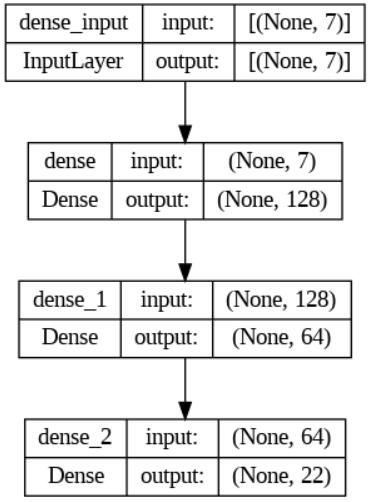
Fig -2:ProposedDNNmodel
The input layer is the initial layer where the raw data is fed into the network. It consists of nodes each of which representsafeatureoftheinputdata.Inthisarchitecture, there are 7 neurons in the input layer representing the seven features in the dataset. The seven features are Nitrogen, Phosphorus, Potassium, Rainfall, Temperature, PH,Humidity.
DNNs consist of one or more hidden layers sandwiched betweentheinputandoutput layers.Eachhiddenlayer is composed of multiple neurons. Neurons in each hidden layer receive input signals from the previous layer, perform computations, and pass the output to the next layer.thereare2hiddenlayersinthisarchitecturewithx andyneuronsineachlayerrespectively.
wherexmin istheminimumvalueofthefeatureandxmax is the maximum value of the feature. Data normalization converts the features to [0,1] scale. Next the normalized data is split into training and testing data in the ratio of 80:20.
Activation functions introduce non-linearity into the network,enablingittolearncomplexpatternsinthedata. ReLU is one of the most widely used activation functions in hidden layers due to its simplicity and effectiveness in mitigating the vanishing gradient problem and is given in (2).
International Research Journal of Engineering and Technology (IRJET) e-ISSN:2395-0056
Volume: 11 Issue: 04 | Apr 2024 www.irjet.net p-ISSN:2395-0072
TheoutputlayeroftheDNNproducesthefinalpredictions or outputs. The number of neurons in the output layer depends on the nature of the task. For example, in binary classification,theremaybeasingleneuronwithasigmoid activation function, while in multi-class classification, there may be multiple neurons with softmax activation. Sincethispaperrecommendsamongthe22classofcrops, it uses 22 neurons in the output layer with softmax activationfunctionasgivenin(3).
Thetrainedneuralnetworkprovidesrecommendationsto the users for the input features that they specify. The performance of the neural network model was then evaluatedusingtheaccuracymeasures.
The accuracy metric is widely used in evaluating the performance of crop recommendation systems. Accuracy measures the proportion of correctly classified instances outofthetotalinstancesevaluatedandisgivenin(4).
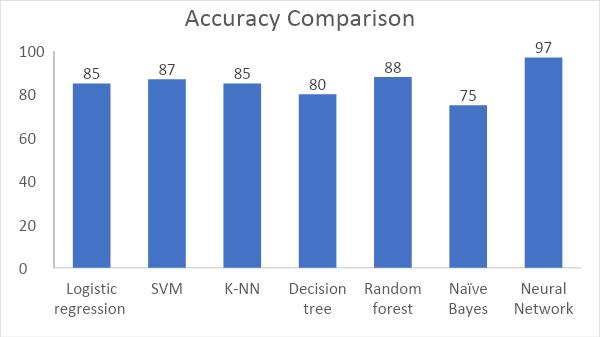
where TP is the number of true positives, TN is the number of true negatives, P is the number of positive samples and N is the number of negative samples. The accuracyscoreofvariousmachinelearningalgorithmsand the proposed model is tabulated in Table (1) and graphicallyrepresentedinFigure(3).Fromtheresultsitis observed that the proposed deep neural model outperformsalltheothermachinelearningalgorithmsfor croprecommendation.
Table1.Accuracyofthemodels
This system analyzes the soil characteristics and environmental characteristics to give better recommendationsofcropstofarmers.Theperformanceof the Deep Neural Networks proposed for crop recommendation outperforms all the other machine learning algorithms. By utilizing DNNs, the system can handle complex patterns and relationships within the data, leading to more accurate predictions and recommendations. Further features related to crop yield prediction could be studied and incorporated to achieve greater impacts in agriculture. Also, user-friendly mobile applications could be designed for easy access of crop recommendations by the farmers. The adaptability of these systems is particularly crucial in agriculture, where environmental conditions can vary widely from season to season. As new data becomes available and conditions change, neural networks can update their algorithms to ensure that recommendations remain accurate and relevant.
1. Tanmay Banavlikar,Aqsa mahir,Mayuresh Budukh,Soham Dhodapkar, “Crop recommendationsystemusing machine learning”, Volume: 05 Issue: 05 | May-2018, CorpusID:231784031.
2. ViviliyaB,VaidhehiV,“TheDesignofHybridCrop RecommendationSystemusingMachineLearning Algorithms ”, Volume-9 Issue-2, December 2019 9(2):4305-4311DOI: 10.35940/ijitee.B7219.129219
3. Pushpa, Shwetha, Ramya, Pooja, “Crop recommendation system using machine learning”,CEI-2022,Volume-10 Issue-11, , DOI : 10.17577/IJERTCONV10IS11044.
International Research Journal of Engineering and Technology (IRJET) e-ISSN:2395-0056
Volume: 11 Issue: 04 | Apr 2024 www.irjet.net p-ISSN:2395-0072
4. Prasad Mane, Abhaysingh Rajpurohit, Ankeeta Ahire, “Crop recommendation system using machinelearning”, Volume3,Issue2,March 2023,DOI:10.48175/IJARSCT-8875.
5. V. Nagesh, M. Moulika, K. Vaishnavi “Crop recommendation System using machine learning.”, Volume 11, Issue 12 December 2023, CorpusID:268099127.
6. Mahmudul Hasan, Md Abu Marjan , “Crop recommendation for effective prediction system using machine learning” Original Research, 10 August2023DOI10.3389/fpls.2023.1234555.
7. https://www.kaggle.com/code/vijay20213/croprecommendation-with-99-45-accuracy