
International Research Journal of Engineering and Technology (IRJET) e-ISSN:2395-0056
Volume: 11 Issue: 04 | Apr 2024 www.irjet.net p-ISSN:2395-0072
International Research Journal of Engineering and Technology (IRJET) e-ISSN:2395-0056
Volume: 11 Issue: 04 | Apr 2024 www.irjet.net p-ISSN:2395-0072
Anil Kumar1, Mr. Ushendra Kumar2
1Master of Technology, Civil Engineering, Lucknow Institute of Technology, Lucknow, India
2Head of Department, Department of Civil Engineering, Lucknow Institute of Technology, Lucknow, India
Abstract - Concrete is one of the most widely used construction materials globally, and its composition significantly impacts its properties and performance. The quest for sustainable construction practices has led researchers to explore alternative materials to enhance concrete's mechanical properties while reducing environmental impact. Marble dust, a byproduct of marble processing, has emerged as a potential candidate for partial replacement of fine aggregate in concrete mixtures. This reviewpaperpresentsacomprehensivecomparativestudyof the effects of incorporating marble dust in concrete mixes. Various aspects such as workability, compressive strength, tensile strength, durability, and environmental implications are critically analyzed and compared with traditional concrete mixtures. The review highlights the influence of differentfactorssuchasmarbledustparticlesize,dosage,and curingconditionsontheperformanceofmarbledustconcrete. Furthermore,challengesandopportunitiesassociatedwiththe utilization of marble dust in concrete production are discussed, providing insights for future research directions. Through a systematic evaluation of existing literature, this review aims to offer valuable insights into the potential of marble dust as a sustainable alternative in concrete productionandpavethewayforinformeddecision-makingin theconstruction industry.
Key Words: Concrete, marble dust, fine aggregate replacement, sustainable construction, mechanical properties, compressivestrength,tensilestrength.
Concreteisawidelyusedconstructionmaterialcomposed primarily of cement, aggregate (such as gravel and sand), andwater.It'saversatilematerialthatcanbeformedinto variousshapesandsizes,makingitsuitableforawiderange of construction applications, from buildings and roads to bridges and dams. Here are the main components of concrete:
Cement: Cementisthebindingagentinconcrete.It'safine powdermadefromlimestone,clay,andothermineralsthat areheatedinakilnandthengroundtoafinepowder.The mostcommontypeofcementusedinconcreteisPortland cement, which accounts for the majority of cement productionworldwide.
Aggregate: Aggregatesaregranularmaterialssuchassand, gravel,crushedstone,orrecycledconcretethatmakeupthe bulkofconcrete.Theyprovidestrengthanddurabilitytothe concrete mixture. Aggregates are divided into two categories: coarse aggregates (such as gravel or crushed stone)andfineaggregates(suchassand).Theproportionsof coarseandfineaggregatesusedinconcretemixturesvary depending on the desired strength and workability of the concrete.
Water: Water is essential for the chemical reaction that bindsthecementandaggregatestogethertoformconcrete. Theamountofwaterusedinaconcretemixtureaffectsits workability, strength, and durability. Too much water can weaken the concrete, while too little water can make it difficult to work with and result in a less durable final product.
Admixtures: Admixturesareadditionalmaterialsaddedto concrete mixtures to modify its properties or enhance its performance. They can be used to improve workability, increase strength, reduce water content, or enhance durability. Common types of admixtures include airentraining agents, water reducers, accelerators, retarders, andplasticizers.
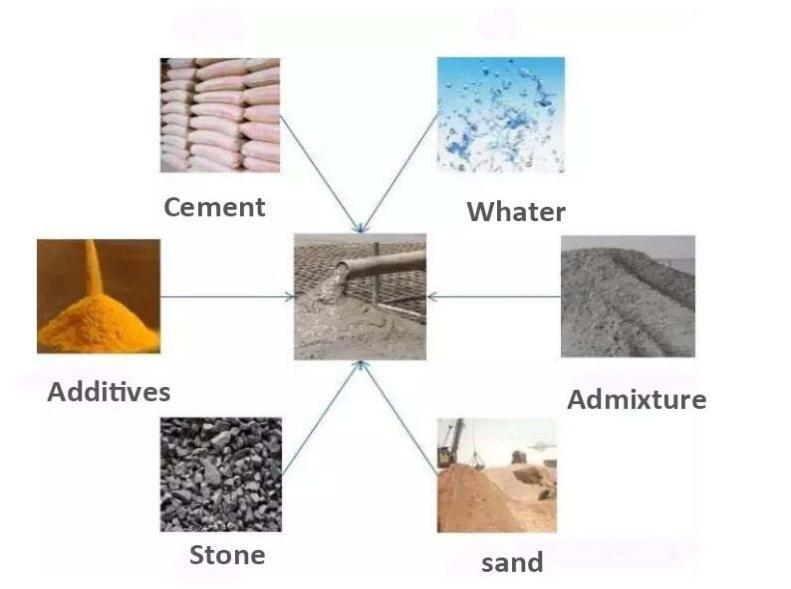
Component of concrete
International Research Journal of Engineering and Technology (IRJET) e-ISSN:2395-0056
Volume: 11 Issue: 04 | Apr 2024 www.irjet.net p-ISSN:2395-0072
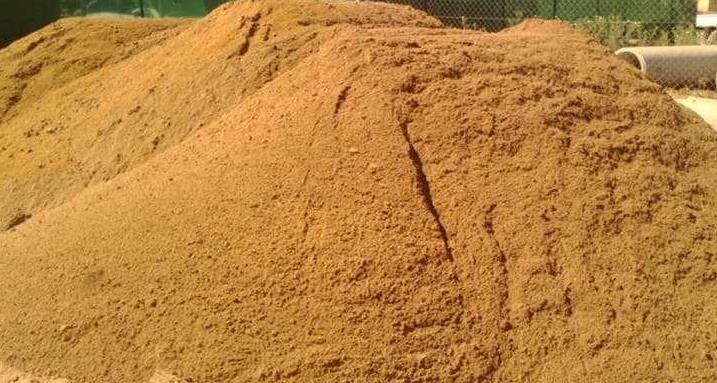
Fineaggregateisanindispensablecomponentinconcrete, playingamultifacetedroleindeterminingitspropertiesand performance. Primarily, it enhances the workability of concrete mixtures by filling the voids between coarse aggregatesandfacilitatingsmoothplacementandfinishing. Moreover, fine aggregate significantly contributes to the strength and durability of concrete by promoting proper particle packing and enhancing the bonding with cementitious materials during hydration. This not only ensures structural integrity but also optimizes the use of cement, thereby offering economic benefits. Additionally, fine aggregate aids in controlling volume changes, minimizingcracking,andimprovingdimensional stability. Its texture influences surface finish, making it crucial for aesthetic applications. Furthermore, fine aggregate helps mitigate issues like bleeding and segregation, ensuring uniformity in the mixture. Lastly, in scenarios requiring pumping, the quality and gradation of fine aggregate are pivotalformaintainingflowcharacteristicsandpreventing blockages. In essence, the importance of fine aggregate in concreteliesinitsabilitytoenhanceworkability,strength, durability, economy, surface finish, volume stability, and pumpability, making it an indispensable constituent of concretemixtures.
Marble dust, a finely ground powder originating from the grinding of marble, finds versatile applications across diversefields.Primarilyembracedbyartistsandsculptors,it servesasafundamentalmaterialforcraftingsculpturesand artworkswhencombinedwithbindingagentslikeresinor plaster. Additionally, in construction, it bolsters the properties of concrete and mortar mixes, enhancing their strength,durability,andworkability.Marbledustalsoplays asignificantroleintheproductionofmarble-basedflooring tiles and countertops, augmenting both their aesthetic appealandperformance.Moreover,itfeaturesincosmetics and personal care products, contributing to exfoliating scrubsandmasksowingtoitsgentleyeteffectiveremovalof
deadskincells.Inhorticulture,gardenersintegratemarble dust into potting mixes or soil amendments to improve drainage and aeration, along with soil pH adjustments. Furthermore, it is instrumental in the restoration and polishing of marble surfaces, providing a lustrous finish when mixed with water or polishing compounds. While boasting diverseapplications,prudenthandling of marble dust is imperative due to potential respiratory hazards associated with its dry form. Thus, adherence to safety protocolsisparamounttomitigatehealthrisks.
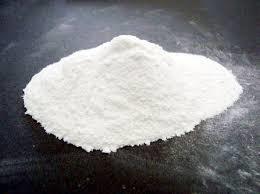
Marbledustpossessesseveralcharacteristicsthatmakeita valuablematerialforvariousapplications:
Fine Particle Size: Marbledustistypicallygroundtoavery fineparticlesize,whichgivesitasmoothtextureandallows it to be easily mixed with other materials such as resins, plasters,orconcrete.
White Color: Dependingonthesourceofthemarble,marble dustisoften whiteoroff-whiteincolor. Thiscoloration is desirable for many applications where a bright, clean appearanceispreferred.
Chemical Inertness: Marble dust is chemically inert, meaning it does not react with most substances. This property makes it suitable for use in a wide range of applicationswithoutcausingunwantedchemicalreactions.
Compressive Strength: Whenincorporatedintoconcreteor mortar mixes, marble dust can enhance the compressive strengthanddurabilityoftheresultingmaterial.Thismakes itvaluableinconstructionapplicationswherestrong,longlastingstructuresarerequired.
Aesthetic Appeal: In art and sculpture, marble dust is valuedforitsabilitytomimictheappearanceandtextureof marble when mixed with binding agents. It can create a visually striking finish that resembles real marble at a fractionofthecost.
International Research Journal of Engineering and Technology (IRJET) e-ISSN:2395-0056
Volume: 11 Issue: 04 | Apr 2024 www.irjet.net p-ISSN:2395-0072
Absorbent Properties: Marble dust has absorbent properties,whichcanbebeneficialinapplicationssuchas cosmetics and horticulture. It can help absorb excess moisture or oils, making it useful in formulations for skincareproductsorasasoilamendmentingardening.
4.REPLACEMENT OF MARBLE DUST AS FINE AGGREGATE
The replacement of marble dust as a fine aggregate in concreteorotherapplicationscanhaveseveralimplications, bothpositiveandnegative.Herearesomepointstoconsider:
4.1.Positive Aspects
Resource Conservation: Utilizing marble dust as a substitute for traditional fine aggregate can help in conservingnaturalresourcesbyreducingthedemand for sand, which is often dredged from rivers and beaches.
Waste Reduction: Marbledustisoftenabyproductof marble processing industries. By using it as a replacement for fine aggregate, it provides a sustainable solution for disposing of this waste material.
Improved Aesthetics: Depending on the source and quality of the marble dust, it may offer aesthetic benefitsbyimpartingauniqueappearancetoconcrete or other materials, such as a white or off-white colorationthatresemblesnaturalmarble.
Enhanced Properties: Marbledustcancontributeto improved properties of concrete, such as increased compressive strength, reduced permeability, and enhanced durability, when used in the appropriate proportions.
4.2.Negative Aspects
Workability Issues: Marble dust may affect the workabilityofconcretemixesduetoitsfinerparticle size and different particle shape compared to traditionalfineaggregatelikesand.Adjustmentstothe mix design may be necessary to maintain desired workability.
Potential Alkali-Silica Reaction (ASR): Thereisarisk of alkali-silica reaction when using marble dust, particularly if it contains reactive silica components. This reaction can lead to expansion and cracking of concrete over time, compromising its structural integrity.
Cost Considerations: While marble dust may be readily available as a waste product from marble processing,transportationandprocessingcosts,aswell
as any additional processing required for its use as a fineaggregatereplacement,couldaffectitsoverallcosteffectivenesscomparedtotraditionalmaterials.
Quality Control: Ensuring the consistent quality of marble dust can be challenging, as it may vary in compositionandpropertiesdependingonfactorssuch asthesourceofthemarbleandtheprocessingmethods used. Quality control measures may be necessary to maintaindesiredperformance.
5.STRENGTHIMPROVEMENT OF THE CONCRETEBY USING DIFFERENT FINE AGGREGATE.
Improvingthestrengthofconcretecanbeachievedthrough variousmeans,oneofwhichisbyutilizingdifferenttypesof fine aggregates. Fine aggregates typically constitute a significant portion ofconcretemixturesandplaya crucial roleindeterminingthepropertiesoftheconcrete.Hereare some ways in which the strength of concrete can be enhancedbyusingdifferentfineaggregates:
1. Particle Shape and Texture: Theshapeandtextureof fineaggregatescansignificantlyinfluencethestrength ofconcrete.Usingfineaggregateswithangularorrough surface texture can improve interlocking between particles, leading to increased strength compared to roundedorsmoothaggregates.
2. Grading of Aggregates: Properly graded fine aggregates ensure better packing density within the concretemixture,resultinginimprovedstrengthand reduced voids. Fine aggregates with a continuous gradingcurvecanenhancetheoverallperformanceof concrete.
3. Size and Fineness Modulus: Fine aggregates with a suitable size distribution and fineness modulus can enhance the workability and strength of concrete. A balancedcombinationofcoarseandfineparticlescan optimize packing density and reduce the amount of cementpasterequired,therebyimprovingstrength.
4. Mineralogy and Composition: Differenttypesoffine aggregates, such as sand, crushed stone dust, quarry dust, manufactured sand, etc., possess varying mineralogical compositions. Some aggregates may contain minerals that contribute to pozzolanic reactions,resultinginimprovedstrengthanddurability ofconcrete.
5. Surface Characteristics: Surfacecharacteristicssuch asporosity,absorption,andsurfaceroughnessoffine aggregatescaninfluencethebondbetweenaggregates and cement paste. Fine aggregates with low porosity and absorption rates tend to produce concrete with higherstrengthanddurability.
International Research Journal of Engineering and Technology (IRJET) e-ISSN:2395-0056
Volume: 11 Issue: 04 | Apr 2024 www.irjet.net p-ISSN:2395-0072
6. Chemical Admixtures: Incorporating chemical admixturessuchassilicafume,flyash,metakaolin,or microsilica in concrete mixtures can enhance the strength by filling voids, improving particle packing, and promoting pozzolanic reactions with calcium hydroxide.
Inthis,wewillstudyaboutthepreviousresearchworkbased onthereplacementofthefineaggregatefromtheconcrete byusingthedifferentmaterial.Thesummaryoftheprevious researcharegivenbelowinthedetails.
Fikri & Ninda: Partial replacementoffineaggregate with marble dust in concrete showed an optimal 6.62% replacement by weightof cement,increasingcompressive strengthby11.77%intheexperimentalstudy.Marbledust canbeusedasafillerinconcretetoreducecementcontent. The optimum usage of marble dust is 6.62% by weight of cement, resulting in a 11.77% increase in compressive strengthofconcrete.Marbledustwasusedasanalternative materialinconcrete.Theadditionofmarbledustincreased thecompressivestrengthofconcrete.
Yeng et.al: Optimumpercentageof10%FMKand10%CBA had highest compressive strength. 10% to 50% CBA replacement is suitable with 10% FMK substitution. Investigatedcombinationoffine-metakaolinandcoalbottom ash in seawater-concrete. Found 10% FMK and 10% CBA hadhighestcompressivestrength.
Shahid et.al: RHA and RWG can be used as partial replacementsinconcrete10%replacementofRHAandRWG isrecommended.RWGcanreplacenaturalsandinconcrete productionRHAcanreplacecementinconcreteproduction.
Bishen & Madan: Partial replacement of cement with marble dust in concrete enhances compressive strength. Marble dust improves concrete quality by densifying the matrix,asshownthroughUltrasonicPulseVelocitytesting. Optimum value of marble dust as substitute for cement is around10%.Goodqualityconcretecanbedevelopedwith up to 10% marble dust. Marble dust is investigated as a partial replacement for cement in concrete.Compressive strengthandultrasonicpulsevelocitytestsareconductedto assessthequalityoftheconcrete.
Zuzanna et.al: Inthisarticle,theeffectofreplacingcement with waste granite powder on the properties of fresh and hardened mortars intended for masonry applications was studied.Andtheresultsshowedthatthepartialreplacement ofcement with thegranite powder significantlyincreased the water sorption coefficient and the consistency of the fresh mortar, and its density and water absorption also increased whencomparedtothe referenceseries.Granite powder can partially replace cement in masonry mortars.
Propertiesofmortarswithgranitepowderarecomparable toreferenceseries.
Zalipah et.al: In this paper , the effect of a lower sand replacementcontent(5−25%)inglasswaste(smallerthan 5mm)onboththemechanicalanddurabilitypropertiesof concretewasinvestigated.Lowerreplacementpercentageof glasswasteenhancesconcreteproperties.Glasswastecan actasasustainableandalternativematerialinthefuture.
Basaran et.al: Partial replacement of fine aggregate with marbledustinconcretecansignificantlyimpactcompressive strength, with up to 50% replacement showing notable changes,asindicatedbymultivariateregressionanalyses.In thisarticle,theresultsofaxialcompressiontestsonatotal of 429 concrete mixtures with marble aggregates were compiled by paying special attention to reporting all test variables(formandcontentofmarblewastes,water-cement ratio, cement content, proportion of coarse and fine aggregatesinallaggregates)affectingtheconcretestrength. Replacing fine aggregates with marble powder up to 15% improves compressive strength. Replacing both fine and coarseaggregateswithmarbleaggregatesmayhaveadverse effectsoncompressivestrength.
Roshan et.al: In this article , the authors used different dosagesofmarblewasteaggregates(MWA)andstonedust (SD) as a replacement for coarse and fine aggregate, respectively,toevaluatethephysicalpropertiesofconcrete. PartialsubstitutionofMWAandSDinconcreteisfeasible. Optimalmixture:15%MWAand50%SDforhigherstrength.
Haitham et.al: In this paper , the effect of the partial replacementofordinaryPortlandcementwithCKDonthe engineering properties of pozzolanic concrete for use in block manufacturing was investigated, and the results showedthatincreasingCKDcontentloweredthevoidsand increased the water absorption. Increasing CKD content lowers voids and increases water absorption. 15% CKD samplehashighestcompressivestrength.
Zhao et.al: In this article , the authors proposed a methodology for quantitatively assessing the life-cycle economicandenvironmentalimpactswhenrockdustisused inPCCpavementroadwayconstruction,whichcanachieve substantialbenefitsinsavingnatureresourcesandreducing energy consumptionaswell asgreenhousegas emissions. Usingrockdustinconcretepavementsprovidescostsavings andenvironmentalbenefits.Thebestsustainableoptionisto replace20%fineaggregateand10%cementwithrockdust.
Kiran et.al: Inthisarticle,theauthorsexploredtheuseof waste plastic as a fine aggregate replacement in mediumstrength reinforced concrete pavements, for improving plastic aggregate performance and the intrinsic reasoning forobservedstrengthperformance. 5%replacementoffine aggregates with plastic waste is feasible. 10% plastic replacementmaybefeasibleinnon-primarystructures.
International Research Journal of Engineering and Technology (IRJET) e-ISSN:2395-0056
Volume: 11 Issue: 04 | Apr 2024 www.irjet.net p-ISSN:2395-0072
Farah et.al: Inthisarticle,theinfluenceofspentgarnetasa fine aggregate substitute on the fresh, mechanical, and durability properties of palm oil clinker concrete was determined, including workability, compressive strength, flexural strength, splitting tensile strength, modulus of elasticity,waterabsorption,andacidresistanceofthewater curedconcrete. Workabilityofconcreteincreasedwiththe increaseofspentgarnetcontent.Durabilitypropertiessuch aswaterabsorptionandacidresistancewereenhanced.
Christopher et.al: Inthispaper,astudywasconductedto evaluatethedurabilityandinvestigatethemicrostructureof concretewithfineaggregatepartiallyreplacedbypulverized termitemound(PTM).PTMimprovesdurabilityofconcrete up to 70% replacement. Concrete with PTM has smaller porescomparedtocontrol.
Thamer et.al: In this paper , the measured mechanical characteristicsofconcretewerestudiedinfivemixes,both with and without internal curing, and the results showed that the ceramic and Attapulgite internal curing purposes were highly effective, especially with a 20% replacement. CeramicandAttapulgiteinternalcuringmaterialsenhance concrete characteristics. 20% replacement rate shows highestcompressiveresistanceimprovement.
Aliyu et.al: In this paper, the effect of partially replacing cement with quarry dust in cement-sand mortar was investigated, and the results showed that the partial replacement shows an improvement of compressive strength at 5% quarry dust content after which there is a decrease with increase in quarry dust contents at all the ages.Quarrydustcanreplacecementupto5%.Above5%,it canreplacefineaggregateinlow-strengthmortar.
Jahanzaid et.al: Inthispaper,anendeavorhasbeenmadeto think about the regular concrete and lightweight total substantial utilizing blend M25, which is made by Partial ReplacementofCoarseAggregatewithvariousproportions ofPumicegoingfromhalf,60%,and70%.Beststrengthwith 60%pumiceaggregatereplacement.Lightweightconcrete suitablefornon-structuralpartitions.
Chamini et.al: Inthispaper,thefeasibilityofusingflyashas apartialfineaggregatereplacingmaterialinconcreteandits effects on the compressive strength and some significant durability properties when cured under different curing temperatures.Flyashasapartialfineaggregatereplacement increases compressive strength in concrete. Higher fine aggregatereplacementpercentageleadstohigherstrength gain.
Bilawal et.al: Thestudyfocusesonthecombinedeffectof marble powder and ceramic tile waste as partial replacements in concrete, impacting workability and compressive strength negatively with increasing replacement ratios. In this article, the combined effect of wastemarblepowder(M.P)andCeramictilewaste(CTW)as
partialreplacementofCement(10%)andCoarseAggregates (10,20,30% respectively) is observed and analyzed. Compressive strength of concrete with replacement is approximately same as that of Conventional Concrete at (10%+10%). Workability and Compressive Strength of Concretedecreasewithincreasingratioofreplacement.
Priya et.al: The study focuses on partial replacement of cement with marble dust and glass powder in concrete, aimingtoreducecosts,controlemissions,andpromoteecofriendly construction practices. The use of waste marble powderasapartialreplacementofcementcanreducethe costofcementandalso,controltheemissionofharmfuldust into environment and proving to be eco-friendly to the environment as mentioned in this paper. Slump of fresh concreteincreasedat30%replacement(10%marbledust powder,20%glasspowder).Strengthlossincompressive, flexural, and split tensile strength increased after 30% replacement
Begashaw & Bahiru: Partial replacement of sand with marble waste in concrete enhances compressive strength butreducesworkability.Optimumlevelsare22.5%marble waste and 44.5% scoria, saving costs up to 4.5%. In this article, the chemical, physical, mechanical, and fresh propertyofconcretecontainingmarblewasteandscoriawas investigated and it was shown that the workability and compressive strength decrease with an increase in the contentofmarblewaste.Concretecontainingmarblewaste and scoria shows better compressive strength. Optimum replacementlevelis22.5%marblewasteand44.5%scoria.
Habib & Maan: Partialreplacementoffineaggregatewith marble dust in concrete positively impacts strength and microstructure properties, enhancing flowability and cohesion,asshowninrecentresearchtrends.Inthispaper, the authors summarize recent investigations on the properties of concrete incorporating marble waste as cementreplacementmaterials,highlightthepotentialgaps in the literature, and propose a prediction model for estimating the compressive and flexural strengths of concretewithmarbledustusingregressionanalysis.Marble dustcanpositivelyimpactthestrengthandmicrostructure propertiesofconcrete.Marbledustcanbeusedasafillerto improvetheflowabilityofcement-basedmaterial.
Pradeep & Vias: The study compared the effects of replacing fine aggregate with marble dust in concrete, showing increased compressive and flexural strength initially,peakingat20%marblepowderreplacement.Inthis paper, a design mix of concrete was designed by partially replacing cement with bagasse ash, fine aggregate with marblepowderandcoarseaggregatewithrecycledconcrete aggregate at varying proportions. Compressive strength peakswith20%SBA,20%MarblePowder,25%RCA.Split tensilestrengthpeakswith20%SBA,40%MarblePowder, 25%RCA.
International Research Journal of Engineering and Technology (IRJET) e-ISSN:2395-0056
Volume: 11 Issue: 04 | Apr 2024 www.irjet.net p-ISSN:2395-0072
Inconclusion,thiscomparativestudyontheeffectsofpartial replacementoffineaggregatewithmarbledustinconcrete provides valuable insights into the potential benefits and challenges of utilizing marble dust as a sustainable alternative in construction materials. Through a thorough examinationofvariousparametersincludingcompressive strength,workability,durability,andenvironmentalimpact, itbecomesevidentthattheincorporationofmarbledustcan significantly influence the properties of concrete. The findingssuggestthatwhilemarbledustcanenhancecertain propertiessuchasworkabilityandreducethedemandfor naturalresources,itsimpactoncompressivestrengthand durability may vary depending on factors such as particle size, percentage replacement, and curing conditions. Moreover,considerationsregardingthepotentialalkali-silica reaction and the long-term performance of concrete structuresareessentialforensuringthesustainabilityand reliability of this approach. This review underscores the importance of further research and experimentation to optimize the use of marble dust in concrete production. Collaborative efforts among researchers, engineers, and industry stakeholders are crucial for developing standardizedguidelinesandbestpracticestoharnessthefull potentialofmarbledustasaviablesolutionforsustainable construction.Byaddressingthesechallengesandleveraging the benefits of marble dust, the construction industry can movetowardsmoreeco-friendlypracticeswhilemaintaining the desired performance and longevity of concrete structures.
1. Pozzolanicpropertiesofmarbleindustrialwasteandits used in concrete. 7(3), 1083–1090. https://doi.org/10.33379/gtech.v7i3.2765.
2. Experimental Investigation of Concrete by Partial ReplacementofFineAggregatewithRedSoil.(2023). Experimental Investigation of Concrete by Partial Replacement of Fine Aggregate with Red Soil. 5(3). https://doi.org/10.36948/ijfmr.2023.v05i03.3973
3. Feasibility study of fine-metakaolin and coal bottom ash as cement and fine aggregate replacement in seawater-mixed concrete. (n.d.). Feasibility study of fine-metakaolinandcoalbottomashascementandfine aggregate replacement in seawater-mixed concrete. 1205(1), 012041–012041. https://doi.org/10.1088/1755-1315/1205/1/012041
4. Experimental Study on Light Weight Concrete using Plastic Waste as a Partial Replacement of Fine Aggregate.(n.d.).ExperimentalStudyonLightWeight ConcreteusingPlasticWasteasaPartialReplacement of Fine Aggregate. https://doi.org/10.21203/rs.3.rs2552757/v1
5. RecyclingofWasteGlassasPartialReplacementtoFine AggregateandRiceHuskAshasPartialReplacementof Cement in Concrete Production. 2(1). https://doi.org/10.30880/jsmbe.2022.02.01.006+
6. QualityAssessmentofConcreteproducedwithMarble dustasPartialReplacementofCementusingUltrasonic Pulse Velocity Test. 1, 1305–1310. https://doi.org/10.38208/acp.v1.655
7. EffectofthePartialReplacementofCementwithWaste Granite Powder on the Properties of Fresh and Hardened Mortars for Masonry Applications. 15(24), 9066–9066.https://doi.org/10.3390/ma15249066
8. EvaluationofFreshandHardenedConcreteProperties Incorporating Glass Waste as Partial Replacement of Fine Aggregate. 14(23), 15895–15895. https://doi.org/10.3390/su142315895
9. Effects of Waste Powder, Fine and Coarse Marble AggregatesonConcreteCompressiveStrength.(n.d.). Effects of Waste Powder, Fine and Coarse Marble AggregatesonConcreteCompressiveStrength.14(21), 14388–14388.https://doi.org/10.3390/su142114388
10. Prediction of Strength Properties of Concrete ContainingWasteMarbleAggregateandStoneDust ModelingandOptimizationUsingRSM.15(22),8024–8024.https://doi.org/10.3390/ma15228024
11. Cement Kiln Dust (CKD) as a Partial Substitute for CementinPozzolanicConcreteBlocks.(n.d.).Cement Kiln Dust (CKD) as a Partial Substitute for Cement in PozzolanicConcreteBlocks.13(2),568–568.