
International Research Journal of Engineering and Technology (IRJET) e-ISSN:2395-0056
Volume: 11 Issue: 04 | Apr 2024 www.irjet.net p-ISSN:2395-0072
EFFECT OF THE LATERAL FORCE ON THE SPECIAL MOMENT RESISTING FRAME STRUCTURE IN THE VARIOUS TYPES OF SOIL TYPE ACCORDING TO IS 1893 PART-1:2016
Rishikesh Tiwari1, Mr. Ushendra Kumar2
1Master of Technology, Civil Engineering, Lucknow Institute of Technology, Lucknow, India
2Head of Department, Department of Civil Engineering, Lucknow Institute of Technology, Lucknow, India
Abstract - Throughout our research paper, we have delvedintotheintricaciesoftheSpecialMomentResisting Frame of the RC Structure in varying soil conditionsnamely soft soil (type-1), medium soil (type-2), and hard soil(type-3).Inordertoaccuratelyassesseachtypeofsoil, we utilized RC structures with the same cross-section of beam, column, and slab made from different grades of concrete, including M25 and M30 Concrete. These structures were then placed in various types of soil in order to analyze their stability using the Time History Method through the ETABS Software. To ensure accuracy and consistency throughout our research, several Indian StandardCodeswereimplementedsuchasIS875Part(IS Code for Dead Load), IS 875 part-2 (IS Code for Imposed load), and IS 1893 part-1: 2016 (IS code used for Seismic Analysis). By studying three different models under various parameters - including Base Shear, period, storey overturningmoment,andmaximumstoreydisplacementwe are able to gain valuable insight into the stability and resilienceoftheRCStructureindifferenttypesofsoil.
Key Words: ETABS,RCFrame,SMRF,Soft,Medium,and HardSoil,LateralForce.
1.HISTORY
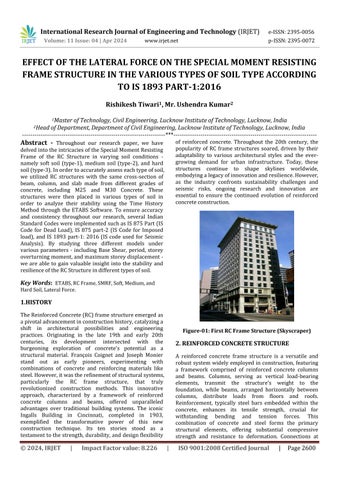
TheReinforcedConcrete(RC)framestructureemergedas apivotaladvancementinconstructionhistory,catalyzinga shift in architectural possibilities and engineering practices. Originating in the late 19th and early 20th centuries, its development intersected with the burgeoning exploration of concrete's potential as a structural material. François Coignet and Joseph Monier stand out as early pioneers, experimenting with combinations of concrete and reinforcing materials like steel.However,itwastherefinementofstructuralsystems, particularly the RC frame structure, that truly revolutionized construction methods. This innovative approach, characterized by a framework of reinforced concrete columns and beams, offered unparalleled advantages over traditional building systems. The iconic Ingalls Building in Cincinnati, completed in 1903, exemplified the transformative power of this new construction technique. Its ten stories stood as a testamenttothestrength,durability,anddesignflexibility
of reinforced concrete. Throughout the 20th century, the popularity of RC frame structures soared, driven by their adaptability to various architectural styles and the evergrowing demand for urban infrastructure. Today, these structures continue to shape skylines worldwide, embodyingalegacyofinnovationandresilience.However, as the industry confronts sustainability challenges and seismic risks, ongoing research and innovation are essential to ensure the continued evolution of reinforced concreteconstruction.

2. REINFORCED CONCRETE STRUCTURE
A reinforced concrete frame structure is a versatile and robust system widely employed in construction, featuring a framework comprised of reinforced concrete columns and beams. Columns, serving as vertical load-bearing elements, transmit the structure's weight to the foundation, while beams, arranged horizontally between columns, distribute loads from floors and roofs. Reinforcement, typically steel bars embedded within the concrete, enhances its tensile strength, crucial for withstanding bending and tension forces. This combination of concrete and steel forms the primary structural elements, offering substantial compressive strength and resistance to deformation. Connections at
International Research Journal of Engineering and Technology (IRJET) e-ISSN:2395-0056
column-beam intersections create a cohesive and rigid framework, crucial for maintaining structural integrity. These connections can be established through welding, bolting, or specialized connectors, ensuring stability and load distribution throughout the structure. Reinforced concrete frame structures are prized for their durability, adaptability, and capacity to withstand diverse environmental conditions, making them a popular choice for a widearray ofconstruction projects,from residential buildingstotoweringskyscrapers.

2.1. Purpose of RC Frame Structure
The reinforced concrete (RC) frame structure serves a multifaceted purpose, pivotal in modern construction endeavors. Primarily, it functions as a stalwart support system, tasked with bearing the substantial weight of buildings and infrastructure, efficiently channeling these loads downwards to the foundation. A core objective lies in its ability to evenly distribute various burdens encountered in structures, encompassing live, dead, and environmental loads, including those from seismic and windforces.Yet,beyondmereutility,RCframestructures offer architects a canvas of design flexibility, accommodating diverse forms and layouts to realize architectural visions. Their durability stands as a testament to longevity, resisting corrosion, fire, and weathering, ensuring sustained structural integrity with minimal maintenance requirements. Paramount is the assurance of safety and stability, underpinned by meticulous design, construction, and material choices, safeguarding occupants against potential hazards. Additionally, these structures present an economically viable solution, balancing cost-effectiveness with performancemetrics.Moreover,theiradaptabilityextends beyond initial construction, facilitating retrofitting and modifications to meet evolving needs and standards, enhancing the sustainability and resilience of existing infrastructure. In essence, the RC frame structure embodies a harmonious amalgamation of strength, functionality, and versatility, underscoring its indispensableroleinthebuiltenvironment.
Volume: 11 Issue: 04 | Apr 2024 www.irjet.net p-ISSN:2395-0072 © 2024, IRJET | Impact Factor value: 8.226 |
3. SPECIAL MOMENT RESISTING FRAME (SMRF) STRUCTURES
Special Moment Resisting Frame (SMRF) structures are sophisticatedengineeringsolutionsdesignedtowithstand the formidable lateral forces encountered during seismic events, particularly in earthquake-prone regions. These structures are meticulously crafted to provide a robust defense against such forces, ensuring both the safety of occupants and the structural integrity of the building. Integral to their design is the concept of moment resistance, wherein the framework is engineered to effectively redistribute and absorb seismic energy, allowing controlled yielding and deformation while maintaining overall stability. Ductility is a hallmark feature, enabling the structure to undergo significant deformation without compromising its integrity, thereby dissipating seismic energy harmlessly. SMRFs are characterized by redundant load paths and robust connections, enhancing resilience and mitigating the risk ofcatastrophicfailure.Compliancewithstringentbuilding codesspecifictoseismicregionsisparamount,guidingthe designandconstructionprocessestomeetrigoroussafety standards. Engineers leverage advanced analytical tools and expertise in structural dynamics to optimize the performance of SMRF structures, ensuring their ability to withstand the unpredictable forces of seismic activity. In essence, SMRF structures represent a pinnacle of engineering innovation, embodying resilience, safety, and reliabilityinthefaceofseismicchallenges.
4. IMPORTANCE OF LATERAL FORCE IN SMRF STRUCTURES
Lateral force plays a pivotal role in Special Moment ResistingFrame(SMRF)structures,particularlyinseismic regions where the threat of earthquakes looms large. These forces, predominantly seismic in nature, pose a significant challenge to the stability and integrity of buildings. In SMRF structures, the management of lateral forces is of utmost importance, driving the design and engineering decisions to ensure the structure's resilience against seismic events. Moment resisting frames, a key feature of SMRFs, are specifically designed to counteract these lateral forces by redistributing bending moments and shearing forces throughout the structure. This capability allows SMRFs to effectively withstand the dynamic loading induced by earthquakes while maintainingstructuralstability.Ductilityisanothercritical aspect, enabling the structure to undergo controlled deformation without catastrophic failure, thereby dissipating seismic energy and reducing the risk of damage.Compliancewithstringentbuildingcodestailored to seismic regions further underscores the importance of addressinglateralforcesin SMRFstructures,ensuringthe safety and well-being of occupants. Ultimately, the meticulous consideration of lateral forces in the design
International Research Journal of Engineering and Technology (IRJET) e-ISSN:2395-0056
Volume: 11 Issue: 04 | Apr 2024 www.irjet.net p-ISSN:2395-0072
and construction of SMRF structures is paramount, as it ensures their ability to withstand seismic events and provideasecurebuiltenvironmentforall.
5.ORDANARY MOMENT RESISTING FRAME (OMRF) STRUCTURES
Ordinary Moment Resisting Frame (OMRF) structures represent a practical yet robust solution in building construction, particularly in regions with lower seismic risk. These structures utilize moment resisting frames to provide stability, albeit with a design that is simpler and more cost-effective compared to their Special Moment ResistingFrame(SMRF)counterparts.OMRFsaretailored for areas where seismic forces are less intense, offering a moderate level of seismic resistance that meets the requirements of building codes without the need for extensive seismic provisions. While they may not withstand extreme seismic events like SMRF structures, OMRFs still ensure structural integrity and safety for occupantsinregionswithstableseismic conditions.Their simplifieddesignandconstructionmakethemsuitablefor various applications, providing an economical and practical choice for building projects in regions with low tomoderateseismicactivity.Despitetheirreducedseismic resistance, OMRF structures must adhere to relevant building codes to guarantee compliance and ensure the safety of the built environment. In essence, OMRF structures strike a balance between structural stability, cost-effectiveness,andseismicresilience,offeringa viable solution for construction projects in regions with milder seismicchallenges.
6.IS 1893 PART-1:2016 AND ITS SIGNIFICANCE IN SEISMIC DESIGN
IS 1893 Part-1:2016 stands as a cornerstone in seismic design within India, providing comprehensive guidelines and criteria for ensuring the earthquake resistance of structures. This standard, titled "Criteria for Earthquake ResistantDesignofStructures-Part1:GeneralProvisions and Buildings," issued by the Bureau of Indian Standards (BIS), offers a meticulous framework encompassing seismic hazard assessment, structural analysis, design criteria, detailing requirements, and construction practices. Notably, it categorizes regions across the country into seismic zones, enabling engineers to tailor seismic design and detailing accordingly to mitigate risks effectively. Through its provisions, IS 1893 Part-1:2016 facilitates precise structural analysis techniques, such as response spectrum analysis and dynamic analysis, aiding in accurately evaluating seismic forces and structural responses.Furthermore,itunderscoresthesignificanceof detailing requirements for enhancing ductility, strength, and energy dissipation capacity, crucial factors in minimizing structural damage during earthquakes. As a mandatory compliance standard for new constructions
and significant renovations, IS 1893 Part-1:2016 underscores the importance of quality control measures and construction practices to ensure the effective implementation of seismic design provisions, thus fortifying structures against seismic hazards and safeguardinglivesandpropertyacrossIndia.
7.TYPE OF SOIL ACCORDING TO IS 1893 Part1:2016
AccordingtoIS1893Part-1:2016,theIndianStandardfor seismic design of structures, soils are categorized into different types based on their seismic characteristics. These soil types are classified as per their seismic response and amplification effects during earthquakes. Theclassificationisasfollows:
7.1.Type I (Hard Soil)
This category includes hard rock and soils with a shear wave velocity greater than 760 m/s. Such soils typically exhibit minimal amplification of seismic waves and are consideredtohavelowvulnerabilitytoseismicshaking.
7.2.Type II (Medium Soil)
TypeIIsoilshave shear wavevelocities ranging from360 m/s to 760 m/s. They include stiff to medium stiff soils, such as gravelly soils and stiff clays. These soils may experience moderate amplification of seismic waves and are considered to have moderate vulnerability to seismic shaking.
7.3.Type III (Soft Soil)
Soft soils, including loose to medium dense sands, silty soils,andsoftclays,fallunderTypeIIIclassification.These soilshaveshearwavevelocitiesbetween180m/sand360 m/s. They are susceptible to significant amplification of seismic waves and are considered to have high vulnerabilitytoseismicshaking.
8.METHODOLOGY
ThemethodologysectionofourresearchdelvesintoanindepthanalysisoftheSpecialMomentResistingFrame.We have carefully examined and studied various aspects, including the Indian StandardCodeutilized, thegeometry of the building, as well as seismic parameters. By conducting a comprehensive study of these elements, we aim to gain a deeper understanding of this important framework and its significance in construction practices. Throughourmeticulousanalysisandresearch,wehopeto provide valuable insights and contribute to the advancementofknowledgeinthisfield.
International Research Journal of Engineering and Technology (IRJET) e-ISSN:2395-0056
Volume: 11 Issue: 04 | Apr 2024 www.irjet.net p-ISSN:2395-0072
8.1.Indian
Standard Code
The focus of our research paper was to investigate the various Indian Standard Codes that are applicable to the design and construction of structures. Specifically, we delved intotheUSCode875part-1, which pertains tothe deadloadofastructure,aswellastheISCode875part-2, which deals with imposed loads on structures. Additionally,weexploredtheIScode1893part-1:2016in relation to seismic loads on reinforced concrete (RC) structures. Our aim was to gain a comprehensive understanding of these codes and their significance in ensuring safe and efficient structural design and construction practices in India. By examining and analyzing these codes, we hope to contribute towards improving the quality and safety standards of structures acrossIndia.
8.2.Seismic Parameter
In the section of the seismic parameter section, we have studied the all seismic parameter included in this RC Structure,these detailsare given belowintheformofthe table:
Table 1: Seismic Parameter
9. RESULT AND ANALYSIS
We'llanalyzetheresultsofthreeETABSmodelsinvarious soil conditions. We'll use seismic data such as base shear and storey drift to study factors like natural period and maximumdisplacesment.
9.1.Base Shear
"Base shear" is the term used to describe the greatest lateralforcethatastructurewillexperienceduetoground motion during an earthquake. This force is generated when seismic activity causes the ground to move, and it acts in the opposite direction of the motion. The building must be designed and constructed to withstand this base shearvalue, ratherthan intermediatevalues. Ifthelateral forceexceedsthebaseshear,thestructuremaycollapse.

Base Shear of all models due to EX.
9.2.Natural
Period
Whenitcomestobuildings, oneofthekey characteristics thatisalwayspresentistheirfundamentalnaturalperiod, denoted as T. This property can be affected by any alterations or modifications made to the structure of the building, resulting in a different value for T. It's worth noting that the range of typical structures varies greatly, from single-story buildings to towering skyscrapers reaching twenty stories high. The fundamental natural periodsTforthesevarioustypesofbuildingscantypically be found within a range of 0.05 to 2.00 seconds. To help visualizethisinformation,agraphhasbeencreatedbelow which displays the natural period values for all models in question.

Graph-02: Natural Period of all these models
9.3.Maximum
Storey Displacement
Theterm"storeydisplacement"pertainstothemovement of a storey laterally outwards from its base. This movement can be prevented by implementing a lateral force-resisting system in the building. In situations where wind loads are present, an acceptable limit for lateral displacementisH/500,althoughsomemayoptforH/400 instead. A graph depicting the maximum storey displacementresultingfromloadcaseEX(seismicforcein theX-direction)forallthreemodelsisprovidedbelow.
International Research Journal of Engineering and Technology (IRJET) e-ISSN:2395-0056
Volume: 11 Issue: 04 | Apr 2024 www.irjet.net p-ISSN:2395-0072

Graph-03: Maximum Storey Displacement of these models.
10. CONCLUSION
Upon conducting an analysis of three different models based on seismic parameters, including the Base shear of the structure, maximum storey displacement, maximum storey drift, and natural period, we have come to a conclusion. Specifically, when examining the graph of the base shear of the Special Moment Resisting Frame of the RC Structure, it was found that model-03 had the highest maximum base shear. Notably, this model exists in hard type soil. Conversely, model-01 had the lowest value for base shear and is situated in soft soil. When considering the natural period graph for all three models, it was determined that model-03 had the highest maximum natural period due to its location in hard type soil. In contrast, model-02 had the lowest value for natural time as a result of its presence in soft type soil. Finally, upon reviewing the graph for maximum storey displacement and storey drift, it became apparent that model-03 exhibitedthehighestvaluesforbothmetricscomparedto model-01andmodel-02.
REFERENCE
1) J. Bielak, “Dynamic behavior of structures with embedded foundations,” Earthquake Engineering & StructuralDynamics,vol.3,no.3,pp.259–274,1975.
2) J.P.Stewart,G.L.Fenves,andR.B.Seed,“Seismicsoilstructure interaction in buildings. I: analytical method,” Journal of Geotechnical and GeoenvironmentalEngineering,vol.125,no.1,pp.26–37,1999.
3) J.P.Stewart,R.B.Seed,andG.L.Fenves,“Seismicsoilstructure interaction in buildings. II: empirical findings,” Journal of Geotechnical and GeoenvironmentalEngineering,vol.125,no.1,pp.38–48,1999.
4) K. Bhattacharya and S. C. Dutta, “Assessing lateral period of building frames incorporating soil-
flexibility,” Journal of Sound and Vibration, vol. 269, no.3–5,pp.795–821,2004.
5) G. Saad, F. Saddik, and S. Najjar, “Impact of soilstructure interaction on the seismic design of reinforced concrete buildings with underground stories,” in Proceedingsofthe15thWorld Conference onEarthquakeEngineering,Lisbon,Portugal,2012.
6) R. K. Goel and A. K. Chopra, “Period formulas for moment-resisting frame buildings,” Journal of Structural Engineering, vol. 123, no. 11, pp. 1454–1461,1997.
7) H. Crowley and R. Pinho, “Period-height relationship for existing European reinforced concrete buildings,” Journal of Earthquake Engineering, vol. 8, no. 1, pp. 93–119,2004.
8) H. Crowley and R. Pinho, “Simplified equations for estimating the period of vibration of existing buildings,” in Proceedings of the 1st European Conference on Earthquake Engineering and Seismology,p.1122,Geneva,Switzerland,2006.
9) C. G. Karayannis, B. A. Izzuddin, and A. S. Elnashai, “Application of adaptive analysis to reinforced concrete frames,” Journal of Structural Engineering, vol.120,no.10,pp.2935–2957,1994
10) M. J. Favvata, M. C. Naoum, and C. G. Karayannis, “Limit states of RC structures with first-floor irregularities,” Structural EngineeringandMechanics, vol.47,no.6,pp.791–818,2013.
11) W. Pong, Z. H. Lee, and A. Lee, “A comparative study of seismic provisions between international building code 2003 and uniform building code 1997,” Earthquake Engineering and Engineering Vibration, vol.5,no.1,pp.49–60,2006.
12) A.Do˘gang¨unandR.Livaoˇglu,“Acomparativestudy ofthedesignspectradefinedbyEurocode8,UBC,IBC and Turkish Earthquake code on R/C sample buildings,” Journal of Seismology, vol. 10, no. 3, pp. 335–351,2006.
13) S.K.GhoshandM.Khuntia,“Impactofseismicdesign provisions of 2000 IBC: comparison with 1997UBC,” in Proceeding of the 68th Annual ConventionStructuralEngineersAssociationof California(SEAOC ’99),pp.229–254,SantaBarbra,Calif,USA1999.
14) Y. Singh, V. N. Khose, and D. H. Lang, “A comparative study of code provisions for ductile RC frame buildings,” in Proceedings of the 15th World Conference on Earthquake Engineering, pp. 24– 28, Lisbon,Portugal,2012.
International Research Journal of Engineering and Technology (IRJET) e-ISSN:2395-0056
15) V. N. Khose, Y. Singh, and D. H. Lang, “A comparative study of design base shear for RC buildings in selected seismic design codes,” Earthquake Spectra, vol.28,no.3,pp.1047–1070,2012.
Volume: 11 Issue: 04 | Apr 2024 www.irjet.net p-ISSN:2395-0072 © 2024, IRJET | Impact Factor value: 8.226 | ISO 9001:2008 Certified Journal | Page2605