
International Research Journal of Engineering and Technology (IRJET) e-ISSN:2395-0056


Volume:11Issue:04|Apr2024 www.irjet.net p-ISSN:2395-0072
International Research Journal of Engineering and Technology (IRJET) e-ISSN:2395-0056
Volume:11Issue:04|Apr2024 www.irjet.net p-ISSN:2395-0072
Venkatesh.G, Srushti V Sannakki, Sahana M J, Sridevi S, Sourabh Verma
Student, Information Science of MVJ College of Engineering, Bangalore, Karnataka, India
Professor, Information Science of MVJ College of Engineering, Bangalore, Karnataka, India
Student, Information Science of MVJ College of Engineering, Bangalore, Karnataka, India
Student, Information Science of MVJ College of Engineering, Bangalore, Karnataka, India
Student, Information Science of MVJ College of Engineering, Bangalore, Karnataka, India
Abstract - Handling forensic evidence with precision, storing it safely, and maintaining correct chain of custody records are all essential components of contemporary criminal investigations. Data manipulation, unauthorised access, and a lack of transparency are problems that traditional evidence management systems have. This study discusses a novel use of blockchain technology in the forensic evidence management system to overcome these problems. To guarantee the integrity, security, and transparency of forensic evidence throughout its existence, the suggested method makes use of blockchain's decentralised and immutable properties. To increase productivity and lower the possibility of human mistake, smart contracts are used to automate the chain of custody procedure. The proposed system leverages the suggested method makes use of blockchain's decentralised and unchangeable structure to guarantee the authenticity, safety, and transparency of forensic evidence for the course of its existence. By automating the chain of custody procedure, smart contracts increase productivity and lower the possibility of human mistake. Furthermore, the legitimacy of the evidence may be confirmed with the use of cryptographic hashing techniques without disclosing private information. A blockchain-based forensic evidence management system prototype was created and put through testing ina controlled setting. The evaluation's findings showthat the system safeguards private data from unauthorised parties and offers better accessibility, accountability, and data integrity. A blockchain-based forensic evidence management system prototype was created and put through testing in a controlled setting. The evaluation's findings show that the system safeguards private data from unauthorised parties and offers better accessibility, accountability, and data integrity.
Key Words:Forensic,Blockchain,ChainofCustody
An imprecise approximation compiled from several academic and journalistic sources indicates that over 20,000 Americans are wrongfully charged, found guilty, and imprisoned year. Since no single organisation gathers verified information about exonerations resulting from mistaken convictions and even if it did, it would not be able to know about the situations in which someone was never exonerated it is necessary to use a variety of sources to approximate the number. Exconerations are rare among the estimated 20,000 people wrongfully charged, convicted, and imprisoned in the US alone. Contributing factors have resulted in 28% of convictions due to erroneous identification, 12% of false confessions, 23% of forensic science-related exonerations, 54% of official wrongdoing, and 58% of false accusations and perjury-related exonerations. (Source: The Innocence Project. More than 100% due to some cases having multiple contributing factors.) In fact, according to the National Institutes of Justice, “The most significant number of wrongful convictions in which forensic science is considered a contributing factor is attributable to eyewitness misidentification and official misconduct.” Many people effectively lose their entire lives to false imprisonment as the average term served by those falsely convicted was 10 years. That’s a decade in the life of a broth er, sister, father, mother, colleague, or student who will not be allowed to contribute fully to society once falsely convicted of a crime. Even after release, convicts struggle throughout their lives to gain and keep opportunities those without a criminal history are provided. Blockchain technology, which offers a decentralised and unchangeable ledger system, has completely transformed.
a Evidence management is one area where blockchain technology shows great promise. Conventional evidence management systems frequently encounter issues with transparency, security, and data integrity. The purpose of blockchain-based evidence management systems is to leverage the inherent characteristics of blockchain technology, like immutability, transparency, and decentralised consensus, to overcome these difficulties. Electronic proof can be managed and stored in a safe, unchangeable


International Research Journal of Engineering andTechnology (IRJET) e-ISSN:2395-0056
Volume:11Issue:04|Apr2024 www.irjet.net p-ISSN:2395-0072
repository with the help of a blockchain-based evidence management system. Time stamps, chain of custody, and metadata can all be securely recorded together with the guarantee that the data is unaltered and auditable at all times during its lifecycle. Blockchain-based solutions improve trust, transparency, and efficiency in evidence management procedures by leveraging distributed ledger technology and cryptography approaches.
Title: “BlockchainfortheProtectionofDigitalEvidence:ASystematicLiteratureReview”Authors:A.Collotta,L.Grassi, L.RongaPublished:2020
Thisliteraturereviewprovidesanoverviewofcurrentresearchonblockchainandtechnologyandtheuseofdigitalevidence storagebasedonmethods.Itinvestigatesmanyaspectssuchasdataintegrity,confidentiality,accesscontrolandscalability. Thereviewalsohighlightschallengesandfuturedirectionsinthisfield.
Title: “Blockchain-basedanti-tamperingofdigitalforensiclogs”Author:H.Yang,System.
Itspurposeistoensuretheintegrityandnon-duplicationoflogs,whichareimportantevidenceincriminalinvestigations. Thisstudyusesrealdatatodemonstrateefficiencyandmeasureefficiencyandsustainability.
Title: "Blockchain-based approach to ensuring data integrity in digital research" Author: S. R. Rad, M. Z. Alhaddad,M. Dehghantanha,K.-K.R.Choopublished:2020
This research demonstrates a way to provide information in digital research through blockchain. Describe the details of combiningblockchainwithothercryptographictechnologiestoprovideproofandsecurity.Thisarticlealsodiscussesthe prosandconsoftheplan.
Title: “BlockchainTechnologytoIncreaseTrustandConsentinProducts”Author:D.Khan,R.Khan,R.Z. Khan,M.AhmedPublicationDate:2021
Indirectforevidencemanagement,ButthisstudyexplorestheuseofEvidencemanagementTheuseofblockchaininsupply chainmanagement,whichhassimilaritieswiththeprocess.Itdiscussestheadvantagesofusingblockchaintechnologyto increasetrust,transparencyandsecurityinthesupplychain,withbenefitsextendingtoevidence-basedmanagement.
Title: "Blockchain-Based Digital Evidence Management in Criminal Justice" Author: P. Elsden, R. Grasso, A.V. Moere Publicationdate:2019
Thisstudyexplorestheuseofblockchaintechnologyin criminaljustice.Itcanbeusedinevidencemanagement.Itdiscusses thebenefitsandchallengesofusingblockchaintostoredigitalevidence,ensureauthenticity,andfacilitatesecuresharing amongstakeholders.Thisarticlealsoexploresthelegalandethicalimplicationsofblockchainevidencemanagement.
These papers provides information on the current state of research and application of blockchain-based evidence managementsystems.Theydemonstratedthebenefits,challenges,andpotentialapplicationsofblockchaintechnologyin improvingtheintegrity,security,andtransparencyofevidencemanagementprocesses.
The objective ofintegrating blockchain technologyinto a forensic evidence management system,combined with chain of custodyprotocolsandfacerecognitiontechnology,istocreateahighlysecureandtransparent environmentforhandling digital evidence. Blockchain's immutability ensures that every transaction and access to evidence is securely recorded, enhancingtheintegrityofthechainofcustodyandmakingittamper-proof.Byincorporatingfacerecognition, thesystem adds an extra layer of authentication, allowing only authorized personnel to access specific evidence or perform actions within the system. This integration not only enhances security but also streamlines processes through automation, reducing manual errors and improving overall efficiency. Furthermore, blockchain's decentralized nature ensures transparency and trust in the data, making it invaluable for maintaining the evidentiary value of digital information in forensicinvestigations.
International Research Journal of Engineering andTechnology (IRJET) e-ISSN:2395-0056
Volume:11Issue:04|Apr2024 www.irjet.net p-ISSN:2395-0072
TheprojectfocusesoneffectivelyusingblockchaintechnologywithintheLawEnforcementchainofevidence,whichcanbe consideredatypeofsupplychainforevidencecollection.Theauthorsandresearchersofthisprojectareusingtheterms “chainofcustody”interchangeably.AlisterInc.isintroducingablockchain-basedevidencemanagementsystemtoalleviate theproblemsthetraditionalchainofcustodyhas,includinglossofevidence,theft,tampering,andworse,manipulationof evidence within the evidence management system. Blockchain technology can shield defendants and police officers who have been unfairly targeted from chain of custody problems that could result in false imprisonment for defendants and, worse, wrongful firing for cops. This project will outline the specific difficulties associated with keeping evidence on a blockchainandofferaworkablefix.TheprojectutilisingBlockchaintechnologyinfinancialapplicationswillnotbeableto provideservicesifasinglecentralisedserverexperiencesahackorcrashasaresultofanexcessivenumberofrequests.To recoverfrom Decentralised Blockchaintechnology,whichmaintainsdata atseveral nodes or serversandallows usersto accessservicesfromotheroperational nodesintheeventofa nodefailure,canbeappliedtothissituation.An estimated approximation compiled from several academic and journalistic sources suggests that over 20,000 Americans are wrongfully charged, found guilty, and imprisoned year. Since no single organisation gathers verified information about exonerationsresultingfrommistakenconvictions andevenifitdid,itwouldnotbeabletoknowaboutthecasesinwhich there wasno exoneration itisnecessarytousea varietyof sourcestoapproximatethe number.Exonerationsfrom the estimated20,000peoplewrongfullycharged,convicted,andimprisonedintheUSalonearerareandfarbetween.
2. Implementation
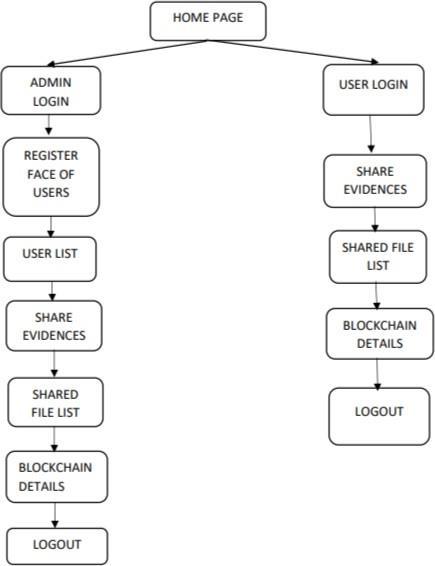
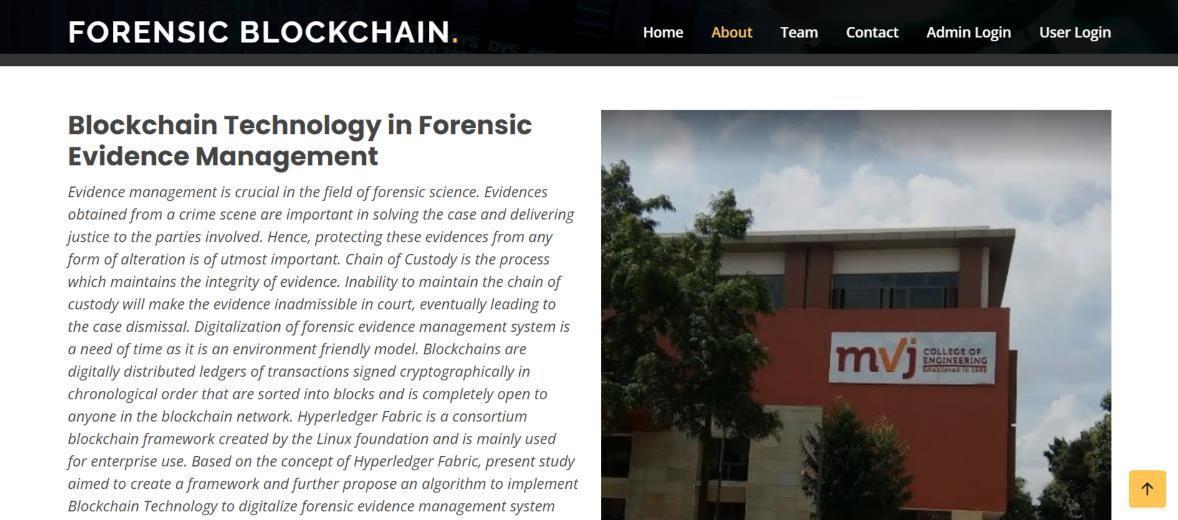
In the execution of this project, we have harnessed a PYTHON-based Blockchain tool known as FLASK. The endeavor is structuredaroundthefollowingpivotalmodules:
I. AdminLogin: This model provides security personnel access totheapplication. Authentication is doneusingthe username"admin"andpassword"admin".Theadmincanaddthe‘User’andseetheUserlist.Admincanalsoadd theevidences.
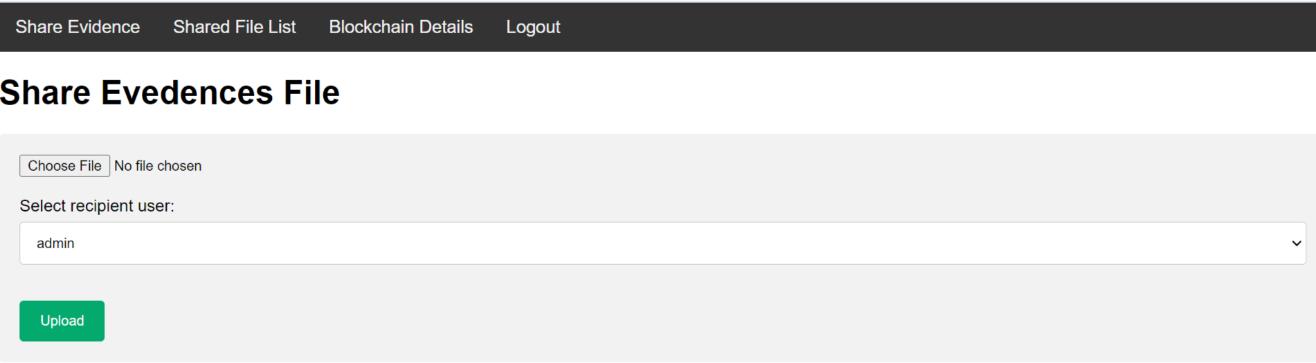
II. UserLogin:ThismodelcanaddevidencestotheBlockchain.
International Research Journal of Engineering andTechnology (IRJET) e-ISSN:2395-0056
Volume:11Issue:04|Apr2024 www.irjet.net p-ISSN:2395-0072
III. Addcredentialstotheblockchain:Inthismode,AdminandUsershavetheopportunitytoaddnewcredentialsto theblockchain.Thisprocessensuresthesecurityandimmutabilityofimportantevidence.
IV. Recoveringevidencefromblockchain:Thismodelallowslawenforcementtoextractevidencepreviouslystoredin blockchain files. It is important to note that access to this feature is only allowed to authorized and authorized personnel,thuspreservingtheintegrityandsecurityofthetranscriptoriginallystoredontheblockchain.


International Research Journal of Engineering andTechnology (IRJET) e-ISSN:2395-0056


3. Conclusion
Itmakessenseandisveryvitaltoemployblockchaintechnologytoimprovetheintegrityofevidenceinthecriminaljustice system. It can be a reasonably priced and all-inclusive solution that keeps agencies utilising all of their current products whileeliminatingthemajorityoftherisksassociatedwithhumanerrorandcriminalintent.LOCARDandAlisterInc.Inan efforttorebuildpublicconfidenceinthecriminaljusticesystem,theEUplanstointegrateblockchaintechnologyintothe chainofevidence.
International Research Journal of Engineering andTechnology (IRJET) e-ISSN:2395-0056
Volume:11Issue:04|Apr2024 www.irjet.net p-ISSN:2395-0072
Verified evidence tracking across many law enforcement agencies will be feasible with blockchain. Thesystemwillonlyregisterhashesthatvalidatethe"state"ofthephysicalevidence,enablingbetterandquickerprocessing aswellasincreaseddigitalstoragecapacity.Immutabletrackingofevidencefromthescenetocourtwillbepossiblewith theattributionofhashestotangiblepiecesofevidence,andthisapproachwillmakeitsimpleandquicktorejectinadmissible evidence. The authors and researchers from Alister Inc. hope to provide their readers with a clear understanding of the significanceofblockchaintechnologyinthejusticesystemandthevariouswaysitwillaidinthepursuitofamore equitable and precise criminal evidence tracking system through the tragic cases that have been detailed above. Maintaining due processinthegloballegalsystemdependsonaccurateevidencewithatrackrecordofintegrity.Trackingthisevidenceusing blockchaintechnologymightreducethenumberofpoliticalunrestcausedbyerroneousarrestsandconvictions. Wewillall lose a large deal of hardworking, honest, and unfairly accused Americans who may have become the next great doctor, lawyer,inventor,researcher,orpoliceofficerifwedon'taddressthissystematicissuewithourcriminaljusticesystem.You reallycannotaffordtostaythesame,andimplementingblockchainintheevidencesupplychainisthenecessarychange.
[1]Barone,Emily.“Exonerations:FalselyAccusedFreedatHighestRates.”Time,Time,2020,time.com/wronglyconvicted/.
[2] Cummings, Brandi. “Q&A: Placerville Police Discuss Roman Lopez's Suspicious Death.” KCRA, KCRA, 20 Feb. 2020, www.kcra.com/article/qanda-placerville-police-discussroman-lopezs-suspicious-death/310080
[3] Farmer,BritMccandless.“TheOpioidEpidemic: WhoIstoBlame?”CBSNews,CBSInteractive,21June2020, www.cbsnews.com/news/the-opioid-epidemic-who-is-to-blame60-minutes-2020-06
[4]Friedersdorf,Conor.“CSIIsaLie:ForensicInvestigationsAreOverdueforReform.”TheAtlantic,AtlanticMediaCompany, 26Apr.2015,www.theatlantic.com/politics/archive/2015/04/csi-is-a-lie/390897/
[5] Lustbader,Sarah,etal.“Spotlight:'ANewWaveofProsecutorialTransparency'.”TheAppeal,TheAppeal,7June2019, theappeal.org/spotlight-a-new-wave-of-prosecutorialtransparency/
[6]Madrid,AssociatedPress|Salina.“Police:Ex-NewMexicoDeputyHoardedLostEvidenceinHome.”KFOX,KFOX,31July 2020,kfoxtv.com/news/local/police-ex-new-mexicodeputy-hoarded-lost-evide
[7] NA.“TodayIsWrongfulConvictionDay.”Mid-AtlanticInnocenceProject,MAIPNews,2Oct.2019, exonerate.org/wcd2019/.
[8]NationalInstitutesofJustice,“WronguflConvictionsandDNAExonerations:UnderstandingtheRoleofForensicScience”, April,2018,NIJJournalissueno.279,
[9] Neufeld,PeterNeufeld.“HowManyInnocentPeopleAreinPrison?”InnocenceProject,TheInnocenceProject,12Dec. 2011,www.innocenceproject.org/how-many-innocent-peopleare-in-prison
[10] M.SUDHAKAR,Publishedapaperentitled“EMOTIONBASEDMUSICPLAYERA”In(Volume21,May-2022Issue05, YMER).
[11]M.SUDHAKAR,Publishedapaperentitled“CASHLESSSOCIETY:MANAGINGPRAVACYANDSECURITY”.In(Volume02, July-2022Issue,YMER).
[12] M.SUDHAKAR,publishedapaperentitled“DETECTINGAPOTHOLEUSINGDEEPCNNFORANADAPTIVESHOCK OBSERVINGINAVECHILEDRIVINGE”In(Volume20,June-2022Issue06,NEROQUANTOLOGYSCOPUS).
[13] M.SUDHAKAR,publishedapaperentitled“DETECTIONOFNEUROLOGICALDISORDER”In(Volume13,Jan-2023 Issue01,IJARST).
[14] M.SUDHAKAR,Publishedapaperentitled“AnEnsembleAlgorithmforCropYieldPredictioninAgricultureSector”In (Volume15,Jan-2023Issue01,JICR).
9001:2008 Certified Journal | Page2592
International Research Journal of Engineering andTechnology (IRJET) e-ISSN:2395-0056 Volume:11Issue:04|Apr2024 www.irjet.net
[15] M.SUDHAKAR, Published a paper entitled“COVID-19 Epidemic Analysis using Machine Learning and Deep Learning Algorithm”In(Volume05,Issue:08AUG2021,IJSREM).
[16] M.SUDHAKAR,Publishedapaperentitled“ASURVEYONIMPROVEDPERFORMANCEFORKEYWORDQUERY ROUTING”In(Volume02,July-2015Issue,JREECSM).
[17] M.SUDHAKAR,Publishedapaperentitled“AMethodforForecastingHeartDiseaseusingEffectiveMachineLearning Process”atthe(ICRCSIT-20)heldonJune17thand18th28,2020.