
International Research Journal of Engineering and Technology (IRJET) e-ISSN: 2395-0056
International Research Journal of Engineering and Technology (IRJET) e-ISSN: 2395-0056
Manoj U
1,
Ganeshachari B
2
, Chithra Y 3, Manojkumar H.M4
,
Dr. Annapoorna T. L5, Dr. Batluri Tilak Chandra6
1,2,3,4 8th Semester, Department of Mechanical Engineering, 8th semester students, Sri Siddhartha Institute of Technology, Tumkur – 572105
5, 6 Assistant Professor, Department of Mechanical Engineering, Sri Siddhartha Institute of Technology, Tumkur –572105
Abstract - Passengers who are elderly, young, or crippled find it difficult to get aboard the train with their bags. Generally speaking, the train bogie's steps are substantially higher than the station platforms. Our decision was made to create a sliding ramp for trains, specifically for low-floor trains. The ramp needed to be highly capable of withstanding heavy loads and function autonomously and rapidly. A motor and a sensor are used to accomplish actuator. Three primary structural components make up the ramp, along with a few auxiliary parts that facilitate the movement of the major structural components. Standing in front of the IR sensor is the passenger when the door is open. The Arduino Uno will receive the signals from the IR sensor. The ramp expands selfsufficiently and waits for people to board the train before returning to its initial position on its own after a certain amount of time. It is positioned beneath the door to enable the ramp to be extended from its retracted position. The motors within the housing spin the pinion on the rack, causing the second plate to glide forward. When it comes out of the second plate, the first plate will go through the same procedure. The onlydifferentiation in the mechanism, however, is that in the first plate motion, the rack moves linearly and the motor or pinion is fixed, but in the second plate motion, the rack is stationary and the motor hubs have linear motion When both plates are fully extended, they should be at a particular angle with the ground. As a result, the second plate's tilt hinges are fitted. The motor will now revolve in the other direction and retract the plate using the same procedure.
Key Words: Rack and Pinion, Guide ways, DC Motor, and a Sensors
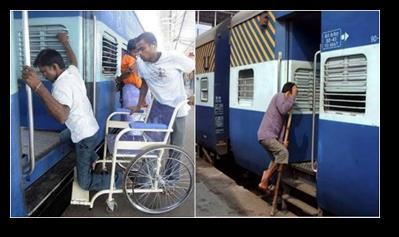
There are certain low-floor light rail vehicles (LRVs) that employ bridge plates, which are moveable, mechanical wheelchairramps.TheAmericanswithDisabilitiesActinthe USmandatesthattheslopemustbenomorethanoneinchof rise for every twelve inches of length. The bridge plate extends from the vehicle to the platform, which must be raisedtonearlythelevelofthefloorofthevehicletoavoid thewheelchairhavingtotravelanoverlysteepramp.Rather thanusingabridge,manylow-floorbusesusearampthatis normallypartofthefloorbutcanbeflippedoutthroughthe door(usingahingeatthedoor)ontothecurborstreet;in
thisinstance,therampislongenoughtofunctionasatrue wheelchair ramp without being overly steep. Wheelchair accessibility is additionally provided by bridge plates on certainlow-floorbuses,whichinthisinstanceextendtothe ground Bridge plates can be manually deployed (by the driveroranothercrewmember)ormotorized,retractable ramps. First completed in 1996, the Siemens SD660 LRV passengerrailcarsoperatedbyTriMet(Portland,Oregon) werethefirstinNorthAmericatobeoutfittedwithfolding bridgeplates.Inthepast,non-poweredbridgeplatesfixed on station platforms were utilised in the newly finished SacramentoRTLightRailsystemin1987tobridgethegap betweenanLRV'sfloorandahigh-platformsectionateach station.
2.
1. To facilitate board and deboarding for those with disabilities.
2.Toreducetheneedforoutsideassistancewhilemovinga wheelchair inside the coach.
3. To create a well-thought-out system that includes an aluminum slant sheet that can easily provide a track for wheelchair mobility.
4.ToimplementrackandpiniontechnologywithIRsensor inanautomatedrampsystemforboardandgettingoffon Indiantrains.
Threeprimarystructuralpiecesandafewauxiliarypartsfor thesestructuralelements'movementwillmakeuptheramp. Whenthedoorisopen,passengersmuststandinfrontofthe IRsensor,whichsendssignalstotheArduinoUnotocause the ramp to automatically expand and wait for people to boardthetrain.Afterashortwhile,therampreturnstoits initialpositionthemajorbody,secondplate,andfirstplate are these three sections. The first and second moveable platesoftherampcanboth slideslinearlyinsidethemain body.Onepartofthemainandsecondplatesistherackand pinionsystemthatmovestheplatesoneandtwo.Toensure that the plates move smoothly; guidelines are included. themainplatetowhichthesecondaryplateisfastened.The secondplateslideswithinthemainbodyoftherackwhile thepinion,coupledtothemotor,moves.Therackremains
Volume: 11 Issue: 04 | Apr 2024 www.irjet.net p-ISSN: 2395-0072 © 2024, IRJET | Impact Factor value: 8.226 |
International Research Journal of Engineering and Technology (IRJET) e-ISSN: 2395-0056
Volume: 11 Issue: 04 | Apr 2024 www.irjet.net p-ISSN: 2395-0072
stationary during this process. For the purpose of moving thefirstplate,themotorissituatedinthemiddleofthemain body.Thefirstplateslideseasilyintothesecondbecauseof the guideways, and it has a rack at its right end that is hookedtothepinionofthemotor.Whenthemotorstartsto spinthestationarypinion,therackwillmovelinearlyasa result.Thefirstplatewillthereforeadvance.
Whenapassengerwithadisabilityjoinsthetrainthroughan open door, an IR sensor will detect their presence and automatically extend and retract the ramp. The sensor locatednexttothedoor.Thetrainwillautomaticallyreverse courseafterstoppingandrampingdowntothestationlevel forawhile.Itiswheretherampismovedtoexpandfromits retractedposition.Tomovethesecondplateahead,motors housedwithinthehousingturntherack'spinion.Thefirst platewillexperiencethesamethingasitbeginstoemerge fromthesecondplate.However,thesoledistinctioninthe mechanismisthatinthecaseofthefirstplatemotion,the motororpinionisstationaryandtherackhaslinearmotion, whereasinthecaseofthesecondplatemotion,therackis stationaryandthemotorhubhaslinearmotion.Bothofthe plates should be at a certain angle with the ground when they are fully stretched. Thus, hinges are installed on the secondplateforthistilt.Now,inordertoretracttheplate, themotorwillrotateintheotherdirection,usingthesame procedure. IR sensor components were also provided.
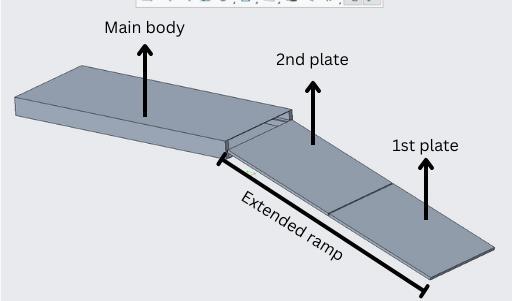
Thefirstplate oftheassemblyisinstalledintothesecond plate.Withlinearmotionwithinthesecondplate,thefirst plate is also mobile. With the aid of a rack and pinion mechanism housed inside the second plate, the first plate advances.Thisrackhasamovingpinionandafixedrack.
Thesecondplatewasinstalledwithintheassembly'smain body.Withinthemainbody, thesecondplateismoveable and has linear motion. With the aid of a rack and pinion mechanism housed inside the primary plate, the second plate advances. Here the rack is stationary & pinion is moving.
The primary plate represents the entire Assembly's supportingframework.Theprimaryplate,whichisattached to the lowest portion of the low floor bus door, remains motionless. Holding the second plate of our construction withithelps.Therackandpinionmechanismislocatedin the main plate. For the second plate to move linearly and smoothly,guidewaysarealsoincludedintheprimaryplate
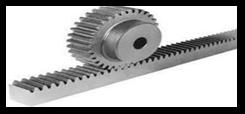
Arackandpinionmechanismisakindoflinearactuatorin which rotational motion is converted to linear motion by meansofacirculargear(calledthepinion)interactingwitha linear gear (called the rack). The ramp is extended and retractedinthisexampleusingarackandpinionsystem.
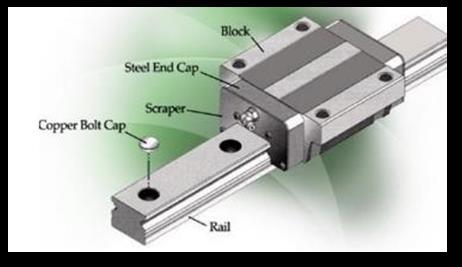
Thewheelchairramp'ssmoothmovementismadepossible bylinearguides.Theseallowthefirstplatetogentlyglide withinthesecondplateandthesecondplateinsidethemain body.
Electrical energy is typically converted into mechanical energy using motors. In order to move the plates both
International Research Journal of Engineering and Technology (IRJET) e-ISSN: 2395-0056
Volume: 11 Issue: 04 | Apr 2024 www.irjet.net p-ISSN: 2395-0072
forwardandbackward,amotorisnecessarytoprovidethe pinionwithrotatingmotion.Here,bidirectionalmotionwas achievedusingtheservomotor.
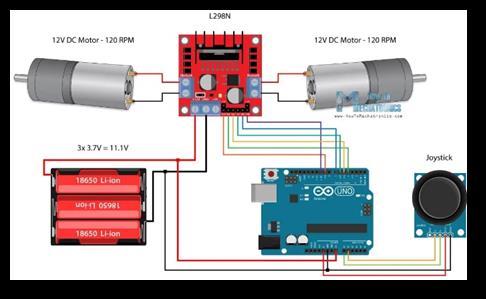
Anamplifierorpowermodulethatjoinsacontrolleranda DCmotoriscalledaDCmotordriver.Ittransformsthestep and direction input from the controller into currents and voltages that the motor can use. The voltage, current, directionality,andprotectionrequiredtoeffectivelyoperate robotic components or devices must be provided by the motordriver.DCmotorsareelectromechanicaldevicesthat run an electric current through a shaft to rotate it. Their abilitytospinin bothforwardandbackwarddirections is helpfulinavarietyofsituations.ADCmotorcanbeusedfor applicationsthatneedvariablespeedssinceitcanchangeits speed by adjusting the supplied voltage or current. DC motors are crucial for a variety of applications, such as locomotives,rollingmills,steelmills,andlifts.Herearesome pointers for selecting between a DC gear motor and a DC motor: Calculate your voltage, torque, and speed. Think aboutsizeforincreasedtorque,usebrushDCgearmotors.
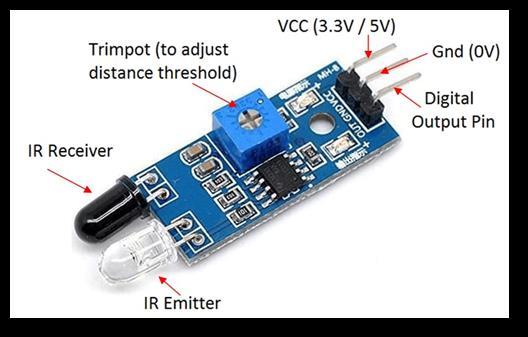
An apparatus that recognizes and interprets infrared (IR) signalsisknownasanIRsensorboardorIRsensormodule. Typically,ithasasignalamplifier,ademodulatorcircuit,and an IR receiver LED. While the signal amplifier and demodulator circuits process and amplify the IR signals, respectively, the IR receiver LED detects the signals. Photodiodes that detect infrared light are called infrared
sensors. The resistances and output voltages of the photodiodefluctuateinresponsetotheintensityofinfrared lightasitreachesit.Infraredsensorsareabletomonitoran object'stemperatureanddetectmovement.Theyareutilized in a wide range of fields and daily activities, including consumerelectronics,automationsystems,androbots.
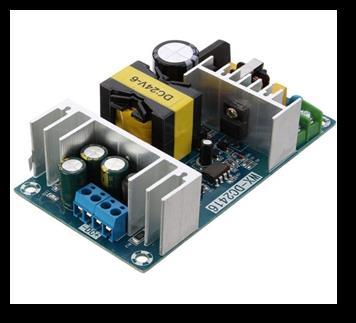
An electrical device that provides power to linked components is called a power supply board. In order to powertheload,ittransformselectriccurrentfromasource intothepropervoltage,current,andfrequency.Protection againstshortcircuit,overvoltage,overcurrent,undervoltage, and overtemperature may be present on power supply boards.
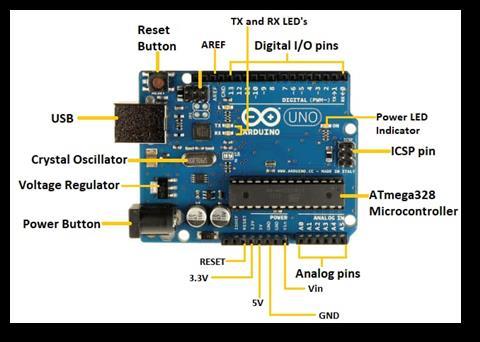
A well-known microcontroller board built on the ATmega328P chip is the Arduino Uno. The reason for its popularityinhobbyistprojectsandprototypingisitsbroad communitysupport,simplicity,andadaptability.Inaddition tosixanalogueinputs,aUSBport,apowerconnector,andan ICSP header for programming, it features fourteen digital input/outputpins.Itworkswellforbothnoviceandexpert makerstocreateavarietyofelectricalprojects.
International Research Journal of Engineering and Technology (IRJET) e-ISSN: 2395-0056
Volume: 11 Issue: 04 | Apr 2024 www.irjet.net p-ISSN: 2395-0072
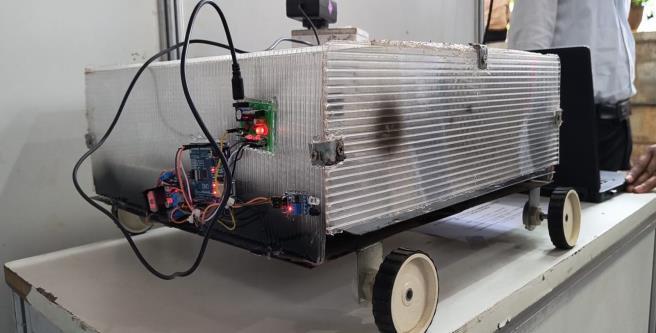
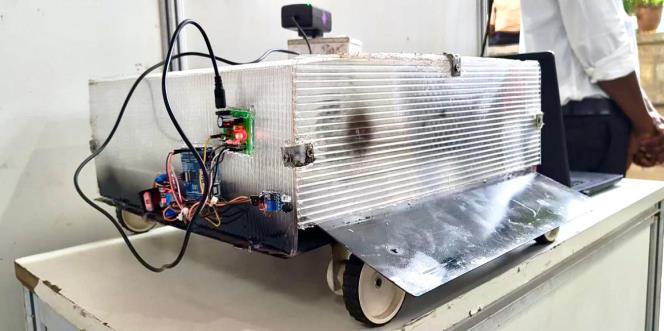
Threeprimarystructuralpiecesandafewauxiliarypartsfor thesestructuralelements'movementwillmakeuptheramp. Thesethreeparts,whicharethefirstplate,secondplate,and majorbody.Theramp'sfirstandsecondplatesaremovable partsthatmaybothglidelinearlywithinthemainbody.The rackandpinionmechanismthatmovesthefirstandsecond platesisacomponentofboththeprimaryandsecondplates. There are guideways to ensure that the plates slide smoothly. The pinion is installed on the motor, which is encasedinahousingthatisfastenedtothebarwithinthe mainplateandhingedtothesecondplate,inordertomove thesecondplate.Regardingthesecondsliding
plate located in the main body, the rack is fixed, and the pinion connected to the motor is moving. The motor is placedatthefrontrightendofthesecondplatetodrivethe motionofthefirstplate.Becauseoftheguideways,thefirst plate moves smoothly into the second, and it has a rack attached to its right end that is connected to the motor's pinion. Thus, the rack will move linearly when the motor beginstorotatethestationarypinion.Thus,thefirstplate willmoveahead.
Whenapassengerwithadisabilityjoinsthetrainthroughan opendoor,aninfraredsensorinfrontoftheraildoordetects theirpresence,causingtheramptoautomaticallyextendand retract.thesensorthatispositionednext tothedoor.The train will automatically reverse course after stopping and rampingonalevelsurfaceforawhile.
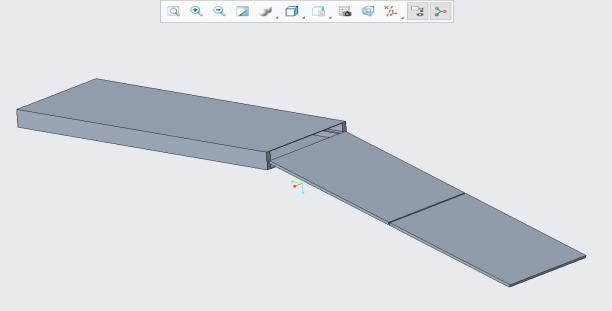
ThechoiceofmaterialsisPopularaluminumalloy6061is renownedforhavingexceptionalstrength,weldability,and corrosion resistant qualities. Aluminum makes up the majority of it, with silicon and magnesium serving as the mainalloyingcomponents.Becauseofitsexcellentstrengthto-weight ratio and adaptability, alloy 6061 is utilized extensively in a variety of sectors, including aerospace, automotive,marine,andstructuralapplications.It'swidely utilised in the building of structural elements including beams, frames, and panels as well as in the production of bicycleframes,carparts,andmaritimeequipment.
For aluminum alloy 6061, which is commonly used in structuralapplications,typicalvaluesareasfollows:
Tensileyieldstress:Around276MPa
Tensileultimatestress:Around310MPa
Compressiveultimatestress:Around310MPa
GivenDimensions:
Length(L)=2.2m
Width(W)=0.85m
Force(F)=980N
Cross-sectionalarea(A):A=LengthxWidth=2.2mx0.85m =1.87m²
Now,let'scalculatestress(σ)inMPa:
1.Stress(σ)=Force(F)/Area(A)980N1.87m²σ≈524.06 kPa=0.52406MPaσ
Now,let'scalculatedisplacement(8)inmm:
1.Displacement(6)=Strain(e)*Originallength(L)δ=7.59 ×10-6x2.2mδ≈0.01658mm
So,withthesecalculations:
Stress(σ)≈0.52406MPa
Displacement(6)≈0.01658mm
Basedonthegivenallowablestressof200MPa,thedesignis safeasthecalculatedstressissignificantlylower.
International Research Journal of Engineering and Technology (IRJET) e-ISSN: 2395-0056
Volume: 11 Issue: 04 | Apr 2024 www.irjet.net p-ISSN: 2395-0072
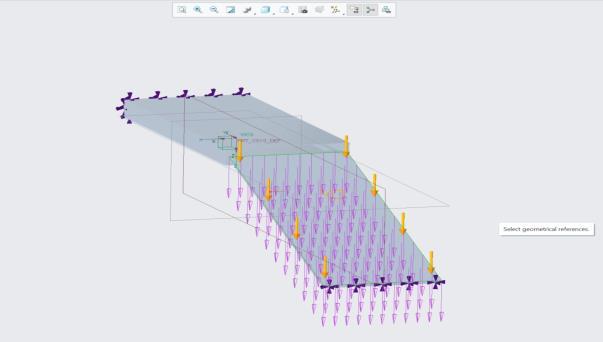
Fig 12: Force and constraints
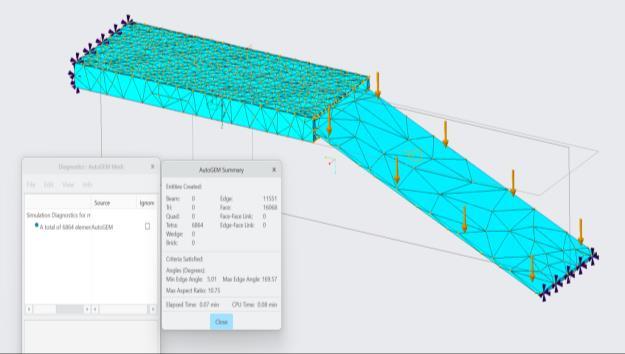
Fig 13: Meshed model
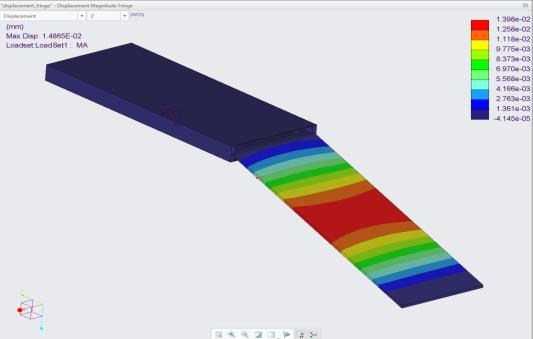
Fig 14: Maximum deformation obtained is 0.014865 mm
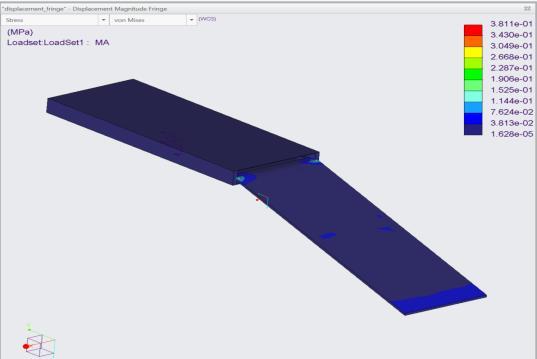
Fig 15: Maximum value for von-mises stress is 3.811e01 Mpa
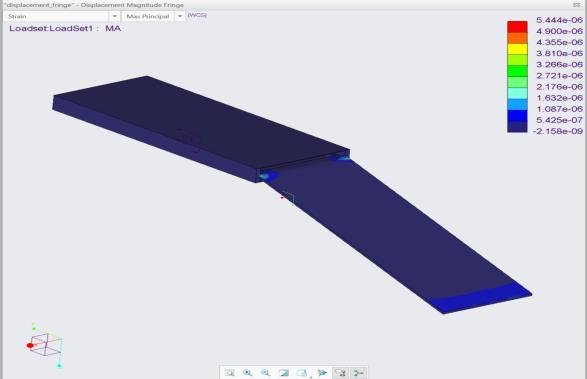
Fig 16: Value for maximum principle strain is 5.444e06 MPa
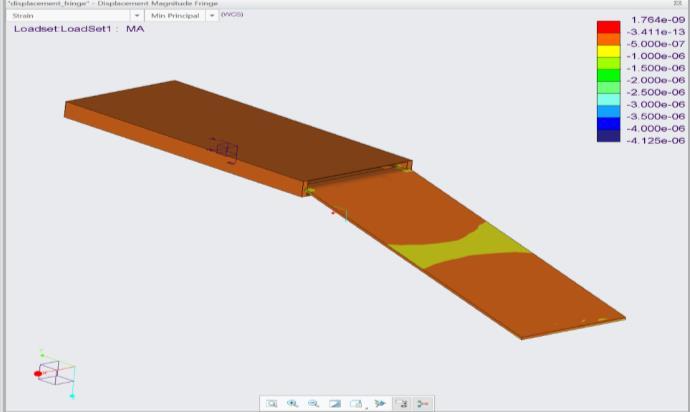
Fig 17: Value for minimum principle strain is 1.764e09 Mpa
Table :1Comparision of results
Theaboveresults showthatthemaximumdeformation is 0.014865 mm, which is very small. So, the design of the systemissafe.
International Research Journal of Engineering and Technology (IRJET) e-ISSN: 2395-0056
Volume: 11 Issue: 04 | Apr 2024 www.irjet.net p-ISSN: 2395-0072
“Thestructuralstudydemonstratesthattheramp'sdesignis safeandcapableofsupportingloadswithoutexperiencing significant deformation. The goals of the project are accomplished with the creation of an effective yet straightforwardrampsystem.Inordertomaintainaslant anglethatprovidesproperergonomicsandcomfort,there are no complicated mechanisms involved. The system is automated using rack and pinion in an industrial setting. Through this initiative, we can ensure that people with disabilitiescaneasilytransfertheirwheelchairsontotrains."
ACKNOWLEDGEMENT
"We extend our sincere gratitude to the Karnataka State CouncilforScienceandTechnology(KSCST)forgenerously providing financial assistance, which was instrumental in successfullycompletingthisproject."
[1]AswinSanthosh:“AnAutomatedSelf-AdjustingRampto EntrainandDetrainForDifferentlyAbledInIndianRailway System”Internationalresearchjournalofengineeringand technology (irjet) eissn: 2395-0056volume: 07 Issue: 08 | Aug2020
[2]ShitalPate:“DesignofAutomaticRampforHandicapped People” International research journal of engineering and technology (irjet) eissn: 2395-0056volume: 08 Issue: 05 | May2021
[3]Jishnuv:“Semiautomatedadaptablerampfordifferently abledtoentrainanddetrain” Internationalresearchjournal of engineering and technology (irjet) eissn: 23950056volume:05Issue:05|may-2018
[4]Abhishek gupta: “conceptual design to transfer handicappedpeoplefromrailwayPlatformtotheircoaches”, international journal of mechanical and production engineeringIssn:2320-2092,volume-5,issue-9,sep.-2017
[5]RSKhurmi:“Designofmachineelements-I”,2015
[6]Ibrahim, arish: “design and fabrication of ramp attachmentforwheelchair”,journal,Vol.7,no.7,pp.46-48, 2014
[7]Storr,tim:“Designfeaturesofportablewheelchairramps andtheirimplicationsForcurbandvehicleaccess”,vol.41, no.3B,pp.443–452,2008
[8]Designofaninnovativeretrofittedtricycleforadisabled person,2007
[9]Vehiclesforpeoplewithdisabilitiesimportedvehicles, modifiedvehicles,specialpurposevehicles,Equipmentand accessories,2004
[10]D. Kornack and P. Rakic, “Cell Proliferation without NeurogenesisinAdultPrimateNeocortex,”Science,vol.294, Dec.2001,pp.2127-2130,doi:10.1126/science.1065467
[11]M.Young,TheTechnicalWriter’sHandbook.MillValley, CA:UniversityScience,1989