
Volume: 11 Issue: 04 | Apr 2024 www.irjet.net
Volume: 11 Issue: 04 | Apr 2024 www.irjet.net
T.Ranjith Kumar1 , Anishka Akarapu2 , Sathwik Rao Allam3 , Naga Chandana Gattepally4 , Pooja yashaswi Nellutla5
1Assistant professor, Computer Science and Engineering, Kakatiya Institute of Technology and Science, Warangal, India
2,3,4,5 Computer Science and Engineering, Kakatiya Institute of Technology and Science, Warangal, India
Abstract This paper presents an advanced chatbot application designed to provide comprehensive first aid guidance and support to users. With the increasing digitalization of healthcare, chatbots offer promising solutions for delivering timely and accessible information. Leveraging state-of-the-art technologies such as the Natural Language Toolkit (NLTK) for natural language processing (NLP) tasks and the Keras deep learning framework, the developed chatbot demonstrates a sophisticated understanding of user queries and generates contextually relevant responses. The development process involves several key phases. Initially, a dataset comprising first aid intents is collected and meticulously preprocessed using NLTK's tokenization, part-of-speech tagging, and syntactic parsing functionalities to extract meaningful information from user inputs. Subsequently, multiple neural network architectures including Long Short-Term Memory (LSTM), Gated Recurrent Unit (GRU), Bidirectional LSTM, and Dense Neural Network are implemented and trained on this preprocessed dataset. Performance evaluation metrics such as accuracy, precision, recall, and user feedback are employed to assess the efficacy of the developed chatbot. Comparative analyses with existing chatbot systems are conducted to highlight its strengths and identify potential areas for improvement. Notably, after thorough evaluation, the Dense Neural Network model is chosen for its superior performance in understanding user intent, maintaining context in conversations, and generating responses that mimichuman-like interactions.Thispapercontributes tothe ongoing evolution of chatbot technology by presenting a sophisticated solution tailored for first aid guidance. The findings underscore the potential of chatbots in providing valuable support in healthcare and emergency response domains, paving the way for further enhancements and applicationsindigitalhealthcareservices.
Keywords Natural Language Tool kit (NLTK), Dense neural network, Keras, Long Short-Term memory (LSTM), GatedRecurrentUnit(GRU),BidirectionalLSTM.
Chatbots have become increasingly popular in the tech industry,providinguserswithpersonalizedandinteractive experiences. These computer programs simulate conversationwithhumanusers,offeringauniqueinterface for communication [1]. Initially, chatbots were rule-based systems triggering predefined responses with specific keywords[2].However,advancementsinmachinelearning and neural networks have enabled chatbots to generate more nuanced responses, enhancing their conversational
capabilities[3].Oneoftheprimaryapplicationsofchatbots is in customer service, where they handle routine queries and provide instant support [4]. They have also found utility in diverse sectors like healthcare, education, and ecommerce, streamlining tasks and enhancing user experiences. In recent years, the integration of chatbots intovariousplatformshastransformedthewaybusinesses interact with their customers, offering round-the-clock support and personalized assistance. This shift towards automatedcommunicationreflectsthegrowingrelianceon technology to streamline processes and enhance user experiences.
Moreover, the adaptability ofchatbots to different industries underscores their versatility and potential for innovation. As technology advances, chatbots are expected to understand context, emotions, and user intent more accurately, ushering in a new era of conversational interfaces. The increasing demand for efficient communication solutions has led to heightened interest in chatbot development. This project aims to contribute to thislandscapebyimplementingachatbotusingtheNatural LanguageToolkit(NLTK)andKeras,twopowerfullibraries in natural language processing (NLP) and deep learning. NLTK,renownedforitscomprehensivesuiteoftools,offers functionalities for tokenization, stemming, and syntactic analysis. Keras simplifies the development of deep neural networks, providing an intuitive interface for building and training complex models. The synergy between NLTK and Keras positions our project at the forefront of conversationalAIresearchandimplementation.
Chatbots, powered by NLP techniques, have gained popularityacross various domainsdueto theirhuman-like interaction capabilities. They offer a promising avenue for enhancing communication and user engagement, contributing to the evolution of human-computer interaction.
The motivation for this project stems from the increasing demand for efficient communication solutions across diverse sectors. In today's digital era, businesses, organizations, and individuals seek innovative tools to streamline customer interactions and enhance user experiences.Chatbots,drivenbyartificialintelligence,offer
International Research Journal of Engineering and Technology (IRJET) e-ISSN: 2395-0056
Volume: 11 Issue: 04 | Apr 2024 www.irjet.net p-ISSN: 2395-0072
a promising solution to address these needs. Despite the growing adoption of chatbots, there remains a need for advanced solutions capable of understanding user intent anddeliveringcontextuallyrelevantresponses.Thisproject aims to leverage cutting-edge technologies, particularly Natural Language Processing (NLP) and deep learning frameworks like NLTK and Keras, to develop a sophisticated chatbot application. By addressing practical challenges in chatbot development, such as managing conversationalcontextandimprovingresponsecoherence, this project seeks to contribute to the advancement of conversational AI. The ultimate goal is tocreate intelligent and adaptive conversational agents that empower users anddrivetechnologicalinnovation.
Create an operational chatbot proficient in understanding and generating responses akin to humaninteraction.
Employ the Natural Language Toolkit (NLTK), a prominent Python framework tailored for handling human language data, to augment the chatbot'snaturallanguageprocessingskills.
Incorporate Keras, an accessible deep learning framework,toenabletheconstructionofa neural network model, thus enhancing the chatbot's comprehension of conversations and the generationofresponses.
The literature survey reveals a dynamic landscape in chatbot development, marked by notable advancements and emerging challenges. Chatbots leverage sophisticated natural language processing (NLP) techniques, as highlighted by Jurafskyand Martin(2019),tocomprehend user inputs and generate contextually relevant responses [5]. Deep learning methodologies, as discussed by Goodfellow et al. (2016), have further enhanced their capability to handle intricate conversational scenarios [6]. Frameworks like NLTK and Keras, as described by Bird et al. (2009), have emerged as prominent choices, offering comprehensive tools for NLP tasks and neural network development[7].
Despite these advancements, existing chatbot systems encounter limitations that impede their effectiveness and usersatisfaction.Onesuchlimitation,asidentifiedbyTang et al. (2019), is the inability to handle ambiguous queries adeptly [9]. Additionally, many chatbots exhibit limited adaptabilitytodynamicconversationalcontexts,leadingto interactionsthatfeelgenericorrepetitivetousers,asnoted byHendersonetal.(2019)[10].
Scalability and performance issues are also significant challenges,particularlyinenvironmentswithhighvolumes of concurrent users or complex dialogue flows, as highlighted by Liu and Lane (2019) [11]. Moreover, the
dependency on predefined responses or rule-based systems constrains the flexibility of chatbots, hindering their ability to provide personalized and contextually relevantinteractions,asdiscussedbyWuetal.(2019)[12].
Integrationofsupportformultimodalinputs,suchasvoice inputs, further complicates the processing and response generation process, as pointed out by Chung et al. (2014) [13]. These insights underscore the need for continued research and innovation to address the limitations and challengesfacingchatbotdevelopmentanddeployment.
The proposed system aims to surpass existing chatbot limitations by integrating advanced natural language processing(NLP)anddeeplearningtechniques.Itincludes improvedambiguityhandling,dynamiccontextadaptation, scalability and performance optimization, personalized response generation, and multimodal input support. With sophisticated algorithms for interpreting user queries and dynamic context management, the chatbot will provide accurate responses even with vague inputs. Efficient architecturedesignwillensurescalabilityandperformance under varying loads. Additionally, personalized responses tailored to user preferences and support for diverse input modalities will enrich the user experience. This system promises significant advancements in chatbot technology forvariousreal-worldapplications.
• Aquire the datasets from Kaggle or other relevant sources.
• Conduct data preprocessing procedures specificallytailoredforthefirstaiddataset.
• Implement deep learning algorithms such as LSTM,Denseneuralnetwork,Gatedrecurrentunit, and Bidirectional LSTM on the first aid dataset.Finalize the efficient model which has highestaccuracy.
• Identify the most efficient model based on its highestaccuracy.
• Executetrainingandtestingphasesonthefirstaid datasettoachieveoptimalaccuracy.
• Load both the processed datasets and the trained modelfileforfurtherusage.
• Develop a User Interface Design using a Python Flask extension, enabling users to pose queries andobtainaccurateresults.
International Research Journal of Engineering and Technology (IRJET) e-ISSN: 2395-0056
Volume: 11 Issue: 04 | Apr 2024 www.irjet.net p-ISSN: 2395-0072
Select the Dataset: The first step involves selecting a suitable dataset for training and testing the chatbot. This dataset should ideally consist of conversational data relevanttothedomainorapplicationofthechatbot.
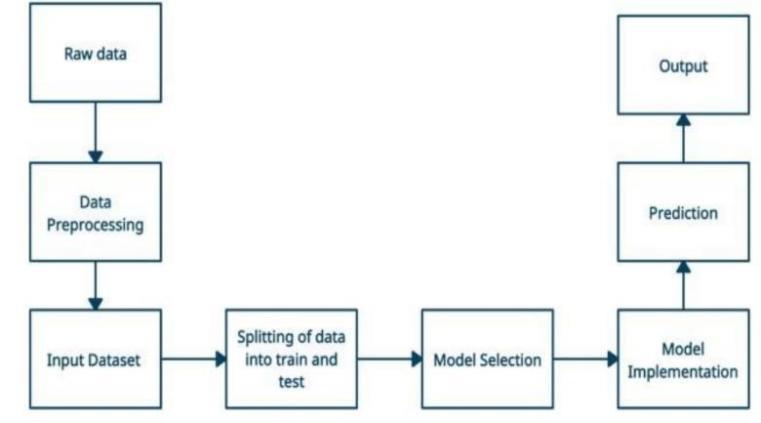
Fig.1.Processforpredictingbestmodel
Data Collection and Preprocessing: The first-aid dataset contains intents, patterns, and responses for a medical chatbot, covering greetings, farewells, creator inquiries, and various medical conditions. Each intent has example patternsrepresentinguserinputsandresponsesproviding medical advice. The dataset offers guidance on treatment, medication, and self-care for common medical issues. Preprocessing techniques like tokenization and removing stopwords are applied to clean and standardize the text dataaftercollection.
Algorithm Comparison: After preprocessing the data, a comparison of different algorithms is conducted to determine the most suitable approach for building the chatbot model. Common algorithms for chatbot development include rule-based systems, deep learning models (e.g., dense neural networks, LSTM). Each algorithm has its advantages and limitations, and the choice depends on factors such as the complexity of the task,thesizeofthedataset,andcomputationalresources.
Model Construction: Based on the selected algorithm, a chatbot model is constructed using the preprocessed data. The model architecture is designed and optimized to achievethedesiredperformancemetrics,suchasaccuracy andefficiency.
Algorithm Implementation: Once the model is constructed, it is implemented using programming languages and frameworks such as Python and TensorFlow. The implementation involves coding the logic for processing user queries, feeding them into the model, and generating responses.Dependingon thecomplexity ofthemodel,this step may also include fine-tuning hyperparameters and optimizingthemodel'sperformance.
Response Prediction: Finally, the trained model is used to predictresponsesforuserqueriesinreal-time.Thechatbot takes user inputs, processes them using the implemented algorithm, and generates appropriate responses based on thelearnedpatternsandknowledgefromthetrainingdata. The prediction accuracy and overall performance of the chatbot are evaluated using metrics such as precision, recall,andF1-score,andfurtherrefinementsmaybemade basedontheevaluationresults.
Flask website: We have created a user interface outline where the user enters queries in the chat container. We used HTML, CSS, JAVASCRIPT for responsive design and styling.
DenseModel:
Dense models represent a widely-used neural network architecture applicable to diverse machine learning tasks, encompassingclassificationandregression.
Step 1: Begin by importing the requisite modules from TensorFlow or Keras, renowned libraries for constructing deeplearningmodels.
Step 2: Define a Sequential model, a linear assembly of layers, leveraging the Sequential class. Integrate dense layers into the model using the Dense class, specifying neuronquantitiesandactivationfunctionsforeachlayer.
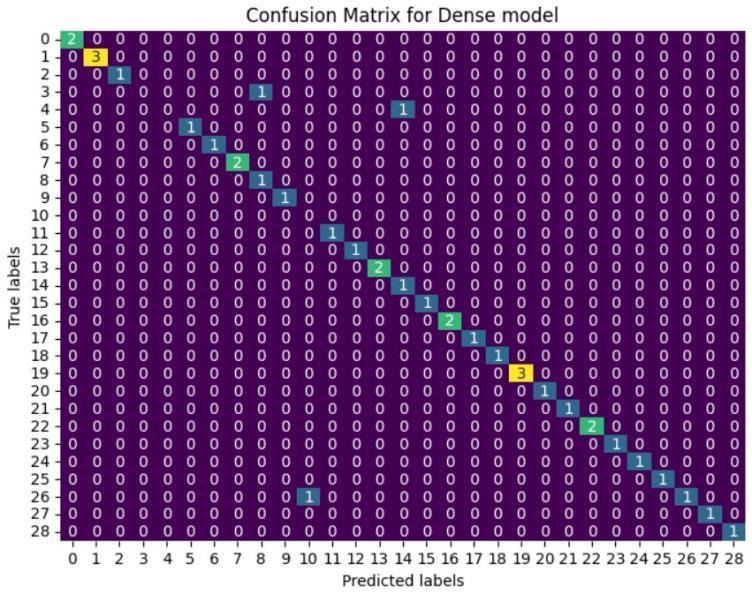
Fig.2.ConfusionmatrixforDensemodel
Step 3: Configure the model's structure by appending multiple dense layers, each linked to the preceding layer. Adjust parameters like neuron count and activation functions to align the model's behavior with the specific taskathand.
Step 4: Train the dense model using training data (Xtrain) paired with their corresponding labels (Ytrain).
Throughout training, the model iteratively refines its internalparametersvia backpropagation,fine-tuningthem tominimizethechosenlossfunction.
Step 5: Following training, evaluate the dense model's performance by deploying it on test data (Xtest) and contrasting its predictions with the actual labels (Ytest). Thisstepfacilitatestheassessmentofthemodel'scapacity to generalize to unseen data and deliver accurate predictions.
Step 6: Analyze the model's performance by generating metrics such as accuracy, loss, and any other relevant evaluationmetrics.Thesemetricsprovideinsights intothe model's effectiveness and help identify areas for improvement.
LSTMModel:
Step 1: Start by importing the necessary modules from TensorFlow or Keras, which are widely used libraries for deeplearningtasks.
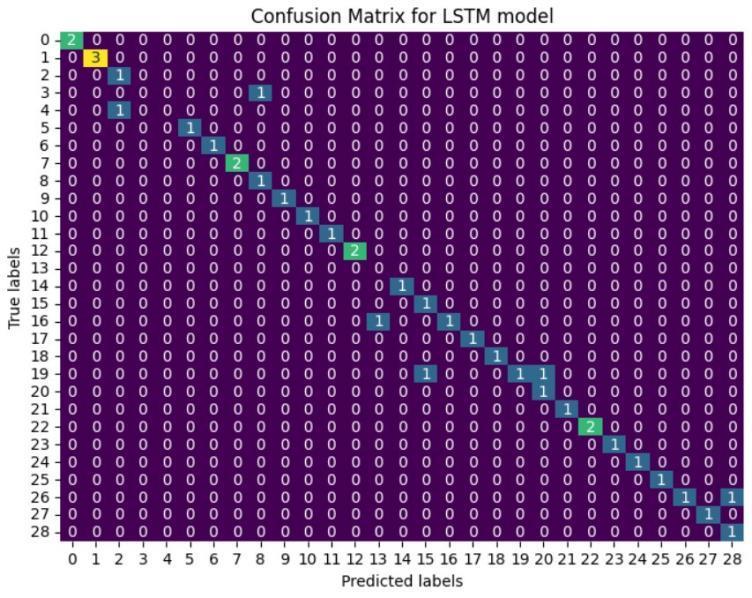
Step 2: Define a Sequential model, which represents a linear stack of layers, using the Sequential class. Integrate an LSTM (Long Short-Term Memory) layer into the model tocapturetemporaldependencieseffectively.
Step 3: Customize the model's architecture by adding additional layers as required, such as Dense layers for classificationorregressiontasks.
Step 4: Train the LSTM model using the training data (Xtrain) along with their corresponding labels (Ytrain), allowing the model to adjust its internal parameters throughbackpropagationduringthetrainingprocess.
Step5:EvaluatethetrainedLSTMmodel'sperformanceby applying it to the test data (Xtest) and comparing its predictions with the true labels (Ytest). This evaluation
helpsdeterminethemodel'sabilitytogeneralizeandmake accuratepredictionsonunseendata.
Step 6: Perform an in-depth analysis of the LSTM model's performance by computing relevant evaluation metrics such as accuracy, loss, and any other pertinent metrics. These insights offer valuable information about the model's effectiveness and highlight potential areas for improvement.
GRUModel:
Step 1: Begin by importing necessary modules from TensorFlow or Keras, widely-utilized libraries for deep learningtasks.
Step 2: Define a Sequential model, which represents a linear stack of layers, using the Sequential class. Incorporate a GRU (Gated Recurrent Unit) layer into the modeltoeffectivelycapturetemporaldependencies.
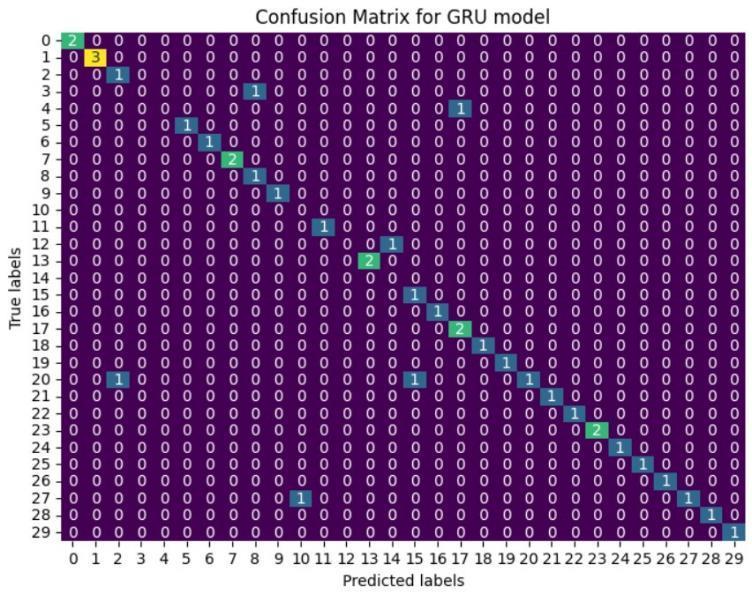
Fig.4.ConfusionmatrixforGRUmodel
Step 3: Customize the model's architecture by adding additional layers as necessary, such as Dense layers for taskslikeclassificationorregression.
Step 4: Train the GRU model using the training data (Xtrain) along with their corresponding labels (Ytrain), allowing the model to dynamically adjust its internal parameters through backpropagation during the training process.
Step 5: Evaluate the trained GRU model's performance by applying it to the test data (Xtest) and comparing its predictions with the true labels (Ytest). This evaluation is essential for assessing the model's capability to generalize andmakeaccuratepredictionsonunseendata.
Step 6: Conduct a comprehensive analysis of the GRU model's performance by computing relevant evaluation metrics such as accuracy, loss, and any other pertinent
metrics. Theseinsights furnish valuable information about the model's effectiveness and highlight potential areas for enhancement.
BidirectionalLSTMModel:
Step 1: Begin by importing essential modules from TensorFlow or Keras, which are widely-used libraries for deeplearningtasks.
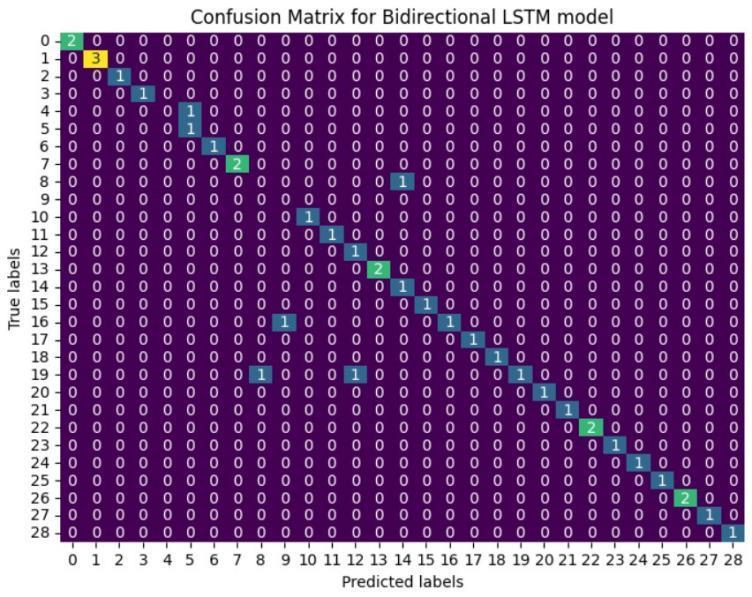
Fig.5.ConfusionmatrixforBirectionalLSTMmodel
Step 2: Define a Sequential model, representing a linear stack of layers, using the Sequential class. Integrate a Bidirectional layer with LSTM units into the model to capture temporal dependencies effectively, considering bothforwardandbackwarddirections.
Step 3: Customize the model's architecture by incorporating additional layers as required, such as Dense layersfortaskslikeclassificationorregression.
Step 4: Train the Bidirectional LSTM model using the trainingdata(Xtrain)alongwiththeircorrespondinglabels (Ytrain), enabling the model to dynamically adjust its internal parameters through backpropagation during the trainingprocess.
Step 5: Evaluate the trained Bidirectional LSTM model's performance by applying it to the test data (Xtest) and comparingitspredictionswiththetruelabels(Ytest).This evaluationiscrucialforassessingthemodel'scapabilityto generalizeandmakeaccuratepredictionsonunseendata.
Step 6: Conduct a comprehensive analysis of the Bidirectional LSTM model's performance by computing relevant evaluation metrics suchasaccuracy,loss,and any other pertinent metrics. These insights offer valuable information about the model's effectiveness and highlight potentialareasforimprovement.
The Dense Neural Network (DNN) model is trained and evaluated using the first aid dataset. During data preprocessing, the dataset undergoes tokenization and one-hot encoding of class labels. The architecture of the DNN model comprises dense layers with relu activation and dropout, facilitating effective feature extraction and nonlinear transformations. To optimize the model's performance, it is compiled with the Stochastic Gradient Descent (SGD) optimizer, incorporating momentum for fasterconvergence.Trainingoccursover150epochswitha batch size of 5, enabling the model to learn intricate patterns and relationships within the data. Finally, performance evaluation involves assessing classification metrics and analyzing accuracy plots to gauge the model's effectivenessinhandlingthegiventask.
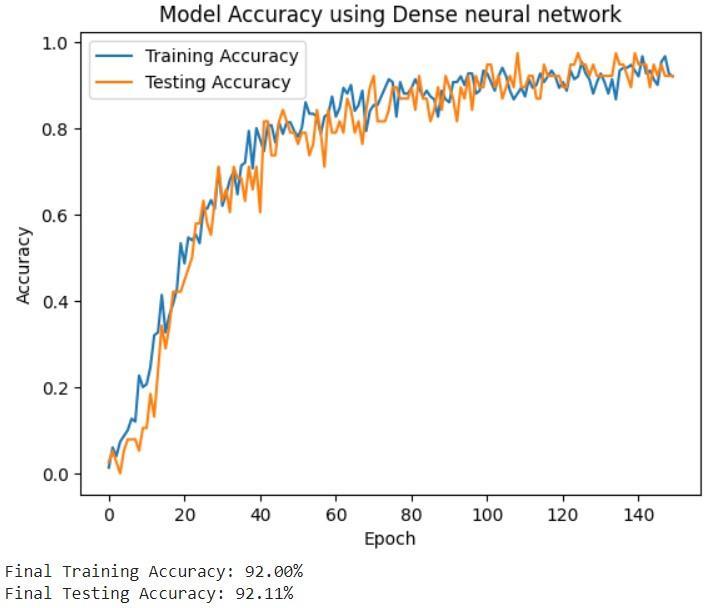
Denseneuralnetwork
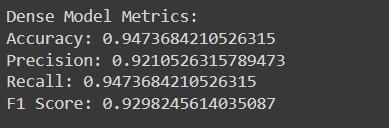
2.LSTMClassificationModel:
TheLSTM(Long Short-TermMemory) classificationmodel isdesignedtoprocesssequentialdataandisappliedtothe first aid dataset. Data preprocessing involves tokenization andpaddingofsequencestoensureuniforminputlengths. The model architecture includes an Embedding layer, followedbyanLSTMlayerwithdropoutforregularization. International Research Journal of
Dense layers with relu activation are incorporated for featureextraction,andasoftmaxactivationlayerisutilized for multi-class classification. The model is compiled using the sparse categorical crossentropy loss function and the Adam optimizer for efficient gradient descent. Training spans 150 epochs with a batch size of 16 to iteratively update model parameters. Performance evaluation is conducted using classification metrics and accuracy plots to assess the model's predictive capabilities and convergence.
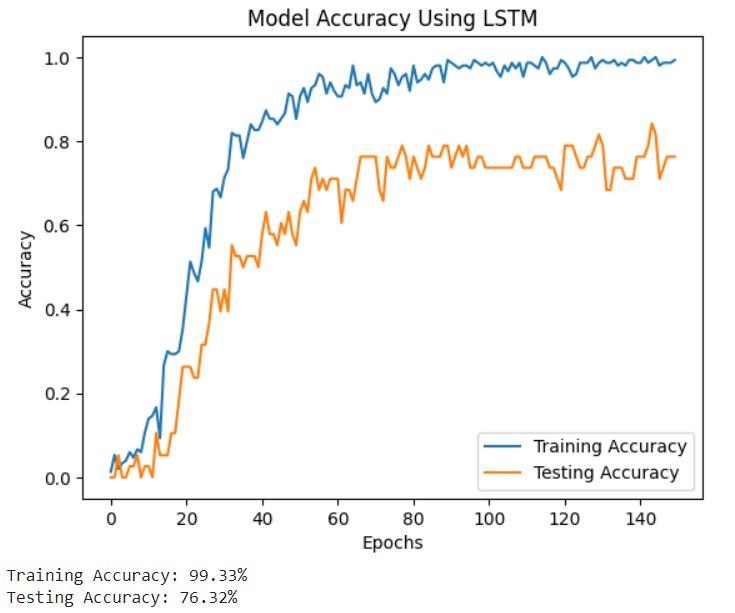
Fig.8.ModelaccuracyusingLSTM
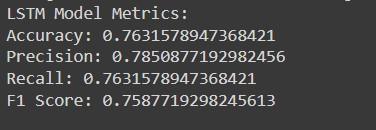
Fig.9.PerformancemetricsusingLSTM
3.GRUModel:
The GRU (Gated Recurrent Unit) model, utilized for classification, operates on the first aid dataset, primarily used for sequential data processing. Prior to model training, the dataset undergoes tokenization and sequence padding to standardize input dimensions. Model architecture comprises an Embedding layer followed by a GRU layer integrated with dropout to prevent overfitting. Dense layers employing relu activation contribute to feature extraction, while a softmax activation layer facilitates multi-class classification. Compilation of the model employs the sparse categorical crossentropy loss function and the Adam optimizer for efficient parameter optimization. Training unfolds across 150 epochs with a batch size of 16, ensuring iterative refinement of model parameters. Evaluation entails assessing classification
metrics and visualizing accuracy plots to gauge model performanceandconvergence.
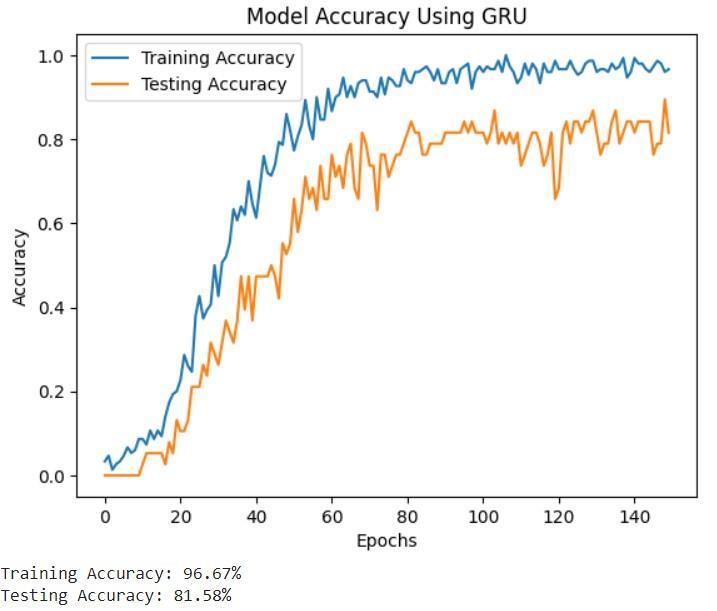
Fig.10.ModelaccuracyusingGRU
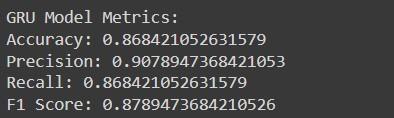
Fig.11.PerformancemetricsusingLSTM
4.BidirectionalLSTMModel:
TheBidirectionalLSTM(LongShort-TermMemory)model, applied for classification tasks, operates on the first aid dataset, a corpus commonly used for sequential data analysis.Preprocessinginvolvestokenizationandsequence padding to ensure uniform input dimensions. The model architecture encompasses an Embedding layer, coupled withaBidirectionalLSTMlayeraugmentedwithdropoutto mitigate overfitting. Dense layers with relu activation contributetofeature extraction,whileasoftmaxactivation layer facilitates multi-class classification. Model compilation utilizes the sparse categorical crossentropy loss function and the Adam optimizer for efficient parameter optimization.Trainingspans150 epochswitha batch size of 16, enabling iterative refinement of model parameters. Evaluation entails assessing classification metrics and visualizing accuracy plots to measure model performanceandconvergence.
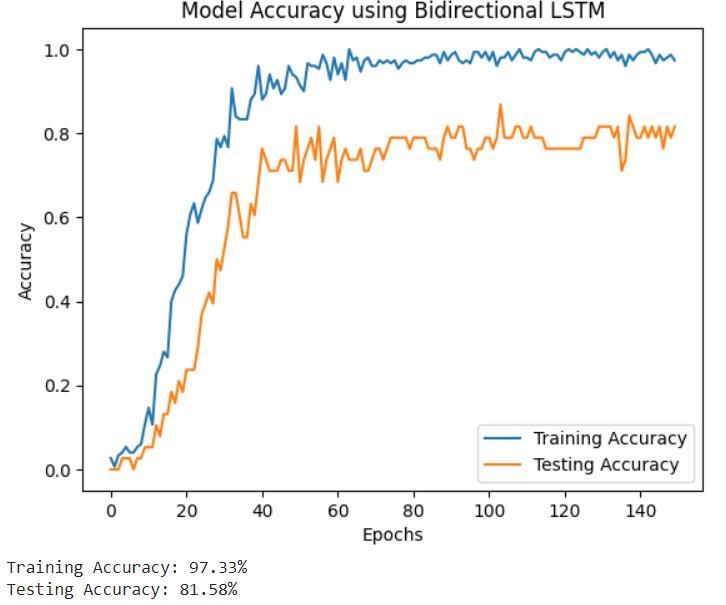
Fig.12.ModelaccuracyusingBidirectionalLSTM
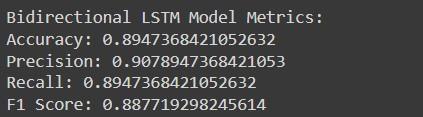
Fig.13.PerformancemetricsusingBidirectionalLSTM
The graphical comparison of testing accuracies across differentmodelsplaysa crucialroleinthemodelselection process for specific tasks. This visual representation provides a convenient and efficient means to assess how well each model performs in terms of accuracy. Accuracy, being a fundamental metric in classification, indicates the proportion of correctly predicted instances relative to the totalinstances.
By examining and contrasting testing accuracies, informed decisions can be made regarding the most suitable model for the given application. This is especially important in machine learning, where model performance directly impacts resource allocation, computational efficiency, and generalizability to new data. Moreover, the graph aids in identifying overfitting by comparing training and testing accuracies; models with notably higher training accuracy but lower testing accuracy may indicate overfitting to the trainingdata.
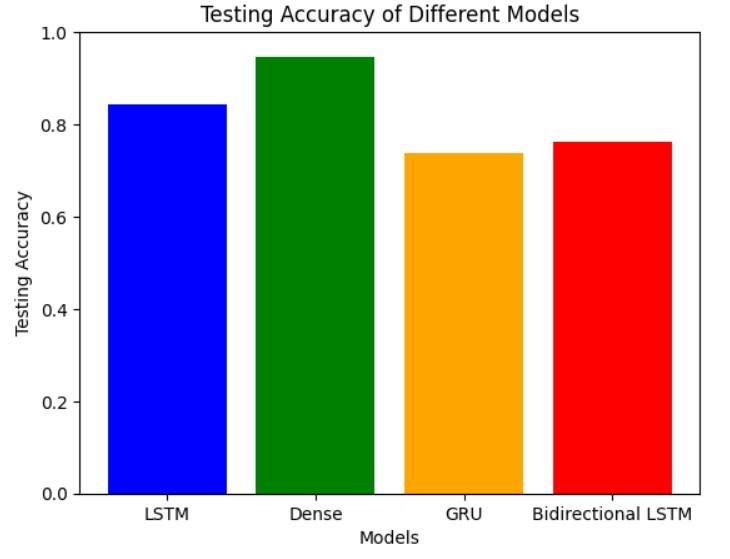
Fig.14.comparisonofaccuraciesamongLSTM,Dense NeuralNetwork,GRU,andBidirectionalLSTM
The graph's interpretability makes it accessible to stakeholders who may not be familiar with detailed metrics, allowing for a clear understanding of relative modelperformance.Ultimately,selectingamodelwithhigh testing accuracy enhances the likelihood of successful generalization to new and unseen data, thereby improving the model's predictive capability in real-world scenarios. Theiterativeprocessofmodelselectionandcomparisonis facilitated by the graph, enabling adjustments and refinements until the desired level of performance is attained.

Fig.15.comparisonoflossesamongLSTM,DenseNeural Network,GRU,andBidirectionalLSTM
The loss function measures the discrepancy between predicted and actual values, serving as a guide for model optimization and convergence. Throughout the training process,themodelsaimtominimizethisloss,indicativeof improvedperformanceandbetterfittothedata.
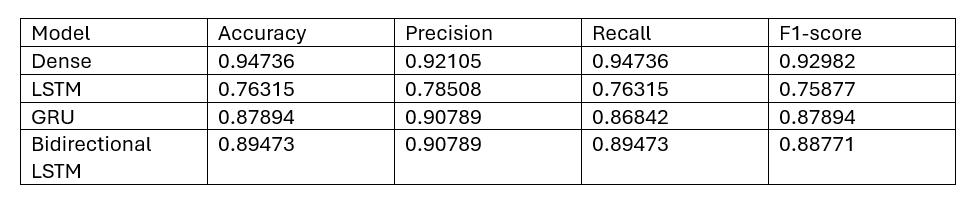
Fig.16.comparisonofPerformancemetricsforLSTM, DenseNeuralNetwork,GRU,andBidirectionalLSTM
International Research Journal of Engineering and Technology (IRJET) e-ISSN: 2395-0056
Volume: 11 Issue: 04 | Apr 2024 www.irjet.net p-ISSN: 2395-0072
Graphical User Interface (GUI): For creating the user interface of the chatbot we have used Flask, HTML, CSS and Java script. Flask is a lightweight and flexible web framework written in Python, designed to make web development quick and easy. It provides tools, libraries, and patterns for building web applications, allowing developers to create web-based projects efficiently. HTML, which stands for Hypertext Markup Language, is thestandardmarkuplanguageusedtocreateanddesign webpages.Itprovidesthestructureandcontentofaweb page by using a set of predefined elements and tags. CSS is a stylesheet language used to style the appearance of HTML elements on web pages. It allows developers to control the layout, colors, fonts, and other visual aspects of a website. JavaScript is a versatile programming language primarily used for adding interactivity and dynamicbehaviortowebpages.Itenablesdevelopersto create interactive elements, manipulate HTML and CSS, handle user events, validate forms, perform animations, andinteractwithwebAPIs.
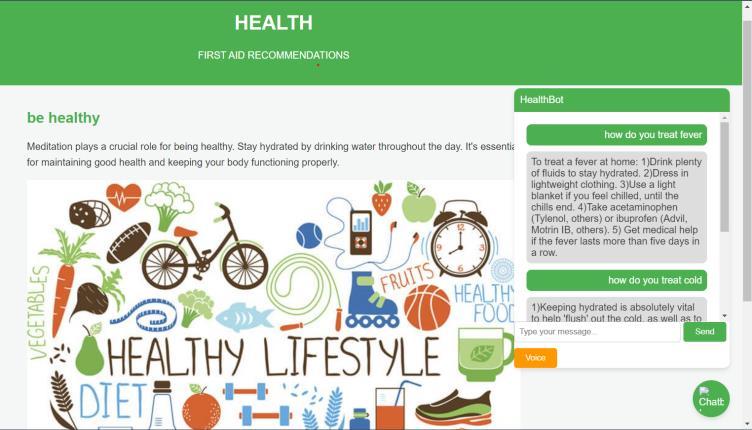
Fig.12.GUIofchatbotusingFLASK
In conclusion, the development of the chatbot using Dense Neural Networks (DNN) marks a significant milestone in providing accessible and user-friendly first aid information. The utilization of DNN, known for its simplicity and effectiveness, has enabled the chatbot to effectivelyclassifyandrespondtoadiverserangeofuser inquiries.Throughrigoroustrainingover150epochs,the model demonstrates commendable accuracy in understandingandcategorizinguserinputs,asevidenced bythegraphical representationoftrainingaccuracy.The incorporation of regularization techniques such as dropout, along with the Stochastic Gradient Descent (SGD) optimizer, has enhanced the model's generalization and efficiency during training. The successful convergence of various neural network components underscores the effectiveness of the chosen architecture. While the current implementation achieves its objectives, there exists ample scope for future enhancements. These include the exploration of
advanced NLP techniques, implementation of contextaware systems, and integration of multimodal learning for enhanced user guidance. Collaboration with UX/UI designers, expansion of the dataset, and continuous model refinement through updates and retraining are crucial for ensuring the chatbot's adaptability and relevance in real-world scenarios.The developed chatbot represents a significant step forward in providing accessible and reliable first aid assistance. Its effectiveness, combined with the potential for future enhancements, positions it as a valuable tool in promotinghealthandsafetyinvariouscontexts.
While the current chatbot is robust, there are promising opportunitiesforfutureenhancements.Oneavenueisthe integration of advanced Natural Language Processing (NLP) techniques, such as pre-trained models like BERT or GPT, which could greatly enhance the chatbot's language understanding capabilities. Another promising enhancement involves implementing a context-aware system to enable the chatbot to maintain more coherent and personalized conversations by considering the context of previous interactions. Establishing a user feedback loop for continuous learning and refinement, expandingthedatasettocoverabroaderrangeoftopics, and implementing real-time assistance capabilities are alsocrucialconsiderationsforfutureimprovements.
Collaborating with UX/UI designers to enhance the user interfaceandexperience,providingmultilingualsupport, andensuringrobustsecurityandprivacymeasuresarein place are essential steps for enhancing the chatbot's usability and accessibility.Lastly, a commitment to continuous model refinement through regular updates and retraining will ensure that the chatbot remains upto-date with evolving language usage and practices. These future endeavors aim to not only enhance the chatbot's effectiveness but also ensure its adaptability and relevance in the dynamic landscape of information and assistance.accessible first aid information and assistancetouserswhenneeded.
[1] - Williams, R., & Johnson, M. (2018). Exploring the Potential of Chatbots in Modern Communication: A Survey Study. Journal of Information Technology, 25(3), 212-228.
[2]-ChatbotEvolution:FromSimpleRule-basedSystems toAdvancedNeuralNetworks,TechReview,2018.
[3]-Sutskever,I.,Vinyals,O.,&Le,Q.V.(2014).Sequence to sequence learning with neural networks. In Advances in neural information processing systems (pp. 31043112).
Volume: 11 Issue: 04 | Apr 2024 www.irjet.net
[4] - Smith, J. (2020). The Role of Chatbots in Modern Customer Service Practices. Journal of Customer Experience,5(2),89-104.
[5] -Jurafsky, D., & Martin, J. H. (2019). Speech and Lang uageProcessing(3rded.).Pearson.
[6]-Goodfellow,I.,Bengio,Y.,&Courville,A.(2016).Deep Learning.MITPress.
[7] -Bird, S., Klein, E., & Loper, E. (2009). Natural LanguageProcessingwithPython.O'ReillyMedia,Inc.
[8] -Chandar, S., Khapra, M. M., & Larochelle, H. (2019). The problem of evaluation in generative adversarial networks.arXivpreprintarXiv:1903.01340.
[9] -Tang, D., Qin, B., & Liu, T. (2019). Target-Guided Open-Domain Conversation. In Proceedings of the 57th Annual Meeting of the Association for Computational Linguistics(pp.2613-2623).
[10] -Henderson, M., Islam, R., Pineau, J., Williams, J., & Chang, M. (2019). A Survey of the Usages of Dialogue SystemsinHealthcare.arXivpreprintarXiv:1907.01452.
[11]-Liu,C.,&Lane,I.(2019).RecentAdvancesinDialog Management for Task-Oriented Dialog Systems. arXiv preprintarXiv:1906.04771.
[12] -Wu, Y., Wu, W., Zhang, Y., Lu, W., & Zhu, T. (2019). Dynamic Graph Representation Learning via SelfAttention Networks. In Proceedings of the AAAI Conference on Artificial Intelligence (Vol. 33, pp. 36353642).
[13] -Chung, J., Gulcehre, C., Cho, K., & Bengio, Y. (2014). Empirical evaluation of gated recurrent neural networks onsequencemodeling.arXivpreprintarXiv:1412.3555.
[14] Garima Srivastava, Surbhi Agarwal and Mr. Deepak Vishwakarma, 2020 “DEEP NEURAL NETWORK BASED CHATBOT”.
[15] Eleni Adamopoulou, Lefteris Moussiades, 2020 “Chatbots:History,technology,andapplications”. International Research
-ISSN: 2395-0072