
International Research Journal of Engineering and Technology (IRJET) e-ISSN:2395-0056
Volume: 11 Issue:04 | Apr2024 www.irjet.net p-ISSN: 2395-0072
International Research Journal of Engineering and Technology (IRJET) e-ISSN:2395-0056
Volume: 11 Issue:04 | Apr2024 www.irjet.net p-ISSN: 2395-0072
Ms. Chape Kalyani Sunil
Department of Electronics Engineering
Amrutvahini College of Engineering Sangamner, A.Nagar, India
Mr.D.A.Mhaske
Department of Electronics Engineering
Amrutvahini College of Engineering Sangamner, A.Nagar, India
Ms. Gavhane Pratiksha
Krishna
Department of Electronics Engineering
Amrutvahini College of Engineering Sangamner, A.Nagar, India
Abstract This paper proposes a solution for the modernization of poultry farming through automation using wireless sensor networks and mobile communication systems. By integrating technology into poultry management, the aim is to improve productivity, quality, and efficiency while reducing manual labor. Environmental parameters such as humidity, temperature, light, and ammonia gas are monitored and controlled automatically, alongside tasks like food feeding and water supply. The system enables remote monitoring and management through a web-based interface, enhancing farm management and optimizing chicken health and production. This approach addresses the increasing demand for poultry products while promoting sustainability and profitability in theindustry.
Keywords- Poultry farming, automation, wireless sensor network, mobile communication, productivity.
Over the past few decades, the global poultry industry has witnessed significant growth driven by advancements instandardizedfarmingpracticesandincreasedawareness regarding food safety. Chicken, being the most consumed agricultural produce, offers a nutrient-rich source of proteinwithlowfatandcholesterolcontent.However,this surge in demand has necessitated innovative solutions to enhanceproductionefficiencyandqualitywhileminimizing manuallabor.
Traditionalpoultryfarmingmethods,althougheffective, often face challenges in precise feed management, leading to inefficiencies and wastage. As the industry strives to meet the escalating demand for broiler chicken, the pressure to scale up production has intensified. Yet, this pursuitofhigheryieldscomesatacost,asnon-precisefeed practicescontributetoeconomiclossesandenvironmental strain.
Gadakh Ashvini
Chandrashekhar
Department of Electronics Engineering
Amrutvahini College of Engineering Sangamner, A.Nagar, India
Embracingtechnology-drivensolutionsisimperativeto addressthesechallengesandensuresustainablegrowthin the poultry sector. This paper focuses on the implementation of an automated poultry farming system utilizing wireless sensor networks and mobile communication technology. By integrating sensors to monitorenvironmentalparametersandautomateessential tasks suchas food feedingand water supply, the proposed systemaimstooptimizeproductivity,quality,andresource utilizationinpoultryfarmingoperations.
Furthermore, the adoption of precision livestock farming not only enhances production efficiency but also mitigates environmental impacts associated with feed wastage and resource depletion. Through real-time monitoringandremotemanagementcapabilitiesofferedby the proposed system, poultry farmers can make informed decisions to improve farm operations, promote animal welfare, and meet the rising demand for poultry products sustainably.
Inlightoftheseconsiderations,theimplementationofa smart poultry farming system holds promise in revolutionizingtheindustry,usheringinaneraofefficient, sustainable,andtechnology-drivenpoultryproduction.
The ever-increasing demand for broiler chicken places immense pressure on the poultry industry to scale up production, leading to inefficiencies in non-precise feed livestock practices and environmental strain. Traditional poultryfarmingmethodsrelyonmanualfeedmanagement, resultinginexcessfeedconsumption,economiclosses,and environmental degradation through deforestation and greenhouse gas emissions. Embracing precision livestock farmingiscrucial toaddress thesechallengesandsecurea sustainablefutureforthepoultryindustry.
11 Issue:04 | Apr2024
• To study the impact of automated feeding systems onpoultryproductivity.
• To analyze the effectiveness of wireless sensor networksinmonitoringpoultryhealth.
• To assess the economic feasibility of implementing mobile communication systems in poultry management.
• To investigate the correlation between environmental parameters and chicken welfare in automatedfarms.
• To evaluate the potential of precision livestock farming in reducing feed wastage and environmentalimpact.
1. IoT-based Mobile and Wireless Network Management for Poultry Farming by Ms. Sakshi Mishra, Mr. Aamir Sheikh, Ms. Snehal Chore, and Ms.SonamKshirsagar(2019):Thisstudypresents an innovative approach to poultry farming management through the integration of IoT technologies. By leveraging mobile and wireless networks, the researchers aimed to enhance monitoring, control, and automation in poultry farms. The system proposed in this paper enables real-time data collection of environmental parameters such as temperature, humidity, and feed levels, allowing farmers to remotely monitor and manage their poultry operations efficiently. This research contributes to the advancement of poultry farming practices by introducing costeffective and scalable solutions for improved productivityandresourceutilization.
2. Smart Household PoultryFarming Using ZigBee Module byJ.ArthurVasanthetal.(2022):Vasanth and colleagues explored the application of ZigBee Module technology in smart household poultry farming. The study focused on developing an integrated system capable of monitoring and controlling various aspects of poultry management, including environmental conditions, feeding schedules, and health monitoring. By leveraging ZigBee Module technology, the researchers aimed to create a robust and reliable communication infrastructure for seamless data transmission and remote management. This research contributes to the field by introducing a comprehensive solution for household poultry farmingthatenhancesefficiency,productivity,and animalwelfare.
3. Monitoring and Feeding System in Poultry Farming using Mobile and Wireless Network Management bySHUBHAMK.VERMA,JAYESHM. GANVIR,andTANMAYG.GHODE(2020):Vermaet al. conducted a study on the implementation of a monitoring and feeding system in poultry farming using mobile and wireless network management techniques. The research focused on developing a system that enables real-time monitoring of environmental parameters and automated feeding basedonpredefinedcriteria.Byintegratingmobile and wireless network technologies, the proposed system allows farmers to remotely monitor and control poultry operations, thereby improving efficiency and productivity. This study contributes totheadvancementofpoultryfarmingpracticesby introducing technology-driven solutions for enhancedmanagementandautomation.
4. Study of Wireless Sensors and Mobile System for Poultry Farming by S. T. Naphade and S. G. Badhe (2021): Naphade and Badhe investigated the utilization of wireless sensors and mobile systems for poultry farming applications. The study aimed to develop a comprehensive system that integrates wireless sensor networks with mobile communication technology to enable remote monitoring and management of poultry farms. By deploying wireless sensors to collect data on environmental conditions and poultry health, and leveraging mobile systems for data transmission and control, the researchers proposed a solution that enhances efficiency, productivity, and animal welfare in poultry farming operations. This research contributes to theadvancementofprecisionlivestockfarmingby introducing innovative technologies for improved managementandautomation.
5. Automatic Poultry Farm Network Management by Mr. Aamir Sheikh (2019): Mr. Aamir Sheikh's research focuses on the development of an automatic network management system for poultry farms. The study aims to streamline poultry management operations by automating taskssuchasfeeding,watering,andenvironmental monitoring. By implementing a network management system, the proposed solution enables centralized control and monitoring of poultry farm activities, thereby enhancing efficiency, productivity, and resource utilization. This research contributes to the advancement of poultry farming practices by introducing automated solutions for improved management andproductivity.
International Research Journal of Engineering and Technology (IRJET) e-ISSN:2395-0056
Volume: 11 Issue:04 | Apr2024 www.irjet.net p-ISSN: 2395-0072
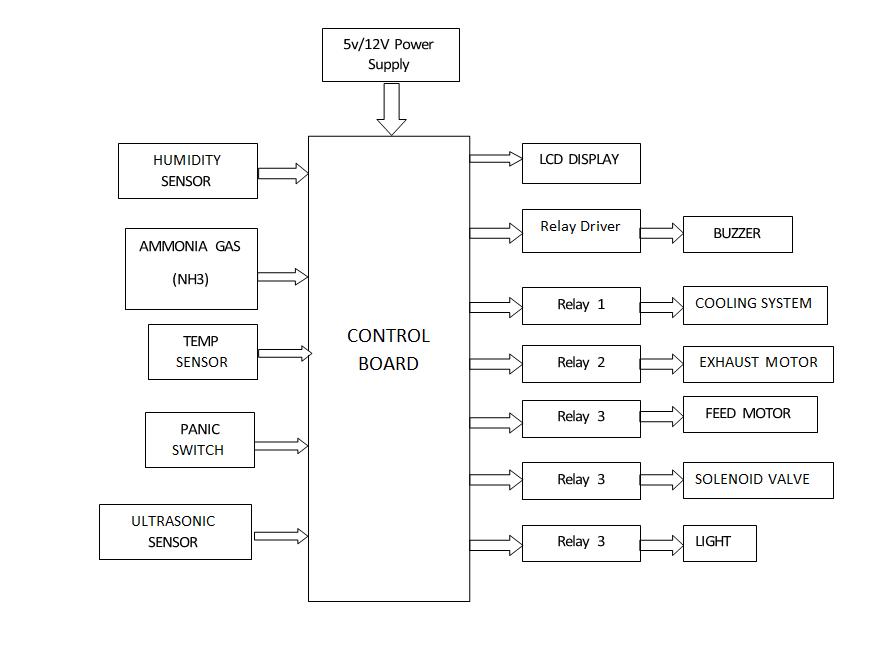
Fig.1SystemArchitecture
The proposed poultry automation system represents a paradigm shift in poultry farming management, offering a holistic solution for monitoring and controlling essential parameters critical to chicken health and productivity. Central to this system is its ability to seamlessly monitor and regulate environmental factors such as temperature, humidity, and ammonia gas levels, all of which are crucial for ensuring optimal conditions within poultry facilities. Through the integration of sensors and a centralized controller,real-timedataontheseparametersarecollected and analyzed, enabling proactive adjustments to maintain idealconditionsformaximumpoultryproduction.
In addition to environmental monitoring, the automationsystemalsoencompasseskeyprocessessuchas feeding, water level management, and egg collection. By automating these tasks, the system streamlines operations and reduces the reliance on manual labor, thereby enhancing efficiency and productivity. Furthermore, the system's accessibility via mobile phones or PCs connected totheinternetempowersfarmerstoremotelymonitorand manage their poultry farms from anywhere, providing flexibilityandconvenienceinfarmmanagement.
The system's capability to store and analyze data in a cloud platform facilitates informed decision-making and continuous improvement in poultry farming practices. Historical data on environmental conditions, feeding patterns,andproductionmetricsenablefarmerstoidentify trends, optimize resource allocation, and implement targeted interventions to maximize poultry output. Moreover, the system's portability and cost-effectiveness makeitaccessibletoawiderangeoffarmers,regardlessof scaleorresources.
Overall,theproposedpoultryautomationsystemoffers a comprehensive and innovative approach to poultry farming management. By leveraging advanced technology to monitor and control critical parameters, automate essential tasks, and facilitate data-driven decision-making, the system empowers farmers to optimize production, minimize risks, and ensure the welfare of their poultry stock.
DiscussionandSummary:
1. Microcontrollerunit(Pic Series):
Description:Microcontrollers,specifically PIC(ProgrammableInterfaceControllers), are programmable electronic circuits capableofexecutingawiderangeoftasks. They are commonly found in various electronic devices such as alarm systems, computercontrolsystems,andphones.
Features: The PIC18F4520 Microcontroller is part of the Low Pincount (20) PIC Flash microcontroller series. It offers features such as a wide operating voltage range (2.0-5.5 volts), onboard EEPROM Data Memory, and nanoWattTechnology.
Specifications:
OperatingFrequency:40MHz
ProgramMemory:32768
DataMemory:1536
InterruptSources:20
I/OPorts:PortsA,B,C,D,E
Timer:4
10BitADC:13InputChannels
2. HumiditySensor (HR202):
Description: The HR202 is a humiditysensitive resistor made from organic macromolecule materials. It finds applications in various fields such as hospitals, storage, textiles, and meteorology.
Features:
Excellentlinearity
Lowpowerconsumption
Widemeasurementrange
Quickresponse,anti-pollution
Highstability
Highperformance-priceratio
International Research Journal of Engineering and Technology (IRJET) e-ISSN:2395-0056
Volume: 11 Issue:04 | Apr2024 www.irjet.net p-ISSN: 2395-0072
Technical Specifications:
Operating Range: Humidity (2095%RH),Temperature(0-60°C)
PowerSupply:1.5VAC(Maxsine)
Operating Frequency: 500Hz2kHz
RatedPower:0.2mW(Maxsine)
Accuracy: ±5%RH, Hysteresis: ±1%RH
Long-termStability:±1%RH/year
3. TemperatureSensor (LM35):
Description: The LM35 is an analog, linear temperature sensor that provides an output voltage linearly proportional to temperaturechanges.Itiscommonlyused intemperaturemeasurementapplications.
Features:
Measurestemperaturefrom-55°C to+150°C
Outputvoltageincreasesby10mV per degree Celsius rise in temperature
Operating Principle: Based on the principle of a diode, where the voltage across the diode increases linearly with temperature.
4. DC Motor:
Description: A geared DC motor incorporates a gear assembly attached to the motor shaft. The gear assembly helps increasetorqueandreducespeed,making itsuitableforvariousapplications.
Working Principle: The motor's speed is measuredintermsofrotationsperminute (RPM), and the gear assembly helps in reducing the speed while increasing torquethroughgearreduction.
5. Battery/Transformer:
Description: A transformer is used to efficientlyraiseorlowerACvoltagesusing Faraday's law and the ferromagnetic properties of an iron core. It cannot increasepowerbutcanvaryvoltagelevels.
Working Principle: The transformer steps up or steps down the voltage based
on the turns ratio between the primary andsecondarycoils.
Description: A buzzer is an electrical componentusedtoproduceaudiblesound alerts or alarms. It operates on low current consumption and is compact in size.
Features:
Operating Power: 3-6V DC / 25mA
Extremely compact, ultrathin construction
Noelectricalnoise
Low current consumption yet highsoundpressurelevel
7. LCDDisplay:
Description:LCD(LiquidCrystal Display) screens are electronic display modules widely used in various devices and circuits.A16x2LCDdisplaycandisplay16 charactersperlineacross2lines.
Features:
Economical and easily programmable
No limitation on displaying special/customcharacters
Suitablefordisplayinganimations andgraphicalcontent
Internal structure includes command and data registers for controllingdisplaycontent
8. PowerSupply:
Description: The power supply provides the necessary electrical power to operate the entire system. It includes components suchastransformers,rectifiers,filters,and voltageregulators.
Design Considerations: The power supply design involves selecting appropriate components and designing circuits to generate stable DC voltages requiredforthesystem'soperation.
Components: Transformer, Rectifier, Filter,Regulator,etc.
International Research Journal of Engineering and Technology (IRJET) e-ISSN:2395-0056
Volume: 11 Issue:04 | Apr2024 www.irjet.net p-ISSN: 2395-0072
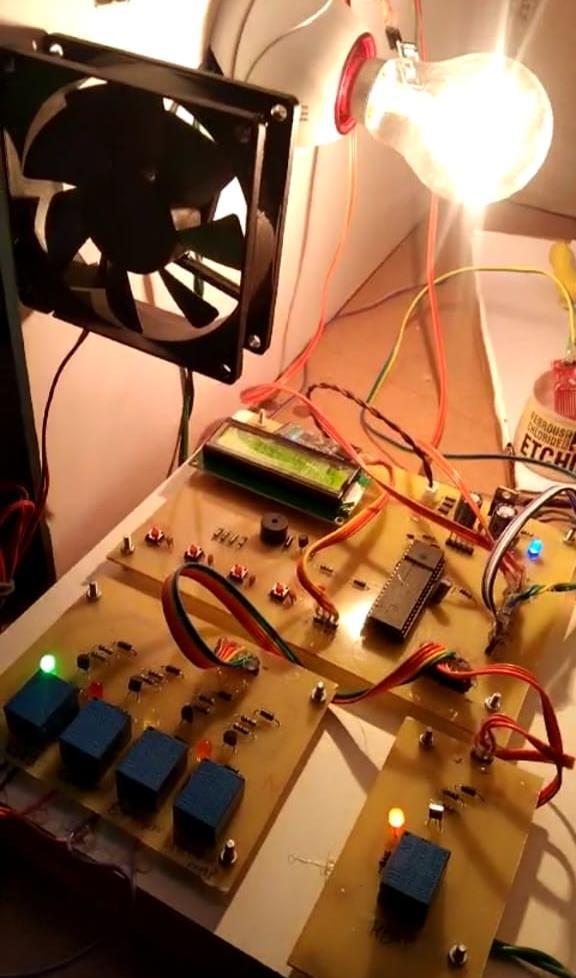
The implemented poultry automation system has demonstratedsignificantimprovementsinpoultryfarming management and productivity. By effectively monitoring and controlling environmental parameters such as temperature,humidity,andammoniagaslevels,thesystem ensures optimal conditions for chicken health and growth, leadingtoincreasedproductionratesandimprovedquality of poultry products. Moreover, the automation of essential tasks such as feeding, water level management, and egg collection has streamlined farm operations, reducing manuallaborandoperationalcostswhileenhancingoverall efficiency.
The system's accessibility via mobile phones or PCs connected to the internet allows farmers to remotely monitor and manage their poultry farms from anywhere, providingconvenienceandflexibilityinfarmmanagement. Real-time data collection and analysis enable informed decision-making, allowing farmers to identify trends, optimize resource allocation, and implement targeted interventions for maximizing poultry output. Overall, the implemented poultry automation system represents a sustainable and cost-effective solution for modern poultry farming, offering improved productivity, efficiency, and profitabilityforfarmers.
In future work, the poultry automation system can be expanded to incorporate advanced technologies such as machine learning and artificial intelligence to enhance predictive analytics capabilities. By leveraging historical dataandreal-timesensorinformation,AIalgorithmscanbe developed to forecast poultry growth patterns, detect potential health issues, and optimize feeding schedules for maximum efficiency. Additionally, integration with blockchain technology can enhance traceability and transparency in the poultry supply chain, ensuring food safetyandqualityassurancefromfarmtotable.Expanding the system's scalability and interoperability with other agricultural management systems will also be essential for accommodating larger-scale poultry operations and facilitatingseamlessdataexchangeacrossdifferentfarming platforms.
In conclusion, the proposed IoT-based automated monitoring system for poultry farming offers a transformative solution to modernize and enhance the efficiency of this age-old practice. By leveraging cuttingedge technology, traditional backyard poultry farming can be converted into a highly profitable and scientificallydriven commercial enterprise. This innovative system not only optimizes the health and growth conditions for chickens but also empowers landless laborers and small farmers to explore poultry farming as a viable secondary income stream. With its ability to streamline operations andmaximizeproductivity,thisautomatedpoultryfarming approachhasthepotentialtorevolutionizetheagricultural industry in India and beyond, cementing poultry farming's status as an indispensable and lucrative component of the sector. Ultimately, this project design represents a significant stride towards sustainable and technologicallyadvanced poultry farming practices, offering a promising avenue for economic growth and self-sufficiency in rural communities.
1. Mishra,S.,"IoTbasedmobileandwirelesssystems for poultry automation," IOSR Journal of Engineering(IOSRJEN),2019.
2. Sheikh, A., "Automatic network management for poultry engineering," International Journal of Electrical Engineering and Technology (IJEET), 2022.
3. Chore, S., "Poultry systems: A comprehensive review," IOSR Journal of Engineering (IOSRJEN), 2019.
International Research Journal of Engineering and Technology (IRJET) e-ISSN:2395-0056 Volume: 11 Issue:04 | Apr2024 www.irjet.net p-ISSN: 2395-0072
4. Kshirsagar, S., "Smart Poultry Farm System: Implementation and Evaluation," International Journal of Engineering and Technology (IJET), 2020.
5. Vasanth, J. A., "Smart household poultry farming using ZigBee Module," International Journal of Electrical Engineering and Technology (IJEET), 2022.
6. Nidharshan, R., et al., "Implementation of monitoring and feeding system for poultry farming,"ScientificResearchJournal,2021.
7. Verma, S. K., "Mobile and wireless network management for poultry farming," International Research Journal of Engineering and Technology (IRJET),2020.
8. Ganvir, J. M., et al., "Real-time monitoring of environmental parameters and feeding system in poultryfarming,"InternationalResearchJournalof EngineeringandTechnology(IRJET),2020.
9. Naphade, S. T., & Badhe, S. G., "Wireless sensors and mobile system for poultry automation," JournalofScientificResearch,2021.
10. "PIC18F4520 Microcontroller Datasheet," MicrochipTechnologyInc.,2019.
11. "HR202 Humidity Sensor Datasheet," HR Electronics,2020.
12. "LM35 Temperature Sensor Datasheet," Texas Instruments,2022.
13. "DCMotorSpecifications,"JohnsonElectric,2021.
14. "Transformer Basics and Principles," Electrical4U, 2023.
15. "BuzzerTechnicalSpecifications,"MallorySonalert Products,Inc.,2022.
16. "LCD Display Module Datasheet," SparkFun Electronics,2023.
17. "Power Supply Design Guide," Texas Instruments, 2021.
18. "Relay Basics and Applications," Omron Corporation,2022.
19. "PCB Design Guidelines and Standards," IPCAssociation Connecting Electronics Industries, 2020.