
International Research Journal of Engineering and Technology (IRJET) e-ISSN: 2395-0056
Volume: 11 Issue: 04 | Apr 2024 www.irjet.net p-ISSN: 2395-0072
International Research Journal of Engineering and Technology (IRJET) e-ISSN: 2395-0056
Volume: 11 Issue: 04 | Apr 2024 www.irjet.net p-ISSN: 2395-0072
Dr.Ranjit K N1, Ms. Bhoomika Rajendra Vernekar2, Ms. Chandana MR3, Ms. Spandana MP4 , Mr. Mallikarjun Bachwar5
1 Associate Professor, Dept. of Computer Science and Engineering, Maharaja Institute of Technology, Thandavapura
2,3,4,5Students, Dept of Computer Science and Engineering, Maharaja Institute of Technology, Thandavapura ***
Abstract – Nowadays, people conduct practically all their business online. While there are many benefits to online transactions, like viability, speedier payments, and ease of use, there are drawbacks as well, including fraud, phishing, and data theft. The increasing volume of internet transactions raises the possibility of fraud and dishonest business practices that compromise an individual's privacy. When a criminal can take control of an account and move money out of a person's online bank account. To minimize anticipated financial losses, it is also necessary to enhance traditional machine learning techniques. A feature-engineered machine learning-based model that is Random Forest and Gradient Boosting algorithm which can improve its performance, reinforce its stability, and gain experience by processing as much as data it can. Finally, understanding the costs and risks associated with payment methods is essential to fighting fraud in a methodical and costeffective manner. We define three models to address these issues: a risk model to forecast fraud risk while taking counter measures into account; machine learning-based fraud detection; and economic optimization of machine learning outcomes. Real data is used to test the models.
Key Words: Machine Learning, Random Forest, Gradient Boosting, Reinforce, Fraud Detection
Theworldisheadingquicklytowardacashlesssociety. The number of people making purchases online has increased,accordingtonumerouspollsandstudies,anditis expectedthatthistrendwillcontinueintheyearstocome. While this might sound like good news, there is also an increase in fraudulent transactions on the other hand. Despite the deployment of multiple security measures, fraudulent transactions nonetheless result in the loss of a substantialamountofmoney.Whensomeoneusesanother person's credit card for unauthorized personal purchases online without the cardholder's or the card issuer's knowledge,thisisknownasonlinefraud.
The process of monitoring user activity to assess, spot, or stop unwanted behaviour, such as fraud, intrusion, and defaults, is known as fraud detection. A person who has fallenforoneofthesescamsfrequentlydoesnotrecognizeit until it is too late. Real-world examples show how fast automated systems evaluate the enormous amount of
paymentrequeststoselectwhichtransactionstoauthorize. Every authorized transaction is examined, and any suspicious activity is found, using machine learning algorithms. Before chatting with the experts looking into these claims, cardholders need to determine whether a transaction was legitimate or fraudulent. The automated systemthatcreatesandrefinesthealgorithmincorporates suggestions from the detectives to gradually increase the accuracyoffrauddetection.
Toprogressivelyimprove theaccuracyof fraud detection, the automated system that develops and improves the algorithm considers recommendations made by the detectives. With the help of several technologies, we are tryingtodevelopa Webapplicationformachinelearningbasedfrauddetectioninthisproject.Anonlinetransaction fraud detection system is necessary to safeguard digital financial transactions and thwart unlawful or fraudulent activities. As more financial transactions are being done online,robustfrauddetectiontechniquesarebecomingmore andmoreimportant.Theprimarygoalofthesesystemsisto immediatelyidentifyandthwartfraudulentconductinorder tosafeguardtheintegrityandsecurityofonlinetransactions.
An online transaction fraud detection system is a set of instruments,algorithms,andprocessesdesignedtoidentify andprevent.
To achieve high accuracy in fraud detection while minimizing false positives. Analyze user behavior and transactionpatterns.Continuouslyadaptto evolvingfraud tacticsandpatterns.Seamlesslyintegratewithvariousonline paymentgatewaysandfinancialinstitutions.Enhanceuser authentication methods. Ensure scalability to handle increasing transaction volumes Identify and mitigate potential risks associated with online transactions, to industryregulationsandcompliancestandardswhichBuild andmaintaintrustamongusers.
Firstoff,evenwhiletransactiondatacontainsextremely fewfraudulentevents,thedata'simbalancemayskewmodel performance in favour of the majority class, leading to imprecise frauddetection. Second, because fraudsters use dynamictechniques,ideadriftoccurs,andmodeladaptionis
International Research Journal of Engineering and Technology (IRJET) e-ISSN: 2395-0056
Volume: 11 Issue: 04 | Apr 2024 www.irjet.net p-ISSN: 2395-0072
ongoing to identify changing fraud trends. Moreover, challenges exist in precisely identifying fraud indicators relatedtotheselectionandengineeringofpertinentfeatures fromlargeanddiversedatasets.Trainingandperformance ofthemodelarefurthercomplicatedbyproblemswithdata quality,suchasnoisyorincompletedata.Furthermore,fraud detectionsystems'resilienceiscompromisedbyMLmodels' vulnerability to adversarial attacks, in which criminals benefit from flaws to avoid detection. Scalable infrastructures and effective algorithms are necessary for real-time processing requirements to quickly examine transactions.
To distinguish between authentic and fraudulent transactions, the Random Forest algorithm is utilized as a reliableandefficientinstrument.Tofunction,RandomForest buildsmanydecisiontrees,eachofwhichistrainedusinga different subset of the characteristics and data that are available.Together,thesedecisiontreescreateanensemble, witheachtreeaddingtothefinalclassification.Thealgorithm can recognize suspicious activity depending on multiple transaction variables such transaction amount, frequency, location,anduserbehaviorbecauseithaslearnedpatterns andrelationshipswithinthetransactiondataduringtraining. RandomForest'scapacitytohandletheimbalancednatureof transactiondatasets wherefraudulentcasesarefrequently greatly outnumbered by genuine ones is one of its main advantagesforfrauddetection.
Thisissueofclassdisparitycanbesuccessfullyaddressedby Random Forest by using strategies like class weighting or modifyingdecisioncriteria,whichwillenhanceitsaccuracy in detecting fraudulent transactions. Moreover, highdimensional data that is frequently encountered in fraud detection applications is a good fit for Random Forest models.Theirreal-timeprocessingabilityofvastamountsof transaction data makes them perfect for online fraud detection systems that need to quickly identify any suspiciousactivity.Furthermore,RandomForestsguarantee dependable performance even in dynamic transaction contextssincetheyareresistanttooverfittingandnoisein the data. Random Forest also has the benefit of being interpretable.Throughtheexaminationoffeatureimportant scoresproducedduringmodeltraining,fraudanalystscan acquire valuable knowledge regarding the transaction attributesthatmostsignificantlyaffectthathavethegreatest impactontheidentificationoffraudulentactivity
Oneeffectiveandpopularmethodforspottingfraudisthe GradientBoostingalgorithm.GradientBoosting,incontrast to conventional machine learning algorithms, creates an ensembleofdecisiontreessuccessively,witheverynewtree ofdecisiontreesinastepwisemanner,witheachnewtree trying to improve on the mistakes of the one before it. By
concentratingonthecasesthatwereincorrectlyclassifiedin earlier iterations, this iterative procedure enables the algorithm to progressively increase its forecast accuracy. The methods are particularly effective in addressing imbalanced datasets, which have a large proportion of genuinetransactionscomparedtofraudulenttransactions,in the context of online transaction fraud detection. Also, it prioritizes the identification of fraudulent transactions, improvingoverallperformancebyassigninggreaterweight tomisclassifiedoccurrences.
These models are skilled in identifying intricate patterns andrelationshipsintransactioninformation,allowingthem to distinguish minute distinctions between authentic and fraudulent activity. Gradient Boosting can efficiently leverage features like transaction amount, frequency, location, and user behavior to spot suspicious activities. Furthermore, the flexibility that Gradient Boosting algorithms provide with regard to model complexity and parameter adjustment enables fraud detection systems to adjusttoshiftingfraudpatternsanddynamicthreats.This flexibility is essential in dynamic online contexts because fraud strategies are ever-changing. Moreover, Gradient Boosting offers feature important insights that help fraud analysts determine which transaction The most crucial elementsforspottingfraudulentactivity.
Thereisonegooddealofpublishedresearchonfinancial frauddetection;foranoverview,seeWestandBhattacharya, and for a thorough analysis of financial fraud detection techniques,readHajekandHenriques.Investigationsintothe risk factors of financial fraud revealed that the most significant risk factor is pressure or incentive to commit fraud.Thefollowinggeneralcategoriescanbeusedtogroup relatedstudiesbasedonthetypeoffinancialfraud:Thefour primary fraud channels physical, web, telephonic, and mobile were also identified by account takeover fraud, paymentfraud,andapplicationfraud.[1]
The explanation in a study on the data and techniqueorientedaspectsofmastercardfrauddetection,mastercard tookaveryimportantruleoutoftoday'seconomiclandscape. It is a pleasant neighborhood for families, businesses, and internationalendeavors.Whenusedsensiblyandproperly, creditcardscanbeverybeneficial;nevertheless,fraudulent activitycanalsoseriouslydamagecreditandcausefinancial loss. Several strategies are put forth to stop the growth of mastercardfraud.[2]
Virjanand, Rajkishan Bharti, Shubham Chauhan, and Suraj Pratapproposed,theseveralmethodsforidentifyingfraudin onlinetransactionsareenumeratedinthisreviewpaper.To effectivelyhandle the issues raised by fraud detectionand prevention, it provides knowledge of numerous research articlesinthefieldofonlinetransactionfrauddetection.To detect fraudulent online transactions, future research may
International Research Journal of Engineering and Technology (IRJET) e-ISSN: 2395-0056
Volume: 11 Issue: 04 | Apr 2024 www.irjet.net p-ISSN: 2395-0072
combinemachinelearningalgorithmswithvariousinputand outputconsiderationconfigurations.[3]
The most popular delivery strategies are balanced ones. Three categories comprise the most popular suggested solutions:synthesis,algorithm,anddatalayersolutions.Class imbalance may suffer if preprocessing is shortened as a resampletoapplydata-levelsolutions.Thealgorithmiclevel solution is to modify the learning biases of the current algorithmsordevelopnewonesfortheminorityclass.[4]
One of the key issues in the application domain has been identified as the lack of real-world datasets for the data utilizedinpriorstudies.Asaresult,mostpaststudiessought tocreatesyntheticdatasimulationsusingfeaturestakenfrom actual fraud and valid transactions. Riekeet al. did this by takingpaymentlaunderingpatternsfromactualoccurrences. Still,since
early investigations (Coppolino et al., Rieke et al.) showed relativelylowfalsenegativerates,thenumberofcaseswas insufficientforeffectivefrauddetection.Theintroductionof thePaySimfinancialsimulator,whichmimicstypicalmobile transactionsandintroducesfraudulentbehaviortoincrease the frequency of financial frauds, is a significant advancement.[5]
Many fraud detection systems incorporate predefined rulesandthresholdsbasedonknownpatternsoffraudulent behavior. These rules can be set to flag transactions that deviate from normal parameters, such as unusually large transactions, multiple transactions within a short time frame,ortransactionsfromhigh-riskgeographiclocations. Statistical analysis is often used to identify patterns and trendswithintransactiondata.Deviationsfromestablished patterns may indicate potential fraud. For example, the system may look for anomalies in transaction amounts, frequency,orlocation.
One of the most important aspects of fraud detection is analyzinguserbehavior.Foreveryuser,thesystemcreatesa baseline of typical behavior based on variables including transaction history, spending habits, and the typical locations of transactions. When this baseline is departed from,notificationsforadditionalresearchmaybetriggered. Systemsfordetectingfraudruninrealtimetokeepaneye ontransactionsastheytakeplace.Fraudulentactsmustbe stopped as soon as possible to avoid financial damage. Financial institutions such as banks and credit card firms frequentlyworktogetherwithfrauddetectiontechnologies.
The recommended method for identifying online transaction fraud simply uses two powerful machine learningalgorithms:randomforestandgradientboosting.
These algorithms were chosen because they are good at handling the complexity of transaction data and spotting patterns that indicate fraud. The system's meticulous approach starts with the collection and preparation of transaction data, which prepares the ground for model training. After that, the dataset is split into training, validation, and testing sets to help in the creation and evaluation of the model. The random forest and gradient boosting models are trained using the training set. Two techniques are utilized to optimize the hyperparameters: grid search and randomized search along with crossvalidation.
AUC,F1-score,recall,accuracy,precision,andROC-AUCare amongthemetricsusedtoassessthemodels'performance onthevalidationset.Tomakesurethemodelcangeneralize, the top-performing model is then chosen for additional testingonthetestingsetthathasn'tbeenseenyet.Following validation, the model is implemented in the online transactionsystem,whereitisimmediatelyintegratedinto the pipeline for real-time transaction classification and processing. In reaction to emerging fraud tendencies and distributionadjustments,themodel'sperformanceneedsto be regularly assessed, extended, and retrained using new data.Throughoutthedevelopmentprocess,ethicsanddata protectionrulesarestrictlyadheredto,andinterpretability techniques are employed to inspire trust and facilitate stakeholders'comprehensionofthemodel.
Several interconnected components that cooperate to identify and stop fraudulent activity usually make up the system architecture utilized in online transaction fraud detection.Thedata ingestionandprocessingcomponents, whichareimportanttothearchitecture,overseegathering transactiondatafromanassortmentofavarietyofsources, includingonlineplatforms,paymentgateways,andfinancial institutions.Toguaranteethequalityandconsistencyofthe data,thesecomponentspreprocessandcleanitbycarrying outoperationssuchdatanormalization,deduplication,and enrichment.Afterthedataisready,it isputintothefraud using machine learning methods as a detecting engine to evaluate transaction patterns and spot suspect activity. These algorithms include Random Forests, Gradient Boosting, and Neural Networks. Various algorithms are employedtodifferentiatebetweenauthenticandfraudulent transactions based on factors including transaction value, frequency,location,anduserbehavior.Toapplyparticular frauddetectiontechniquesorcomplianceneeds,thefraud detection engine may additionally integrate rule-based systems.
International Research Journal of Engineering and Technology (IRJET) e-ISSN: 2395-0056
Volume: 11 Issue: 04 | Apr 2024 www.irjet.net p-ISSN: 2395-0072
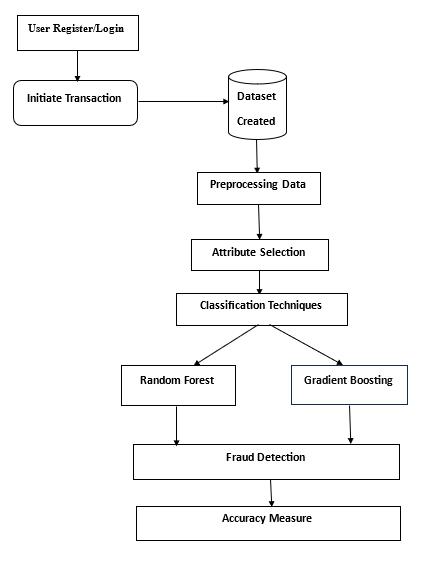
5.2 Data Flow
Initially,transactiondataiscollectedfromvarioussources such as online platforms, this raw transaction data then undergoespreprocessing,whereitiscleansed,normalized, and enriched to ensure consistency and quality. Once the data is prepared, it is fed into the fraud detection system, wheresophisticatedalgorithmsanalyzetransactionpatterns and behaviors to identify potentially fraudulent activity. These algorithms leverage features such as transaction amount, frequency, location, and user behavior to distinguishbetweenlegitimateandfraudulenttransactions. Thereal-timemonitoringcomponentscontinuouslymonitor transaction streams for any anomalies or suspicious patterns.Ifatransactionisflaggedaspotentiallyfraudulent, it is routed to an alerting system, which notifies relevant stakeholdersforfurtherinvestigationorintervention.
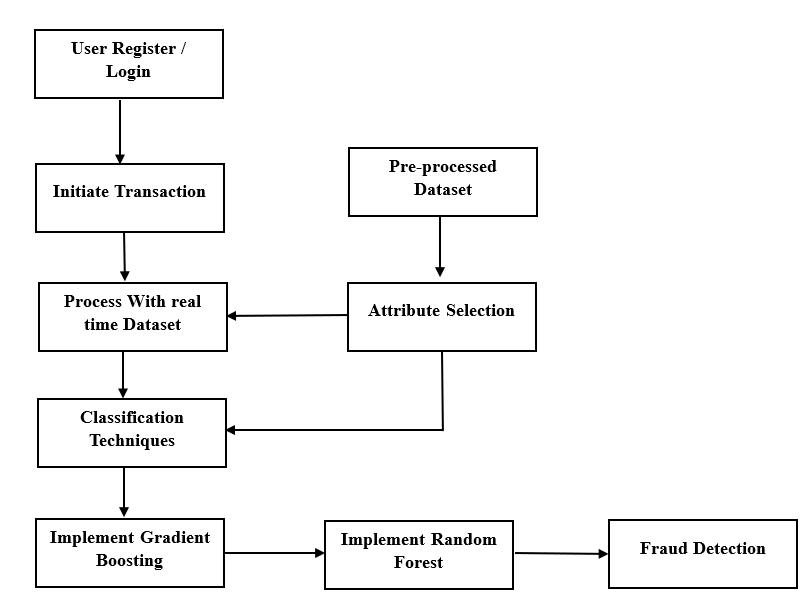
Our dataset obtained from the Kaggle website. Ten thousand transaction details were used as training data amongthemwedivideastypeofpayment,amount,original name,oldbalanceandnewbalance.Onethousanddatasets wereusedfortestingandreal-timedatasetsweregenerated as transactions occurred. To efficiently detect fraud transactions the real-time datasets are processed and comparedwiththeacquireddataset.
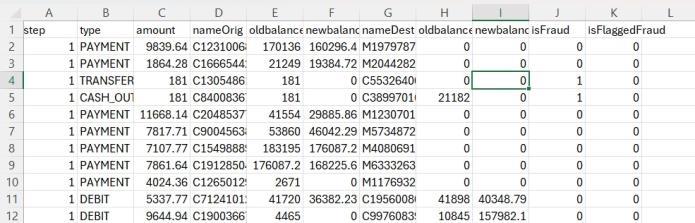
1. Login/Register: Thisstep,theuserregistersorlogsinto the website to make transactions. user login user their credentialslikenameoremail-Idandpassword.Iftheuseris avaliduserhe/sheisloggedinsuccessfullyotheritwillfail thentheuserneedstoregistertothewebsite
2. Make Transaction: After the successful login, the user needs to make Transactions on this website. Once the
International Research Journal of Engineering and Technology (IRJET) e-ISSN: 2395-0056
Volume: 11 Issue: 04 | Apr 2024 www.irjet.net p-ISSN: 2395-0072
transaction is completed the real-time dataset is created usingthecurrentlyoccurringtransaction.
3. Pre-processing Dataset: Thisstepwillcleanthedataby handling missing values and noise. Perform features engineeringtoextractrelevantfeatures andtransformthe data into a suitable format for the Random Forest and GradientBoostingalgorithm.
4. Random Forest algorithm for efficient detection of fraudulent activities:
TheRandomForestalgorithmoffersseveralbenefits in the detection of fraudulent activities. By leveraging the ability to handle large amounts of Dataset.
Random Forest can analyze various features associated with the Transaction this will help in detecting the patterns that are indicative of fraudulentactivities.
Thisalgorithmcanabletoidentify anomaliesinthe transaction such as unusual purchasing patterns, hugeamounts,inconsistentIPaddresses,ortypical userbehaviors.
5. Gradient Boosting algorithm:
Thisalgorithmworksbycombiningmultipleweak learners sequentially, with each new learner focusingonthemistakemadebythepreviousone.
Thisprocessisveryhelpfultoimprovethemodel’s predictivepower
Gradientboostingcaneffectivelyhandleimbalanced datasetsandcapturecomplexrelationshipsbetween variousfeatures.
Duringthefrauddetectionphase,eachdecisiontree votes on the class label of input data. The final prediction is determined by combining the individualpredictions.
6. Fraud Detection: Following the use of algorithms the transaction undergoes feature extraction and attribute selectionbasedonthetrainingdatasetitwilldetectwhether thetransactionisFraudornot.Oncetheusercompletesthe Transaction process it will detect the risk of the ongoing transactionanddetectthechancesoffraud.
7. Notify the user and the bank branch manager at the same time: If the transaction is detected as fraud, it will block the transactionandalsosendthe notification to the useraswellasthebranchmanager.Supposethetransaction isdonebytheuserhereceivesthenotificationmessageand approves the transaction further or if it was done by the
intruder the account holder receives the message, he/she canblockthetransaction.
Fromthisprojectwecansafeguardourmoneyandpersonal information this will be very helpful in detecting the anomalieshappeninginouronlinetransactions.Thiscanbe performedinreal-timescenariosso,wecandetectfraudulent activitiesatanytime.
To sum up, using machine learning techniques to the identification of fraudulent online transactions provides a strong defence against fraudulent activity in financial institutions. Organizations may efficiently identify and minimizepotentialthreatsinrealtimebyutilizingadvanced algorithms and comprehensive data analysis. Machine learning models can optimize fraud protection efforts by improvingdetectionaccuracywhilereducingfalsepositives andnegativesthroughconstantrefinementandadaptionto changingfraudpatterns.Bypreservingasmoothtransaction experience,thisnotonlyresultsinsignificantcostsavings and risk mitigation but also maintains client trust and happiness. In addition, the facilitation of regulatory standardscomplianceandtheassuranceoftransparencyin the detection process allow enterprises to achieve strict criteriawithoutfallingbehinddevelopingrisks.Intheend, machinelearning-basedonlinetransactionfrauddetectionis aproactivestrategythatfightsfinancialfraud,strengthens security,andpreservestheintegrityofdigitaltransactions.
We would like to thank Dr. Ranjit KN, our department head,forhercrucialadviceandideasthathavehelpedour projectgoaboveandbeyondwhatwehadanticipated.We extendourheartfeltgratitudetoourProjectCoordinator,Dr. HKChethan,forhisunwaveringsupportanddedication in helping us complete this project within a tight timeframe Ourprofoundgratitudeisfinallysenttoourprincipal,Dr.YT KrishneGowda,forgivingusthefantasticchancetoworkon a projecttitled"OnlineTransactionFraudDetectionusing MachineLearning"andforhisconstantsupportofourstudy andresearchefforts.
[1] MettildhaMary,Priyadarshini,Dr.Karuppasamy.K,Ms. MargretSharmila.F.2021InternationalConferenceon Advance Computing and Innovative Technologies in Engineering(ICACITE)|978-1-7281-7741-0/20/$31.00 ©2021 IEEE | DOI: 10.1109/ICACITE51222.2021.9404750
[2] Ms.KishoriDhanajiKadam,Ms.MrunalRajeshOmanna, Ms.SakshiSunilNeje,Ms.ShraddhaSureshNandai. 1,2,3,4Student,SharadInstituteofTechnologyCollege ofEngineering,Ichalkaranji.
International Research Journal of Engineering and Technology (IRJET) e-ISSN: 2395-0056
Volume: 11 Issue: 04 | Apr 2024 www.irjet.net p-ISSN: 2395-0072
[3] U.Siddaiah,P.Anjaneyulu,Y.Haritha,MRamesh.2023 7thInternationalConferenceonIntelligentComputing and Control Systems (ICICCS) | 979-8-3503-97253/23/$31.00 ©2023 IEEE | DOI: 10.1109/ICICCS56967.2023.10142404
[4] Yeming Chen, Xinyuan Han Clarity AI Beijing, China. 2021 IEEE International Conference on Consumer ElectronicsandComputerEngineering(ICCECE)|9781-7281-8319-0/20/$31.00 ©2021 IEEE | DOI: 10.1109/ICCECE51280.2021.9342475.
[5] PetrHajek,MohammadZoynulAbedin, Uthayasankar Sivarajah.
[6] DarshanAladakatti,GaganaP,AshwiniKodipalli,Shoaib Kamal.Publishedin:2022InternationalConferenceon Smart and Sustainable Technologies in Energy and Power Sectors (SSTEPS)| DOI: 10.1109/SSTEPS57475.2022.00063.
[7] Hongwei Chen, Lun Chen. Published in: 2022 4th InternationalConferenceonMachineLearning,BigData and Business Intelligence (MLBDBI)| DOI: 10.1109/MLBDBI58171.2022.00064
2024, IRJET | Impact Factor value: 8.226 | ISO 9001:2008