
International Research Journal of Engineering and Technology (IRJET) e-ISSN: 2395-0056
Volume: 11 Issue: 04 | Apr 2024 www.irjet.net p-ISSN: 2395-0072
International Research Journal of Engineering and Technology (IRJET) e-ISSN: 2395-0056
Volume: 11 Issue: 04 | Apr 2024 www.irjet.net p-ISSN: 2395-0072
Ahmed Abid Malpura1 , Fawwaz Asif Wanjwarkar2, Shahid Mustak Rajedia3, Abrar Abdullah Bhola4, Abaan Fayaz Salema5, Nehal Muchhala6
1Student, Diploma in Mechanical Engineering, Thakur Polytechnic, Kandivali, Maharashtra, India
2Student, Diploma in Mechanical Engineering, Thakur Polytechnic, Kandivali, Maharashtra, India
3Student, Diploma in Mechanical Engineering, Thakur Polytechnic, Kandivali, Maharashtra, India
4Student, Diploma in Mechanical Engineering, Thakur Polytechnic, Kandivali, Maharashtra, India
5Student, Diploma in Mechanical Engineering, Thakur Polytechnic, Kandivali, Maharashtra, India
6Head Of Department in Mechanical Engineering, Diploma in Mechanical Engineering, Thakur Polytechnic, Kandivali, Maharashtra, India
Abstract- Thermoplastic polymers find extensive applications across various industrial sectors, including automotive,agricultural,aeronautical,andhomeaccessories. Their versatility is realized through three primary manufacturing processes: Injection molding, extrusion, and additive manufacturing, commonly referred to as a new technology driven by Computer-Aided Design (CAD). This innovative approach involves the use of raw materials in the formofpowdersorfilaments,knownas3Dprinting,wherethe filament diameter (ranging from 1.75mm to 2.5mm) is influencedbythesizeofthe3Dprinter. Addressingchallenges such as the high cost, permanent mechanical properties, and chemicalcompositionof filaments, aswellasthegenerationof wasteful plastics, led to the adoption of a solution. This solutionfocusesonthecreationandproductionoffilamentsby utilizing thermoplastics in the forms of pellets, granules, and waste materials. Notably, the proposed solution aims to resolve previous issues and enhance mechanical properties, allowingforthemodification offilamentbehaviorthroughthe addition of other polymers, including the combination of two or more.
Key Words: Extruder, additive manufacturing, thermoplastic,computer-aideddesign,filament,polymers, mechanicalbehaviour.
3D printing technologies, also known as Additive Manufacturing(AM),haverevolutionizedtheproductionof physical parts using various materials such as thermoplastics,composites,andmetals.Thisinnovationhas foundapplicationsindiverseindustries,includingaerospace and automotive, allowing for the creation of intricately designed components without the need for expensive tooling.Thetechniqueinvolvesbuildingupsuccessivelayers of raw thermoplastic materials, particularly utilizing polyamide (PA), acrylonitrile butadiene styrene (ABS), polylacticacid(PLA),polycarbonate(PC),andpolystyrene (PS). Despite the widespread availability of these thermoplastics with favourable mechanical, chemical, and
physical properties, they are often expensive and largely imported. To address cost concerns and promote environmental sustainability, waste plastics are incorporated into the process. To further enhance the propertiesofthe3D-printedparts,modificationstothefused depositionmodelling(FDM)printingtechniquehavebeen undertaken. A crucial aspect of this project involves designing and realizing a testbed for a filament extruder capable of producing filaments at specific diameters of 1.75mm and 2.5mm. The project's objectives include the development of a low-cost filament extruder machine for extractingfilamentsuitablefor3Dprinting.Subsequently,a comparativestudyinvestigatesthemechanicalpropertiesof theproducedfilamentscomparedtothosecommonlyused in the automotive industry. Mechanical tensile tests are conducted using an MTS Tensile Testing Machine with varying crosshead speeds, in line with testing standards. Specimenswithdiametersof1.75mmand2.5mmandatotal length of 200mm are examined, employing a crosshead made of PA6 known for its widespread use in various industrialdomainsdespiteitslimitedUVresistance.
o Theexpensivepriceofthe3Dprintingfilament
o Permanentmechanicalproperties
o Importationfilament
o Designandmanufacturingofnewfilamentextruder design
o Reducing the price of the filament used in 3D printer
o Improving FMD filament materials by conduction modifications
International Research Journal of Engineering and Technology (IRJET) e-ISSN: 2395-0056
Volume: 11 Issue: 04 | Apr 2024 www.irjet.net p-ISSN: 2395-0072
In2021,ArupDey,IsnalaNanjin,RoanEagle,andNitaYodo authored"AComprehensiveReviewonFilamentMaterials forFusedFilamentFabrication,"publishedintheJournalof ManufacturingandMaterialsProcessing.[A]
T. Sathies, P. Senthil, and M. S. Anoop explored "Advancements in Applications of Fused Deposition Modelling Process: A Critical Review" in their 2020 publicationintheRapidPrototypingJournal,26(4),669–87. [B]
RubenForesti,StefanoRossi,andStefanoSelleripresented theirworkon"Nano-Functionalizationof3DBio-Engineered Scaffold in Bio-Composite Materials" at the 2019 IEEE International Conference on BioPhotonics (BioPhotonics), pages100–101.[C]
Mohsen Attaran's 2017 publication in Business Horizons, 60(5), titled "The Rise of 3-D Printing: Advantages of AdditiveManufacturingoverTraditional Methods,"delves intotheevolvinglandscapeofadditivemanufacturing.[D]
Samuel H.Huang,PengLiu,AbhiramMokasdar,andLiang Hou conducted a "Comprehensive Literature Review on AdditiveManufacturingandItsSocietalImpact,"published in the International Journal of Advanced Manufacturing Technology,67(5–8),in2013.[E]
MonaANassar,MohammedElfarahaty,SaberIbrahim,and Youssef Hassan discussed the "Design of 3D Filament Extruder for Fused Deposition Modeling Additive Manufacturing"inVolume9(4),pages55–62,publishedin 2019.[F]
PatrickHolzmann,RobertJ.Breitenecker,AqeelA.Soomro, andErichJ.Schwarzexamined"UserEntrepreneurBusiness Models in 3D Printing" in the Journal of Manufacturing TechnologyManagement,28(1),publishedin2017.[G]
Juan Wang, Jianping Qiu, Siyi Xu, JianxiLi, and Liguo Shen examined the impact on the mechanical properties and water absorption of Polycaprolactam (PA6) and Polyhexamethylene Adipamide (PA66) in their 2020 publicationinRSCAdvances,10(36),pages21491–86.[H]
"3DPrintingforDummies" byKKHausman andR. Horne, published by Wiley in Somerset in 2014, is a resource availablefromProQuestEbookCentral.[I]
Shan Zhong and Joshua M. Pearce explored "Coupled Distributed Recycling and Manufacturing with Recyclebot andRepRap3-DPrinting" inResources,Conservationand Recycling(January),pages48–58,publishedin2018.[J]
M.Kreiger,G.C.Anzalone,M.L.Mulder,A.Glover,andJ.M. Pearcediscussed"DistributedRecyclingofPost-Consumer PlasticWasteinRuralAreas"inMaterialsResearchSociety SymposiumProceedings,1492,pages91–96,in2013.[K]
XinranXiao's2008publication,"DynamicTensileTestingof PlasticMaterials,"in Polymer Testing, 27(2), exploredthe mechanical properties of plastic materials under dynamic tensileconditions.[L]
In 2014, T. Letcher and M. Waytashek conducted a study titled"MaterialPropertyTestingof3D-PrintedSpecimensin PLA on an Entry-Level 3D Printer," and the findings were published in Volume 2A of the Advanced Manufacturing journal.[M]
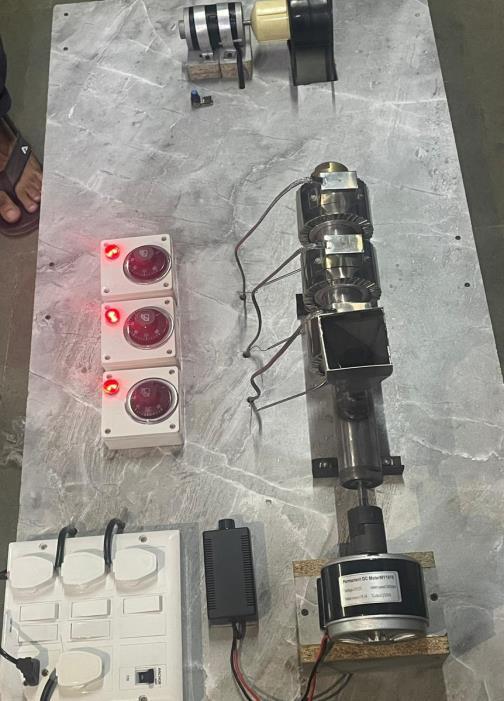
Theextruderisanextended,continuousprocessforworking with polymers, employed in the production of tubing, tire treads, and wire coverings. This apparatus functions by pushingrawmaterialinpelletformintoaheatedtube.The tubeisheatedby2-5heatersfixedonitsexternalside.During this process, an endless turning screw, driven by a motor, facilitatesthepushingoftherawmaterialthroughtheheated tube. The material is then compressed into a shaping die, ultimatelyresultingintheextractionofthefinalproduct–a filament with diameters of 1.75mm and 2.5mm (refer to Fig.1).
International Research Journal of Engineering and Technology (IRJET) e-ISSN: 2395-0056
Volume: 11 Issue: 04 | Apr 2024 www.irjet.net p-ISSN: 2395-0072
Thisextrudermachinewasmanufacturedusingcomponents listedbelow:
3.2.1
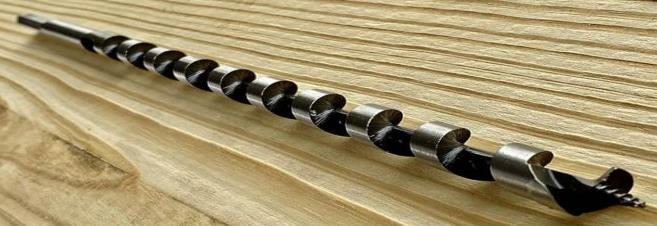
Therotatingscrewutilizedmeasures32mmindiameterand hasa total length of 400mm. This screw is responsible for transferring thermoplastic materials, facilitating their extrusionintovariousfinalforms.Thisisachievedthrough its rotation around its axis of revolution, coupled withthe specific geometry of the flights. Each flight has a width of 20mm,andthepitchisfixedat43.5mmbetweeneverytwo successiveflights,withachanneldepthof17mm
3.2.2
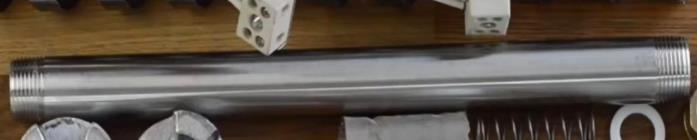
IThetubefunctionsasahousingchamberforthescrew, facilitatingthefeedofrawmaterialintothechamberthrough the screw. The dimensions of the tube include a 34mm internaldiameter,45mmexternaldiameter,andalengthof 400mm.Notably,thetubefeaturesahollowareaonitslateral surfacespecificallydesignatedformaterialfeed,asillustrated
inFig.3.
3.2.3
Thesuctionhopperservesavitalroleinthisprocessby retainingtherequiredquantityofmaterialforfeedinginto thescrew.
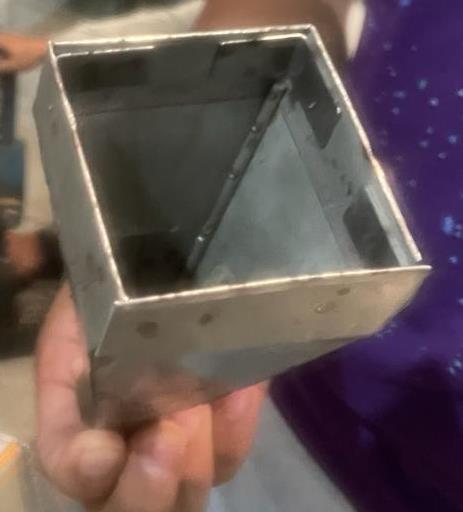
3.2.4
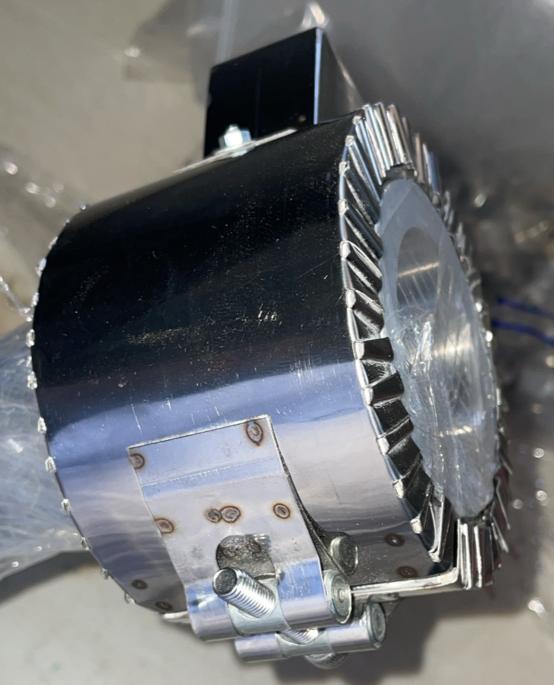
Theheatersarepositionedonthelateralsurfaceofthe copper tube to ensure the internal thermoplastic material reaches a fusion temperature of 350 degrees Celsius. This facilitatestheextrusionprocessinthefinalstep.
International Research Journal of Engineering and Technology (IRJET) e-ISSN: 2395-0056
Volume: 11 Issue: 04 | Apr 2024 www.irjet.net p-ISSN: 2395-0072
3.2.5
At the final section of the filament extruder, where the filamentisdischarged,thereisacylindricalcomponentwith an open top and a small hole in the center of its bottom surface. Typically constructed from brass due to its heatresistantproperties,thiselementiscrucialforshapingthe extruded filament. For the experimental setup, die will be employed with a diameter of 1.75mm for the small hole. Additionally, it features an inner hex shape to facilitate
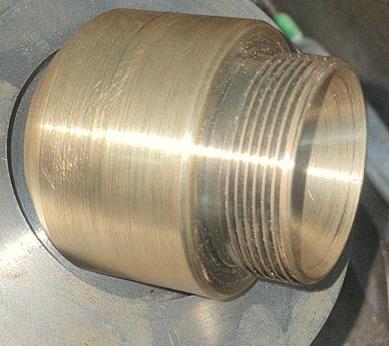
3.2.5 Motor
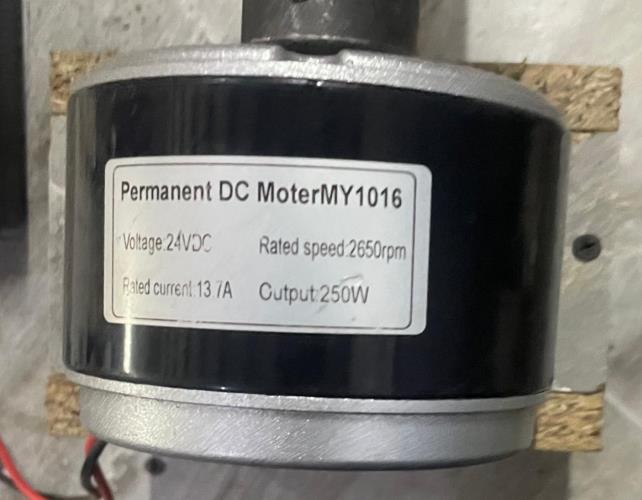
Thesystemisequippedwitha35RPMmotor,anditsspeedis regulated by a Pulse Width Modulation (PWM) speed controller.Thiscontrolleriswiredinserieswiththepower source from a 24 V supply and the motor, representing a straightforwardcontrolsystem.Operatingasavariablespeed controlsystem,theRPMisdeterminedbyadjustingtheduty cycle. To ensure proper material mixing and melting, the optimalscrewspeedistargetedatapproximately40RPM.
Securing raw materials for 3D printing poses a significant challenge in the utilization of additive manufacturing for production and commercial purposes. This challenge is further compounded by the demand for materials with commendable mechanical properties. To address these issues,wedevisedacomprehensiveplanencompassingthe designandproductionofafilamentextruder.Theprocess initiatedwithconceptualizationthroughsoftwaredesignand culminatedintheactualizationoftheextruder.Throughout this endeavor, various parameters influencing filament extrusion were systematically studied. Additionally, the mechanical properties of the produced filament were subjectedtocharacterization,yieldingsatisfactoryresults. The streamlined workflow has not only reduced time and costs but has also contributed to the development of an efficientsystemformanufacturingfilamentextrusion.
IandmyteamarethankfulofourHeadoftheDepartment, MentorMrs.NehalMuchhalama’amforhersupportandour collegeThakurPolytechnic.
[A] Dey, A., Nanjin, I., Eagle, R., & Yodo, N. authored "A Comprehensive Review on Filament Materials for Fused Filament Fabrication," published in the Journal of ManufacturingandMaterialsProcessingin2021.
[B] Sathies, T., Senthil, P., & Anoop, M. S. explored "Advancements in Applications of Fused Deposition ModellingProcess:ACriticalReview"intheirpublicationin the Rapid Prototyping Journal, volume 26, issue 4, pages 669–87,in2020.
[C]Foresti,R.,Rossi,S.,&Selleri,S.presentedtheirworkon "Nano-Functionalization of 3D Bio-Engineered Scaffold in Bio-Composite Materials" at the 2019 IEEE International ConferenceonBioPhotonics,pages100–101.
[D]Attaran,M.delvesintotheevolvinglandscapeofadditive manufacturing in their 2017 publication in Business Horizons,volume60,issue5,titled"TheRiseof3-DPrinting: Advantages of Additive Manufacturing over Traditional Methods."
[E]Huang,S.H.,Liu,P.,Mokasdar,A.,&Hou,L.conducteda "Comprehensive Literature Review on Additive Manufacturing and Its Societal Impact," published in the International Journal of Advanced Manufacturing Technology,volume67,issues5–8,in2013.
International Research Journal of Engineering and Technology (IRJET) e-ISSN: 2395-0056
Volume: 11 Issue: 04 | Apr 2024 www.irjet.net p-ISSN: 2395-0072
[F] Nassar, M. A., Elfarahaty, M., Ibrahim, S., & Hassan, Y. discussed the "Design of 3D Filament Extruder for Fused DepositionModelingAdditiveManufacturing"involume9, issue4,pages55–62,publishedin2019.
[G] Holzmann, P., Breitenecker, R. J., Soomro, A. A., & Schwarz,E.J.examined"UserEntrepreneurBusinessModels in3DPrinting"intheJournalofManufacturingTechnology Management,volume28,issue1,publishedin2017.
[H] Wang, J., Qiu, J., Xu, S., Li, J., & Shen, L. examined the impactonthemechanicalpropertiesandwaterabsorption of Polycaprolactam (PA6) and Polyhexamethylene Adipamide (PA66) in their 2020 publication in RSC Advances,volume10,issue36,pages21491–86.
[I] "3D Printing for Dummies" by K. K. Hausman and R. Horne,publishedbyWileyinSomersetin2014,isaresource availablefromProQuestEbookCentral.
[J]Zhong,S.,&Pearce,J.M.explored"CoupledDistributed RecyclingandManufacturingwithRecyclebotandRepRap3D Printing" in Resources, Conservation and Recycling, volume(January),pages48–58,publishedin2018.
[K]Kreiger,M.,Anzalone,G.C.,Mulder,M.L.,Glover,A., & Pearce, J. M. discussed "Distributed Recycling of PostConsumer Plastic Waste in Rural Areas" in Materials Research Society Symposium Proceedings, volume 1492, pages91–96,in2013.
[L] Xiao, X. explored the mechanical properties of plastic materials under dynamic tensile conditions in their 2008 publication"DynamicTensileTestingofPlasticMaterials"in PolymerTesting,volume27,issue2.
[M] Letcher, T., & Waytashek, M. conducted a study titled "MaterialPropertyTestingof3D-PrintedSpecimensinPLA on an Entry-Level 3D Printer," and the findings were published in volume 2A of the Advanced Manufacturing journalin2014.