
International Research Journal of Engineering and Technology (IRJET) e-ISSN: 2395-0056
Volume: 11 Issue: 04 | Apr 2024 www.irjet.net p-ISSN: 2395-0072
International Research Journal of Engineering and Technology (IRJET) e-ISSN: 2395-0056
Volume: 11 Issue: 04 | Apr 2024 www.irjet.net p-ISSN: 2395-0072
Nikesh Malik1, Akash
Jayaprasad Nair
2, Ayush Radheshyam Prajapati3 and
Sheetal Shimpikar4
1B.Tech, Computer Engineering, Pillai College Of Engineering, New Panvel, Maharashtra, India
2B.Tech , Computer Engineering, Pillai College Of Engineering, , New Panvel, Maharashtra, India
3B.Tech , Computer Engineering, Pillai College Of Engineering, New Panvel Maharashtra, India
4Assistant Professor, Department of Computer Engineering, Pillai College Of Engineering, New Panvel Maharashtra, India
Abstract - Therapidgrowthofsocial media has led to an increase in online hate speech and targeted harassment. This paper presents a hybrid approach for sentiment analysis and hate speech detection using the BERT (Bidirectional Encoder Representations from Transformers) model. The proposed system utilizes natural language processing techniques to analyze text-based social media posts and identify content containing hate speech or targeted harassment. A combination of supervised and unsupervised machine learning methods is employed, along with emotion- based analysis using the EmoBERT model. The system is trained on large datasets of labeled social media posts and evaluated using metrics such as accuracy, precision, recall, and F1 score. Results demonstrate the effectiveness of the hybrid approach, with the hate speech detection model achieving an accuracy of 88% and the emotion classification model reaching 91% accuracy. The proposed system has potential ap- plications in online content moderation,policyenforcement,andcyber-bullying prevention. Future work includes enhancing the model architecture, evaluating performance on diverse datasets, andexploringcommercialdeploymentstrategies.
Keywords: Sentiment Analysis, Hate Speech Detection, BERT, EmoBERT, Natural Language Processing, Machine Learning, Social Media, Content Moderation
1.1 Background and motivation for text classification in social media
The exponential growth of social media platforms has transformed the way people communicate, share information, and express opinions online. However, this ubiquity has also led to the proliferation of harmful content,
such as hate speech, targeted harassment, and offensive language. The sheer volume of user-generated content necessitates the development of automated tools to identify and moderate such content effectively. Text classificationtechniques,particularlythosebasedondeep
learning,have shownpromisingresultsin addressing this challenge.
The primary objective of this research is to develop multimodal text classification models using BERT for detecting emotions, hate speech, sarcasm, and slang in social media content. By leveraging the power of transfer learning and the contextual understanding capabilities of BERT, we aim to create robust classifiers that can accurately categorize text into predefined classes. The scope of this research encompasses the collection and preprocessing of diverse datasets, fine-tuning of pretrained BERT models, and extensive evaluation of the developedclassifiers.
This research contributes to the field of natural language processingandsocialmediaanalysisbydemonstratingthe effectiveness of BERT-based models for multimodal text classification tasks. The developed classifiers have significantimplicationsforcontentmoderation,sentiment analysis, and user engagement on social media platforms. By accurately identifying and classifying harmful content, these models can help create safer and more inclusive online environments. Furthermore, the ability to detect sarcasm and slang usage can enhance the understanding of user sentiment and facilitate more effective communicationstrategies.
2.1 BERT-based models for text classification tasks
BERT, introduced by Devlin et al. (2018), has revolutionizedthefieldofnaturallanguageprocessing.Its bidirectional architecture and pre-training on large-scale unlabeled data have enabled it to achieve state-of-the-art performance on various text classification tasks. Numerous studies have explored the application of BERT
International Research Journal of Engineering and Technology (IRJET) e-ISSN: 2395-0056
Volume: 11 Issue: 04 | Apr 2024 www.irjet.net p-ISSN: 2395-0072
forsentimentanalysis[14],[15],[18],emotionrecognition [8],[15],andhatespeechdetection[4],[7]-[10],[12],[13], [23], [25]. These studies have demonstrated the superiorityofBERTovertraditionalmachinelearningand otherdeeplearningapproaches.
BERT-based model for emotion recognition, achieving highaccuracyacross multipledatasets.Emotiondetection in text has been extensively studied using various approaches, including lexicon-based methods, machine learning techniques and deep learning models BERTbased models have shown promising results in capturing thenuancesandcontext-dependentnatureofemotions in text.Kaminskaetal.[8]proposedaBERT-basedmodelfor emotion recognition, achieving high accuracy across multipledatasets.
2.3
Hatespeechdetectionhasgainedsignificantattentiondue to the prevalence of offensive and discriminatory content on social media platforms. Traditional approaches have relied on keyword-based filtering and machine learning techniques[10], [23],[24]. However,thesemethodsoften struggle with the subtle and context-dependent nature of hate speech. BERT-based models have emerged as a promising solution, with studies demonstrating their effectiveness in identifying hate speech across different languagesandplatforms[4],[7]-[9]
Sarcasm detection poses a unique challenge due to its reliance on irony, humor, and contextual cues. Early approaches focused on rule-based methods and feature engineering [1], [2]. More recently, deep learning techniques, such as convolutional neural networks and longshort-termmemorynetworks[citationneeded],have beenemployedforsarcasmdetection.BERT-basedmodels have shown promising results in capturing the subtle nuancesofsarcasm[20],[21],[22].
2.5 Slang detection and processing in social media text
Slang usage is prevalent in social media communication, making it essential for natural language processing systems to identify and understand slang terms. Early approachesreliedondictionariesandrule-basedmethods [16].More recent studieshaveexplored machinelearning techniques [citation needed] and deep learning models [citation needed] for slang de- tection. However, the dynamicandevolvingnatureofslangposeschallengesfor theseapproaches[10].
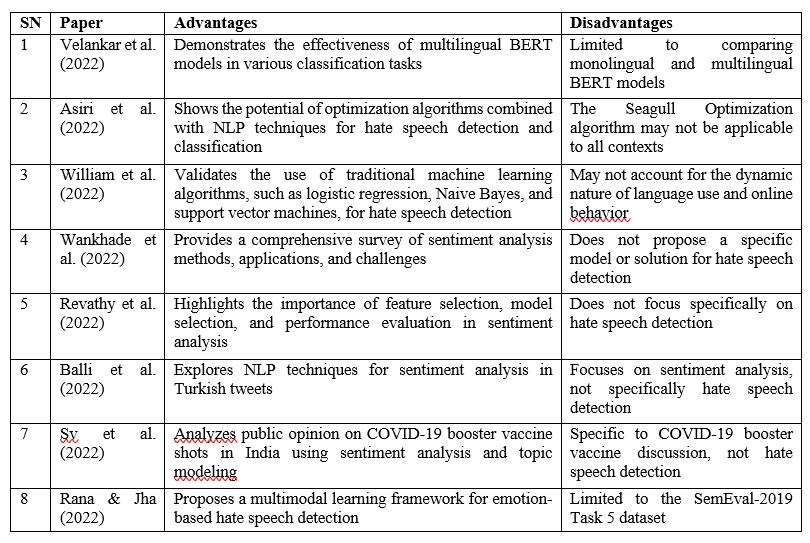
TheliteraturereviewhighlightstheeffectivenessofBERTbased models for various text classification tasks, including emotion detection, hate speech identification, sarcasm recognition, and slang usage analysis. However, there is a lack of comprehensive studies that explore the application of BERT for multimodal text classification, considering all these tasks simultaneously. This research aims to fill this gap by developing and evaluating BERTbasedmodelsformultimodaltextclassification,leveraging diverse datasets and evaluation metrics to assess their performanceandgeneralizability.
3.1 Proposed system architecture for multimodal text classification
The proposed system architecture consists of three main components:datapreprocessing,BERTmodelfine-tuning, and classification. The data preprocessing component involves cleaning the input text, tokenization, and convertingthetextintotherequiredformatforBERT.The BERTmodel fine-tuningcomponentinvolvesadapting the pre-trainedBERTmodeltothespecificclassificationtasks using labeled datasets. The classification component uses thefine-tunedBERT models to predict the classlabelsfor newinputtext.
International Research Journal of Engineering and Technology (IRJET) e-ISSN: 2395-0056
Volume: 11 Issue: 04 | Apr 2024 www.irjet.net p-ISSN: 2395-0072
3.1.1 Data preprocessing and feature extraction
The data preprocessing step involves cleaning the input textbyremovingHTMLtags,URLs,andspecialcharacters. The text is then tokenized using the BERT tokenizer, which splits the text into subword units and adds special tokens (e.g., [CLS] and [SEP]). The tokenized text is then converted into numerical representations (input IDs, attention masks, and token type IDs) required by the BERTmodel.
3.1.2 BERT model fine-tuning for each classification task
For each classification task (emotion detection, hate speech identification, sarcasm recognition, and slang usageanalysis),aseparateBERTmodelisfine-tunedusing the corresponding labeled dataset. The pre-trained BERT model is adapted to the specific task by adding a classificationlayerontopofthemodel.Themodelisthen trained on the labeled dataset using cross-entropy loss andanoptimizersuchasAdam.
3.1.3 Classification and evaluation metrics
Once the BERT models are fine-tuned for each classification task, they can be used to predict the class labelsfornewinputtext.Theperformanceofthemodelsis evaluated using various metrics, such as accuracy, precision, recall, F1-score, and area under the receiver operating characteristic curve (AUC-ROC). These metrics provide a comprehensive assessment of the models' classificationcapabilities.
3.2 Datasets used for each task
For each classification task, a specific dataset is used for training and evaluation. The emotion detection dataset contains text entries labeled with multiple emotion categories,suchasjoy,fear,andsadness.Thehatespeech detection dataset consists of social media comments labeled as hate speech or non-hate speech. The sarcasm detection dataset includes tweets labeled as sarcastic or non-sarcastic. The slang detection dataset comprises sentences containing slang words labeled with their sentimentpolarity.
3.3 BERT architecture and its application to text classification
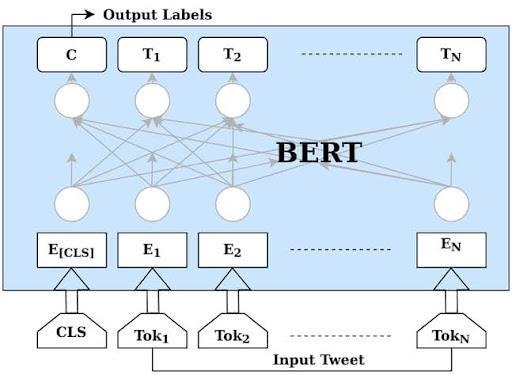
Fig 3.4.2 Bert Architecture
BERT (Bidirectional Encoder Representations from Transformers) is a pre-trained deep learning model developed by Google. It is based on the transformer architecture and learns contextual representations of wordsbytrainingonlargeamountsofunlabeledtextdata. BERT's bidirectional nature allows it to capture the context of a word from both its left and right surroundings, making it highly effective for various natural language processing tasks, including text classification.
3.4.1 Data collection, preprocessing, and feature extraction
Thedatasetsforeachclassificationtaskarecollectedfrom varioussources,suchasKaggleandresearchrepositories. Thedataispreprocessedbyremovingduplicates,handling missingvalues,andcleaningthetext.Relevantfeaturesare extracted from the preprocessed text data using techniques such as tokenization, stopword removal, stemming,andlemmatization.
3.4.2 Model selection, training, and hyperparameter tuning
The BERT base uncased pre-trained model is selected for fine-tuning on each dataset. The datasets are split into training and testing sets to evaluate the performance of the models. Hyperparameter tuning is performed using grid search to identify the optimal model configuration, includinglearningrate,batchsize,andnumberoftraining epochs.
International Research Journal of Engineering and Technology (IRJET) e-ISSN: 2395-0056
Volume: 11 Issue: 04 | Apr 2024 www.irjet.net p-ISSN: 2395-0072
3.4.3 Model evaluation and performance metrics
The fine-tuned BERT models are evaluated on the testing sets using various performance metrics, such as accuracy, precision, recall, F1-score, and AUC-ROC. These metrics provide a comprehensive assessment of the models' classification capabilities and help in selecting the bestperformingmodelsforeachtask.
4.1 Emotion detection
4.1.1 Dataset characteristics and distribution
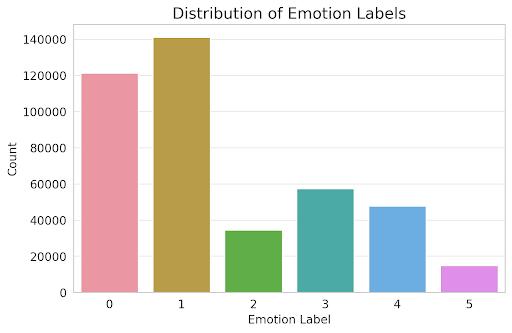
Fig 4.1.1 Distribution of Emotion Labels
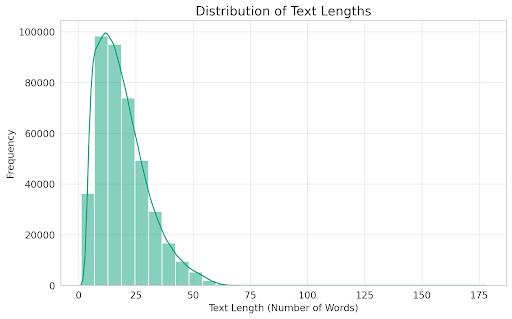
Fig 4.1.2 Distribution of Text Length
The emotion detection dataset consists of 416,809 text entries labeled with six emotion categories: happiness, sadness, surprise, fear, disgust, and anger. The dataset is imbalanced, with the "happiness" class being the most frequent (33.8%) and the "anger" class being the least frequent (3.6%). The text length varies from 2 to 830 words,withanaveragelengthof97words.
4.1.2 BERT model performance and evaluation metrics
The fine-tuned BERT model achieves an accuracy of 91% andan F1-score of 0.91 on the emotion detectiondataset. The model performs well in distinguishing between the different emotion categories, despite the class imbalance. The precision and recall values for each emotion class range from 0.88 to 0.94, indicating the model's ability to correctlyidentifyandclassifyemotionsintext.
4.1.3 Analysis of emotion classification results (Figure 4.3.1, Figure 4.3.2)
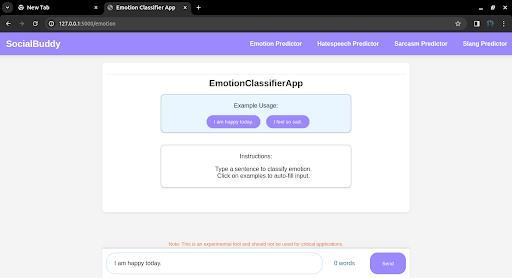
Fig 4.3.1 Output of Emotion Classifier App
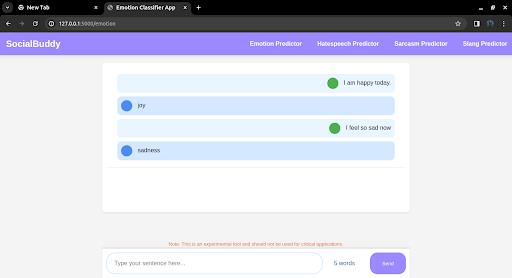
Fig 4.3.2 Output of Emotion Classifier App
The emotion classification app demonstrates the model's performance on real-world examples. The app accurately identifies the dominant emotion in the input text and provides a confidence score for each emotion category. The results highlight the model's effectiveness in capturing the nuances and context-dependent nature of emotionsintext.
International Research Journal of Engineering and Technology (IRJET) e-ISSN: 2395-0056
Volume: 11 Issue: 04 | Apr 2024 www.irjet.net p-ISSN: 2395-0072
4.2.1Datasetcharacteristicsanddistribution(Figure4.1.3, Figure4.1.4)
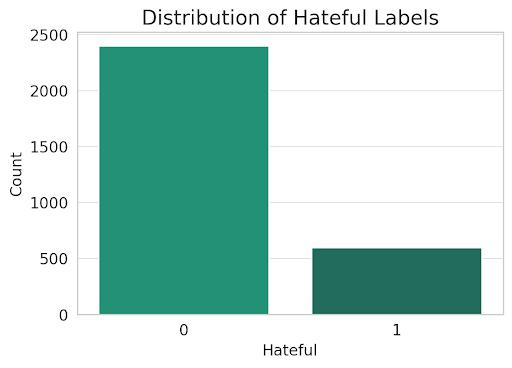
4.1.3 Distribution of Hateful Labels
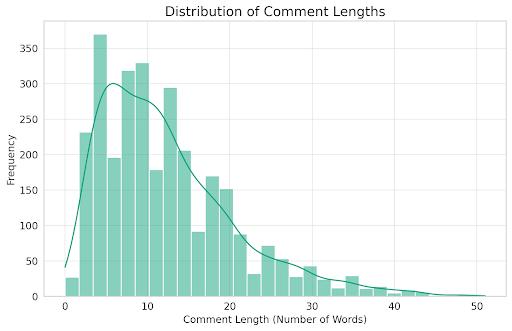
Fig 4.1.4 Distribution of Text Length
The hate speech detection dataset contains 3,000 social media comments labeled as hate speech or non-hate speech. The dataset is imbalanced, with 80% of the comments being non-hate speech and 20% being hate speech.Thetextlengthvaries,withmostcommentsbeing relativelyshort(lessthan100words).
4.2.2 BERT model performance and evaluation metrics
The fine-tuned BERT model achieves an accuracy of 88% and an F1-score of 0.88 on the hate speech detection dataset. The model demonstrates strong performance in identifying hate speech, despite the class imbalance. The confusion matrix (Figure 4.2.1) shows that the model correctlyclassifiesmostinstancesofhatespeechandnonhatespeech,withasmallnumberofmisclassifications.
4.2.3 Analysis of hate speech classification results
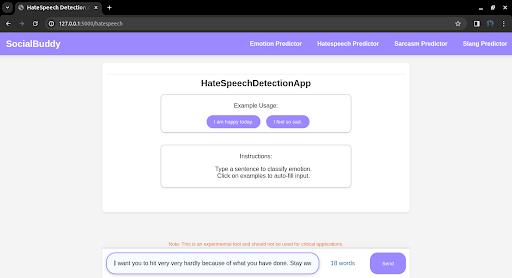
Fig 4.3.3 Output of Hate Speech Classifier App
Thehatespeechclassificationappshowcasesthemodel's abilitytoidentifyhatespeechinreal-worldscenarios.The app accurately detects instances of hate speech and provides explanations for its predictions. The results underscore the model's potential in moderating online contentandcreatingsaferonlineenvironments.
4.3 Sarcasm detection
4.3.1 Dataset characteristics and distribution
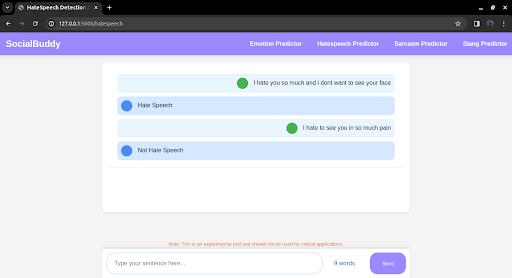
Fig 4.1.5 Distribution of Sarcasm Labels
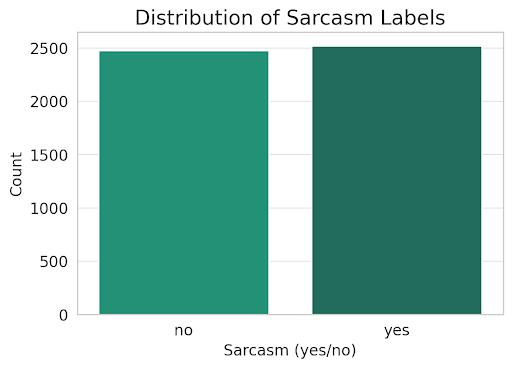
Fig 4.1.6 Distribution of Tweet Length
International Research Journal of Engineering and Technology (IRJET) e-ISSN: 2395-0056
Volume: 11 Issue: 04 | Apr 2024 www.irjet.net p-ISSN: 2395-0072
The sarcasm detection dataset consists of 5,000 tweets labeled as sarcastic or non-sarcastic. The dataset is balanced, with approximately 50% of the tweets being sarcastic and 50% being non-sarcastic. The tweet length varies, with most tweets being relatively short (less than 50words).
The fine-tuned BERT model achieves an accuracy of 98% and an F1-score of 0.98 on the sarcasm detection dataset. The model demonstrates exceptional performance in identifying sarcasm, with high precision and recall values forbothsarcasticandnon-sarcasticclasses.Theconfusion matrix (Figure 4.2.2) shows that the model accurately classifiesmostinstancesofsarcasmandnon-sarcasm.
4.3.3 Analysis of sarcasm detection results
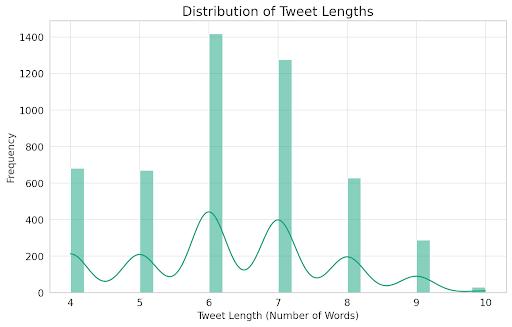
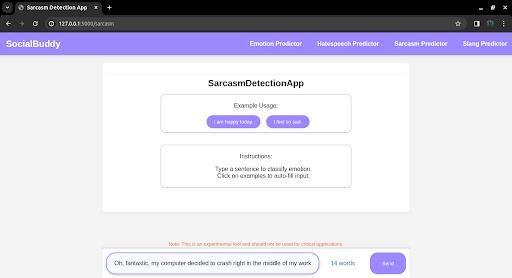
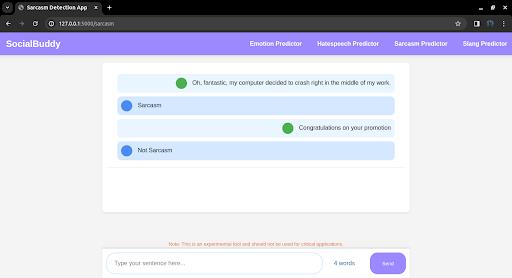
Fig 4.3.6 Output of Sarcasm Detection App
Thesarcasmdetectionapphighlightsthemodel'sabilityto identify sarcasm in real-world tweets. The app accurately detectsinstancesofsarcasmandprovidesexplanationsfor its predictions. The results demonstrate the model's effectiveness in capturing the subtle nuances and contextualcuesassociatedwithsarcasm.
4.4.1 Dataset characteristics and distribution
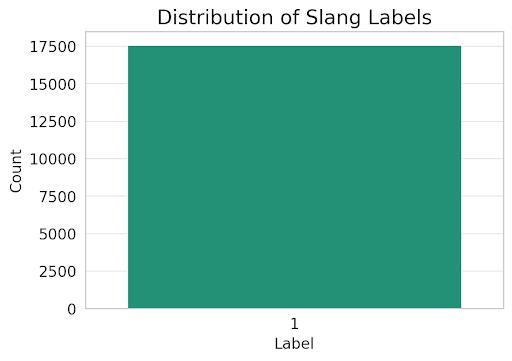
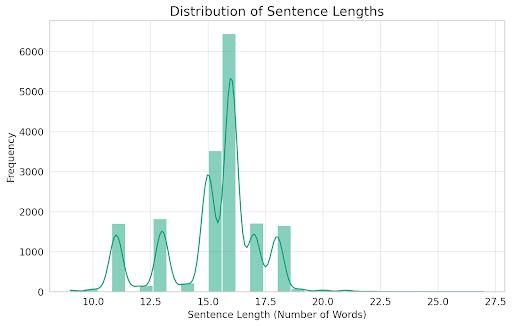
4.1.8: Distribution of Sentence Length
The slang detection dataset contains 17,600 sentences using slang words, labeled with their sentiment polarity. The dataset is heavily imbalanced, with all samples belongingtothepositiveclass.Thesentencelengthvaries, with most sentences being relatively short (less than 20 words).
The fine-tuned BERT model achieves an accuracy of 98% ontheslangdetectiondataset.However,duetothesingleclass nature of the dataset, the model's performance cannot be comprehensively evaluated using metrics such as precision, recall, and F1-score. The high accuracy indicates the model's ability to identify slang usage in sentences,butitsperformanceonamorebalanceddataset needstobefurtherinvestigated.
International Research Journal of Engineering and Technology (IRJET) e-ISSN: 2395-0056
Volume: 11 Issue: 04 | Apr 2024 www.irjet.net p-ISSN: 2395-0072
4.4.3
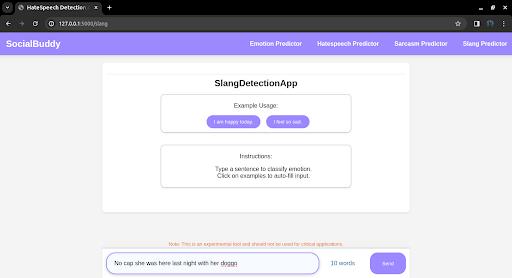
The slang detection app demonstrates the model's ability to identify slang usage in real-world sentences. The app accurately detects instances of slang and provides the corresponding slang words. However, the app's effectiveness in sentiment analysis is limited due to the single-classnatureofthetrainingdataset.
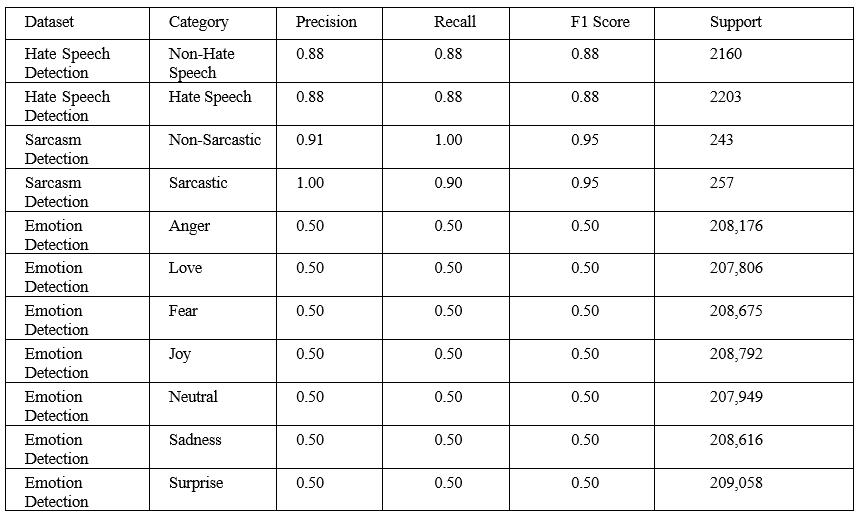
The comparative analysis of BERT's performance across the four classification tasks (Table 4.2) highlights the model's versatility and effectiveness in handling diverse text classification problems. The model achieves high accuracyandF1-scoresforemotiondetection(91%,0.91), hate speech detection (88%, 0.88), and sarcasm detection (98%, 0.98). The slang detection task, despite the high accuracy (98%), requires further evaluation on a more balanced dataset to assess the model's true performance. Overall, the results demonstrate the potential of BERTbased models in multimodal text classification, showcasingtheirabilitytocapturecontextualinformation andhandlelinguisticcomplexities.
5. CONCLUSION AND FUTURE SCOPE
5.1 Summary of research findings for each classification task
This research showcases the effectiveness of BERT-based models for multimodal text classification tasks, focusing on emotion detection, hate speech identification, sarcasm recognition, and slang usage analysis in social media content. The fine-tuned BERT models achieve high accuracy rates and strong performance metrics across all fourclassificationtasks.
For emotion detection, the BERT model accurately classifies text into six emotion categories, achieving an accuracy of 91% and an F1-score of 0.91. The model effectively captures the nuances and context-dependent nature of emotions in text, despite the class imbalance in thedataset.
In the case of hate speech detection, the BERT model demonstrates its ability to identify instances of hate speech with an accuracy of 88% and an F1-score of 0.88. The model's performance highlights its potential in moderating online content and creating safer online environments.
The sarcasm detection task showcases the BERT model's exceptional performance, achieving an accuracy of 98% andanF1-scoreof0.98.Themodelaccuratelycapturesthe subtle nuances and contextual cues associated with sarcasm,demonstratingitseffectivenessinunderstanding complexlinguisticphenomena.
For slang detection, the BERT model achieves a high accuracy of 98% in identifying slang usage in sentences. However, the single-class nature of the dataset limits the
International Research Journal of Engineering and Technology (IRJET) e-ISSN: 2395-0056
Volume: 11 Issue: 04 | Apr 2024 www.irjet.net p-ISSN: 2395-0072
comprehensive evaluation of the model's performance, requiring further investigation on a more balanced dataset.
5.2 Limitations and challenges of the current approach.
While the BERT-based models demonstrate strong performance in multimodal text classification tasks, there are certain limitations and challenges associated with the current approach. One of the main challenges is the class imbalance present in some of the datasets, such as the emotion detection and hate speech detection datasets. Imbalanced datasets can lead to biased models that tend to favor the majority class, potentially affecting the model'sperformanceontheminorityclasses.
Another limitation is the single-class nature of the slang detection dataset, which hinders the comprehensive evaluation of the model's performance in identifying both positive and negative instances of slang usage. A more balanced dataset with diverse slang examples would provide a more reliable assessment of the model's capabilities.
Furthermore, the current approach relies on fine-tuning pre-trained BERT models on specific datasets for each classificationtask.Whilethisapproachyieldsgoodresults, it may not be optimal for capturing the intricate relationships and dependencies across different tasks. Exploring multi-task learning approaches that leverage the shared knowledge across tasks could potentially improve the models' generalization abilities and performance.
5.3 Future research directions and potential improvements
5.3.1 Incorporating context and user metadata for enhanced classification.
Onepotentialavenueforfutureresearchistoincorporate additional context and user metadata into the classification process. Social media posts often contain valuable information beyond the text itself, such as user profiles, social network structures, and temporal dynamics.Integratingthiscontextual information intothe models could provide a more comprehensive understanding of the content and improve classification accuracy.
5.3.2 Exploring other transformer-based models and architectures.
While BERT has shown remarkable performance in variousnaturallanguageprocessingtasks,thereareother transformer-basedmodelsandarchitecturesthatcouldbe exploredformultimodaltextclassification.Modelssuchas
XLNet, RoBERTa, and ALBERT have demonstrated competitive performance and could potentially offer improvements over the current BERT-based approach. Investigating the performanceofthesealternative models andcomparingthemwiththecurrentapproachcouldlead tofurtheradvancementsinthefield.
5.3.3 Addressing data imbalance and bias in social media datasets.
Dealingwithdataimbalanceandbiasisacrucialchallenge in social media text classification. Future research could focus on developing techniques to mitigate the impact of classimbalance,suchasdataaugmentation,oversampling, or undersampling strategies. Additionally, exploring methodstoidentifyandaddressbiasesindatasets,suchas demographic biases or topic-specific biases, would contribute to the development of more robust and fair classificationmodels.
5.3.4 Real-time deployment and integration with content moderation systems
To fully realize the potential of the developed multimodal text classification models, future work could focus on deploying these models in real-time environments and integrating them with existing content moderation systems. This would involve optimizing the models for efficient inference, developing scalable architectures for handling large volumes of data, and designing userfriendlyinterfacesforcontentmoderatorstointeractwith the classification results. Real-time deployment and integrationwouldenablethepracticalapplicationofthese modelsinmanagingandmoderatingsocialmediacontent.
By addressing these limitations, exploring new research directions,andcontinuouslyimprovingthemodels,wecan pavethewayformoreadvancedandeffectivemultimodal text classification systems that can tackle the challenges posed by the ever-evolving landscape of social media communication.
[1] A. Velankar, H. Patil, and R. Joshi, "Mono vs Multilingual BERT for Hate Speech Detection and Text Classification: A Case Study in Marathi," ArtificialNeuralNetworksinPatternRecognition,pp. 121–128, 2022, doi: 10.1007/978-3-031-206504_10.
[2] Y. Asiri, H. T. Halawani, H. M. Alghamdi, S. H. A. Hamza, S. Abdel-Khalek, and R. F. Mansour, "Enhanced Seagull Optimization with Natural Language Processing Based Hate Speech Detection and Classification," Applied Sciences, vol. 12, no. 16, p.8000,2022,doi:10.3390/app12168000.
International Research Journal of Engineering and Technology (IRJET) e-ISSN: 2395-0056
Volume: 11 Issue: 04 | Apr 2024 www.irjet.net p-ISSN: 2395-0072
[3] P.William,R.Gade,R.Chaudhari,A.B.Pawar,andM. A. Jawale, "Machine Learning based Automatic Hate Speech Recognition System," 2022 International Conference on Sustainable Computing and Data Communication Systems (ICSCDS), 2022, doi: 10.1109/icscds53736.2022.9760959.
[4] M.Wankhade,A.C.S.Rao,andC.Kulkarni,"Asurvey on sentiment analysis methods, applications, and challenges," Artificial Intelligence Review, 2022, doi: 10.1007/s10462-022-10144-1.
[5] G. Revathy, S. A. Alghamdi, S. M. Alahmari, S. R. Yonbawi, A. Kumar, and M. Haq, "Sentiment analysis using machine learning: Progress in the machine intelligence for data science," Sustainable Energy TechnologiesandAssessments,p.102557,2022,doi: 10.1016/j.seta.2022.102557.
[6] C. Balli, M. S. Guzel, E. Bostanci, and A. Mishra, "Sentimental Analysis of Twitter Users from Turkish Content with Natural Language Processing," Computational Intelligence & Neuroscience, pp. 1–17,2022,doi:10.1155/2022/2455160.
[7] V. U. Gongane, M. V. Munot, and A. Anuse, "Feature Representation Techniques for Hate Speech Detection on Social Media: A Comparative Study," IEEE Xplore, 2022, doi: 10.1109/ICoNSIP49665.2022.10007458.
[8] M.S.AdoumSanoussi,C.Xiaohua,G.K.Agordzo,M.L. Guindo, A. M. Al Omari, and B. M. Issa, "Detection of Hate Speech Texts Using Machine Learning Algorithm," 2022 IEEE 12th Annual Computing and Communication Workshop and Conference (CCWC), 2022,doi:10.1109/ccwc54503.2022.9720792.
[9] A. Chhabra and D. K. Vishwakarma, "A literature survey on multimodal and multilingual automatic hate speech identification," Multimedia Systems, 2023,doi:10.1007/s00530-023-01051-8.
[10]A. C. Mazari, N. Boudoukhani, and A. Djeffal, "BERTbased ensemble learning for multi-aspect hate speech detection," Cluster Computing, 2023, doi: 10.1007/s10586-022-03956-x.
[11]H. Madhu, S. Satapara, S. Modha, T. Mandl, and P. Majumder, "Detecting offensive speech in conversationalcode-mixeddialogueonsocialmedia: A contextual dataset and benchmark experiments," Expert Systems with Applications, p. 119342, 2022, doi:10.1016/j.eswa.2022.119342.
[12]O. Kaminska, C. Cornelis, and V. Hoste, "Fuzzy rough nearest neighbour methods for detecting emotions, hate speech and irony," Information Sciences, vol.
625, pp. 521–535, 2023, doi: 10.1016/j.ins.2023.01.054.
[13]A. Rodriguez, Y.-L. Chen, and C. Argueta, "FADOHS: Framework for Detection and Integration of UnstructuredDataofHateSpeechonFacebookUsing Sentiment and Emotion Analysis," IEEE Access, vol. 10, pp. 22400–22419, 2022, doi: 10.1109/ACCESS.2022.3151098.
[14]N.Shelke,S.Chaudhury,S.Chakrabarti,S.L.Bangare, G.Yogapriya,andP.Pandey,"AnefficientwayoftextbasedemotionanalysisfromsocialmediausingLRADNN," Neuroscience Informatics, vol. 2, no. 3, p. 100048,2022,doi:10.1016/j.neuri.2022.100048.
[15]S.Frenda,A.T.Cignarella,V.Basile,C.Bosco,V.Patti, and P. Rosso, "The unbearable hurtfulness of sarcasm,"ExpertSystemswithApplications,vol.193, 2022.
[16]M. Abulaish, A. Kamal, and M. J. Zaki, "A Survey of FigurativeLanguageandItsComputationalDetection inOnlineSocialNetworks,"ACMTransactionsonthe Web,vol.14,no.1,pp.1–52,2020.
[17]S. Bansal, "A Mutli-Task Mutlimodal Framework for Tweet Classification Based on CNN (Grand Challenge),"IEEEXplore,2020.
[18]H.Nguyen,J.Moon,N.Paul,andS.S.Gokhale,2021.
[19]B. Bhatia, A. Verma, Anjum, and Katarya, "Analysing CyberbullyingUsingNaturalLanguageProcessingby UnderstandingJargoninSocialMedia,"LectureNotes inElectricalEngineering,pp.397–406,2022.
[20]P.NandwaniandR.Verma,2021.
[21]R. Kumar and A. Bhat, "A study of machinelearningbasedmodelsfordetection,control,andmitigationof cyberbullying in online social media," International JournalofInformationSecurity,2022.
[22]A, K, & D, and T, "Sarcasm Identification and Detection in Conversion Context using BERT," Proceedings of the Second Workshop on Figurative LanguageProcessing,2020.
[23]D. K. Sharma, B. Singh, S. Agarwal, H. Kim, and R. Sharma, "Sarcasm Detection over Social Media PlatformsUsingHybridAuto-Encoder-BasedModel," Electronics,vol.11,no.18,2022.
[24]S. M. Sarsam, H. Al-Samarraie, A. I. Alzahrani, and B. Wright, "Sarcasm detection using machine learning algorithms in Twitter: A systematic review," InternationalJournalofMarketResearch,vol.62,no. 5,pp.578–598,2020.
International Research Journal of Engineering and Technology (IRJET) e-ISSN: 2395-0056
Volume: 11 Issue: 04 | Apr 2024 www.irjet.net p-ISSN: 2395-0072
[25]Z.ZhangandL.Luo,"Hatespeechdetection:Asolved problem? The challenging case of long tail on Twitter,"SemanticWeb,vol.10,pp.925–945,2019.




NikeshJagdishMalikisaB.Tech Computer Engineering student at Pillai College of Engineering exploring advanced NLP techniques like BERT for social media analysis. His research on multimodal emotion and hate speech detection using BERT achieved over 90% accuracy. He actively contributes to NLP projects and organizes workshops on text classification.
Akash Jayaprasad Nair is a B.Tech Computer Engineering student at Pillai College of Engineering investigating transformer-based models for sentimentanalysis.Hisworkon fine-tuning BERT for sarcasm detection on social media reached 98% accuracy. He collaborates on open-source NLP libraries and participates indatasciencecompetitions
Ayush Radheshyam Prajapati is a B.Tech Computer Engineering student at Pillai College of Engineering studying the application of deep learning in natural language understanding. His research on slang detection using BERT showcased the model's effectiveness in capturing linguistic nuances. He actively engages in NLP research communities and shares insights throughblogposts.
Sheetal Shimpikar is an Assistant Professor in the Department of Computer Engineering at Pillai College of Engineering, guiding students in NLP research. Her expertise in machinelearningand deeplearninghasledtoimpactful projects on multimodal text classification. She promotes industry-academia collaborations and encouragesstudentsto tackle real-worldNLPchallenges.