
International Research Journal of Engineering and Technology (IRJET) e-ISSN:2395-0056
Volume: 11 Issue: 04 | Apr 2024 www.irjet.net p-ISSN:2395-0072
Mrs.
International Research Journal of Engineering and Technology (IRJET) e-ISSN:2395-0056
Volume: 11 Issue: 04 | Apr 2024 www.irjet.net p-ISSN:2395-0072
Mrs.
Suhasini, Mr. Akhilesh N , Mr. Harsath Vijayakumar ,Mr. Nikhil S, Mr. Rahul MR
1 Assistant Professor, Dept. of Computer Science and Engineering, Maharaja Institute of Technology, Thandavapura
2,3,4, 5 Students, Dept of Computer Science and Engineering, Maharaja Institute of Technology, Thandavapura
Abstract -The intent of this study is to present a new Smart Reader system, to improve accessibility for those with visual impairments. Leveraging the versatile capabilities of Raspberry Pi, the system integrates both hardwareandsoftware components to facilitate real-time text recognition and audio output. Its hardware setup comprises a Raspberry Pi microcontroller, a camera module, and audio peripherals, ensuring a portable and efficientdesign.Byemployingcomputervisiontechniques, the system extracts text from various textual materials, such as books, documents, and signs, and converts it into sound.Machinelearningalgorithmscontributetoaccurate text recognition, while natural language processing ensures coherent audio delivery. Future enhancements may concentrate on bolstering system resilience, broadening language support, and incorporating additionalfeaturestocateruserrequirements.
Key Words: Smart Reader, Raspberry Pi, Language support, real-time text recognition, Cost-effective.
Peoplewhohaveimpairedvisionencountermany challenges when it comes to accessing printed information, hindering their independence. Traditional methods like braille or audio recordings offer some solutions but often lack real-time access to dynamic text content. Leveraging modern computing advancements to develop assistive technologies presents a promising solutiontobridgethisgap.
RaspberryPi,acost-effectiveandversatilecreditcard-sized single-board computer, provides an optimal platform for developing assistive technologies. By incorporating hardware and software algorithms, this system intends to enable real-time text identification and audiooutput,enablingindividualswithimpairedvisionto gainaccesstoprintedmaterialssuchasbooks,documents, andsigns.Theacquisitionoftextfromimagescapturedby aconnectedcameramodulecanbefacilitatedbycomputer vision techniques. Subsequently, natural language processing techniques convert the recognized text into coherentaudiooutputforseamlesscomprehensionbythe user.
The progress of this Smart Reader system representsanoteworthyadvancementinthepromotionof
inclusivityandautonomyforvisuallyimpairedindividuals across various environments. By providing independent access to printed information, this technology enables users to engage more fully in educational, professional, and recreational activities. Additionally, the affordability and portability of the Raspberry Pi platform make this solutioncomprehensibletousers,particularlyinresourceconstrainedsettings.
The principal aim is to craft a portable and cost-effective solution proficient in real-time text recognition and audio output. This entails harmonizing hardware components, such as the Raspberry Pi device andacameramodule,withsoftwarealgorithmstoadeptly extract and process text from printed materials. By harnessing computer vision techniques, textual data will be extracted by the system from images captured by the camera module to ensure precise recognition. OCR will subsequently interpret and identify the extracted text, ensuring the Smart Reader's performance is both reliable and efficient. Additionally, the system will incorporate naturallanguageprocessingmethodstoconvertidentified text into clear audio output, making it easier for visually impaired individuals to understand. Rigorous testing will further validate the objectives, assessing the system's accuracy, usability, and effectiveness in augmenting accessibilityforvisuallyimpairedindividuals.
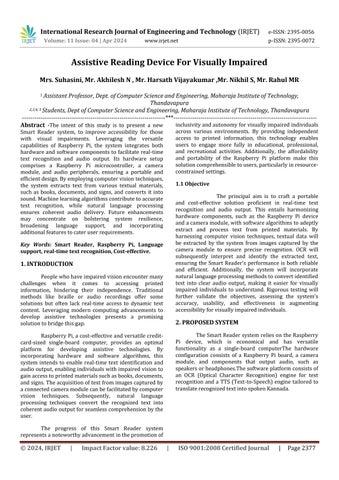
TheSmartReadersystemreliesontheRaspberry Pi device, which is economical and has versatile functionality as a single-board computerThe hardware configuration consists of a Raspberry Pi board, a camera module, and components that output audio, such as speakersorheadphones.Thesoftwareplatformconsistsof an OCR (Optical Character Recognition) engine for text recognition and a TTS (Text-to-Speech) engine tailored to translaterecognizedtextintospokenKannada.
International Research Journal of Engineering and Technology (IRJET) e-ISSN:2395-0056
Volume: 11 Issue: 04 | Apr 2024 www.irjet.net p-ISSN:2395-0072
Improving the level of accessibility for those who have impaired vision has been a primary goal of technological progress for many years. While traditional assistivetoolslikebrailledisplaysandScreenreadershave made substantial progress in bridging accessibility gaps, challenges such as high costs and limited portability have impeded widespread adoption (Sharma et al., 2017; Chen et al., 2018). Recent research has sought to overcome these obstacles by harnessing affordable and adaptable platforms like Raspberry Pi to develop innovative solutions.
Raspberry Pi's compact form factor, affordability, androbustcommunitysupportmakeitanidealcandidate for crafting assistive devices 1. tailored to address the unique requirements of people with impaired vision.(Memon et al., 2019). Its versatility enables combination of hardwarecomponentsandsoftware tools, facilitatingthecreationofcustomizedsolutionstoaddress specificaccessibilitychallenges.
Research has delved into the utilization of Raspberry Pi in navigation aids and object recognition systems, however, there remains a research void regarding its capacity to develop a portable smart reader specifically designed to convert printed text into accessible formats (Sharma et al., 2017; Memon et al., 2019). The system has the capacity to significantly enhance the autonomy and standard of living for individuals with impaired vision. It provides immediate access to printed materials without requiring costly software or specialized hardware, potentially transformingtheireverydayexperiences.
Thus, this proposed project seeks to bridge this gapbyleveragingRaspberryPitodevelopacost-effective anduser-friendlysmartreader.Throughtheintegrationof a camera module for text capture, optical character recognition (OCR) software for text interpretation, and text-to-speech (TTS) technology for speech synthesis, the systemaimstodeliveraseamlessandefficientsolutionfor converting printed text into audible content in Kannada. Furthermore, considerations for user interaction, ergonomic design, and accessibility features will be paramount in ensuring the usability and effectiveness of
the proposed smart reader in real-world scenarios. Through this endeavor, we aspire to contribute to the advancement of assistive technology and enhance the accessibility and quality of life for visually impaired individuals.
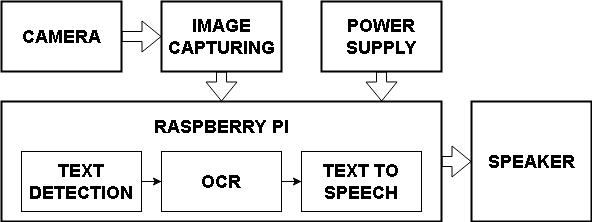
Developing a sophisticated reader requires the completion of various essential stages. Firstly, Raspberry Pi is set up with the necessary operating system and software libraries. Next, the camera module is connected to Raspberry Pi to capture images of printed text. OCR softwareistheninstalledandconfiguredtorecognizetext from the captured images. The Text-to-speech engine enables the conversion of recognized text into spoken words. Rigorous testing guarantees the precision and dependability of the system, incorporating enhancements according to user input. This implementation offers numerous benefits, including greater independence, affordabilityandportability.
International Research Journal of Engineering and Technology (IRJET) e-ISSN:2395-0056
Volume: 11 Issue: 04 | Apr 2024 www.irjet.net p-ISSN:2395-0072
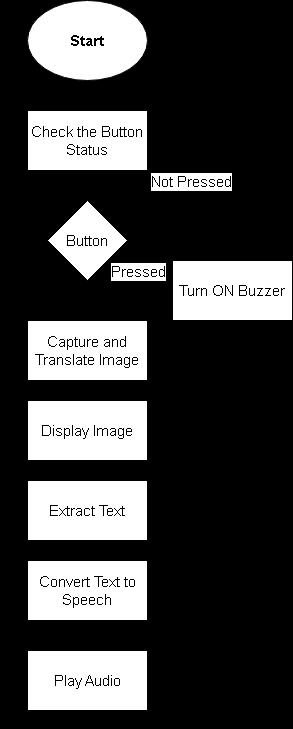
1. Raspberry Pi 4: This device stands out as a versatile and cost-effective single-board computer tailored for an array of computing tasks and do-it-yourself projects. Comprised of a Broadcom BCM2711 quad-core CortexA72 (ARM v8) 64-bit system-on-chip (SoC) clocked at 1.5GHz,itdeliverssubstantialperformanceenhancements compared to its predecessors. Users can select from 2GB, 4GB,or8GBofLPDDR4-3200SDRAM.
Its connectivity suite encompasses two micro HDMI ports supporting 4K resolution, two USB 3.0 ports, two USB 2.0 ports, Gigabit Ethernet, dual-band 802.11ac Wi-Fi, and Bluetooth 5.0, offering ample flexibility for peripheraldevicesandnetworkconnectivity.
Its compact form factor, minimal power consumption, and affordability render it suitable for educational initiatives, home automation endeavors, media centers, retro gaming consoles, and a myriad of other applications. Operating system such as Raspbian (now Raspberry Pi OS), Ubuntu, various Linux distributions,andWindows10IoTCoreprovideflexibility in software development and utilization, further enhancingitsappealtoabroadspectrumofusers.
2. Use of Raspberry Pi: The Raspberry Pi serves as the cornerstoneofaninventivesmartreadertailoredtofulfill the unique demands of visually impaired individuals. Outfitted with a camera module, this device captures imagesofprintedtext,whichundergoprocessingthrough optical character recognition (OCR) software operated on the Raspberry Pi. Upon text recognition, the Raspberry Pi seamlessly translates it into spoken words via text-tospeech (TTS) technology, providing users with real-time audioofthecontentsof books,documents,oranyprinted material. The device features an intuitive user interface, incorporatingtactilebuttonsoratouchscreendisplaywith high-contrast and large-font options for effortless navigation and control. To enhance accessibility further,
voice recognition functionality enables users to issue verbal commands, augmenting the overall user experience. The smart reader offers a cost-effective and flexible solution, allowing individuals with visual disabilitiestoaccessprintedtext.
3.Camera module : The Raspberry Pi Camera Module 2 capturesimagesofprintedtext,providingvisualinputfor thesmartreader.
a. 8-megapixelSonyIMX219sensor
b.Pictureresolutionis3280*2464
c. It supports 1080p30, 720p60 and 640*480p/90 videorecord
d.Dimension:25mm*20mm*9mm
4. Buzzer: The buzzer serves as an indicator for image capture. A single beep signals successful capture, while twobeepsindicateincorrectdocumentplacement.
5. Push Button: The push button enhances accessibility for visually impaired individuals. Pressing it captures the EnglishtextimageandtranslatesitintoKannadaaudio.
6.Speaker: The converted text which is from English to Kannadaisplayedthroughthespeaker.
In our design, we utilize Python 3 as the primary programming language. Additionally, we've installed Tesseract OCR and gTTS (Google Text-to-Speech) to enhancefunctionality.
Python3:
We've employed Python 3 as the primary programming language due to its user-friendly nature, extensive feature set, and abundant package availability. Since the Raspberry Pi comes pre-installed with Python and pip3 for package installation, no additional setup stepswerenecessary.
OCR technology is vital for our system's operation, facilitating text extraction from printed or scanned documents using optical methods. We opted for Tesseract OCR, an open-source engine known for its accuracy and versatility. Installing Tesseract was straightforward; we used the command "sudo apt-get installtesseract-ocr"intheterminal.
International Research Journal of Engineering and Technology (IRJET) e-ISSN:2395-0056
Volume: 11 Issue: 04 | Apr 2024 www.irjet.net p-ISSN:2395-0072
TesseractOCRisinvaluableforconvertingimages into text format. Its matrix matching capabilities, flexibility,andextensivelanguagesupportmadeitanideal choice for our project. Specifically, we utilized Tesseract OCR to recognize English alphabets, enhancing the capabilitiesofourSmartReadersystem.
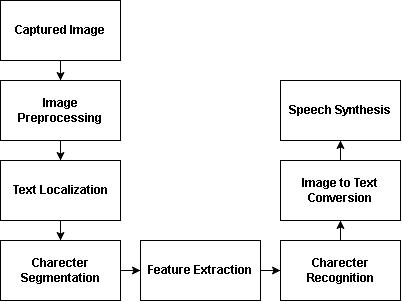
Fig 4. Working Principle
Result:
1. Image Capture: Utilizingthecameramoduleconnected to the Raspberry Pi, the system can capture images of printedtext.
2. Optical Character Recognition (OCR): By leveraging TesseractOCR,thesystemextractstextfromthecaptured images with a high degree of accuracy. Tesseract OCR's capabilities enable it to recognize English alphabets efficiently, enhancing the system's ability to convert imagesintotextformat.
3. Text-to-Speech Conversion (TTS): Once the text is extracted, it is converted into speech using gTTS (Google Text-to-Speech). This allows the system to audibly read out the text to the user in a clear and understandable manner.
4 User Interaction: The system provides a user-friendly interfacedesignedforblindusers,possiblyincorporatinga button. This enables users to control the reading process, such as pausing/resuming reading, skipping sections, or adjusting the reading speed, enhancing their overall experience.
5. Accessibility Features: The system prioritizes accessibilitybyprovidingfeaturestailoredtotheneedsof blind users. This includes voice commands for hands-free operation, customization options for adjusting speech preferences, and a user interface designed with considerationsforaccessibility.
In conclusion, the smart reader represents a significant step forward improving visually impaired people's independence and accessibility. By prioritizing user-centric design and incorporating intuitive features such as tactile controls, voice commands, and customizable speech settings, we have created a versatile tool that addresses the unique needs of our target users. Through ongoing refinement and collaboration with the visuallyimpairedcommunity,wearecommittedtofurther improving the smart reader's functionality and usability. Our ultimate objective is to enable those with visual disabilities to conveniently read printed text, fostering equalityandinclusivityinourincreasinglydigitizedworld.
[1] Sharma, N., Sharma, S., & Singh, P. (2017). Assistive Technologies for Visually Impaired: A Survey. International Journal of Computer Applications, 158(9), 29-33.
[2] Chen, L., Luo, H., & Zhang, Z. (2018). A Review of Assistive Technologies for Visually Impaired People. In 2018 IEEE 9th International Conference on Software Engineering and Service Science (ICSESS) (pp. 261-264). IEEE.
[3] Memon, M. H., Bhayo, I. A., & Halepoto, I. A. (2019). Raspberry Pi Based Assistive Technologies: A Review. InternationalJournalofScientific&EngineeringResearch, 10(5),1262-1267.